Your worry isn't random

- What your mind assumes silence means
- What your body reaches for when uncertainty hits
- What you secretly believe would happen if you stopped worryingNothing here is a diagnosis. It's a mirror. You're not broken. You're someone who learned to stay ready, so you wouldn't get hurt again.
Worry Wheel: What Are You Really Afraid Of Under The Worry?

Worry Wheel: What Are You Really Afraid Of Under The Worry?
If your mind won't stop scanning for what's "wrong", this helps you find the fear under the spiral, without shaming yourself for needing reassurance.
What am I afraid of... really?

That thing where you feel anxious, but you can't even explain why... it's not because you're dramatic. It's because your mind is trying to protect something precious, and it doesn't know how to do it quietly.
The Worry Wheel is a simple way to answer the question you keep Googling at 1:17am: "what am I afraid of" under all the smaller worries. It isn't a test that tells you to "calm down" and move on. It helps you name the core fear that keeps restarting the spiral, so you can stop arguing with yourself and start responding with actual care.
This is also why so many women end up wondering why am I always anxious, or why do I always feel anxious, even on "good" days. The surface changes. The deeper fear stays the same until you can finally name it.
Your Worry Wheel result is one of five types:
Heart Protector
- What it is: Your worry spikes hardest around closeness, distance, and "Are we okay?"
- Common signs: rereading texts, tone-scanning, that breath-holding while you wait for their reply
- Benefit of knowing: you learn how to ask for reassurance without apologizing for existing
Worth Guardian
- What it is: Your worry spikes around being judged, failing, or being seen as not enough
- Common signs: perfection spirals, over-preparing, feeling shaky after feedback even when it's mild
- Benefit of knowing: you stop treating every mistake like a referendum on your lovability
Safety Keeper
- What it is: Your worry spikes around uncertainty, unpredictability, and not having a plan
- Common signs: needing clarity, feeling panicky when things are vague, researching everything to death
- Benefit of knowing: you build steadiness even when you don't have all the answers (so you can move anyway)
Burden Minimizer
- What it is: Your worry spikes around taking up space, needing too much, or "being a problem"
- Common signs: shrinking your needs, offering help before anyone asks, feeling guilty for wanting support
- Benefit of knowing: you learn to ask directly without the shame hangover
Belonging Seeker
- What it is: Your worry spikes around feeling behind, excluded, or like everyone else got a secret invite to life
- Common signs: comparison spirals, timeline panic, social anxiety in groups even when you're "fine"
- Benefit of knowing: you stop using other people's milestones as proof you're failing
One more thing that makes this a little different: it doesn't stop at the big fear. It's the only test in the world, and yes I mean that, that also maps the "bonus spokes" that keep your wheel spinning, like reassurance-seeking, rejection sensitivity, rumination, perfectionism, people-pleasing, belonging insecurity, self-compassion, needs expression, and self-trust.
Yes, you can take this as a Worry Wheel quiz free experience. No pressure. But if you've been asking why am I feeling anxious for no reason, this is one of the gentlest ways to finally get an honest answer.
5 ways knowing your Worry Wheel type changes everything (without changing who you are)

- Discover what your worry is actually protecting, so what am I afraid of stops being a mystery and starts being a name you can work with.
- Understand why you keep asking why am I always anxious, even when nothing is "happening" on the outside.
- Recognize the exact moment your spiral begins (the text delay, the vague plan, the "can we talk"), so you can interrupt it sooner.
- Learn why you keep wondering why am I feeling anxious for no reason, and how to respond without turning it into a self-attack.
- Honor your needs in relationships, work, and friendships without over-explaining, shrinking, or trying to be "low maintenance."
- Build self-trust so why do I always feel anxious becomes, "Oh. This is my pattern. I can handle this."
Mary's Story: The Fear Under the Fear

My phone lit up with a name I cared about, and my stomach dropped before I even read the message. Not because it was bad. Because it could be. Because my brain is apparently addicted to turning "maybe" into "doom" in under three seconds.
I'm Mary, I'm 33, and I'm an animal shelter worker. I know the sound of a nervous dog before it starts shaking. I can tell when a cat is about to swat just by the tiniest shift in its shoulders. I thought that meant I was observant, tuned in, good at reading the room. The part I didn't say out loud was how often I was doing that same scanning with people, too. Like my body was on shift even when I was home.
Most days I came back from the shelter with fur on my hoodie and this weird, buzzing tenderness in my chest. It wasn't even sadness exactly. It was more like my system never got the memo that the emergency was over.
The pattern was small and constant, which made it easy to dismiss. I would reread a text and suddenly hear a different tone. I'd replay a conversation with a coworker and try to pinpoint the exact moment I maybe sounded annoying. I'd keep my ringer on even when I was exhausted, because what if someone needed something and I missed it? What if that meant I was a bad friend? A bad daughter? A bad partner? It was like my worth had become this fragile glass thing I carried around, and any tiny bump could shatter it.
And then there were the nights. The nights were the worst because there was nothing to manage. No animals to care for. No distractions. Just me, the quiet, and a brain that would take one awkward pause from someone and build an entire timeline where they never wanted me again.
I didn't call it anxiety at first. I called it "being realistic." I called it "being prepared." I called it "I just care a lot."
The truth was, I was exhausted. Not the kind of tired a nap fixes. The kind where even good things feel risky because you're bracing for the part where it turns.
One night, after I got home and did that thing where I stress-clean without realizing I'm doing it (wiping counters that are already clean, reorganizing a drawer that does not need reorganizing), I caught myself standing in the kitchen with a sponge in my hand, staring at nothing. I wasn't even thinking about the dishes. I was thinking about whether a friend sounded "off" earlier, and how long it had been since she initiated a plan, and what that might mean about me.
I remember thinking, very quietly, almost like admitting a crime: I don't even know what I'm actually afraid of. I just know I'm afraid all the time.
The next day at work, during a slower moment, Karen was helping me fold towels for the kennels. She was 27 and had this calm energy that made me feel both safer and slightly jealous. We were talking about nothing, and I made some throwaway comment like, "I hate how my brain can turn one thing into ten things."
She didn't do the pep talk thing. She just nodded like she knew exactly what I meant.
"I took this quiz," she said. "It's called Worry Wheel: What Are You Really Afraid Of? It sounds cheesy, but it was... uncomfortably accurate."
I laughed, because I always laugh when something hits too close. But I wrote the name down in my notes app anyway, like it was a grocery list item: eggs, coffee, figure out why I'm like this.
Later that night I took it on my couch, still in my work leggings, hair in a sloppy knot, a blanket pulled up to my waist even though it wasn't that cold. I expected something light. A label. Maybe a few tips. Something I could skim and move on from.
Instead, it asked questions that felt like they were poking under the floorboards. Not "what are you worried about?" but "what happens if that worry is true?" And then, "and if that happens, then what?" It kept going, like a gentle, annoying little kid asking why.
At first my answers were practical.
If I don't respond fast enough, they'll think I don't care.If they think I don't care, they'll stop reaching out.If they stop reaching out, I'll be alone.
But somewhere around the third or fourth loop, the language shifted. The fear got smaller and sharper.
I'll be alone, and it will be my fault.I'll be alone, and it will prove I'm not worth staying for.I'll be alone, and there will be no one to come back for me.
That was the moment I put my phone down for a second. Not dramatically. More like my hands got heavy.
The quiz results gave me a "type" (it used its own terms, but in my head it translated into something like: you don't just worry about situations, you worry about what they say about you). It was the first time something explained my spirals as a system instead of a personality flaw.
It wasn't, "You're too much."It was, "Of course your brain goes there. It's trying to keep you from getting hurt."
I sat there and realized how often my worry wheel wasn't actually about the thing in front of me. Not the late reply. Not the coworker being quiet. Not the plan that might fall through. It was about the fear underneath: that closeness is temporary. That I'm one mistake away from being dropped.
And I hated how true that felt.
The shift didn't happen like a movie. I didn't wake up the next day cured, glowing, unbothered, sipping water like a new person.
What happened was smaller. Messier. More like: I started catching the first spin of the wheel.
A week later, a guy I'd been seeing (Brian, 24, sweet in this slightly distracted way) didn't text me back for most of the day. The old me would have done the full routine: check the time, check my last message, read it again, decide it sounded stupid, open Instagram, see that he watched my story, feel my stomach drop, decide he was slowly losing interest, draft a "no worries!" text that sounded casual but tasted like panic.
Instead, I did this weird thing. I sat on the edge of my bed and talked to myself out loud like a person who has lost it.
"Okay. What am I actually afraid of?"
I wasn't afraid he was busy. People are busy. I was afraid the distance meant something permanent. I was afraid I was misreading the whole thing. I was afraid that if I asked for reassurance, he'd think I was needy. I was afraid that if I didn't ask, I'd be abandoned silently anyway.
There it was. The fear under the fear: if I have needs, I'll be too much. If I don't have needs, I'll disappear.
So I waited. Not in a cute, empowered way. More like I forced myself to do ten minutes without making it my job to fix the uncertainty. I unloaded the dishwasher. I fed my cat. I looked at the clock like it was judging me.
When my brain tried to sprint ahead, I tried to answer it with something steadier, something almost boring: "Not knowing isn't proof. It's just not knowing."
He texted back later with an apology and a photo of his lunch, like nothing was wrong. And I felt this wave of relief that was so big it almost made me angry. Not at him. At how much my body had suffered over something that wasn't real.
The next time it happened, I tried again. Ten minutes. Sometimes fifteen. Sometimes I failed and checked my phone anyway. But the difference was I wasn't spiraling blind anymore. I could see the wheel.
At the shelter, I started noticing it in other places too. When a volunteer canceled last minute and my first thought was, they don't respect you. When an adoption didn't go through and I felt like it meant I wasn't doing enough. When my manager looked tired and my brain decided it was because I was a problem.
I began to do this little mental move: take the surface worry, and quietly ask myself what it was protecting.
Sometimes it was the fear of being judged.Sometimes it was the fear of being replaceable.Sometimes it was the fear that if I wasn't useful, I wouldn't be loved.
And that one, honestly, hurt the most. Because it explained so much. It explained why I over-explained. Why I apologized before anyone accused me. Why I made myself small in rooms where I wanted to take up space.
A few months after taking the Worry Wheel quiz, I was sitting in my car outside my apartment, engine off, keys still in the ignition. I had been invited to a small get-together with friends, and I could feel myself about to say no in that automatic way I do when I'm scared of not being "on" enough. The old fear was ready: if you go and you're quiet, they'll think you're boring. If they think you're boring, they'll stop inviting you. If they stop inviting you, you'll be alone.
I sat there and ran the wheel, not perfectly, but honestly.
If I'm quiet, what am I afraid that means?That I'm not lovable unless I'm performing.And if I'm not lovable unless I'm performing, what's the real fear?That the real me isn't enough.
My throat tightened. Because that one wasn't about a party. That was years old.
I went anyway. I didn't force myself to be funny. I didn't apologize for being tired. I let myself be a little quiet and a little present. And nothing collapsed. No one abandoned me in real time. One of my friends handed me a drink and started talking about her day, and I realized I wasn't being evaluated. I was being included.
Now, I still spiral. I still have nights where the quiet makes my brain loud. I still sometimes reach for control in the form of overthinking. But I don't feel as tricked by it.
When the worry wheel starts spinning, I can usually find the center faster. And the center is almost always the same: I'm afraid of losing love. I'm afraid of being left. I'm afraid that my needs will cost me connection.
I don't have it figured out. I still catch myself drafting texts like they're legal documents. But at least now, when fear shows up wearing a new outfit, I recognize the shape of it. And that makes it feel a little less like truth, and a little more like a part of me asking to be held.
- Mary W.,
All about each Worry Wheel type
| Worry Wheel Type | Common names and phrases you might relate to |
|---|---|
| Heart Protector | "Waiting for their reply", "Are we okay?", "I overthink texts", "I hate distance", "I need reassurance" |
| Worth Guardian | "Not good enough", "I have to be perfect", "One mistake ruins everything", "I can't handle criticism" |
| Safety Keeper | "I need a plan", "I can't relax until I know", "Uncertainty makes me spiral", "What if something goes wrong?" |
| Burden Minimizer | "I don't want to be a burden", "I'll handle it", "My needs feel embarrassing", "I take up too much space" |
| Belonging Seeker | "Everyone's ahead", "I feel behind", "I don't fit in", "I'm missing something", "I'm not chosen" |
What the Worry Wheel reveals about you (the part under the noise)
If you've been stuck in the loop of why do I always feel anxious, it's usually because you're trying to solve the wrong level of the problem. You're addressing the surface worry ("Did I say something wrong?" "What if I fail?" "What if the plan changes?") while the real fear stays hidden underneath.
The Worry Wheel gives you a map. Not a label to carry around like a diagnosis. A map you can use when your brain starts sprinting.
Here's what it measures, in real-human language:
- Connection fear (Heart Protector energy): The fear isn't "being alone." It's the fear of being dropped emotionally. It's that moment when your chest tightens because their tone changed, and your brain goes, "Something is off. Fix it."
- Worth fear (Worth Guardian energy): The fear isn't "failure." It's being exposed as not enough, and then being judged for it. It's the kind of worry that makes you triple-check an email and still feel sick after you hit send.
- Certainty hunger (Safety Keeper energy): The fear isn't "uncertainty" as a concept. It's the feeling of your body not being able to settle until you know what's happening. It's why vague plans feel like a threat, not a neutral situation.
- Space fear (Burden Minimizer energy): The fear isn't "having needs." It's being punished for them. It's why asking for help can make you feel guilty for two days, even if the other person is totally fine.
- Belonging fear (Belonging Seeker energy): The fear isn't "comparison." It's the fear of being quietly excluded from life. It's scrolling and feeling your stomach drop because everyone seems to be moving forward without you.
And then the "bonus spokes" that make it feel extra specific:
- Reassurance-seeking: how often your nervous system wants an outside signal (a text, a tone, a check-in) to feel okay again.
- Rejection sensitivity: how quickly you interpret neutral cues (a short reply, a paused smile) as disapproval.
- Perfectionism: how much you rely on being flawless to feel safe.
- Rumination: how much you replay the moment, especially at night.
- People-pleasing: how often you trade honesty for harmony.
- Belonging insecurity: how shaky you feel about your place in groups.
- Self-compassion: whether you can be kind to yourself when you're spiraling.
- Needs expression: whether you can say what you want without over-apologizing.
- Self-trust: whether you believe you can handle outcomes, even uncomfortable ones.
So when you're asking why am I feeling anxious for no reason, this is the answer: it isn't "no reason." It's a reason your brain learned a long time ago. The quiz helps you find it.
Where you'll see your Worry Wheel play out (even when you swear you're "fine")
In romantic relationships: This is where the Worry Wheel gets loud. It's the waiting-for-the-text moment. It's the tiny shift in affection that makes your whole body go alert. It's the spiral that starts because you don't know if you're loved, or if you're annoying, or if you're about to be left. If you've ever whispered to yourself why am I always anxious when dating, you're not alone. So many women have the exact same 3am ceiling-staring loop.
In friendships and group chats: It's the "Did I overshare?" hangover. It's seeing friends hang out without you and trying to be chill while your stomach is doing flips. It's writing a message, deleting it, rewriting it, and still feeling weird. If your fear is belonging, you're not needy. Your system is trying to keep you connected.
At work or school: It's the "Can we talk?" message from a boss or professor that makes your throat close. It's the urge to over-prepare so no one can criticize you. It's taking neutral feedback like it's a personal rejection. If you're constantly asking why do I always feel anxious in professional spaces, it might not be the work. It might be the fear underneath: worth, safety, or being a burden.
In daily decisions: It's the weird part where even small choices feel high-stakes. Picking the "wrong" restaurant. Sending the "wrong" text. Saying yes when you want to say no. Your Worry Wheel turns ordinary moments into tiny tests, and you end up exhausted. This is exactly why "what am I afraid of" is such a powerful question. It brings you back to the real issue.
What most people get wrong about worry (and why it keeps you stuck)
- Myth: If I worry enough, I'll prevent pain. Reality: worry feels like preparation, but it often turns into self-punishment. You deserve protection that doesn't cost you your peace.
- Myth: If I'm anxious, something must be wrong with me. Reality: anxiety is often a sign your system is working overtime, not a sign you're broken.
- Myth: If I ask for reassurance, I'm needy. Reality: reassurance is a normal relationship need. The right people don't make you feel ashamed for being human.
- Myth: If I can't explain it, it's "for no reason." Reality: if you're asking why am I feeling anxious for no reason, your body probably knows before your mind does.
- Myth: I should be able to logic my way out. Reality: worry isn't only a thinking problem. It's also a body problem (hello tight chest, clenched jaw, stomach drop).
- Myth: Once I know my type, I should be cured. Reality: the win is clarity. Clarity is what lets you choose a different response next time.
Am I a Heart Protector?

If the Worry Wheel is a map, Heart Protector is the spoke that lights up when closeness feels uncertain. You're not "too intense." You're tuned in. You feel the smallest distance like a siren, even when the other person thinks they're being normal.
This is often the type behind the late-night searches like why am I always anxious in relationships. It's also behind the question what am I afraid of when the logical part of your brain knows everything is probably fine, but your body is acting like it's not.
Heart Protector worry isn't random. It's protective. It just gets loud.
Heart Protector Meaning
Core understanding
If you recognize yourself in this pattern, your worry is usually guarding one thing: connection. Not the idea of a relationship. The felt sense of "we're okay." When that sense wobbles, your mind starts trying to fix it with scanning, checking, and replaying.
This pattern often develops when closeness felt a little unpredictable. Maybe love came with mixed signals. Maybe you learned that being attuned to other people's mood was how you stayed safe. Many women with Heart Protector energy became emotional translators early: "If I can read them, I can keep the bond."
Your body remembers this. It's why you can feel calm all day, then get one short reply and suddenly your stomach drops. This is the kind of fear that makes you ask why am I feeling anxious for no reason, because the trigger looks small, but the meaning feels huge.
What Heart Protector looks like
- Holding your breath for their reply: Your chest tightens when a message goes unanswered, even if you know they're busy. On the outside you might look chill, but inside you're doing time math and tone analysis.
- Tone-tracking like it's your job: You notice the missing emoji, the shorter sentence, the delayed "lol." Others call it overthinking. For you it feels like survival-level pattern recognition.
- Replaying conversations at 3am: You run the scene back, looking for the moment you "ruined it." Your brain is trying to find control by finding a cause.
- Over-explaining your feelings: You add context, disclaimers, and apologies so nobody can misunderstand you. It's like you're trying to prevent abandonment with clarity.
- Asking indirectly: You hint, you joke, you "casually" check in, because directly asking for reassurance feels like risking rejection.
- Feeling responsible for the vibe: If the room feels off, you feel like it's your job to fix it. You might become extra sweet, extra helpful, or extra quiet.
- Soft panic when plans change: A canceled date can feel like a rejection, not a schedule issue. Your body hears, "I'm not wanted," even if your mind tries to correct it.
- Closeness feels like oxygen: When things are good, you feel alive and creative and grounded. When things are shaky, everything else gets harder.
- Quick "I did something wrong" stories: Neutral distance becomes a narrative: "They're mad." You might text more, people-please, or go silent to avoid making it worse.
- Needing reassurance, then feeling guilty: You want the check-in, but you also fear being seen as needy. So you spiral twice: once from fear, once from shame.
- Watching for replacement: You notice exes, new friends, coworkers. You don't want to be controlling. You just don't want to be forgotten.
- Big empathy, big exhaustion: You can sense what's happening with people before they speak. It's a gift. It's also why you're drained.
- Relief when you get clarity: One kind message can settle your whole body. That isn't weakness. It's your system finally getting the signal it was waiting for.
How Heart Protector shows up in different areas of life
- In romantic relationships: You love deeply and you attach quickly to warmth. Distance can feel like danger. Conflict can feel like the beginning of being left, so you either over-repair or over-apologize.
- In friendships: You're the friend who remembers birthdays, checks in, and senses when someone is off. You might struggle to ask for the same care back without feeling "too much."
- At work: You often do well in people-facing roles because you read rooms effortlessly. But feedback from a manager can land like rejection, and you might overwork to earn safety.
- Under stress: You seek certainty through connection. You might text, call, refresh, reread. You're not being dramatic. You're trying to feel okay in your body again.
What activates this pattern
- When someone's tone shifts and you don't know why
- When a text reply is late
- When plans get canceled last minute
- When affection feels "less" than yesterday
- When you ask for reassurance and feel judged
- When conflict hangs unresolved
- When you see signs of possible replacement
The path toward steadier connection
- You don't have to change your depth: Your care is not the problem. The growth is learning that you can ask for closeness without apologizing for it.
- Small repairs beat big spirals: A simple, direct check-in often costs less than hours of rumination. When you can name the need, the wheel slows.
- Your needs are allowed to exist out loud: Needs expression is a skill. It gets easier when you stop treating it like a moral failing.
- Women who understand this type often find: They stop asking "why am I always anxious" as a character flaw and start seeing the pattern, then choosing calmer connection on purpose.
Heart Protector Celebrities
- Zendaya - Actress
- Sydney Sweeney - Actress
- Millie Bobby Brown - Actress
- Timothee Chalamet - Actor
- Jennifer Lawrence - Actress
- Channing Tatum - Actor
- Rachel McAdams - Actress
- Kirsten Dunst - Actress
- Josh Hutcherson - Actor
- Julia Roberts - Actress
- Meg Ryan - Actress
- Tom Hanks - Actor
- Drew Barrymore - Actress
- Ryan Gosling - Actor
Heart Protector Compatibility
| Other Type | Compatibility | Why it feels this way |
|---|---|---|
| Heart Protector | 😐 Mixed | Lots of empathy, but both of you can accidentally amplify reassurance loops. |
| Worth Guardian | 🙂 Works well | You can soothe each other, but you may both fear being "not enough" for the other. |
| Safety Keeper | 😍 Dream team | Their steadiness helps your body settle, and your warmth helps them soften into connection. |
| Burden Minimizer | 🙂 Works well | You offer closeness, they offer gentleness, but both of you may avoid direct need-talk at first. |
| Belonging Seeker | 😐 Mixed | You both crave closeness and can spiral together unless you name the real fear sooner. |
Do I have a Worth Guardian type?
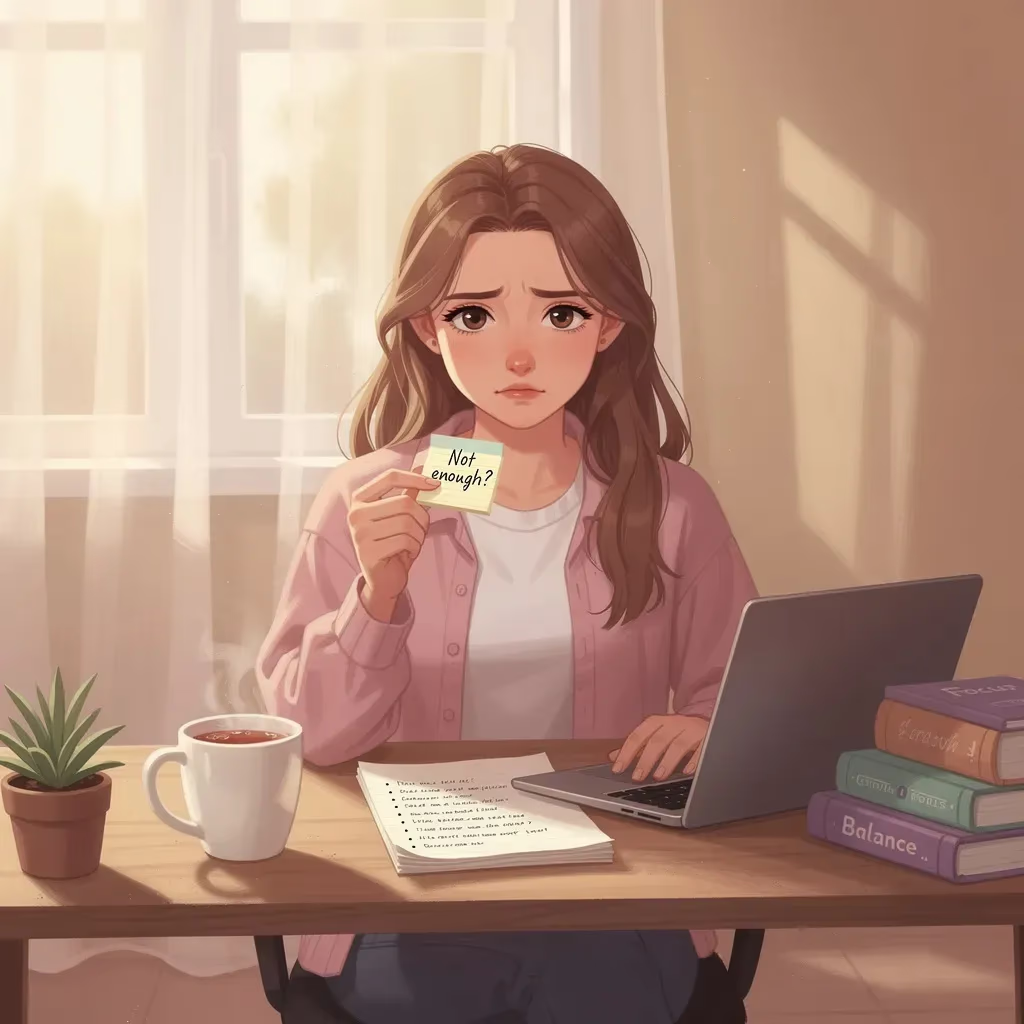
Worth Guardian worry is the kind that tries to keep you safe by keeping you impressive. It's not vanity. It's protection. It's the fear that if you slip, you'll be judged, rejected, or quietly replaced.
A lot of women with this type end up asking why do I always feel anxious around work, school, or anything public. You might also ask what am I afraid of when the fear feels vague, but your body keeps insisting something is at stake.
You're not broken. You're guarding your worth like it's fragile.
Worth Guardian Meaning
Core understanding
If you recognize yourself in this pattern, your worry is often trying to prevent one specific pain: being seen as not enough. So your brain builds a strategy: be prepared, be excellent, be likable, don't make mistakes. It can work. It can also be exhausting.
This pattern often develops when love, approval, or safety felt tied to performance. Many women learned early that being "good" was rewarded, and being messy was punished or ignored. So you became competent. You became reliable. You learned to anticipate expectations before anyone even said them.
Your body remembers that pressure. It's why your shoulders can live near your ears without you noticing. It's why a small critique can make your stomach flip. It's also why you might type why am I feeling anxious for no reason after a normal day, because the fear isn't about the day. It's about what the day might "prove" about you.
What Worth Guardian looks like
- The inner critic that calls itself "realistic": Your thoughts get sharp when you mess up. You might sound confident to others while privately tearing yourself apart.
- Over-preparing to avoid shame: You research, rehearse, perfect. People praise your work ethic, but they don't see the fear fuel behind it.
- Feeling exposed when you don't know: You hate looking uncertain. So you nod, smile, and then panic later while you figure it out alone.
- Reading feedback as a verdict: A simple suggestion can feel like rejection. You might smile and say "totally!" while your heart is racing.
- Comparing your "behind the scenes" to other people's highlight reels: You assume everyone else is effortless. You assume you're failing.
- Needing to be the helpful one: Being useful feels like being safe. When you're needed, you feel less replaceable.
- Spiraling after social moments: You replay your tone, your jokes, your eye contact. You're trying to check if you were "acceptable."
- Avoiding opportunities that matter: Not because you don't want them. Because being seen raises the stakes.
- Apologizing before anyone is mad: You apologize as a reflex, like it prevents disapproval from landing.
- Difficulty receiving praise: Compliments feel unsafe because you fear you won't be able to maintain that standard.
- A constant low-grade pressure: Even when you're relaxing, part of you is tracking what you "should" be doing.
- The fear of being ordinary: Not because you think you're better than others. Because ordinary feels like invisible, and invisible feels unsafe.
- Trying to earn love: You give, you perform, you please. Deep down, you want to believe love can be free.
- Relief when you have a clear role: Titles, grades, checklists calm you. Ambiguity makes your worth feel shaky.
How Worth Guardian shows up in different areas of life
- In romantic relationships: You can people-please to stay lovable. You might hide needs so you stay "easy." If you're rejected, it can hit your identity, not just your heart.
- In friendships: You're often the capable one. The planner. The helper. It can be hard to let someone see you unsure or needy.
- At work: You're high-performing, dependable, and often quietly anxious. You might ask why am I always anxious before presentations, reviews, or any moment where your work could be judged.
- Under stress: You clamp down. You tighten standards. You stop resting. You try to control outcomes by controlling yourself.
What activates this pattern
- Getting feedback (even kind feedback)
- Making a small mistake in public
- Someone else's success triggering comparison
- Being asked to improvise or speak on the spot
- Feeling like you disappointed someone
- Seeing unread messages and imagining disapproval
- Being in a room where you feel "less than"
The path toward quieter self-worth
- Your worth is not a performance review: You can be loved and still be learning. Growth is letting your standards stop being your survival plan.
- Self-compassion is a real skill: It changes everything when your inner voice becomes a safe place instead of a courtroom.
- Your needs don't disqualify you: Needs expression isn't weakness. It's intimacy with yourself.
- Women who understand this type often find: They stop asking "why do I always feel anxious" like it's a personal failure and start seeing how perfectionism was trying to protect them.
Worth Guardian Celebrities
- Taylor Swift - Singer
- Dua Lipa - Singer
- Margot Robbie - Actress
- Emma Stone - Actress
- Natalie Portman - Actress
- Beyonce - Singer
- Rihanna - Singer
- Christian Bale - Actor
- Matt Damon - Actor
- Sandra Bullock - Actress
- Kerry Washington - Actress
- Viola Davis - Actress
Worth Guardian Compatibility
| Other Type | Compatibility | Why it feels this way |
|---|---|---|
| Heart Protector | 🙂 Works well | You both care deeply; the work is not turning reassurance into a "prove I'm enough" cycle. |
| Worth Guardian | 😐 Mixed | High standards can create pressure unless both of you practice gentleness and repair. |
| Safety Keeper | 🙂 Works well | Their predictability helps you relax, but you may both over-plan when stressed. |
| Burden Minimizer | 😐 Mixed | You may both hide needs to stay lovable, which can create quiet resentment. |
| Belonging Seeker | 😕 Challenging | Comparison and worth fear can stack, making both of you feel behind or not chosen. |
Am I a Safety Keeper?

Safety Keeper worry isn't about being controlling. It's about trying to feel safe in your own body. It's the type that lights up when things are vague, plans are unclear, or outcomes are unknown.
This is the type behind the questions why am I feeling anxious for no reason and why do I always feel anxious when, on paper, your life looks fine. Your brain isn't looking for drama. It's looking for certainty.
And yes, it can make you wonder what am I afraid of when the fear feels like static instead of a specific thing.
Safety Keeper Meaning
Core understanding
If you recognize yourself in this pattern, your worry is usually guarding one thing: predictability. Your system relaxes when you know what's happening. When you don't, your mind tries to create a plan, a script, a backup plan, and a backup plan for the backup plan.
This pattern often develops when life felt unpredictable. Many women learned that surprise meant stress, conflict, or consequences. So you became a planner. A forecaster. The friend who double-checks details. It isn't "Type A." It's safety-seeking.
Your body remembers the cost of not knowing. That's why uncertainty can show up physically: your throat tightens, your jaw clenches, your mind races. You might look calm, but inside you're bracing. This is why why am I always anxious can be such a confusing question for Safety Keepers. You're not anxious all the time. You're anxious when you don't know.
What Safety Keeper looks like
- Needing clarity to relax: Vague plans ("maybe later") can spike you instantly. You might try to play it cool while your body is already on alert.
- Researching everything: Reviews, maps, timelines, menus. It's not about being intense. It's your mind trying to remove surprise.
- Decision paralysis: Too many options feels like danger. You can get stuck choosing the "right" thing because the wrong thing feels costly.
- Feeling safer when you're in charge: If you control the plan, you control the risk. Others might call it leadership. You know it's fear management.
- Overthinking the future: You run scenarios to prepare. It can feel responsible. It can also steal your present.
- Physical restlessness: Your legs bounce, your hands fidget, your shoulders tighten. Your body is trying to move energy that has nowhere to go.
- Difficulty trusting "it'll work out": Those words can feel like abandonment. Like someone refusing to take your fear seriously.
- Reassurance through information: You ask questions. You check times. You confirm details. It's reassurance-seeking, but with facts.
- Feeling embarrassed about needing a plan: You might judge yourself for it, then plan even more to compensate.
- Irritation when others are vague: Not because you're mean. Because vagueness makes you feel alone with the uncertainty.
- Over-preparing for conversations: You rehearse what you'll say and what they might say. You're trying to avoid emotional surprise.
- Catastrophe-by-default: If you don't know, your brain fills the blank with worst-case. It isn't pessimism. It's your threat system doing its job.
- Relief when things are confirmed: One clear message can make your whole body exhale. That exhale matters.
- Avoiding "big unknown" choices: Not because you don't want growth, but because your system wants safety first.
How Safety Keeper shows up in different areas of life
- In romantic relationships: Mixed signals are torture. You do best with consistency and direct communication. You may ask for clarity, then worry you're "too much" for asking.
- In friendships: You often become the organizer because it keeps things stable. You can feel unsettled when friends are flaky or unclear.
- At work: You thrive with clear expectations. Ambiguous feedback or shifting priorities can make you spiral. It's common to ask why do I always feel anxious in environments that change fast.
- Under stress: You try to regain control. You make lists. You seek certainty. You might shut down emotionally because your mind is too loud.
What activates this pattern
- Vague plans or unclear timelines
- Last-minute changes
- Waiting for important updates
- Unanswered questions
- Someone saying "we'll see"
- Starting something new with no roadmap
- Feeling like you're not prepared
The path toward steadier safety
- Safety can be built inside you: Not perfectly. Not overnight. But slowly, through self-trust. You can learn, "Even if I don't know, I can handle it."
- Information isn't the enemy: The goal isn't to stop planning. It's to stop planning as punishment.
- Your nervous system deserves kindness: That question why am I feeling anxious for no reason becomes softer when you treat anxiety like a signal, not a flaw.
- Women who understand this type often find: They become calmer not because life gets predictable, but because they get more grounded in themselves.
Safety Keeper Celebrities
- Florence Pugh - Actress
- Austin Butler - Actor
- Emily Blunt - Actress
- Keanu Reeves - Actor
- Rachel Weisz - Actress
- Matthew McConaughey - Actor
- Denzel Washington - Actor
- Michelle Williams - Actress
- Hugh Jackman - Actor
- Meryl Streep - Actress
- Sigourney Weaver - Actress
- George Clooney - Actor
Safety Keeper Compatibility
| Other Type | Compatibility | Why it feels this way |
|---|---|---|
| Heart Protector | 😍 Dream team | You offer steadiness and clear plans, they offer warmth and connection. |
| Worth Guardian | 🙂 Works well | You can build calm routines together, but watch mutual over-control under stress. |
| Safety Keeper | 😐 Mixed | Very stable, but can become rigid unless both of you practice flexibility. |
| Burden Minimizer | 🙂 Works well | They keep things gentle, you keep things clear. The risk is both of you not stating needs directly. |
| Belonging Seeker | 😕 Challenging | Timeline panic plus uncertainty panic can stack unless you name what's real and what's comparison. |
Am I a Burden Minimizer?

Burden Minimizer worry is the kind that whispers, "Don't ask for too much. Don't be a problem. Be easy to love." It usually looks like kindness. It feels like tension.
If you've ever wondered what am I afraid of when you avoid asking for help, the answer might be: you're afraid of being judged for having needs. If you keep thinking why am I always anxious around asserting yourself, it's not because you're weak. It's because your system learned that taking up space is risky.
You're not too much. You're tired of feeling like you are.
Burden Minimizer Meaning
Core understanding
If you recognize yourself in this pattern, your worry is guarding one thing: permission to take up space. Your mind tries to keep you safe by making you smaller, easier, lower-need. It's protective. It also costs you.
This pattern often develops when you learned, directly or indirectly, that your needs were inconvenient. Maybe you were praised for being "mature." Maybe you watched someone else get punished for being emotional. Maybe you learned that conflict meant withdrawal, so you became agreeable to keep closeness.
Your body remembers every time you swallowed a need. That's why you can feel your throat tighten before you speak up. That's why you might feel shaky after setting even a small boundary. It's also why why am I feeling anxious for no reason can show up right after you do something healthy, like saying no. Your brain is bracing for consequences.
What Burden Minimizer looks like
- Saying "it's fine" when it isn't: Your mouth says yes while your body whispers no. Later, you feel resentment or exhaustion and wonder why.
- Apologizing for existing: You apologize for asking a question, for needing time, for having feelings. It's like you're trying to pay for your presence.
- Helping before anyone asks: Being useful feels safer than being needy. People may love you for it, and you might quietly feel used.
- Hiding your preferences: "Whatever you want" becomes your default. Not because you don't care, but because caring feels like taking up space.
- Guilt after asking for support: Even if someone is happy to help, you replay it and worry you were too much.
- Over-explaining boundaries: You add paragraphs of context so no one can be mad. You're trying to soften the impact of your needs.
- Avoiding conflict at all costs: Not because you're cowardly. Because conflict can feel like the beginning of being left.
- Downplaying your pain: You say you're okay when you're not, because you don't want to be a burden.
- Being the "easy" girlfriend or friend: You try to be low maintenance. Then you feel unseen, because you hid yourself.
- Taking responsibility for others' feelings: If someone is upset, you assume it's your job to fix it, even when it isn't.
- Freezing when you need to ask: Your mind goes blank. Your throat closes. You might text instead of speaking, or avoid it altogether.
- Choosing silence over misunderstanding: You'd rather be uncomfortable than risk being misread.
- Over-functioning: You do more so nobody can criticize you. It looks responsible. It feels heavy.
- Relief when someone invites your needs: When someone says, "Tell me what you want," you feel emotional. Because you didn't realize how long you've been starving for permission.
How Burden Minimizer shows up in different areas of life
- In romantic relationships: You may tolerate too much to keep the peace, then feel anxious because your needs aren't being met. You might worry, "If I ask for more, they'll leave."
- In friendships: You're the supportive one. The listener. The helper. You might struggle to ask for reciprocity without feeling selfish.
- At work: You take on extra tasks to be liked. You avoid saying no. Then you wonder why do I always feel anxious on Sundays, because your body knows you're overextended.
- Under stress: You disappear. You minimize. You shut down needs. Then the worry wheel spins because your system isn't getting support.
What activates this pattern
- Being asked "What do you need?"
- Having to say no
- Feeling someone might be disappointed
- Being called "too sensitive"
- Asking for reassurance and fearing judgment
- Receiving help and feeling guilty
- Any situation where you might be inconvenient
The path toward taking up space gently
- You are allowed to have needs: This isn't a pep talk. It's a truth. The right people don't make you earn permission.
- Needs expression can be small: You don't have to become confrontational. You can start with one clear sentence.
- Boundaries are kindness: They prevent resentment. They keep your relationships honest.
- Women who understand this type often find: They stop asking why am I always anxious around relationships, because they're no longer abandoning themselves to keep closeness.
Burden Minimizer Celebrities
- Anya Taylor-Joy - Actress
- Emma Watson - Actress
- Amanda Seyfried - Actress
- Andrew Garfield - Actor
- Zooey Deschanel - Actress
- Julia Stiles - Actress
- Tobey Maguire - Actor
- Winona Ryder - Actress
- Ethan Hawke - Actor
- Halle Berry - Actress
- Keri Russell - Actress
- Joseph Gordon-Levitt - Actor
Burden Minimizer Compatibility
| Other Type | Compatibility | Why it feels this way |
|---|---|---|
| Heart Protector | 🙂 Works well | They invite closeness, you offer softness. The work is letting needs be spoken instead of hinted. |
| Worth Guardian | 😐 Mixed | You may over-give to "earn" safety while they over-perform. Both can forget to rest. |
| Safety Keeper | 🙂 Works well | Their clarity can reduce your fear of disappointing people, as long as they make space for your feelings. |
| Burden Minimizer | 😕 Challenging | Two people minimizing needs can create a relationship that feels calm but quietly lonely. |
| Belonging Seeker | 😐 Mixed | You both fear being excluded or "too much." Honesty builds the bridge here. |
Am I a Belonging Seeker?

Belonging Seeker worry is the kind that turns life into a timeline race. It's the voice that says, "Everyone else is moving forward. I'm falling behind." It's not shallow. It's the fear of being left out of love, community, and "normal life."
If you're constantly asking why do I always feel anxious after scrolling, or walking into social situations, or hearing someone else's good news, this type might be your home base. And if you keep wondering what am I afraid of, the answer is often: being excluded. Being overlooked. Being the one who doesn't get picked.
This is also one of the most common roots of why am I feeling anxious for no reason, because the trigger can be tiny and the meaning can be enormous.
Belonging Seeker Meaning
Core understanding
If you recognize yourself in this pattern, your worry is guarding one thing: a secure place in the group. Not because you're immature. Because humans are wired for belonging. Your system is trying to make sure you aren't left behind.
This pattern often develops when belonging felt conditional. Maybe friendships were cliquey. Maybe you were the "extra" friend. Maybe you learned that being chosen required being useful, fun, pretty, chill, impressive, or low-need. Many women became Belonging Seekers because they learned to track social status the way other people track weather.
Your body remembers what exclusion feels like. That's why your heart can race before group plans. That's why you might feel a stomach drop when you see photos you weren't in. It's also why you end up searching why am I always anxious when your life isn't objectively "bad." Your body isn't responding to bad. It's responding to uncertain belonging.
What Belonging Seeker looks like
- Timeline panic: Engagements, careers, moving, babies, traveling. You see milestones and feel like you're failing. You might even be happy for people and still spiral.
- Scrolling that hurts: You scroll to feel connected and end up feeling excluded. It's like touching a bruise and calling it self-awareness.
- Overthinking group dynamics: You notice who talks to whom, who got invited, who responded. You can read the room like a map of danger.
- Fear of being the "backup": If plans are vague, you assume you're not the priority. You might pretend not to care while your body is on fire.
- Trying to be easy to include: You say yes to things you don't want. You laugh at jokes that don't land. You edit yourself for acceptance.
- Feeling lonely in crowds: You're surrounded by people, but you still feel outside. It's a specific ache.
- Comparing your inner life to others' outer life: You assume their confidence is real and yours is fake.
- Replaying social moments: You analyze your face, your tone, your energy. You're trying to confirm you were liked.
- Chasing reassurance through visibility: Posting, checking, watching views. Not for attention. For proof you exist in the group.
- Staying quiet to avoid embarrassment: You don't want to say the wrong thing. So you shrink.
- Feeling behind even when you're progressing: Your wins don't land because comparison steals the relief.
- Assuming you missed a memo: Everyone seems to know how to be an adult. You feel like you're guessing.
- Big sensitivity to exclusion cues: Someone not replying can feel like a social death sentence. Your body takes it seriously.
- Relief when someone includes you directly: "Come with us." "I saved you a seat." You feel it in your whole body.
How Belonging Seeker shows up in different areas of life
- In romantic relationships: You might fear being replaced, not only by a person but by a lifestyle. You can feel anxious about being "chosen" long-term.
- In friendships: You can over-give to secure your spot. You might avoid conflict so you don't risk being pushed out.
- At work/school: You worry about fitting in. You might feel anxious in meetings, group projects, or social events. It's common to ask why do I always feel anxious before networking or presentations, because approval feels tied to belonging.
- Under stress: Comparison spikes. You might check social media more, ask for reassurance indirectly, or isolate because being around others feels like proof you're behind.
What activates this pattern
- Seeing friends hang out without you
- Group chats going quiet after you message
- Hearing about milestones you don't have yet
- Walking into a room where you don't know the vibe
- Feeling like you weren't chosen first
- Scrolling when you're already tender
- Being left on read by the group
The path toward grounded belonging
- Belonging isn't earned through performance: Real belonging is being wanted as you are. The growth is learning to stop negotiating your personality for a seat at the table.
- Your timeline is not a moral scorecard: You are not behind. You're living your life, not auditioning for someone else's.
- Self-trust changes the whole game: When you believe you can handle being awkward, being new, being human, you stop treating every social wobble as danger.
- Women who understand this type often find: They stop asking why am I feeling anxious for no reason, because they can finally name the real fear: "I want to belong." And then meet it with care.
Belonging Seeker Celebrities
- Hailee Steinfeld - Actress
- Olivia Rodrigo - Singer
- Ariana Grande - Singer
- Camila Cabello - Singer
- Reese Witherspoon - Actress
- Mandy Moore - Actress
- Mila Kunis - Actress
- Jennifer Aniston - Actress
- Cameron Diaz - Actress
- Hilary Duff - Actress
- Josephine Langford - Actress
- Zac Efron - Actor
Belonging Seeker Compatibility
| Other Type | Compatibility | Why it feels this way |
|---|---|---|
| Heart Protector | 😐 Mixed | Shared sensitivity is beautiful, but you can spiral together without direct reassurance and repair. |
| Worth Guardian | 😕 Challenging | Comparison plus perfectionism can make both of you feel like you're failing, even when you're fine. |
| Safety Keeper | 😕 Challenging | Their need for certainty can clash with your need to feel chosen, unless you communicate clearly. |
| Burden Minimizer | 😐 Mixed | You both avoid being "too much," which can block the honest conversations that create real belonging. |
| Belonging Seeker | 🙂 Works well | Deep empathy and shared language, as long as you don't turn your friendship into a comparison loop. |
If you've been stuck asking what am I afraid of, the answer is usually simpler than your spiral makes it feel. Your worry is trying to protect something: connection, worth, safety, space, or belonging. Once you know which one, you stop treating every anxious thought like an emergency and start responding with precision. That's how why am I always anxious and why do I always feel anxious stop feeling like personal flaws and start feeling like patterns you can work with.
What you get from your results (in real life, not theory)
- 🌿 Discover why you are asking why am I feeling anxious for no reason, and name the real trigger underneath it
- 💗 Understand the fear under "what am I afraid of" so you stop fighting yourself
- 🧭 Recognize why you keep thinking why am I always anxious in relationships and social moments
- 🫧 Honor your needs without the apology spiral (needs expression support)
- 🧱 Build self-trust so why do I always feel anxious isn't your identity, it's a moment you can handle
- 🤝 Connect with a framework thousands of women use to feel less alone
Where you are now vs what becomes possible
| Where you are now | What becomes possible |
|---|---|
| You keep googling what am I afraid of, but it still feels fuzzy. | You can name the core fear in one sentence, and your body settles faster. |
| You wonder why am I always anxious and then blame yourself for it. | You recognize your pattern without shame, and you choose a kinder response. |
| You keep thinking why am I feeling anxious for no reason, especially at night. | You understand the trigger chain, and you stop escalating it into a full spiral. |
| You ask why do I always feel anxious and try to "fix" yourself. | You get a practical map: what to ask for, what to practice, what to stop carrying. |
| You give reassurance to everyone else, but feel guilty needing it. | You get permission and language to ask directly, without over-explaining. |
So many women use this as a small self-gift: a few minutes of honesty that makes the rest of the week feel 2% lighter.
Join women who wanted answers, not generic advice
Join over 244,171 women who've taken this under-5-minutes quiz for private results. Your answers stay private, and the insight lasts longer than the spiral.
FAQ
What is the Worry Wheel, and what does it mean to ask "What am I really afraid of"?
The Worry Wheel is a simple way to map your anxiety back to its real source. It helps you see that what you're worrying about on the surface (a text, a tone shift, a mistake at work) usually points to a deeper fear underneath (rejection, not being enough, losing safety, being a burden, not belonging).
If you've been Googling "what am I afraid of" at 1 a.m., you're not being dramatic. You're trying to name something your nervous system already knows. Worry is often the brain's way of scanning for danger when it doesn't feel emotionally safe yet.
Here's the core idea behind "Worry Wheel: What Are You Really Afraid Of?":
- Surface worry (what you notice first): "Why aren't they replying?" "What if I mess up?" "What if they think I'm annoying?"
- Story your mind creates (to fill the gap): "They're losing interest." "Everyone will see I'm not capable." "I'm too much."
- Deeper fear (the real engine): "I'll be abandoned." "I'll be judged and rejected." "If I need anything, I'll be too much and get left."
- Protective behavior (what you do next): over-explaining, people-pleasing, checking your phone, rewriting messages, staying small, avoiding conflict
A lot of us grew up learning that safety came from being easy, helpful, low-maintenance, or "fine." So when a relationship, friendship, workplace, or family dynamic feels even slightly uncertain, your body does what it learned to do: it worries. Constantly.
What makes the Worry Wheel so relieving is that it separates your fear from your circumstances. Because the truth is: sometimes you are not "anxious for no reason." You're anxious because uncertainty pokes an old wound.
This quiz specifically helps you understand which deeper fear your worry tends to orbit around, like:
- protecting your heart from getting hurt
- guarding your worth so you don't feel "not enough"
- chasing safety so you can finally relax
- minimizing your needs so you're not a burden
- searching for belonging so you stop feeling on the outside
When you can name your "real" fear, your anxiety stops feeling like a chaotic personality flaw and starts feeling like a pattern you can work with. That shift alone can make the day feel lighter.
Why am I feeling anxious for no reason?
You're usually not anxious for no reason. It just feels like "no reason" because the trigger is often subtle, ordinary, or social, and your body reacts faster than your brain can explain it.
If you're sitting there thinking, "Why am I feeling anxious for no reason," it's often one of these situations:
- Uncertainty: not knowing where you stand with someone, waiting for a reply, unclear expectations at work
- Micro-signals: a different tone, a shorter message, someone seeming distracted
- Old pattern activation: your nervous system recognizes a familiar emotional situation (even if your adult mind knows you're safe)
Here's what's really happening inside the Worry Wheel:
Your brain detects a possible threat. Not always a real threat, but a familiar one. Emotional distance can feel like danger if you've been abandoned, criticized, or made responsible for other people's moods in the past.
Your body goes into protection mode. This can look like tight chest, nausea, racing thoughts, irritability, people-pleasing, or the urge to fix something immediately.
Your mind tries to make meaning. This is where overthinking starts. It's not because you're "crazy." It's because your mind is trying to reduce uncertainty. That's why you might relate to "why do I always feel anxious" even on days that look fine from the outside.
A big misconception is that anxiety requires a big scary trigger. A lot of women (especially the ones who care deeply and track everyone's emotional weather) get anxious from things like:
- someone taking longer than usual to text back
- feeling like you talked "too much"
- sensing you've disappointed someone
- a friend being quiet and you not knowing why
- making one small mistake and suddenly feeling like everything is unstable
This is also why "understanding my anxiety patterns" can be more helpful than trying to force yourself to calm down. Calm often comes after clarity.
The Worry Wheel helps you go from "I'm spiraling" to "Oh. This is my fear of being left." Or "This is my fear of not being enough." Once you name it, you can respond with more compassion and less panic.
Why do I worry so much about everything, even when nothing is actually wrong?
You worry so much about everything because your brain learned that worrying is how you prevent pain. Even when nothing is wrong, your nervous system may still be on alert, scanning for the moment something might go wrong.
If you've been asking, "Why do I worry so much about everything" or "why can't I stop worrying," you're describing a pattern, not a character defect. Worry is often a strategy: anticipate the threat, rehearse the pain, try to stay one step ahead.
In the Worry Wheel, constant worry usually comes from one (or more) of these deeper systems:
- A fear of abandonment: "If I miss a sign, I'll get blindsided and left."
- A fear of being unlovable or not enough: "If I mess up, they'll see the real me."
- A fear of losing safety: "If I relax, something bad will happen."
- A fear of being a burden: "If I need anything, I'll be too much."
- A fear of not belonging: "If I don't perform perfectly, I won't be included."
And yes, it can show up everywhere. Relationships, friendships, your job, your health, your future. The topic changes, but the deeper fear stays the same.
A lot of women also have a hidden belief that sounds like:
- "If I worry, I'm being responsible."
- "If I worry, I'm staying prepared."
- "If I worry, I won't get hurt as badly."
So even if your life is stable, worrying feels like love. Like loyalty. Like prevention.
Here's a practical way to tell when you're in Worry Wheel mode:
- Productive planning has an end point. You make a plan, you feel clearer.
- Anxiety-based worrying has no end point. You make a plan, and your brain finds five new threats.
This is why "what causes constant worry" is rarely one single thing. It's the emotional rule your system learned early: "I have to stay alert to stay safe."
The hopeful part is that once you can name your deeper fear, you can stop treating every worry like a separate emergency. You start responding to the root, not the symptom. Tomorrow might not be perfect, but it can feel 2% quieter inside.
Am I overthinking everything, or is my intuition trying to tell me something?
Sometimes you're overthinking. Sometimes your intuition is picking up on something real. The difference is in how it feels in your body and how the thought behaves over time.
If you're searching "am I overthinking everything quiz," you're in that exhausting gray area: you don't want to ignore red flags, but you also don't want to spiral and sabotage something good.
Here's a simple way to separate them:
Intuition usually feels:
- calm but clear
- steady, not urgent
- specific ("That comment felt disrespectful" or "This pattern keeps repeating")
- consistent over days, even when you're rested
Overthinking usually feels:
- urgent, panicky, tight
- repetitive (same loop, same fear)
- very focused on controlling the outcome
- worse at night, after coffee, or when you're already stressed
Overthinking often comes from the Worry Wheel's deeper fear. For example:
- If your deeper fear is abandonment, your brain reads distance as danger.
- If your deeper fear is not being enough, you replay conversations to find what you did "wrong."
- If your deeper fear is being a burden, you minimize your needs and then resent yourself for needing anything.
Your intuition can absolutely be wise. Your sensitivity is data, not damage. But anxiety can hijack the same sensitivity and turn it into hypervigilance. That's why it can feel like you're reading micro-expressions for signs of rejection.
A practical check-in that helps:
- "Is this thought making me smaller, or making me clearer?"
- "Does this feeling come with evidence, or with a desperate need for reassurance?"
- "If my best friend told me this, what would I think is happening?"
You're allowed to trust yourself and still acknowledge that your nervous system has been trained by past experiences. Both can be true. Many women are rebuilding that inner trust right now, piece by piece.
The Worry Wheel quiz helps you spot your default fear fast, so you can say, "Oh, this is my pattern." Then you can decide what deserves action and what deserves soothing.
What causes constant worry and anxiety patterns like this? Is it genetic or learned?
Constant worry is usually a mix of temperament (your natural sensitivity) and learning (what your environment taught you was necessary for love and safety). So yes, anxiety can have genetic influences, but the patterns most of us recognize in the Worry Wheel are often deeply learned.
When people ask "what causes constant worry," they're often talking about more than stress. They're talking about a nervous system that expects emotional danger.
Common learned causes include:
- Inconsistent care: love felt unpredictable, so you learned to monitor, anticipate, and adjust
- Being responsible for others' emotions: you became the peacekeeper, the fixer, the "good girl"
- Criticism or high standards: mistakes felt costly, so you learned to over-prepare and overthink
- Emotional invalidation: you were told you were "too sensitive," so now you doubt your own signals
- Past relationship wounds: betrayal, ghosting, hot-and-cold dynamics that trained you to fear uncertainty
Even in adulthood, the trigger might look small: a delayed text, a partner being quiet, a boss using a short tone. Your adult brain might say "This is fine," but your body remembers a time when it wasn't.
This is why "understanding my anxiety patterns" matters so much. Your anxiety isn't random. It's organized. It follows a logic that used to keep you safe.
The Worry Wheel also explains why two people can have the same situation and totally different reactions. One person hears "We need to talk" and thinks, "Okay." Another person hears it and feels their stomach drop. That difference often comes from the deeper fear the situation touches.
You're not broken for having these responses. You're learning your own wiring.
The quiz can help you name which fear your worry returns to most often, and that can make it easier to choose the right kind of support, self-talk, and boundaries.
How does my Worry Wheel fear show up in relationships and dating?
Your Worry Wheel fear shows up in relationships as a predictable set of thoughts, behaviors, and "tests" you don't even mean to run. It can look like being deeply loving and devoted, while also feeling constantly on edge about losing them.
If you relate to "why do I always feel anxious" specifically in dating, you're not alone. This is one of the most common places worry attaches itself, because closeness brings up old fears fast.
Here are a few ways the deeper fears tend to show up:
- Heart Protector: You might want closeness, then pull back the moment it feels real. You keep a part of yourself hidden so it can't get hurt.
- Worth Guardian: You might become performance-focused. You try to be impressive, easy, or "perfect," then panic when you can't maintain it.
- Safety Keeper: You might crave consistency and feel activated by mixed signals. Slow replies or vague plans can feel like a threat.
- Burden Minimizer: You might apologize for needs, minimize feelings, and wait until you're overwhelmed to speak up.
- Belonging Seeker: You might shape-shift to fit what you think they want, then feel anxious about whether the real you would be chosen.
The hardest part is that these responses often create the exact thing you're afraid of. Not because you're "too much," but because anxiety pushes us into survival strategies:
- over-texting, then feeling ashamed
- checking their social media for reassurance
- over-explaining your feelings to avoid conflict
- staying quiet to avoid being a burden
- accepting less than you want because you're afraid to ask
Many women have had the experience of being called "clingy" when what they were really asking for was consistency. Or being told they're "overreacting" when their nervous system is responding to real unpredictability.
The point of the Worry Wheel isn't to blame you. It's to help you understand what's underneath the reaction so you can communicate from the root. "When plans change last minute, I get anxious because consistency matters to me." That's very different from a spiral.
How accurate is a "What am I really afraid of quiz free" type of test?
A free "what am I really afraid of quiz" can be surprisingly accurate at revealing patterns, as long as you treat it as a mirror, not a diagnosis. The best quizzes don't pretend to read your mind. They help you recognize yourself.
Accuracy comes down to three things:
- Quality of questions: Good questions describe real-life moments (like waiting for a reply, replaying conversations, avoiding conflict), not vague personality labels.
- Depth: A useful quiz points to an underlying fear, not just "You worry a lot." It helps explain why you worry and what it protects.
- Interpretation: The results should feel specific and compassionate, not dramatic or shaming.
Also, the most meaningful "accuracy test" is internal. When you read a result and feel your chest loosen a little because it finally makes sense, that's a sign it hit something real. Not because it's magical, but because patterns are recognizable.
A healthy caution: quizzes can oversimplify if they ignore context. For example, if you're in an unstable relationship, feeling anxious isn't a personality flaw. It's a normal response to instability. A strong Worry Wheel quiz makes space for that truth while still helping you understand your default fear response.
If you're worried you'll "answer wrong," that alone is data. Many of us with anxiety patterns treat self-discovery like a test we might fail. You're allowed to approach it with curiosity instead of perfection.
The Worry Wheel quiz is meant to give you language for what you've been living. It doesn't put you in a box. It gives you a map, so you can stop fighting yourself and start understanding what's underneath "why can't I stop worrying."
Can I actually change my anxiety patterns once I know what I'm really afraid of?
Yes. Anxiety patterns can change. Knowing what you're really afraid of is often the first moment your nervous system stops feeling like a mystery and starts feeling like something you can work with.
Change happens because awareness interrupts autopilot. When you can name the deeper fear, you stop treating every moment like it's brand new.
Here's how the change usually unfolds (in a way that feels gentle, not like a self-improvement bootcamp):
- You recognize the trigger faster. The spiral still starts, but you catch it earlier. That's huge.
- You name the real fear. Instead of "I'm freaking out," it becomes "I'm scared I'm not safe," or "I'm scared I'm too much."
- You respond to the fear, not the story. The story might be "They're mad at me." The fear might be "I'm going to be abandoned." Those require different care.
- You practice new safety cues. This can be internal (self-soothing, self-trust) and external (clearer communication, better boundaries, choosing consistent people).
A big reason many women stay stuck is that they try to change the behavior without honoring what it was protecting. If you learned that being low-need kept you loved, then suddenly being direct can feel terrifying. Of course it does. Your body thinks you're risking connection.
You're allowed to go slowly. You don't have to transform overnight for it to count. Progress can look like:
- sending one honest text instead of five anxious ones
- asking one clarifying question instead of assuming the worst
- not apologizing for a normal need
- noticing when you're people-pleasing and choosing a smaller, kinder alternative
The Worry Wheel quiz gives you a starting point for that. It helps you see whether you're protecting your heart, your worth, your safety, your not-being-a-burden identity, or your sense of belonging. Once you know which one is driving the bus, you can build the right kind of support around it.
What's the Research?
Why the "Worry Wheel" feels endless (and why it isn't your fault)
That moment when you think, "Why do I always feel anxious?" even on days that look totally fine from the outside... research actually has an explanation for that.
Across clinical summaries, anxiety is basically your brain and body running a future-safety scan. It's the "what if" emotion: dread about an anticipated threat, not necessarily something happening right now (Wikipedia: Anxiety). That matters for the Worry Wheel because your mind can keep generating possible threats forever. There is no natural finish line.
And the body part is real, too. Anxiety doesn't just live in your thoughts. It shows up as tension, stomach issues, racing heart, trouble sleeping, and that "impending doom" feeling that makes you want to fix everything immediately (Mayo Clinic; Cleveland Clinic). If your body feels like it's bracing for impact, it makes perfect sense that your mind starts hunting for what the impact "must" be.
A lot of women also carry this in a specific, familiar way: we over-monitor people. We over-explain. We replay conversations. Attachment research helps explain why. Attachment theory describes how humans are wired to seek safety through closeness, and how early experiences shape expectations about whether others are reliable and responsive (Simply Psychology: Attachment Theory; Fraley: Adult Attachment Overview). If closeness has ever felt uncertain, your nervous system can treat "distance" (slow replies, emotional flatness, a tone shift) like a real threat.
So the Worry Wheel often isn't "I worry too much about everything." It's: "My body learned that uncertainty equals danger."
The science behind spiraling: worry vs. rumination vs. "problem-solving"
The Worry Wheel is sneaky because it often feels like you're being responsible. Like you're preparing.
But a big chunk of what we call worry is actually repetitive negative thinking. Rumination is one version of that: repetitive, sticky thinking focused on distress and its causes and consequences (APA blog; Harvard Health; Wikipedia: Rumination (psychology)). It can look like replaying what you said, rewriting texts in your head, or mentally trying to "solve" someone else's mood.
Harvard Health describes rumination as a repetitive stream of negative thoughts that can spiral and disrupt functioning, like getting stuck in a conversation with yourself (Harvard Health). That maps perfectly onto the Worry Wheel: the wheel keeps turning because your brain is trying to reach certainty, and certainty is often impossible.
Research summaries also point out something validating: rumination can masquerade as coping. It feels active, but it often doesn't produce solutions, and it tends to deepen anxiety and depression over time (Verywell Mind: Rumination vs. Emotional Processing; Wikipedia: Rumination (psychology)). If you've ever thought, "I can't stop worrying," what you're describing isn't laziness or drama. It's a mental loop your brain learned to run.
This is also why "why am I feeling anxious for no reason" is such a common experience. Your brain doesn't need a clear external reason to spin up the loop. Thoughts, memories, body sensations, and relationship uncertainty can trigger the same threat circuits (Wikipedia: Anxiety; KidsHealth: Anxiety and the stress response).
What you're really afraid of (the Worry Wheel's hidden center)
The Worry Wheel question "What am I afraid of?" sounds simple. In real life, it's layered.
Across anxiety education sources, anxiety often centers on perceived danger, doom, loss of control, or future harm (Mayo Clinic; NIMH). But in day-to-day spirals, the fear is rarely just the surface fear (the meeting, the text, the mistake). It's usually a deeper fear:
- "If I mess up, I'm not safe."
- "If they pull away, I'm not lovable."
- "If I need too much, I'll be abandoned."
- "If I say no, I'll be rejected."
Attachment theory gives language for this: when our sense of emotional safety depends on closeness, signs of distance can activate intense worry and protest behaviors (even if we hide them) because our system is trying to restore connection (Psychology Today: Attachment; Simply Psychology: Attachment Theory).
And this is where the Worry Wheel becomes so useful. It helps you separate the "topic" of the worry from the "meaning" underneath it. That meaning often lines up with one of five very human fear-protection patterns:
- Heart Protector: "If I feel too much, I'll get hurt."
- Worth Guardian: "If I fail or disappoint, I lose my value."
- Safety Keeper: "If I can't predict it, something bad will happen."
- Burden Minimizer: "If I need anything, I'm too much."
- Belonging Seeker: "If I don't fit, I get left behind."
None of these are character flaws. They're strategies. They usually formed because at some point, they worked.
Also, it helps to know how common all of this is. NIMH notes that anxiety disorders affect a huge portion of people across their lives, and anxiety itself is an extremely normal human response that becomes a problem when it’s intense, persistent, and interfering (NIMH; Cleveland Clinic). You aren't weird for having a brain that worries. You're human. You're just tired of carrying it alone.
Why this matters (and how your report makes it personal)
When you can name what you're really afraid of, the Worry Wheel loses some of its power. Not because the world suddenly becomes certain, but because your brain stops treating every worry like a life-or-death emergency.
Across clinical guidance, anxiety becomes more disruptive when it’s hard to control and starts shaping daily life through avoidance, constant scanning, and overthinking (Mayo Clinic; Mental Health America). Rumination research adds that repetitive loops can worsen anxiety and mood over time, especially when they replace action or support (APA blog; Harvard Health).
The Worry Wheel is basically a translation tool. Instead of "I'm overthinking everything," it becomes: "My Safety Keeper is trying to protect me from uncertainty," or "My Burden Minimizer is trying to keep me lovable by needing less," or "My Belonging Seeker is scanning for signs I'm about to be excluded."
And once you know the real fear, you get a more honest option set:
- reassurance-seeking vs. self-trust
- people-pleasing vs. secure connection
- control vs. tolerance for uncertainty
- avoidance vs. tiny, steady action
The science tells us what's common across anxious brains and tender hearts. Your report shows which of these patterns is loudest in you, and what it has been trying to protect all along.
References
Want to go a little deeper? These are genuinely good reads if you're curious:
- Anxiety disorders - Symptoms and causes (Mayo Clinic)
- Anxiety Disorders (National Institute of Mental Health)
- Anxiety Disorders: Causes, Symptoms, Treatment & Types (Cleveland Clinic)
- Anxiety (Wikipedia)
- Anxiety (Mental Health America)
- Anxiety (for Teens) (Nemours KidsHealth)
- Attachment theory (Simply Psychology)
- A Brief Overview of Adult Attachment Theory and Research (R. Chris Fraley)
- Attachment (Psychology Today)
- Rumination: A Cycle of Negative Thinking (American Psychiatric Association)
- Break the cycle (Harvard Health)
- How Rumination Differs From Emotional Processing (Verywell Mind)
- Rumination (psychology) (Wikipedia)
Recommended reading (for when you want to go deeper)
If you're the kind of person who keeps searching why am I always anxious or why do I always feel anxious, books can be a steady place to land. Not because you need fixing. Because having language changes everything. When you can name the fear under the fear, the Worry Wheel stops feeling like a random storm and starts feeling like a system you can understand.
General books (good for any Worry Wheel type)
- The Worry Trick: How Your Brain Tricks You into Expecting the Worst and What You Can Do About It (Amazon, Bookshop.org, AbeBooks) by David A. Carbonell - Clear, kind explanation of worry loops and how to stop obeying them.
- The Anxiety and Phobia Workbook (Amazon, Bookshop.org, AbeBooks) by Edmund J. Bourne - A practical toolkit for calming your body, interrupting spirals, and building steadier habits.
- The Happiness Trap: How to Stop Struggling and Start Living (Amazon, Bookshop.org, AbeBooks) by Russ Harris - Helps you stop treating anxious thoughts like commands and live from values anyway.
- Dare: The New Way to End Anxiety and Stop Panic Attacks (Amazon, Bookshop.org, AbeBooks) by Barry McDonagh - A step-by-step approach for responding differently when fear shows up fast.
- Self-Compassion: The Proven Power of Being Kind to Yourself (Amazon, Bookshop.org, AbeBooks) by Kristin Neff - Teaches self-compassion as a skill that lowers shame, which lowers the Worry Wheel volume.
- Unwinding Anxiety: New Science Shows How to Break the Cycles of Worry and Fear to Heal Your Mind (Amazon, Bookshop.org, AbeBooks) by Judson Brewer - A modern look at anxiety as a habit loop, with tools to change the pattern.
- The Worry Cure: Seven Steps to Stop Worry from Stopping You (Amazon, Bookshop.org, AbeBooks) by Robert L. Leahy - Helps you see what worry is trying to do for you, then swap in better tools.
- Radical Acceptance (Amazon, Bookshop.org, AbeBooks) by Tara Brach - Support for meeting fear with warmth so it stops escalating into shame.
For Heart Protector types (for steadier, safer connection)
- Set Boundaries, Find Peace: A Guide to Reclaiming Yourself (Amazon, Bookshop.org, AbeBooks) by Nedra Glover Tawwab - Boundaries that feel kind, not like abandonment.
- Codependent No More (Amazon, Bookshop.org, AbeBooks) by Melody Beattie - Helps you stop carrying other people's feelings like they're yours.
- Women Who Love Too Much: When You Keep Wishing and Hoping He'll Change (Amazon, Bookshop.org, AbeBooks) by Robin Norwood - For when anxiety and chemistry have gotten tangled.
- Disentangling from Emotionally Immature People: How to Stop Managing Others and Start Living Your Life (Amazon, Bookshop.org, AbeBooks) by Lindsay C. Gibson - A guide for stepping out of the "I have to manage them" loop.
- Running on Empty: Overcome Your Childhood Emotional Neglect (Amazon, Bookshop.org, AbeBooks) by Jonice Webb - Helps you understand why needs can feel dangerous to have.
- Nonviolent Communication: A Language of Life (Amazon, Bookshop.org, AbeBooks) by Marshall B. Rosenberg - Scripts for saying hard things without escalating fear.
For Worth Guardian types (for softer self-worth and less perfection pressure)
- The Gifts of Imperfection (Amazon, Bookshop.org, AbeBooks) by Brene Brown - A warm, grounding antidote to shame-driven striving.
- Self-Compassion: The Proven Power of Being Kind to Yourself (Amazon, Bookshop.org, AbeBooks) by Kristin Neff - Especially helpful if your inner critic is your "motivator."
- The Self-Compassion Workbook for OCD (Amazon, Bookshop.org, AbeBooks) by Kimberley Quinlan - Useful if you get stuck in moral checking or constant "Did I do something wrong?" loops.
- Set Boundaries, Find Peace: A Guide to Reclaiming Yourself (Amazon, Bookshop.org, AbeBooks) by Nedra Glover Tawwab - Helps you practice "no" without feeling like you're unlovable.
- Not Nice: Stop People Pleasing, Staying Silent, and Feeling Guilty... and Start Speaking Up, Saying No, Asking Boldly, and Unapologetically Being Yourself (Amazon, Bookshop.org, AbeBooks) by Aziz Gazipura - A more direct push when you're ready to stop performing for approval.
For Safety Keeper types (for calm when you don't have certainty)
- Set Boundaries, Find Peace (Amazon, Bookshop.org, AbeBooks) by Nedra Glover Tawwab - Helps you build safety through clarity, not over-functioning.
- Not Nice (Amazon, Bookshop.org, AbeBooks) by Aziz Gazipura - Helpful if politeness has become a hiding place.
- Codependent No More (Amazon, Bookshop.org, AbeBooks) by Melody Beattie - Especially relevant if you manage other people's moods to feel safe.
- The Highly Sensitive Person (Amazon, Bookshop.org, AbeBooks) by Elaine N. Aron, Ph.D. - Reframes sensitivity as information, not a flaw.
- When Panic Attacks (Amazon, Bookshop.org, AbeBooks) by David D. Burns, M.D. - Concrete tools for when your body fear gets loud.
For Burden Minimizer types (for taking up space without guilt)
- Set Boundaries, Find Peace: A Guide to Reclaiming Yourself (Amazon, Bookshop.org, AbeBooks) by Nedra Glover Tawwab - Clear boundary language that still feels like you.
- The Disease to Please: Curing the People-Pleasing Syndrome (Amazon, Bookshop.org, AbeBooks) by Harriet B. Braiker - Names the guilt loop and how to step out of it.
- When It's Never about You (Amazon, Bookshop.org, AbeBooks) by Ilene S. Cohen Ph D - Validating support for the "I disappear to keep peace" pattern.
- Not Nice: Stop People Pleasing, Staying Silent, and Feeling Guilty... And Start Speaking Up, Saying No, Asking Boldly, and Unapologetically Being Yourself (Amazon, Bookshop.org, AbeBooks) by Aziz Gazipura - For building brave, doable assertiveness.
- Codependent No More (Amazon, Bookshop.org, AbeBooks) by Melody Beattie - Helps you separate love from over-responsibility.
- Nonviolent Communication: A Language of Life (Amazon, Bookshop.org, AbeBooks) by Marshall B. Rosenberg - Gives you words when you freeze.
- How to Do the Work: Recognize Your Patterns, Heal from Your Past, and Create Your Self (Amazon, Bookshop.org, AbeBooks) by Nicole LePera - Connects patterns to daily practices in an accessible way.
For Belonging Seeker types (for less comparison and more grounded belonging)
- Hold Me Tight: Seven Conversations for a Lifetime of Love (Amazon, Bookshop.org, AbeBooks) by Sue Johnson - Helps you turn "Are we okay?" panic into secure connection conversations.
- Set Boundaries, Find Peace: A Guide to Reclaiming Yourself (Amazon, Bookshop.org, AbeBooks) by Nedra Glover Tawwab - Boundaries that protect belonging instead of sabotaging it.
- Not Nice: Stop People Pleasing, Staying Silent, and Feeling Guilty... And Start Speaking Up, Saying No, Asking Boldly, and Unapologetically Being Yourself (Amazon, Bookshop.org, AbeBooks) by Aziz Gazipura - Good when you're ready to stop editing yourself to fit.
- The Gifts of Imperfection: Let Go of Who You Think You're Supposed to Be and Embrace Who You Are (Amazon, Bookshop.org, AbeBooks) by Brene Brown - A gentle reset from fitting in to belonging.
- I Thought It Was Just Me (but it isn't): Making the Journey from "What Will People Think?" to "I Am Enough" (Amazon, Bookshop.org, AbeBooks) by Brene Brown - Helps you see how shame fuels belonging anxiety.
- Codependent No More (Amazon, Bookshop.org, AbeBooks) by Melody Beattie - If you become the emotional thermostat to secure your place.
- Self-Compassion: The Proven Power of Being Kind to Yourself (Amazon, Bookshop.org, AbeBooks) by Kristin Neff - Helps you stop treating social wobbles like proof you're unlovable.
P.S.
If you're still lying there thinking why am I feeling anxious for no reason, take the Worry Wheel quiz free and get the one thing spirals hate most: a name for what you're really afraid of.