Your Pet Peeve Isn't Random

Dating Pet Peeves: Are You Too Picky Or Do You Just Know What You Need?

Dating Pet Peeves: Are You Too Picky Or Do You Just Know What You Need?
If you've ever felt silly for being bothered by "small" things, this is your reminder: your pet peeve is usually your heart asking for safety, clarity, or respect.
Dating Frustrations: What's Your Biggest Pet Peeve in a Relationship?

That thing where a tiny behavior makes you want to scream into a pillow? Yeah. Those are the pet peeves in a relationship that look "small" on paper, but feel huge in your body because they usually point to something real: reliability, warmth, clarity, space, or autonomy.
This Dating Pet Peeves quiz free is here to stop the spiral of "Am I too picky?" and replace it with "Oh. This is what I need." It also helps you spot what are red flags in a relationship vs. what are just differences in style, so you stop wasting months translating breadcrumbs into hope.
Here are the 5 biggest dating frustration patterns this quiz looks for:
- 💬 Clingy Caller: Closeness starts to feel like pressure, and you can feel your body brace when someone needs constant contact.
- Key signs: fast texting expectations, guilt-y check-ins, "why didn't you answer?" energy
- Benefit: you learn how to ask for space without sounding cold
- 🧊 Cold Wall: You crave warmth, but the minute someone goes distant or emotionally flat, your brain starts working overtime.
- Key signs: "I'm fine" shutdowns, vague feelings, disappearing after closeness
- Benefit: you learn how to name your need for emotional presence without chasing
- 🎢 Loose Cannon: Unpredictability hits your body signals like a jump scare, and you hate living in "we'll see."
- Key signs: last-minute changes, inconsistent effort, mood swings, chaos-as-a-personality
- Benefit: you learn how to deal with disappointment in a relationship without turning it into self-blame
- 🧩 Puzzle Box: Mixed signals drive you insane because your brain wants clarity, not riddles.
- Key signs: vague plans, unclear intentions, half-answers, "go with the flow" used as an excuse
- Benefit: you learn what is a red flag in a relationship vs. just someone being shy
- 🧭 Bossy Driver: Control and subtle pressure set you off, even if they call it "caring."
- Key signs: telling you how to dress, pushing your pace, managing your choices, guilt if you say no
- Benefit: you learn what are deal breakers in a relationship for you, without apologizing
One more thing that makes this quiz different: it doesn't only label the pet peeve. It also measures the "how it feels in you" layer, like whether you're sensitive, expressive, empathetic, resilient, or composed. Because two people can have the same pet peeves in a relationship, but it lands completely differently.
6 Ways Knowing Your Dating Pet Peeves Type Changes Everything (Without You Becoming "Hard")

- Discover which pet peeves in a relationship are actually your needs talking, so you stop judging yourself for reacting.
- Recognize what are red flags in a relationship (and what isn't), so you stop "making it work" with someone who keeps making you anxious.
- Understand how to deal with disappointment in a relationship without the 3am ceiling-staring replay.
- Name what are deal breakers in a relationship for you early, so dating stops feeling like a slow leak of your energy.
- Learn how to overcome disappointment in a relationship without turning into the chill girl who swallows everything.
- Feel less alone, because so many women have the exact same "why does this bug me so much?" moments.
Karen's Story: The Pet Peeve That Was Never "Just a Pet Peeve"

The thing that got me wasn't a breakup. It was a "K" text.
Not even "K." Just... "K". After I had typed this careful, warm paragraph trying to be normal about something that hurt my feelings.
I was sitting in my kitchen with my phone in my hand like it weighed five pounds, rereading my message and instantly regretting every single word. Too long. Too emotional. Too much. Not cool enough. I could feel that familiar heat creep up my neck, like my body was already bracing for being dismissed.
I'm Karen W., 33, and I work as an administrative assistant. Which means I basically get paid to notice what other people need before they ask. I can tell when my boss is stressed by how he closes his laptop. I can tell when the office is in a weird mood by the way people stir their coffee. It's like my whole nervous system is a little antenna, always scanning.
And in dating... that antenna has been working overtime for years.
My biggest relationship pet peeve is when someone is technically "there" but not actually present. Half replies. Vague plans. "We'll see." Hours go by, then a little breadcrumb text like nothing happened. And I'm supposed to just... be chill about it. Like I don't feel my stomach drop every time.
The frustrating part is how quickly it turns me into someone I don't recognize.
I'll catch myself trying to earn their attention back. I become a strategist. I start drafting texts like I'm negotiating a hostage situation. Too casual and they'll think I don't care. Too honest and I'll scare them off. So I pick this weird middle voice that isn't even me.
I also do this thing I'm not proud of, where I apologize for stuff that isn't my fault. "Sorry, I know you're busy." "Sorry, I probably read that wrong." "Sorry, ignore me." I'll watch myself type it and think, why am I shrinking? But my fingers still hit send.
And then the waiting starts.
The holding my breath waiting. The checking my phone and pretending I'm not checking my phone. The way I can be at dinner with a friend and still feel my attention split in half because I'm listening for a buzz that might not come.
I used to tell myself my pet peeve was "bad communication." Like I was just a mature adult with reasonable expectations. And yes, sometimes it really was bad communication.
But if I'm being honest, the part that hurt wasn't only the behavior. It was what it did to me.
It made me feel replaceable. Like if I didn't perform "easygoing" correctly, I'd get quietly dropped. No conversation, no closure, just a slow fade and me standing there trying to act like it didn't matter when it mattered so much.
I kept collecting these almost-relationships where the beginning felt promising and then I'd spend weeks translating crumbs into meaning. He used an exclamation point, he must be happy. He didn't, he must be annoyed. He said "maybe," that's basically a no. Or is it? Maybe he's stressed. Maybe I pushed too hard. Maybe I'm asking for too much.
It sounds exhausting because it is exhausting. And the worst part is I'd still find myself defending them to my friends.
"He's just busy.""He's not a big texter.""He's not great with feelings."
I could make a whole PowerPoint of excuses for someone who couldn't be bothered to make a plan.
One night after a session, my therapist said something like, "You keep describing this like a pet peeve. But your body is reacting like it's a threat. What do you think is getting touched?"
I did that thing where I laughed like it was funny. Then I went home and cried in my car for ten minutes because I knew exactly what she meant and I hated that she was right.
She suggested I take this quiz she'd been recommending to a bunch of clients, something about dating frustrations and what specific patterns we get hooked by. I almost didn't do it because I was tired of "insight." I'm so familiar with insight. Insight doesn't always change what my chest does when someone takes eight hours to reply.
But I took it anyway, on a Sunday afternoon, sitting on my couch with laundry half-folded. The questions were annoyingly specific. Not "Do you like honesty?" but like, what happens in your head when someone is inconsistent? What do you assume? What do you do next?
When the results came up, I actually said "Oh my god" out loud. Not in a cute way. In a sick-to-my-stomach way.
It put me in a type called "Puzzle Box."
Which sounds quirky, like I'm mysterious or something. But in normal words, it basically described how I get hooked on mixed signals. Not because I enjoy them, but because my brain treats inconsistency like a problem to solve. Like if I can find the right combination of words, the right vibe, the right timing, I can finally unlock stability.
And it connected it back to my pet peeve in a way that made me want to throw my phone across the room.
My biggest dating frustration wasn't "he's a bad texter." It was that inconsistency turns on something ancient in me. I start scanning. Interpreting. Performing. Trying to earn clarity instead of asking for it.
It also hit this other nerve: I confuse intensity with progress. When someone is inconsistent, my feelings get louder. I feel more. I think about them more. I invest more. Not because it's healthy, but because uncertainty makes me chase.
I sat there for a long time after I finished. Like my brain needed to catch up with what my body already knew.
I wasn't crazy for having a pet peeve. I wasn't dramatic for wanting basic responsiveness. My nervous system just did not experience "maybe" as neutral. It experienced it as danger. And I've been trying to outsmart that feeling by being perfect.
The shift didn't happen all at once. It was way messier than that.
The first thing that changed was I stopped pretending my pet peeve was small.
The next time a guy (Robert, 24, someone I'd been casually seeing) went silent for almost a day after we talked about meeting up, I felt the old urge rise. Draft a light joke. Send a meme. Pretend I'm not waiting. Act like I'm busy too.
Instead, I did this weird little experiment. I didn't text for ten minutes.
I literally sat on my bed, phone on the comforter, and waited like an idiot. Ten minutes felt like a year. My brain tried everything: He's losing interest. You're being childish. If you don't say something now, you'll ruin it. You should be chill. You should be nice. You should be easy.
But under all of that, there was this smaller, quieter thought: I actually hate this.
Not him. Not dating. This feeling. This setup where I'm the only one monitoring the connection.
So when I did text, I didn't do my usual performance. I didn't apologize. I didn't send something fluffy to make it safe. I sent one sentence that felt terrifyingly plain:
"Hey, I like making plans. Are we still on for this week?"
I stared at it for a full minute before sending. My heart was doing that stupid fast thing, like I'd just started an argument even though I hadn't.
He replied a while later: "Yeah, sorry, busy. Maybe Thursday."
The old me would have grabbed "Maybe Thursday" and tried to reshape it into something solid. I would have replied with ten options, offered to travel to him, made it easy, made it smaller.
This time I wrote: "Thursday works if it's a yes. If you're not sure yet, we can pick a different day when you are."
That sentence cost me something. It felt like stepping off a ledge. I kept waiting for the punishment. For him to get annoyed. For him to ghost. For him to decide I'm too much.
He took a while to respond, and I won't pretend I was Zen about it. I checked my phone. I did the spiral. I tried to talk myself down and failed like twice.
But when he finally answered, he said, "Yeah, Thursday. 7."
Simple. Clear. Done.
And I realized something that honestly made me mad: clarity is not that hard when someone is willing.
Over the next few weeks, I started catching the moments earlier. The moment I wanted to over-explain. The moment I wanted to pre-apologize for having a need. The moment I wanted to send a "no worries!" text when it absolutely was worries.
I also started separating two things that used to blur together for me:
- Someone's communication style.
- My body's reaction to uncertainty.
Because those are not the same. And treating them like the same kept me stuck. If they were inconsistent, I'd blame myself for reacting. Or I'd blame them and stay anyway, because blaming them still let me avoid the real decision: do I want this?
There was one night where Robert texted "u up" at 11:52pm after being vague all week. And I felt that old pull, like maybe this is the moment he finally chooses me. Like this is the proof the connection is real.
I didn't reply. Not because I was playing games. Because I could feel in my body that replying would be me volunteering for crumbs again. Me pretending I didn't care about effort, or planning, or being treated like a real person.
I put my phone face-down and went to brush my teeth. I remember looking at myself in the mirror and whispering, "Don't do it." Not like a command. More like a plea.
The next day, he acted normal. No acknowledgment. No "sorry." Just another vague message.
A month earlier, I would have taken that and tried harder. I would have thought, if I'm more understanding, he'll show up.
Instead, I ended it. Not dramatically. Just a short, honest message saying I didn't think we wanted the same thing. My hands shook while I typed it. I cried after, even though it was my choice. I still wanted him to want me.
That part is the hardest to admit. I can choose myself and still feel grief. Both are true.
I'm not cured of my pet peeve. I still hate inconsistency. I still get irritated by half replies and "we'll see" energy. Sometimes it still makes my chest go tight.
But now when it happens, I understand what's going on in me. It's not me being "too needy." It's me wanting safety.
I don't have it figured out. I still rehearse messages in my notes app sometimes. I still overthink tone. I still catch myself trying to earn certainty instead of asking for it.
But the pet peeve isn't this mysterious flaw anymore. It's information. It's my body pointing at the kind of relationship that makes me disappear.
- Karen W.,
All About Each Dating Pet Peeves Type
| Type | Common names and phrases |
|---|---|
| Clingy Caller | "Too much texting", "space feels safer", "I feel smothered", "why is this so intense?" |
| Cold Wall | "Emotionally unavailable", "cold vibe", "I feel lonely next to you", "I want warmth" |
| Loose Cannon | "Hot and cold", "flake energy", "constant surprises", "I can't relax" |
| Puzzle Box | "Mixed signals", "what are we?", "vague plans", "I need clarity" |
| Bossy Driver | "Controlling", "pressure", "I feel managed", "my choices aren't mine" |
Am I a Clingy Caller?

You know when you like someone, but their "closeness" has this edge to it? Like it's not affection, it's pressure. Like your phone starts feeling heavier in your hand because you can already tell a simple "hey" is about to become a whole monitoring system.
If your biggest pet peeve in a relationship is clinginess, you're not cold. You're not wrong for wanting space. You're usually someone who loves deeply, but you also need breathing room to stay yourself. And when that space gets invaded, your body says "nope" before your mouth can.
A lot of pet peeves in a relationship are actually values alarms. Yours is often a boundary alarm. The quiz helps you figure out if you're reacting to normal enthusiasm, or if you're staring at one of those sneaky early moments that later becomes a clear answer to what is a red flag in a relationship.
Clingy Caller Meaning
Core Understanding
If you recognize yourself in this pattern, the irritation isn't about texts. It's about freedom. It's about the difference between "I miss you" and "I need you to regulate me." When someone uses access to you as proof of love, your body signals start pushing back.
This pattern often develops when you've learned (sometimes the hard way) that closeness can turn into obligation fast. So many women with this type had seasons where they were expected to be available, soothing, responsive, easy to reach. So now your system is protective. Not broken. Protective.
Your body remembers the moment when a partner's need became your job. That can show up as your shoulders creeping up, your stomach dropping when you see a string of notifications, or that edgy urge to turn your phone face-down and disappear for a bit.
What Clingy Caller Looks Like
- "I love you, but I need air": Inside, you feel affection and irritation at the same time. Outside, you might respond warmly but slower, or you suddenly get "busy." Example: you like him, but when he asks "what are you doing?" for the third time in an hour, your chest tightens.
- Hyper-availability pressure: You feel like replying is a test you might fail. Others see you go quieter or more curt. Example: you step into the bathroom at brunch just to answer so you don't get the "??" text.
- Guilt trips disguised as sweetness: Your mind hears the hidden message: "You owe me." You might over-explain to keep peace. Example: "Sorry I didn't answer, I was literally in the shower" becomes a full paragraph.
- Losing yourself in someone else's mood: You notice their emotional shifts instantly. You might start managing their feelings. Example: you cancel your solo night because he sounds sad and you feel responsible.
- Being called "distant" when you're normal: Inside you think, "I'm allowed to have a life." Outside you might get defensive. Example: you don't text for a few hours and he says, "Are you mad?"
- Your calendar becomes a negotiation: You feel squeezed when your time isn't respected. You might start dodging plans. Example: he assumes Friday is his without asking.
- Constant check-ins feel like surveillance: You feel watched, not loved. You might get snappy. Example: "Where are you?" "Who are you with?" "When will you be home?"
- The "prove you care" trap: You can feel the expectation underneath. You might perform affection so it stops. Example: you say "miss you" just to avoid an argument.
- Space as your self-respect: Internally, space equals safety. Externally, you protect it with boundaries or silence. Example: you stop sharing your schedule because you know it will be used against you.
- You start fantasizing about being single: Not because you don't love him, but because you miss peace. Others see you daydreaming or checked out. Example: you stare at your ceiling thinking, "I just want one quiet night."
- You feel relief when he's busy: You feel bad about the relief, which is the sad part. You might act extra sweet when he returns. Example: he goes out with friends and you finally exhale.
- You over-correct into being "too nice": Inside you're irritated, but you don't want conflict. Outside you smile and swallow it. Example: you answer the tenth call, laughing, while your jaw is tight.
- You sense control hidden inside closeness: Your intuition clocks it early. You might stall commitment. Example: he wants exclusivity fast, but you feel like it's about access, not love.
- Your standards feel "mean" to you: You wonder what are deal breakers in a relationship should be, and if yours are valid. You might soften your own boundaries. Example: you tell yourself, "He's just excited," even though your body disagrees.
How Clingy Caller Shows Up in Different Areas of Life
In romantic relationships: You like connection, but you need it to be chosen, not demanded. If someone confuses intensity with intimacy, you start pulling back. You might look "mysterious" when you're actually trying not to be swallowed.
In friendships: You're usually the friend who shows up. But you also hate friends who expect instant access or take offense if you don't reply immediately. You can be deeply loyal and still want breathing room, both can be true.
At work: You tend to do well with autonomy. Micromanaging bosses feel like a personal attack on your body signals. You thrive when expectations are clear, and you can do your job without being hovered over.
Under stress: You go into "escape mode." Your brain starts drafting exit plans. You might shut your phone off, go quiet, or fantasize about a clean break, not because you're dramatic, but because your system is looking for space to reset.
What Activates This Pattern
- Rapid-fire texting that punishes you for being human.
- "Where are you?" energy that feels like control, not care.
- Guilt-y phrases like "I guess you're too busy for me."
- Assumptions about your time, like he owns weekends by default.
- Pressure to define things fast, before trust is built.
- Jealousy framed as love, like "I just care so much."
- You asking for space and him acting wounded.
The Path Toward More Ease (Without Becoming Cold)
- You don't have to change who you are: Wanting space doesn't mean you love less. It means you love with self-respect.
- Small shifts, not dramatic transformation: Instead of over-explaining, try one clean sentence. Example: "I like you. I also need alone time."
- Your body gets to vote: If your chest tightens every time he texts, treat that as information. Your sensitivity is data, not damage.
- Women who understand this type often find they choose partners who can self-soothe, and suddenly dating feels lighter. That is how to overcome disappointment in a relationship: you stop outsourcing your peace to someone else's neediness.
Clingy Caller Celebrities
- Taylor Swift - Singer
- Selena Gomez - Singer/Actress
- Ariana Grande - Singer
- Jennifer Lawrence - Actress
- Hailee Steinfeld - Actress/Singer
- Shawn Mendes - Singer
- Camila Cabello - Singer
- Lili Reinhart - Actress
- Emma Roberts - Actress
- Hilary Duff - Actress/Singer
- Mandy Moore - Actress/Singer
- Leighton Meester - Actress
- Julia Roberts - Actress
- Meg Ryan - Actress
Clingy Caller Compatibility
| Other Type | Match | Why it feels this way |
|---|---|---|
| Cold Wall | 😕 Challenging | If he goes emotionally quiet, you may cling harder or feel trapped, and the push-pull gets loud fast. |
| Loose Cannon | 😬 Difficult | Unpredictability plus closeness pressure can make you feel like you can't breathe or trust anything. |
| Puzzle Box | 😐 Mixed | You can handle space, but mixed signals can still hook you into overthinking and "fixing it." |
| Bossy Driver | 😕 Challenging | Control disguised as care can trigger your escape response and constant irritation. |
Do I have a Cold Wall pattern?

If your biggest pet peeve in a relationship is emotional distance, you know the feeling: you're right next to him, but it feels like you're alone. Like you're asking for crumbs of warmth and trying to pretend it doesn't matter, because you don't want to be "too much."
This is one of the most common pet peeves in a relationship for women who care deeply. It doesn't mean you're needy. It means you're wired for connection. And when connection is missing, your brain tries to make sense of it, because uncertainty is a stressor.
When people Google what are red flags in a relationship, "emotional unavailability" is usually near the top for a reason. The quiz helps you tell the difference between someone who opens up slowly and someone who keeps you in a permanent waiting room.
Cold Wall Meaning
Core Understanding
If you recognize yourself here, your irritation is basically your heart saying, "I don't want a roommate. I want a partner." The Cold Wall pattern shows up when you have a strong need for emotional presence, but you're repeatedly meeting someone who keeps things surface-level, vague, or shut down.
This pattern often develops when you learned you had to work for closeness. So many women with this type became experts at reading energy, tone, pauses, and micro-shifts. You learned to be "easy" so someone wouldn't pull away, which is heartbreaking because your needs never stopped existing.
Your body remembers the drop after you share something vulnerable and get... nothing. Maybe a "damn" or a joke or a subject change. That moment can feel like your cheeks get hot, your throat tightens, and you want to crawl out of your skin and never bring it up again.
What Cold Wall Looks Like
- Searching for warmth in small moments: Inside, you're hungry for emotional closeness. Outside, you might accept tiny gestures like they're huge. Example: he texts "good morning" once and you feel relief wash through your chest.
- 3am meaning-making: Your brain replays conversations trying to decode him. He might think you're "overthinking." Example: you stare at the ceiling wondering why he got quiet when you said you missed him.
- Being the emotional translator: You do the work of naming feelings for both of you. He benefits from your labor. Example: you say, "I think you're stressed," and he says, "I'm fine."
- The lonely-in-the-relationship feeling: You can be in a committed relationship and still feel unseen. Others see you as "strong." Example: you stop bringing up problems because you know you'll hit a wall.
- Over-functioning to earn closeness: You give more, plan more, support more. He stays comfortable. Example: you become the girlfriend experience while he's emotionally on airplane mode.
- Accepting vagueness as a baseline: You tell yourself, "He's not a talker." Your body keeps protesting. Example: you ask how he feels about you and he says, "It's cool."
- The "maybe he's just busy" loop: You rationalize distance so you don't feel rejected. Example: he disappears for a day and you blame his job instead of the pattern.
- You shrink your needs: You say you're fine when you're not. You do it to keep connection. Example: your voice gets smaller when you ask for reassurance.
- You feel embarrassed for wanting more: Internally, you worry you're asking too much. Externally, you apologize. Example: "Sorry, I know this is dumb, but..."
- Avoiding conflict because it gets worse: You bring up an issue and he shuts down or gets defensive. Example: you say, "I felt hurt," and he goes silent for hours.
- Small tenderness feels like oxygen: When he finally opens up, you feel alive. Then you crash when it disappears. Example: one deep talk makes you stay for three more weeks of distance.
- You become the "cool girl" version of yourself: You stop asking, stop pushing, stop needing. You also stop feeling safe. Example: you laugh off a hurtful moment, then cry in the shower.
- Clarity becomes your love language: You want to know where you stand. He avoids labels. Example: you ask what you are and he says, "Why do we need to define it?"
- You wonder what are deal breakers in a relationship: Not in a dramatic way, in a tired way. Example: you think, "Can I live like this for years?"
How Cold Wall Shows Up in Different Areas of Life
In romantic relationships: You chase warmth. You might do "soft protest" like extra texting, over-giving, or trying to create moments. If you feel him retreat, your system gets loud, not because you're broken, but because your body is tracking closeness.
In friendships: You're often the friend people confide in. You show up with depth. But you can feel disappointed when friends keep things surface-level or only talk about themselves. Your pet peeves in a relationship can show up here too: you want mutual emotional effort.
At work: You can be excellent at keeping it together and being professional. But if a boss or coworker gives vague feedback, your mind spins. You want clarity and warmth, even in professional communication.
Under stress: You either pursue (ask, check in, try to talk) or you collapse into silence and sadness. Sometimes you do both: you reach out, feel rejected, then shut down and pretend you don't care.
What Activates This Pattern
- He gets quiet after intimacy, like closeness triggers distance.
- Vague replies that feel like dodgeball: "idk," "we'll see."
- No repair after conflict, like the issue never happened.
- Affection only on his terms, then coldness when you ask.
- Dodging labels when you're building attachment.
- Making you feel dramatic for needing reassurance.
- You asking a direct question and getting a joke instead.
The Path Toward Feeling Chosen (Not Chasing)
- You don't have to become less emotional: Your desire for warmth is not a flaw. It's a requirement for you to relax.
- Small shifts, not dramatic transformation: Ask for one specific thing instead of begging for a vibe. Example: "Can you text me tonight when you get home?"
- Name the pattern, not the person: It helps you see what is a red flag in a relationship without getting pulled into defending your needs.
- Women who understand this type often find the fastest way to deal with disappointment in a relationship is to stop making excuses for chronic distance, and start choosing consistency.
Cold Wall Celebrities
- Zendaya - Actress
- Keanu Reeves - Actor
- Cillian Murphy - Actor
- Saoirse Ronan - Actress
- Andrew Garfield - Actor
- Alicia Vikander - Actress
- Joaquin Phoenix - Actor
- Rooney Mara - Actress
- Adam Driver - Actor
- Kirsten Dunst - Actress
- Nicole Kidman - Actress
- Halle Berry - Actress
- Denzel Washington - Actor
- Jodie Foster - Actress
Cold Wall Compatibility
| Other Type | Match | Why it feels this way |
|---|---|---|
| Clingy Caller | 😕 Challenging | You want warmth, they want space, and both can feel rejected if you don't name it early. |
| Loose Cannon | 😬 Difficult | Emotional distance plus chaos can make you feel unsafe and constantly on edge. |
| Puzzle Box | 😐 Mixed | You both hate confusion, but you may do the emotional work while they demand clarity from you. |
| Bossy Driver | 🙂 Works well | If respect is mutual, boundaries and directness can create a surprisingly steady bond. |
Am I a Loose Cannon type?
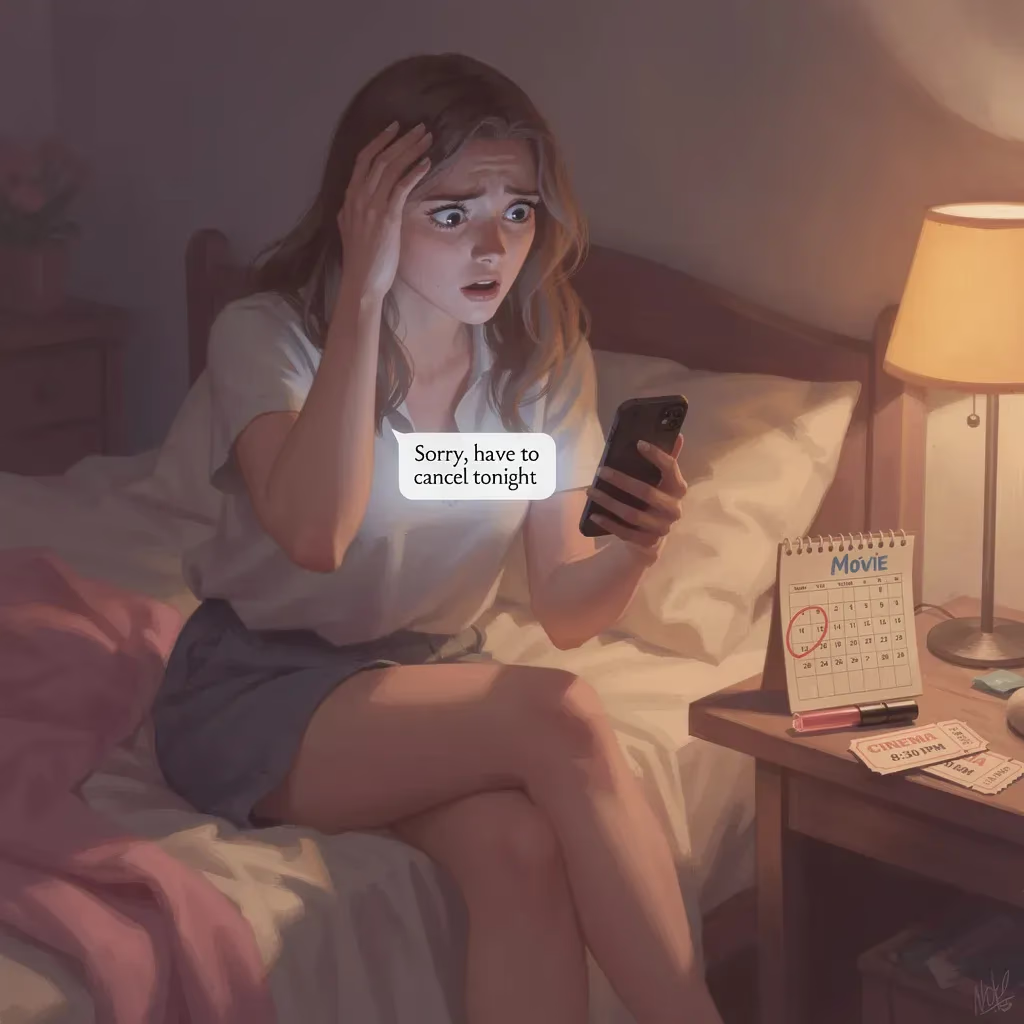
If your biggest pet peeve in a relationship is unpredictability, you probably feel it in your body first. The quick heat in your chest. The tight jaw. The "are you kidding me?" moment when plans shift again and you're expected to be chill about it.
Loose Cannon doesn't mean you're dramatic. It usually means you need steadiness to feel safe. And when someone's behavior is all over the place, your system starts scanning for danger, because inconsistency has a daily cost.
This is where people start Googling how to deal with disappointment in a relationship. Not because they want to "win." Because they're tired. Tired of rearranging their life, tired of being the flexible one, tired of wondering what are deal breakers in a relationship and whether they're allowed to have them.
Loose Cannon Meaning
Core Understanding
If you recognize yourself in this pattern, your irritation is a signal that your body wants predictability. You want a relationship where you can relax into the week, not brace for plot twists. The Loose Cannon pet peeve shows up when a partner's words and actions don't line up consistently enough for you to trust.
This pattern often develops when you've been on the receiving end of inconsistency before. Many women with this type learned to "be adaptable" because it kept the peace. You got good at rolling with it, until your body finally started protesting with resentment, anxiety, or shutdown.
Your body remembers the whiplash. The day he was sweet. The next day he disappeared. The way your stomach sinks when a plan changes, because you're not only losing the plan, you're losing your sense of being chosen.
What Loose Cannon Looks Like
- Plan changes feel personal: Inside, you feel rejected even if you know it's "not about you." Outside, you might say "no worries" while your chest tightens. Example: he cancels and you suddenly feel small.
- You over-prepare to prevent chaos: You try to lock things down so you don't get surprised. Others see you as organized. Example: you confirm plans twice because you don't trust him to show.
- Your mood mirrors the uncertainty: When things are stable, you glow. When things get vague, you spiral. Example: you can't focus at work because you don't know if he's coming tonight.
- You become hyper-aware of patterns: You notice timing, tone, follow-through. He calls you "sensitive." Example: you clock that he only texts late at night.
- You hate last-minute anything: Not because you're rigid, but because it can signal disrespect or lack of care. Example: "Wanna hang now?" at 10pm after silence all day.
- You feel embarrassed by your reaction: You tell yourself you should be cooler. But your body is keeping score. Example: you cry, then hate yourself for crying.
- You try to be the steady one: You hold things together because someone has to. Example: you plan dates, remind him, keep the relationship moving.
- Then you snap: You swallow disappointment until it explodes. Others see a sudden outburst. Example: the fifth cancellation turns into a full argument.
- You second-guess what is a red flag in a relationship: You ask, "Am I expecting too much?" Example: you debate whether consistency is a basic standard or a luxury.
- You get jealous of other couples' calm: Not in a bitter way, just in a "must be nice" way. Example: your friend says her boyfriend always follows through and you feel this ache.
- You stay because of the highs: The good moments are really good. Then the lows hit. Example: he shows up with a sweet gesture after being flaky, and you soften.
- You feel like you can't trust your own judgement: The story keeps changing. Example: he promises to do better, then repeats it.
- You start asking what are deal breakers in a relationship: Because you want a line in the sand. Example: you think, "If he cancels again, I'm done," then you doubt yourself.
- You become composed on the outside: You look calm, but inside you're shaking. Example: you say "okay" while your throat is tight and you want to scream.
How Loose Cannon Shows Up in Different Areas of Life
In romantic relationships: You crave a stable rhythm. You want plans, follow-through, and emotional consistency. When you don't have that, you might chase clarity, argue, or go quiet. This isn't you being "too intense." It's your system asking for safety.
In friendships: You're the friend who shows up. Flaky friends drain you. You might keep forgiving, then suddenly disappear, because you hit a breaking point.
At work: You like predictable expectations and clear timelines. Last-minute changes and vague leadership can make you feel unsteady. You might over-function to compensate, then feel resentful.
Under stress: Your body gets loud. You might go into fight mode (snapping, confronting) or freeze mode (silent, numb). Sometimes you do both in a loop. That's why learning how to overcome disappointment in a relationship matters for you: you need a repair path that doesn't cost you your peace.
What Activates This Pattern
- Last-minute cancellations with no real care.
- Inconsistent texting that keeps you guessing.
- Hot-and-cold affection that feels like a rollercoaster.
- Broken promises that get minimized.
- Plans that are always "maybe".
- Apologies without change.
- You asking for consistency and being called controlling.
The Path Toward Calm (Without Lowering Your Standards)
- You don't have to accept chaos to be lovable: Consistency is not a "princess demand." It's foundational.
- Small shifts, not dramatic transformation: Instead of waiting for the fifth disappointment, name the first one. Example: "When plans change last-minute, I feel unimportant."
- Separate mistakes from patterns: A one-time flake is different from chronic unreliability. This is how to deal with disappointment in a relationship without gaslighting yourself.
- Women who understand this type often find their dating life gets calmer fast when they stop dating potential and start dating behavior.
Loose Cannon Celebrities
- Miley Cyrus - Singer
- Lady Gaga - Singer/Actress
- Robert Downey Jr - Actor
- Katy Perry - Singer
- Britney Spears - Singer
- Lindsay Lohan - Actress
- Ben Affleck - Actor
- Drew Barrymore - Actress
- Ryan Reynolds - Actor
- Justin Bieber - Singer
- Adele - Singer
- Kylie Jenner - Media Personality
Loose Cannon Compatibility
| Other Type | Match | Why it feels this way |
|---|---|---|
| Clingy Caller | 😐 Mixed | If communication expectations are clear, it can work. If not, pressure plus unpredictability feels brutal. |
| Cold Wall | 😬 Difficult | Distance plus inconsistency makes you feel like you're constantly chasing stability. |
| Puzzle Box | 😕 Challenging | Ambiguity and mixed signals can intensify your need for certainty and trigger spirals. |
| Bossy Driver | 🙂 Works well | Directness and structure can soothe you if it stays respectful and not controlling. |
Do I have a Puzzle Box pattern?
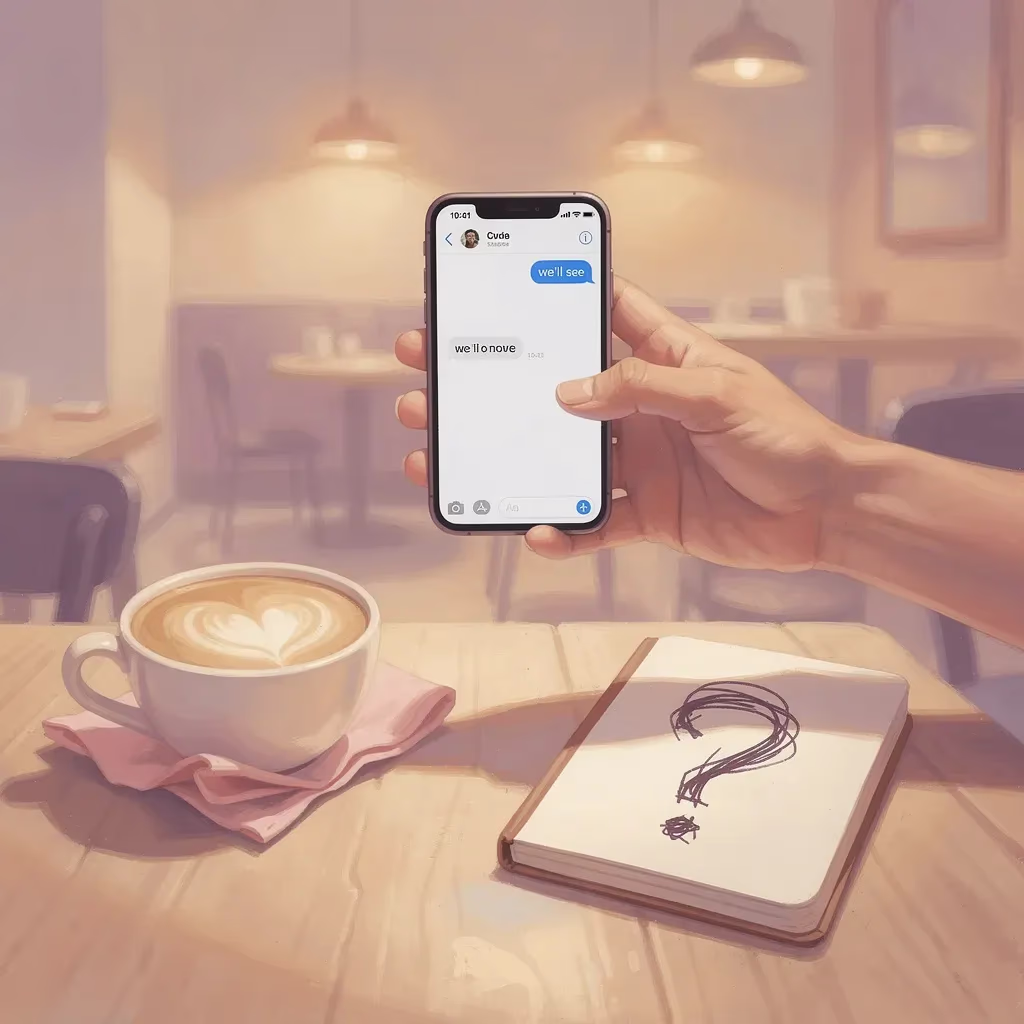
You know when you're not even asking for a grand gesture, you're asking for a sentence that makes sense. A plan. A yes or no. Something you can build your nervous system around.
Puzzle Box is for the women who get stuck in "decoding mode." You don't want drama. You want clarity. And when you don't get it, your brain starts doing the math at 2am, trying to answer the question you didn't want to ask: "Am I being played?"
This is why "what is a red flag in a relationship" searches blow up around situationships. Because ambiguity can feel romantic at first, and then it starts costing you your peace.
Puzzle Box Meaning
Core Understanding
If you recognize yourself in this pattern, your pet peeve isn't the person. It's the fog. It's that floating feeling where you can't get grounded because nothing is direct. Puzzle Box shows up when your strongest need is clarity, and you're dating someone who thrives in vagueness.
This pattern often develops when you've been taught to be agreeable and not "push." Many women with this type learned that asking for clarity risks rejection. So you tried to earn clarity by being easygoing, patient, understanding. Meanwhile your body kept whispering, "This isn't safe."
Your body remembers the dread before asking "what are we?" It can feel like a weight in your stomach, a tight throat, hands going cold. Not because you're weak. Because you're asking for something that, in your history, often came with punishment or withdrawal.
What Puzzle Box Looks Like
- Mixed signals trigger thought loops: Inside, your mind starts connecting dots. Outside, you might act casual. Example: he watches your stories instantly but takes 14 hours to reply.
- You become a detective: You analyze tone, timing, punctuation. Others see you overthinking. Example: you reread "k" like it's a psychology exam.
- You crave directness but fear being "needy": You want to ask. You also want to be chosen without asking. Example: you type "are we still on for Friday?" and delete it twice.
- Vague plans feel disrespectful: Not because you need control, but because you need consideration. Example: "maybe later" hijacks your whole evening.
- You keep giving the benefit of the doubt: You're empathetic. You see good. Example: you assume he's "busy" even when the pattern is weeks-long.
- You settle for partial answers: You accept a half-commitment because you want hope. Example: he says "I'm not ready for anything serious" but still treats you like a girlfriend.
- Your confidence leaks out slowly: You start doubting your standards. Example: you wonder if asking for a clear plan is "too much."
- You feel relief when someone is direct: Even if it's a no, it calms you. Example: you feel lighter when someone says "I'm not interested" versus keeping you guessing.
- You hate the "we'll see" phrase: It feels like a trap. Example: you ask to hang out and he says, "We'll see how I feel."
- You do emotional labor to make the relationship make sense: You fill gaps. You translate. Example: you create reasons for his silence so you don't panic.
- You oscillate between chasing and shutting down: You reach for clarity, then you disappear out of shame. Example: you send a careful text, then mute him and pretend you don't care.
- You Google what are red flags in a relationship: Because you want a reality check. Example: you look up "mixed signals" and end up in a spiral.
- Your standards become secret: You keep them in your head instead of saying them out loud. Example: you want weekly plans, but you never state it.
- You start asking what are deal breakers in a relationship: Because you want to stop negotiating. Example: you decide "no label after X months" is a deal breaker, then you feel guilty for it.
How Puzzle Box Shows Up in Different Areas of Life
In romantic relationships: You need clarity around intentions, plans, and communication. Without it, you feel unsteady, and your attachment gets hooked. Your goal isn't to control someone. It's to stop living in question marks.
In friendships: You're usually the friend who communicates. If a friend ghosts or is vague, you take it personally. You might work hard to "repair" things, even when the other person is not participating.
At work: You do best with clear expectations. Ambiguous feedback can keep you stuck replaying every meeting. You might over-deliver to avoid being misunderstood.
Under stress: Your mind spins. You search for certainty as a way to calm down. Learning how to overcome disappointment in a relationship for you often means learning to ask one clear question and then believe the answer you get.
What Activates This Pattern
- Vague plans like "maybe later."
- Unclear intentions about exclusivity or commitment.
- Dodging direct questions with jokes or deflection.
- Inconsistent contact that keeps you on standby.
- Hot affection, then silence.
- "Go with the flow" as avoidance.
- You asking for clarity and being told you're "overthinking."
The Path Toward Clarity (Without Over-Explaining Yourself)
- You don't have to earn clarity: You are allowed to ask direct questions. The right person won't punish you for it.
- Small shifts, not dramatic transformation: One sentence is enough. Example: "Are you looking for something serious in the next few months?"
- Let behavior answer for you: If the answer is fog, that is also an answer. That's how to deal with disappointment in a relationship without staying trapped.
- Women who understand this type often find dating gets so much easier when they stop trying to solve the Puzzle Box, and start choosing someone who speaks plainly.
Puzzle Box Celebrities
- Timothee Chalamet - Actor
- Emma Stone - Actress
- Florence Pugh - Actress
- Harry Styles - Singer
- Billie Eilish - Singer
- Tom Holland - Actor
- Anya Taylor-Joy - Actress
- Ryan Gosling - Actor
- Natalie Portman - Actress
- Joseph Gordon-Levitt - Actor
- Ethan Hawke - Actor
- Sigourney Weaver - Actress
- Winona Ryder - Actress
Puzzle Box Compatibility
| Other Type | Match | Why it feels this way |
|---|---|---|
| Clingy Caller | 😐 Mixed | You want clarity, they want space. It can work if expectations are named early and kindly. |
| Cold Wall | 😕 Challenging | If he won't talk feelings, you may spiral harder and keep asking the same questions. |
| Loose Cannon | 😬 Difficult | Chaos plus ambiguity makes your nervous system live on high alert. |
| Bossy Driver | 🙂 Works well | Directness can feel soothing, as long as it doesn't tip into control. |
Am I a Bossy Driver type?

If your biggest pet peeve in a relationship is being controlled, you probably don't even argue anymore. You just feel this instant inner "no." The kind that makes your spine straighten and your face go calm, because your body knows exactly what it's dealing with.
Bossy Driver isn't about being bossy. It's about protecting your autonomy. It's about wanting a relationship where you feel like an equal, not a project. And yes, this is one of those areas where learning what are deal breakers in a relationship can save you months of slow resentment.
A lot of women end up here after they spent years being "easygoing" and "understanding" and suddenly realized: being managed is not love. It's control with a pretty filter. It also clarifies what are red flags in a relationship, because control often starts small.
Bossy Driver Meaning
Core Understanding
If you recognize yourself in this pattern, your core irritation is about agency. You want to choose your pace, your friends, your schedule, your body, your life. When someone tries to steer you, even subtly, your system goes into protection mode.
This pattern often develops when you've had to fight for basic freedom, or when your needs were treated as inconvenient. Many women with this type learned early that if you don't guard your choices, someone will happily choose for you. So you became discerning. Not difficult. Discerning.
Your body remembers the tiny moments: him correcting you in front of friends, telling you what you should wear, pushing you to move faster than you want. It can feel like your jaw tightens, your chest gets hot, your patience disappears. This is your body labeling what is a red flag in a relationship before your brain finishes the sentence.
What Bossy Driver Looks Like
- You hate being "guided": Inside, you feel patronized fast. Outside, you might get very calm and short. Example: he says, "Trust me, this is better for you," and your stomach drops.
- Pressure makes you go silent: You stop arguing because it feels pointless. Others see you withdraw. Example: you nod, but you already decided you're not doing it.
- You can spot control dressed up as care: You notice the hook. Example: "I just worry about you" becomes "Don't go out tonight."
- You protect your time like it's sacred: Because it is. Example: he demands last-minute time and you feel irritated, not because you don't like him, but because he didn't ask.
- You feel safest with direct communication: Vibes aren't enough. Example: you ask clear questions about intentions because you refuse to be strung along.
- You get labeled "intimidating": Usually by people who benefit from you being smaller. Example: you state a boundary and he says you're "too intense."
- You struggle to soften when you don't feel safe: Your warmth is real, but it needs respect. Example: you can be playful, but not with someone who keeps testing you.
- You dislike being corrected: Especially publicly. Example: he "jokes" about you being dramatic in front of friends, and you go cold.
- You carry the mental load, then resent it: You end up planning because he won't. Example: you become the organizer and hate it.
- You crave equality, not gestures: Flowers don't fix disrespect. Example: he buys gifts but dismisses your opinions.
- You don't tolerate boundary testing: Once you see it, you can't unsee it. Example: he keeps pushing after you say no, and you feel disgust, not attraction.
- You want partnership, not parenting: You refuse to date a child. Example: he expects you to remind him of basic life tasks and you feel your energy drain.
- You ask yourself what are deal breakers in a relationship: Because you refuse to normalize control. Example: you decide that "telling me what to do" is a hard no.
- You look composed while you're furious: You don't explode. You detach. Example: you smile politely, then you distance yourself for days.
How Bossy Driver Shows Up in Different Areas of Life
In romantic relationships: You're loyal when you feel respected. When you don't, you become distant fast. You need someone who can hold their own without trying to own you.
In friendships: You're the friend who will say the truth gently but directly. You hate passive-aggressive dynamics. You prefer clean communication over pretending.
At work: You do well in environments that reward independence. Controlling managers frustrate you. You might become the "quiet leader" because you refuse chaos and disrespect.
Under stress: You clamp down. You get sharp. You might create rules or distance because you're trying to feel safe again. Learning how to overcome disappointment in a relationship for you often means recognizing when you're in protection mode, then asking: "Is this a one-off mistake, or a control pattern?"
What Activates This Pattern
- Being told what to do with no respect for your choice.
- Guilt when you say no, like your boundary is a betrayal.
- Subtle criticism about your friends, clothes, or lifestyle.
- Pressure to move faster (sex, commitment, living together).
- Financial or social control disguised as "help."
- Your preferences being mocked.
- Boundary testing after you've been clear.
The Path Toward Soft Power (Not Over-Control)
- You don't have to shrink to be loved: The right partner doesn't need you smaller to feel secure.
- Small shifts, not dramatic transformation: Instead of explaining your boundary ten ways, state it once. Example: "That doesn't work for me."
- Choose repair-friendly people: Someone who can hear feedback without punishing you is gold. That's how to deal with disappointment in a relationship without building a wall.
- Women who understand this type often find their dating life becomes calmer when they stop negotiating with control, and start choosing mutual respect.
Bossy Driver Celebrities
- Rihanna - Singer
- Serena Williams - Athlete
- Sandra Bullock - Actress
- Beyonce - Singer
- Gal Gadot - Actress
- Charlize Theron - Actress
- Anne Hathaway - Actress
- Jennifer Aniston - Actress
- Michelle Yeoh - Actress
- Viola Davis - Actress
- Harrison Ford - Actor
- George Clooney - Actor
Bossy Driver Compatibility
| Other Type | Match | Why it feels this way |
|---|---|---|
| Clingy Caller | 😕 Challenging | If closeness becomes pressure, you'll feel controlled and they may feel rejected. |
| Cold Wall | 🙂 Works well | Mutual respect and emotional maturity can make this pairing steady and low-drama. |
| Loose Cannon | 😐 Mixed | You can handle spontaneity, but not inconsistency. Clear agreements make it work. |
| Puzzle Box | 🙂 Works well | Your directness can give them clarity, and their questions can keep you honest, if respect stays high. |
If you're stuck cycling through the same pet peeves in a relationship, it's not because you're impossible. It's because your needs are getting ignored, then your body starts shouting. This quiz helps you sort what are red flags in a relationship from normal differences, and it gives you language for how to deal with disappointment in a relationship without begging, exploding, or disappearing.
- 💡 Discover pet peeves in a relationship that point to real needs.
- 🧭 Recognize what are deal breakers in a relationship (yours, not your friend's).
- 🔎 Understand what is a red flag in a relationship vs. a fixable mismatch.
- 🫶 Learn how to overcome disappointment in a relationship without turning it into self-blame.
- 📩 Practice how to deal with disappointment in a relationship with calmer, clearer words.
- 🤍 Honor your standards without guilt.
| Where you are now | What becomes possible |
|---|---|
| You keep telling yourself you're "too picky." | You realize your pet peeve is a compass, not a flaw. |
| You keep Googling what are red flags in a relationship mid-situationship. | You spot patterns earlier, before you bond to breadcrumbs. |
| You don't know what are deal breakers in a relationship for you until you're already attached. | You name your non-negotiables early, without apologizing. |
| You keep asking how to deal with disappointment in a relationship after the fact. | You prevent the same disappointment by choosing differently at the start. |
| You keep trying to be composed while your heart is freaking out. | You stay steady and still ask for what you need. |
Join over 177,835 women who've taken this under 5 minutes quiz for private results. Your answers stay private.
FAQ
What are pet peeves in a relationship, and why do they feel so personal?
Pet peeves in a relationship are the small (or not-so-small) behaviors that consistently irritate you, drain you, or make you feel subtly disrespected over time. They feel personal because they usually touch something deeper than the surface behavior: your need for safety, consideration, consistency, and emotional care.
If you've ever thought, "Why does this bother me so much?", you're not being dramatic. So many of us are reacting to what the behavior means, not just what it is.
Here's what's really happening beneath the annoyance:
- Pet peeves are often about trust. When someone says they'll call and doesn't, or promises they'll be on time and isn't, your nervous system hears: "I can't rely on you." That can spiral fast, especially if you're already sensitive to abandonment.
- They can be about respect and emotional labor. The classic "I have to remind them of everything" vibe isn't just annoying. It's exhausting. It can feel like you're carrying the relationship alone.
- They can be about your values. For example, if you value honesty, "little white lies" can feel like a big crack in the foundation.
- They can be old wounds getting tapped. Not in a "you're broken" way. In a "your body remembers patterns" way. If inconsistency used to equal danger (emotionally), inconsistency now can feel unbearable.
One helpful reframe: a pet peeve isn't automatically a deal breaker. Sometimes it's a solvable mismatch. Sometimes it is a true red flag in a relationship. The difference is usually this:
- A pet peeve = "This is annoying and I want it to change."
- A deal breaker = "This makes me feel unsafe, unseen, or chronically disrespected."
If you're trying to figure out what your irritation is telling you, you're already doing something brave: you're listening to yourself instead of minimizing your needs. That matters.
Our quiz helps you name your patterns (and the deeper meaning under your frustration), so you're not stuck wondering if you're "too picky" or if this is actually a real compatibility issue.
What are common deal breakers in a relationship vs. normal annoyances?
Common deal breakers in a relationship are behaviors that consistently damage trust, safety, or mutual respect. Normal annoyances are the everyday quirks that can be negotiated, adjusted, or tolerated without you losing yourself in the process.
This question matters because so many women have been taught to downplay their needs. You end up stuck asking, "Am I too picky in relationships?" when the real issue is: "Is this healthy for me?"
A simple way to tell the difference is to check your inner experience over time:
- Normal annoyance: You feel irritated, you talk about it, it improves (or you accept it), and you still feel basically safe and valued.
- Deal breaker: You feel chronically tense, dismissed, anxious, or like you're shrinking to keep the peace.
Here are examples that commonly fall into deal breaker territory:
- Consistent lying, even about small things
- Disrespect during conflict (mocking, name-calling, contempt, stonewalling)
- Cheating or repeated boundary violations
- Refusing accountability ("You're too sensitive" or "You're overreacting" every time)
- Controlling behavior (who you talk to, what you wear, how you spend money)
- Emotional unavailability that never changes (you keep reaching, they keep disappearing)
- Addiction behaviors that impact trust and stability without willingness to seek help
- Cruelty disguised as jokes
Here are examples of normal annoyances that can be workable with communication:
- Different texting styles
- Messiness vs. tidiness preferences
- Different social batteries (one wants to go out, one wants nights in)
- Minor habit stuff (leaving cabinets open, forgetting to buy oat milk)
And here's the tricky part: some behaviors sit in the middle. Like being "bad at communication." Sometimes it's a growth edge. Sometimes it's a quiet form of avoidance that keeps you emotionally starving.
If you're constantly googling "what is a red flag in a relationship" at 2 a.m., that's data. Not proof you're broken. It usually means your body is picking up on instability, even if your mind is trying to make it make sense.
If you want clarity on what your biggest relationship pet peeve is (and whether it's pointing to mismatch, disrespect, or insecurity), the quiz is a gentle way to name it without shaming yourself.
Why do I get so angry in relationships over small things?
You get so angry in relationships over "small things" because they usually aren't small to your nervous system. The anger is often a protective response to feeling dismissed, unsafe, unheard, or like you're carrying the emotional load alone. In other words, the surface trigger is small. The meaning is big.
This is also why searches like "What makes me angry in relationships" feel so relatable. You're trying to translate your reactions into something that makes sense.
A few common reasons "small" things hit hard:
- It's a pattern, not a one-time event. One late reply might be fine. Repeated inconsistency can feel like emotional whiplash.
- You're doing invisible work. If you're the one tracking plans, smoothing conflicts, and anticipating moods, one more disappointment can feel like the final straw.
- It activates fear. For anxiously attached women, anger often sits on top of fear: "If I matter, why does this keep happening?"
- You're grieving the version of the relationship you keep hoping for. That hope is beautiful. It can also be painful if you keep meeting the same wall.
- You haven't been allowed to have needs without guilt. So when your needs show up, they show up loudly. Not because you're too much, but because they've been ignored too long.
A really helpful distinction:
- Clean anger says: "This matters to me."
- Messy anger says: "I can't get you to take me seriously, so now I'm exploding."
If you're reading this and thinking, "I hate that I get like this," I want you to hear something steady: your anger isn't random. It's information. It's trying to protect your heart.
A micro-step that can shift everything is to ask yourself after the irritation spikes:
- "What did I need right then?"
- "What story did my body tell me about what that meant?"
That question alone can turn a spiral into clarity.
If you'd like help naming your exact pattern (and what your irritation is really pointing to), our Dating Frustrations quiz can help you understand your biggest pet peeve in a relationship and how it connects to your deeper needs.
What causes dating frustrations and repeating the same relationship pet peeves?
Dating frustrations usually come from repeating the same emotional dynamic with different people. It can look like bad luck. It can feel like you're cursed. Most of the time, it's a pattern your nervous system recognizes, even if your logical brain doesn't want to admit it yet.
So if you're thinking, "Why do I keep ending up here?", you're in very real company. This is the quiet conversation happening everywhere.
Common causes of repeating pet peeves in a relationship:
- We confuse intensity with connection. Early sparks can feel like safety. Sometimes they're just adrenaline. If you have anxious attachment patterns, inconsistency can feel magnetic because it makes you chase closeness.
- We choose what we know, not what we need. If love used to mean earning attention, you might feel oddly comfortable with partners who make you work for basic effort.
- We avoid hard conversations until resentment builds. Not because you're weak, but because conflict can feel terrifying when you're afraid they'll leave. Then the pet peeve gets bigger and bigger until it explodes.
- We ignore the early data. The first time they cancel last minute, the first time they get defensive, the first time you feel that "hollow" feeling. You tell yourself to be chill. Then you're later googling "how to deal with disappointment in a relationship" because you're trying to soothe something chronic.
Here's the deeper truth: your biggest pet peeve often points to your deepest need.
- If you hate inconsistency, you probably need reliability and follow-through.
- If you hate coldness, you probably need emotional presence.
- If you hate chaos, you probably need steadiness and accountability.
- If you hate mind games, you probably need clarity and honesty.
- If you hate being controlled, you probably need autonomy and respect.
This is also where we start asking bigger questions like "Am I settling in my relationship?" because your irritation is trying to wake you up.
A gentle way forward is to stop debating whether your feelings are "valid enough" and start tracking patterns:
- What behavior repeats?
- What emotion does it create in you (not just anger, but fear, shame, loneliness)?
- What do you do next: chase, shut down, explode, over-explain, go silent?
That pattern is the map.
The quiz helps you put language to your specific dating frustration pattern, so you can stop blaming yourself and start seeing what your system has been trying to tell you.
How accurate is a "What's your biggest relationship pet peeve" quiz?
A "What's your biggest relationship pet peeve" quiz can be surprisingly accurate at highlighting your patterns, as long as you treat it as a mirror, not a diagnosis. The real value is clarity: it helps you name what triggers you most, what you tend to do next, and what kind of dynamic you might be repeating.
If you've ever taken a Toxic relationship behaviors quiz (or even searched for one), you already know the vibe. You aren't looking for entertainment. You're looking for relief and answers.
Here's what makes a relationship quiz more accurate and useful:
- It asks about real situations, not vague traits. Good quizzes focus on what happens during conflict, texting, plans, trust, and repair.
- It captures patterns under stress. Most of our biggest pet peeves show up when we feel uncertain, disappointed, or unseen.
- It reflects the "meaning" you attach to behaviors. Two people can hate slow replies for different reasons. One feels disrespected. Another feels abandoned.
- It gives language you can actually use. The best outcome is, "Oh. This is what I keep reacting to," not "This is who I am forever."
What quizzes cannot do:
- They can't tell you exactly what your partner intends.
- They can't replace professional support if you're in a truly unsafe situation.
- They can't make the hard choices for you.
But a good quiz can help answer the questions underneath the question:
- "What is a red flag in a relationship for me specifically?"
- "What are deal breakers in a relationship for my nervous system?"
- "Am I too picky in relationships, or am I finally listening to myself?"
One of the most healing parts is realizing: your reactions have a logic. You didn't wake up one day and decide to be anxious, angry, or shut down. You adapted.
If you're craving a clearer picture of your biggest pet peeve, and what it reveals about your needs in love, the quiz is a gentle place to start.
Can I change my dating pattern if I keep getting disappointed in relationships?
Yes, you can change your dating pattern, even if you've been disappointed in relationships over and over. Patterns are learned, and anything learned can be updated. It usually starts with understanding what your disappointment is repeatedly pointing to: mismatch, lack of effort, unclear communication, or you abandoning your own needs to keep someone close.
If you've been searching "how to deal with disappointment in a relationship," it makes sense. Disappointment is one of the hardest feelings because it carries hope inside it. You believed. You tried. You pictured something. Then reality didn't meet you there.
Here are a few ways patterns shift (without you having to become a totally different person):
- You stop negotiating with early red flags. Not in a rigid "one mistake and I'm out" way. In a "I trust what I see" way.
- You learn your personal deal breakers. Not what TikTok says. Yours. The ones that make you feel unsafe or chronically unseen.
- You practice faster honesty. When something bothers you, you name it before resentment builds. This is hard for anxious people because honesty can feel like risk. It also creates real intimacy with the right person.
- You choose consistency over chemistry. Chemistry is real. Consistency is what your nervous system can rest inside.
- You build tolerance for the "in-between." The early stage of dating can feel like holding your breath. Learning to stay grounded there changes everything.
A tiny micro-shift that helps many women: after a date, instead of asking "Do they like me?", ask:
- "Do I feel more like myself around them?"
- "Do I feel calm, or do I feel like I'm performing?"
- "Do they follow through?"
This is how you stop accidentally settling. This is how you start choosing.
If you want help spotting your specific pattern (and the pet peeve that keeps showing up), the quiz can give you a clear starting point without shame.
How do I know if I'm settling in my relationship or just being picky?
You're settling in your relationship when you're consistently shrinking, rationalizing, or self-abandoning to keep the relationship stable. You're being picky when you're holding a preference so tightly that no real human could meet it, even though you feel safe and respected.
This is such a tender question because so many of us were taught that wanting more is "asking too much." So we swing between two painful extremes: accepting crumbs or demanding perfection.
If you've been searching "Am I settling in my relationship" or "Am I too picky in relationships," here are grounded signs to look at.
Signs you might be settling:
- You regularly feel anxious, lonely, or emotionally unsafe, even when you're technically "together."
- You keep lowering your needs because you're afraid they'll leave.
- You do most of the repairing after conflict.
- Your gut keeps whispering "this isn't it," but you talk yourself out of it.
- You feel like you have to earn basic kindness, communication, or consistency.
Signs you might be being picky (in an unhelpful way):
- You're rejecting people for minor quirks that don't actually impact respect or compatibility.
- You focus on small status details while ignoring how they treat you.
- You expect mind-reading instead of communication.
- You feel irritated by normal human needs or imperfections.
Now the part that matters most: many women aren't "too picky." They're finally getting honest about what hurts.
A helpful litmus test is this:
- Picky is about preferences.
- Settling is about self-respect.
Preferences are things like height, style, hobbies, introvert vs extrovert. Self-respect is things like honesty, follow-through, emotional safety, and being treated with care.
If you're consistently asking yourself "what are deal breakers in a relationship?", it might be because your body is tired of being the one who adapts.
The quiz can help you identify what your biggest relationship pet peeve is and whether it's pointing to a solvable mismatch or a deeper pattern of settling.
How do I deal with toxic relationship behaviors without blaming myself?
You deal with toxic relationship behaviors by naming what is happening clearly, trusting your reality, and separating "understanding someone" from "excusing someone." Not blaming yourself starts with one truth: someone else's harmful behavior is not your job to fix with more patience, more love, or more self-sacrifice.
A lot of women take a Toxic relationship behaviors quiz because they want confirmation that they're not imagining it. That makes sense, especially if you've been subtly taught to doubt yourself.
Here are common toxic behaviors that often get minimized:
- Gaslighting: They deny your reality, twist facts, or make you feel "crazy" for normal reactions.
- Stonewalling: They disappear emotionally, refuse to talk, or punish you with silence.
- Hot and cold: Intense affection followed by withdrawal, then affection again. This creates a cycle that can hook an anxious nervous system.
- Blame shifting: Every issue becomes your fault. You end up apologizing for having feelings.
- Contempt: Eye-rolling, sarcasm, mocking, making you feel small.
If any of this is landing, the goal is not to diagnose your partner. The goal is to protect your sense of self.
A few gentle anchors that help you stay grounded:
- Name the behavior, not your character. Instead of "I'm too sensitive," try: "I don't feel safe when my feelings are mocked."
- Track patterns, not promises. People can promise anything after a fight. Patterns tell the truth.
- Use "repair" as the standard. Healthy people can mess up and repair. Toxic dynamics repeat and escalate.
- Remember that empathy is not a contract. Understanding their childhood, stress, or trauma doesn't mean you owe them access to you.
If you're wondering "what is a red flag in a relationship?", a powerful clue is this: your body feels chronically on alert. You feel like you're holding your breath waiting for their mood.
You deserve a relationship where you can exhale.
If you want clarity on your biggest pet peeve in a relationship and the pattern it points to (chasing, shutting down, exploding, or over-functioning), the quiz can help you put words to it and feel less alone.
What's the Research?
Why pet peeves hit so hard (and why you're not being "too much")
That specific moment when you read their tone and your stomach drops, even if the words are technically fine? That is not you being dramatic. That is your nervous system tracking safety.
What the research tells us is that romantic relationships are basically a living, breathing system: closeness, trust, self-disclosure, reciprocity, power, and communication are all constantly shaping how secure (or on edge) you feel with someone (Interpersonal relationship - Wikipedia). So when a partner does something that breaks predictability (ghosts for hours, changes the plan last minute, gets weirdly cold after intimacy), it can land as a threat, not a preference.
Attachment theory helps explain why different people have totally different "biggest relationship pet peeve" answers. It describes how our earliest experiences with caregivers shape our expectations of closeness and reliability later on (Verywell Mind - Attachment Theory, Simply Psychology - Attachment Theory, Fraley - Adult Attachment Overview). If your system learned love can be inconsistent, it makes perfect sense that inconsistency in dating becomes the most infuriating thing. Not because you're picky, but because your body remembers.
If your "pet peeve" feels outsized, it's usually because it's touching an old fear: "Will I be left? Will I be dismissed? Will I have to earn love again?"
The sneaky science behind common dating frustrations
Most pet peeves in a relationship aren't really about the behavior. They're about what the behavior signals.
A few patterns show up again and again:
- Lack of openness / vague communication: Healthy relationships need mutual openness, meaning both people share and allow the other to share (Verywell Mind - Maintaining Interpersonal Relationships). So when someone shuts down, withholds, or dodges, it doesn't just annoy you. It blocks the basic pathway that creates closeness.
- Not feeling listened to: Active listening is one of the clearest markers of care because it communicates "you matter here" (Verywell Mind - Maintaining Interpersonal Relationships). When someone interrupts, half-listens, or makes it about them, your frustration is information.
- Boundary violations (physical, emotional, time, texting, privacy): Boundaries are basically how we define "what's okay with me" and protect trust (Psych Central - Personal Boundaries, Stanford Student Affairs - Importance of Boundaries, Mayo Clinic Health System - Setting Boundaries). When someone pushes past them, your irritation is your system defending you.
- Power and control stuff (subtle dominance, deciding for you, punishing you with silence): Relationships always have some power distribution, and when it tilts too far, it starts to feel unsafe or dehumanizing (Interpersonal relationship - Wikipedia). This is why "bossy" behavior can feel like a deal breaker, even when it's framed as "just having opinions."
There is also something quietly validating in the boundaries research: boundaries are not about controlling the other person, they're about clarifying what you'll do to care for yourself when something isn't okay (Personal boundaries - Wikipedia, Mayo Clinic Health System - Setting Boundaries). That matters because so many women get stuck thinking, "If I ask for what I need, I'm being demanding." No. You're being clear.
Your biggest pet peeve usually points to the exact place you need consistency, respect, and emotional safety to actually relax in love.
How your pet peeve maps to the 5 dating frustration types (and what it's really asking for)
If you're taking a "Dating pet peeves quiz free" style quiz or searching "What's your biggest relationship pet peeve," what you're often trying to figure out is: "Am I too picky, or am I finally seeing the truth?"
These five patterns show up a lot. They aren't diagnoses. They're just common ways our nervous systems try to protect us in relationships.
Clingy Caller
- Pet peeve trigger: slow replies, mixed signals, "I'll call you" and then nothing.
- Deeper need: reassurance and reliability. Attachment research describes how fear of disconnection can make inconsistency feel like danger (Verywell Mind - Attachment Theory).
- Hidden question: "Can I trust you to stay emotionally present?"
Cold Wall
- Pet peeve trigger: too much emotion too fast, conflict, or feeling "pressed" to talk.
- Deeper need: space and autonomy without being punished for it. Attachment models describe avoidant patterns as a way people manage closeness when it feels overwhelming (Simply Psychology - Attachment Theory).
- Hidden question: "Can I have room and still be loved?"
Loose Cannon
- Pet peeve trigger: unpredictability, blown-up fights, intense highs and lows, chaotic decision-making.
- Deeper need: stability and emotional regulation. Relationships are dynamic systems, and constant volatility burns trust fast (Interpersonal relationship - Wikipedia).
- Hidden question: "Are we safe, or am I always bracing?"
Puzzle Box
- Pet peeve trigger: vagueness, secrecy, never knowing where you stand, emotional crypticness.
- Deeper need: clarity and openness. Openness is literally one of the foundations of strong interpersonal connection (Verywell Mind - Maintaining Interpersonal Relationships).
- Hidden question: "Will you let me know you, or will I always be guessing?"
Bossy Driver
- Pet peeve trigger: being managed, corrected, controlled, or treated like your preferences are inconvenient.
- Deeper need: respect and shared power. Unequal dominance dynamics can quietly corrode a relationship (Interpersonal relationship - Wikipedia).
- Hidden question: "Do you see me as an equal, or as someone to direct?"
Your pet peeve isn't random. It's your nervous system highlighting the exact condition that makes love feel safe enough to stay soft.
Turning your biggest pet peeve into a useful signal (instead of a spiral)
A lot of women end up Googling things like "what are deal breakers in a relationship" or even "Toxic relationship behaviors quiz" because they don't trust their own internal alarm system anymore. Usually because they've been told they ask for too much, or they've tried to be "chill" and it cost them.
Here are the research-backed pieces that actually help you use your pet peeve wisely:
- Name the category, not just the incident. Was it a boundary violation? A lack of openness? A power move? A bid for connection being ignored? Boundaries research frames boundaries as the lines that protect your well-being and clarify what's acceptable (Psych Central - Personal Boundaries, Stanford Student Affairs - Importance of Boundaries).
- Watch for patterns, not one-offs. Relationship science talks about relationships having phases, including deterioration when trust drops and communication gets thinner (Interpersonal relationship - Wikipedia). A single annoying moment is human. A repeating pattern is data.
- Remember: your needs are allowed to exist. Setting boundaries can feel emotionally uncomfortable, but that discomfort doesn't mean you're wrong (Personal boundaries - Wikipedia). It often just means you're not used to being taken seriously.
And here's the part I love, because it takes the pressure off you having to "figure it out perfectly": The science tells us what's common; your report reveals what's true for you specifically, including which of the five pet-peeve patterns you default to when you're stressed and what that means for the kind of relationship that will actually feel peaceful.
References
Want to go down the rabbit hole (in a good way)? Here are some genuinely helpful reads:
- Interpersonal relationship - Wikipedia
- Verywell Mind - How to Maintain Interpersonal Relationships
- NCBI Bookshelf - Interpersonal Relationships (Clinical Methods)
- Psych Central - Personal Boundaries: Types and How to Set Them
- Mayo Clinic Health System - Setting Boundaries for Well-Being
- Stanford Student Affairs - Trust, Safety, and Respect: The Importance of Boundaries
- Personal boundaries - Wikipedia
- Verywell Mind - What Is Attachment Theory?
- Simply Psychology - Attachment Theory Explained
- R. Chris Fraley - A Brief Overview of Adult Attachment Theory and Research
- Penn State Psychology - Interpersonal Processes
- Proximity principle (social psychology) - Grokipedia
Recommended Reading (for when you want more than a list of pet peeves)
Sometimes you don't need another hot take. You need language. You need a clean way to name what are deal breakers in a relationship, and a way to tell what is a red flag in a relationship without talking yourself out of what you felt.
General books (helpful for any dating pet peeve type)
- Attached (Amazon, Bookshop.org, AbeBooks) by Amir Levine - A clear map for why modern dating triggers pet peeves in a relationship like mixed signals and inconsistency.
- Nonviolent Communication (Amazon, Bookshop.org, AbeBooks) by Marshall B. Rosenberg - Gives words for how to deal with disappointment in a relationship without blame, shutdown, or spiraling.
- Set Boundaries, Find Peace (Amazon, Bookshop.org, AbeBooks) by Nedra Glover Tawwab - Boundary scripts that make it easier to name what are deal breakers in a relationship early.
- Hold Me Tight (Amazon, Bookshop.org, AbeBooks) by Sue Johnson - Helps you understand the cycle underneath fights and distance, so you're not stuck reliving the same disappointment.
- Come as You Are (Amazon, Bookshop.org, AbeBooks) by Emily Nagoski - Helps couples talk about intimacy without shame, which is a surprisingly common category of pet peeves in a relationship.
- How to Not Die Alone (Amazon, Bookshop.org, AbeBooks) by Logan Ury - Practical tools for modern dating ambiguity, mixed signals, and decision-making.
- Eight Dates (Amazon, Bookshop.org, AbeBooks) by John Schwartz Gottman, Julie Schwartz Gottman, Rachel Abrams, Doug Abrams - Eight guided conversations for exploring values, dreams, and emotional needs with your partner.
- The Seven Principles For Making Marriage Work (Amazon, Bookshop.org, AbeBooks) by John Gottman - Research-based tools for lasting relationships built on friendship, respect, and emotional repair.
For Clingy Caller types (protect your space without guilt)
- Anxiously Attached (Amazon, Bookshop.org, AbeBooks) by Jessica Baum - Helps you calm the urge to chase and choose steadier connection.
- The Journey from Abandonment to Healing (Amazon, Bookshop.org, AbeBooks) by Susan Anderson - Supports the "I feel dropped" panic underneath certain pet peeves in a relationship.
- Self-Compassion (Amazon, Bookshop.org, AbeBooks) by Kristin Neff - Powerful if your inner critic attacks you after you ask for reassurance.
- Boundaries (Amazon, Bookshop.org, AbeBooks) by Henry Cloud, John Sims Townsend - Helps you stop treating closeness like access someone can demand.
For Cold Wall types (get warmth without chasing)
- The Emotionally Unavailable Man (Amazon, Bookshop.org, AbeBooks) by Patti Henry - Helps you recognize patterns of emotional distance and decide what is a red flag in a relationship for you.
- Running on Empty (Amazon, Bookshop.org, AbeBooks) by Jonice Webb - Helps you put words to needs you've been minimizing, and learn how to overcome disappointment in a relationship without going numb.
- The Highly Sensitive Person in Love (Amazon, Bookshop.org, AbeBooks) by Elaine N. Aron - Great if you shut down when you're overwhelmed, even when you care.
- The Assertiveness Workbook (Amazon, Bookshop.org, AbeBooks) by Randy J. Paterson - Helps you say what you need before resentment builds.
For Loose Cannon types (build calm and consistency)
- The Dialectical Behavior Therapy Skills Workbook (Amazon, Bookshop.org, AbeBooks) by Matthew McKay - Tools for the moment you want to send the paragraph text you'll regret.
- Codependent No More (Amazon, Bookshop.org, AbeBooks) by Melody Beattie - Helps you stop over-functioning to keep the relationship stable.
- Adult Children of Emotionally Immature Parents (Amazon, Bookshop.org, AbeBooks) by Lindsay C. Gibson - Helps you spot familiar chaos and choose steadier partners.
- The Set Boundaries Workbook (Amazon, Bookshop.org, AbeBooks) by Nedra Glover Tawwab - Helps you name limits early so you don't have to explode later.
For Puzzle Box types (get clarity and stop decoding)
- The Assertiveness Workbook (Amazon, Bookshop.org, AbeBooks) by Randy J. Paterson - Gives you language to ask clear questions and hold boundaries.
- Games People Play (Amazon, Bookshop.org, AbeBooks) by Eric Berne - Helps you recognize interpersonal "games" so you stop solving riddles and start choosing honesty.
- Why Does He Do That? (Amazon, Bookshop.org, AbeBooks) by Lundy Bancroft - Helps you stop translating what are red flags in a relationship into riddles.
- Running on Empty (Amazon, Bookshop.org, AbeBooks) by Jonice Webb - Helps you identify needs underneath your pet peeves in a relationship, so you can ask directly.
For Bossy Driver types (keep your autonomy, keep your softness)
- The Disease to Please (Amazon, Bookshop.org, AbeBooks) by Harriet B. Braiker - Helps you stop over-functioning, then resenting it.
- Not Nice (Amazon, Bookshop.org, AbeBooks) by Aziz Gazipura - Supports directness before you hit the breaking point.
- Crucial Conversations (Amazon, Bookshop.org, AbeBooks) by Kerry Patterson, Joseph Grenny, Ron McMillan, Al Switzler, Stephen R. Covey - Useful for hard talks that protect your dignity without turning into a war.
- Boundaries (Amazon, Bookshop.org, AbeBooks) by Henry Cloud, John Sims Townsend - Helps you separate what is yours to handle from what is theirs.
P.S. If you're still Googling how to deal with disappointment in a relationship at 1am, you deserve more clarity than that. Start with one honest result.