Your Career Badge Is Waiting

Career Badge: What's Your Quirky Career Trophy?

Career Badge: What's Your Quirky Career Trophy?
If you've ever felt invisible at work even while over-delivering, this quiz gives you words for what you bring, so you can stop shape-shifting and start being seen.
What is my quirky career trophy?

That question, "what is my work style", is rarely just curiosity. It's usually you trying to explain yourself without sounding dramatic. Like... why do you work so hard, care so much, and still feel weirdly replaceable?
Career Badge: What's Your Quirky Career Trophy? is a fun, slightly-too-real quiz that gives you a memorable "trophy" for the way you naturally create value when the pressure is on. It also answers the other question you probably keep circling: how would you describe your work style in a way that actually lands with managers, teammates, and interviewers.
This is also a Career Badge quiz free moment. No gatekeeping. No stiff labels. Just clarity.
Your trophy will be one of these five:
Idea Bolt
- Definition: You spark fresh angles fast, especially when everyone else is stuck in the same loop.
- Key traits: quick ideation, playful problem-solving, momentum from novelty
- Benefit: You stop apologizing for "random" and start using it as your edge.
Team Glue
- Definition: You make teams safer, smoother, and more functional, often without anyone noticing how much you held.
- Key traits: emotional steadiness, translating tension, collaborative instincts
- Benefit: You get language for the invisible work you do so you can protect it (and get credit).
Gold Star
- Definition: You turn plans into done, and you care about quality like it is personal.
- Key traits: follow-through, craft, consistency under pressure
- Benefit: You learn how to shine without silently overextending just to stay "the reliable one."
Crystal Ball
- Definition: You see around corners. You spot patterns early and make smart calls before chaos hits.
- Key traits: big-picture thinking, risk-sensing, thoughtful prioritizing
- Benefit: You stop second-guessing your instincts and start trusting your clarity.
Social Spark
- Definition: You build relationships and visibility naturally, connecting people to opportunities (including you).
- Key traits: networking ease, warm influence, social momentum
- Benefit: You learn how to be seen without feeling like you're "performing" for approval.
One more thing that makes this quiz different: it doesn't only tell you a trophy. It also digs into the behind-the-scenes stuff most tests ignore, like people-pleasing, achievement drive, quality focus, networking energy, collaboration style, and the quieter power traits like being genuine, helpful, adaptable, decisive, and empowering. Those details are where the "oh my god, that's me" feeling comes from.
5 Ways Knowing Your Career Badge Can Transform How You Show Up At Work

- Discover the words for your value so "how would you describe your work style" stops feeling like a trick question.
- Understand why "what is my work style" keeps showing up in your brain at 1am, it's not you being dramatic. It's you wanting recognition.
- Recognize your default strengths under pressure, so you stop changing your personality to be "easy to work with."
- Honor your boundaries without guilt by seeing where people-pleasing sneaks into your work identity.
- Create a career story you can actually say out loud in interviews, reviews, and "so what do you do?" conversations.
Rebecca's Story: The Tiny Trophy That Explained Everything

The thing that finally made me cry was a Slack message that said, "Hey, quick question," with no question after it. Just the threat of a question. Hanging in the air. Like a little professional guillotine.
I'm 34, and I work as an office manager. Which is a fancy way of saying I'm the one who knows where the spare key is, how to calm down a vendor, how to order the right toner, and how to translate "we should circle back" into "nothing is happening and I don't know why." I'm also the kind of person who rereads her own words eight times before hitting send, because apparently I think one misplaced exclamation point can end my career.
Every day, I walk around with this invisible collection of tiny trophies that nobody gave me, but I definitely earned. Not the "Employee of the Month" kind. The weird kind.
Like:
- The time I fixed the printer by whispering apologies to it.
- The time I scheduled three meetings that all included the same two people who hate each other, and somehow nobody screamed.
- The time I stayed late to redo the seating chart for the holiday lunch because I could already feel the tension if I put Linda too close to Richard.
Linda (27) calls me "the calm one." Which is cute, because inside I'm a raccoon holding a clipboard, trying to prevent chaos with vibes.
My private pattern was so consistent it was embarrassing. I'd get praised for being "reliable" and my stomach would drop, because reliable meant: "We will ask you again. And again. And again." I'd say yes, then I'd go home and replay the entire day in my head like I was searching for evidence that I messed up. I'd draft messages in Notes app for things that didn't even need messages. I'd apologize for asking questions. I'd apologize for following up. I'd apologize for existing in a shared workplace.
And the trophy I kept winning, over and over, was this one: "Most Likely To Hold It Together While Quietly Panicking."
Nobody saw the moment after a meeting when everyone left the room and I'd sit there alone for ten seconds, hands flat on the table, just trying to get my body to believe I was not in trouble. It wasn't even rational. I wasn't in trouble. But my nervous system acted like every neutral facial expression was a warning.
The worst part was how personal it felt. Not like "work stress," but like a character flaw. Like I was secretly incompetent and the only reason I still had a job was because I was good at smoothing things over. Like if I stopped being the glue, I'd be discarded.
I didn't say that part out loud, obviously. I said things like, "It's been a busy week," while my brain whispered, "If you mess up, they won't need you."
At some point, I had to admit something to myself, and it was not cute: I wasn't chasing success. I was chasing safety. I wanted a gold star so badly because a gold star felt like proof I wasn't about to be abandoned by a team, a boss, a system.
I found the Career Badge quiz in the least magical way possible: I was looking for a template.
Literally. I Googled something like "how to talk about strengths at annual review without sounding cringe" because my review was coming up and I could already feel myself shrinking. I clicked around, ended up on this career post, and there it was: "Career Badge: What's Your Quirky Career Trophy?"
I almost didn't take it because "quirky" sounded like it was going to tell me I'm a "sparkly unicorn collaborator" or something. But it was late, I was tired, and I wanted anything that wasn't another spreadsheet.
So I took it, sitting at my kitchen table with my laptop open and my tea getting cold, answering questions that were weirdly... specific. Not "Are you a leader?" but more like: what do you do when things go sideways? What do people come to you for? What are you doing even when it's not your job?
The result I got was Team Glue.
And I know how that sounds. Like a compliment you'd put on a mug. But the way it explained it hit me in this painfully accurate spot. It basically translated my whole work personality into a sentence I could finally hold.
It wasn't telling me I was "too sensitive" or "bad at boundaries." It was naming the actual trophy I'd been carrying: the quiet emotional labor, the smooth coordination, the unspoken "I'll handle it" energy that makes everyone else feel steady.
I read the section about how Team Glue types often become the default fixer because we notice what everyone else misses. We can feel tension before it becomes a problem, so we try to prevent it. We take pride in being the safe one.
And then there was this line (not literally, but this is what it meant): sometimes we don't even know what we want, because we're so practiced at managing what other people need.
That was the part where I put my hand over my mouth like an idiot and stared at the screen. Because it explained why I felt so tired after "easy" days. Not because the tasks were hard. Because I was doing invisible work all day long: scanning, predicting, softening, absorbing.
I didn't transform overnight. I did not become a boundary queen who serenely says no while sipping matcha. I stayed me.
But something shifted anyway. I started treating my "quirky career trophy" like information instead of a moral identity.
Like, okay. If my trophy is "I keep the team from falling apart," then maybe I don't have to prove it every hour.
The first thing I changed was honestly kind of pathetic, but it mattered. I stopped writing "Sorry" at the beginning of every message.
Not all of them. I'm not a robot. But I noticed how often I was doing it as a preemptive apology for taking up space.
"Sorry, just checking in...""Sorry, quick question...""Sorry, did you see my email..."
I started swapping it for plain words:"Checking in on this.""Quick question.""Did you see my email?"
The first time I sent one, my finger hovered over Enter like I was about to jump off a building. My heart did the whole anxious flutter thing, like I'd committed a crime.
Nothing happened. No one punished me. No one replied, "How dare you ask a question without apologizing."
Then there was this moment at work, a random Tuesday, where a vendor messed up a delivery and everyone started getting that twitchy energy. You know the kind, where people talk louder and faster like volume is competence.
Linda came over to my desk and said, "Can you fix this? I don't even know where to start."
Normally I'd say yes instantly. I'd take it, swallow the panic, and become the solution.
This time I heard my own brain go, "Team Glue, activate!" like I was a Marvel character whose superpower is unpaid coordination.
I said, "I can help. I can call them, but I need you to email me the order number and the contact name first."
A pause. A tiny one. The kind that used to send me into a spiral because I'd interpret it as disapproval.
But she just nodded. "Yeah. Okay."
That was it.
But inside me, something unclenched. Because I helped without disappearing. I helped without turning myself into a one-person emergency response team.
Later that week, my boss asked if I could take on planning a client lunch "since you're so good at that stuff."
And I did the thing I never do. I didn't say yes immediately.
I said, "I can. What's the priority list for this week? I want to make sure I'm not dropping anything else."
I sounded like a normal adult. I also sounded, to my own ears, slightly dangerous. Like I might be perceived as difficult.
My boss didn't freak out. He just pulled up the list and we moved two deadlines. Like that was allowed. Like it had always been allowed and nobody told me.
The weird part is that once I started naming my trophy, I stopped feeling ashamed of it.
Team Glue isn't pathetic. It's a real skill. It just has a shadow side when it turns into: "I am only safe if I am useful."
So now I do this small ritual before a big meeting or a stressful day. I write my "career badge" at the top of my notes page, like a reminder of the role I naturally slip into.
Not as a mandate. More like a weather report.
"Team Glue."
It helps me remember: I'm going to want to smooth everything out. I'm going to want to volunteer. I'm going to want to fix the awkward silence. And I don't have to do it every time.
My life isn't suddenly calm. I still get that stomach-drop when someone says, "Can we talk for a second?" I still reread messages too many times. I still feel weird when I'm not needed.
But the difference is I don't think it's proof that I'm failing. It's just my pattern.
And when I picture my quirky career trophy now, it's not a gold star. It's a little sticky badge that says, "Keeps the wheels on." I can be proud of it without letting it run my entire nervous system.
- Rebecca M.,
All About Each Career Badge Type
| Career Trophy Type | Common names and phrases you might relate to |
|---|---|
| Idea Bolt | "The brainstormer", "the quick fix", "the creative one", "the idea machine", "the fresh eyes" |
| Team Glue | "The peacekeeper", "the safe person", "the mediator", "the group mom friend at work", "the steady one" |
| Gold Star | "The closer", "the dependable one", "the quality queen", "the finisher", "the standards keeper" |
| Crystal Ball | "The planner", "the strategist", "the pattern spotter", "the risk radar", "the big-picture thinker" |
| Social Spark | "The connector", "the networker", "the relationship builder", "the visibility magnet", "the opportunity finder" |
Am I an Idea Bolt Career Badge?
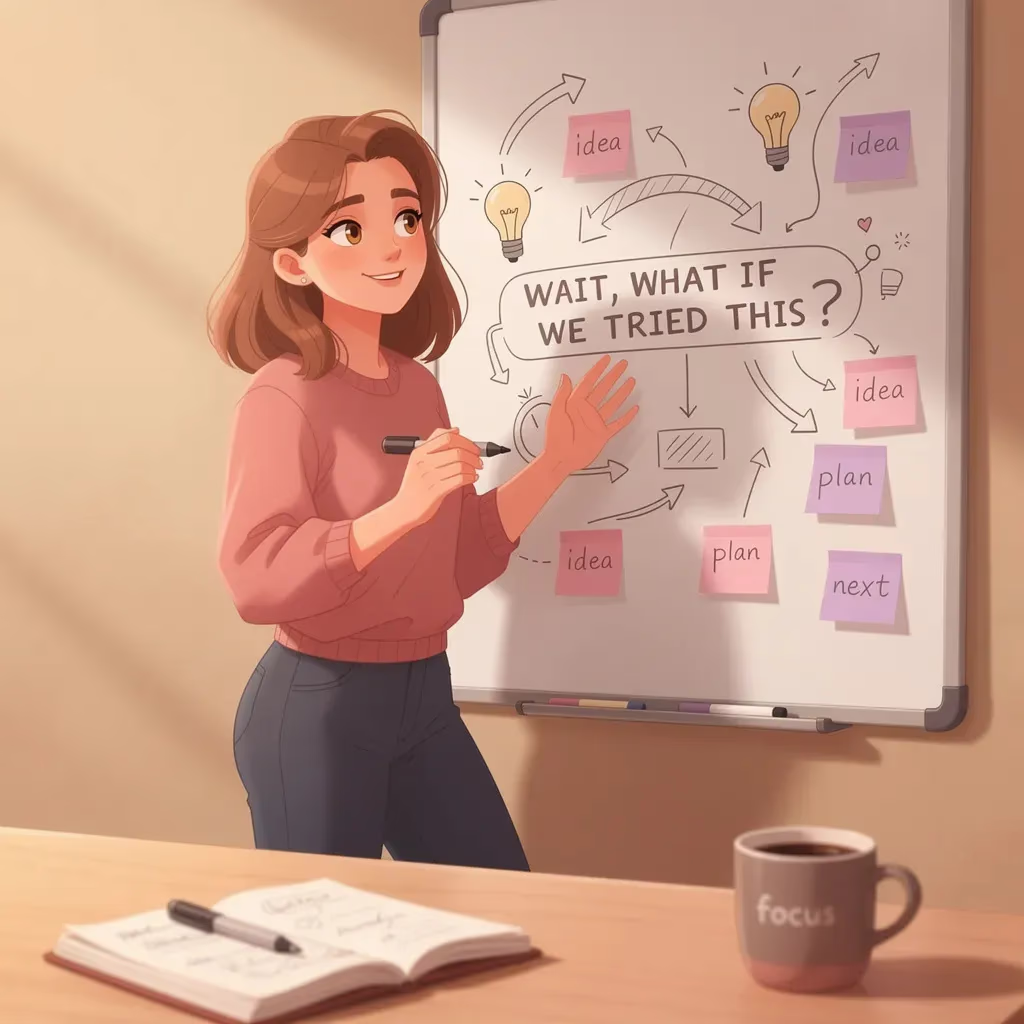
You know that moment when a meeting is dragging and your brain goes, "Wait. There's a better way"? You try to stay quiet because you don't want to seem like you're showing off. But the idea is already fully formed in your head.
If you've been Googling "what is my work style" because you cannot tell if you're brilliant or chaotic, Idea Bolt is that exact tension. You're not random. You're fast. There's a difference.
And when someone asks, "how would you describe your work style", you probably freeze because your style isn't one neat trait. It's a spark that jumps. It connects dots other people do not even see yet.
Idea Bolt Meaning
Core Understanding
Idea Bolt means your value shows up as innovation under real pressure. When work gets stuck, you do not just push harder. You change the angle. If you recognize yourself in that pattern, you've probably had people call you "creative" like it's a cute compliment... while also ignoring your ideas until someone else repeats them.
This pattern often develops when you learned early that being useful meant being quick. Many women with Idea Bolt energy figured out how to earn approval by being the one with solutions, the one who brings a fresh plan, the one who saves the day before anyone has time to panic. It makes sense. It worked.
Your body remembers it too. You might feel a buzz in your chest when a problem appears. Your hands move faster. Your thoughts race ahead. It can feel like electricity, exciting, and also exhausting when you cannot turn it off.
What Idea Bolt Looks Like
- Instant reframes: Your brain flips problems like a Rubik's cube until a new side clicks. People see "quick thinking," but inside it feels like a fast mental sprint. You might blurt the idea out, then immediately worry about your tone and replay it later.
- Starting strong, fading mid-way: The beginning is fireworks for you. The middle can feel like slow-motion sludge, especially when tasks get repetitive. Others might think you "lost interest," but you are actually craving movement and meaning.
- Creative problem-solving as safety: When there's tension or uncertainty, you reach for solutions. From the outside, it looks like leadership. Inside, it can be that old fear: "If I don't fix this, I'll be overlooked."
- Idea hoarding, quietly: You sometimes keep ideas to yourself because you've watched people dismiss you before. You act chill, but your stomach tightens when someone interrupts. Later you think, "I should have said it clearer."
- Pattern jumping: You connect two totally different things and make it make sense. People say "how did you even think of that?" and you shrug. In your head it was obvious because you see patterns everywhere.
- Sensitivity to stale systems: Processes that are slow or pointless make your skin crawl. You can do them, but you feel drained and slightly resentful. You might procrastinate, then suddenly sprint at the end.
- Energy spikes around brainstorming: Put you in a room with sticky notes and you light up. Your posture changes. Your eyes get sharper. You feel alive, like you finally belong.
- Fear of being "too much": You have learned to soften your brilliance so people stay comfortable. You might add too many disclaimers, like "this might be dumb." You are trying to protect connection, not confidence.
- You thrive in ambiguity: When the problem is unclear, you actually get curious. Others feel lost, you feel intrigued. You can tolerate the mess long enough to find a path through it.
- You love building from scratch: Blank pages are your playground. People might say you're "visionary." You just feel relief because you are not stuck inside someone else's box.
- You can struggle with follow-through: Not because you are lazy. Because execution can feel like being chained to one idea when your mind has ten. You might need support systems, not more self-judgment.
- You take feedback personally (even when you pretend you don't): If someone says your idea won't work, you might smile and nod, but your chest tightens. Later you replay it and wonder if you're annoying.
- You get bored fast, then feel guilty: You can feel excited, then suddenly flat. The guilt shows up as overworking or people-pleasing to "make up for it." You're trying to prove you're still valuable.
- You bring lightness to heavy rooms: You crack the joke, or you offer the playful angle that lowers tension. People feel better around you. You might not even notice you're doing it.
How Idea Bolt Shows Up in Different Areas of Life
- In romantic relationships: You can be intensely thoughtful and creative. Dates, gifts, plans, little surprises. If conflict shows up, you might go straight into "solution mode" to fix the vibe, even when what you really want is reassurance and a hug.
- In friendships: You're the friend with ideas: trips, projects, "let's do a themed dinner," "we should start a thing." You also might feel hurt if people do not match your energy, then you tell yourself you're being needy.
- At work: You shine in early stages, strategy sessions, product brainstorming, campaign concepts, new systems. You can struggle when you're handed endless revisions with no clear purpose. Meetings that go nowhere can make your shoulders creep up to your ears.
- Under stress: Your mind can go into overdrive. You might scroll, pace, or start three tasks at once. You can also spiral into "If I'm not impressive, I'm not safe," which makes you over-explain or over-deliver.
What Activates This Pattern
- Being ignored in a meeting, especially when you know your idea is solid.
- Someone repeating your idea and getting credit, and you smile while your stomach drops.
- Vague feedback like "tighten it up" that leaves you guessing what they want.
- Long, slow processes where you feel trapped in "busy work."
- A manager going silent after you send a big idea, and you start rereading your message.
- Being labeled "scattered" when you're actually high-speed and associative.
- Feeling like you have to be likable to be listened to.
The Path Toward More Grounded Confidence
- You don't have to change who you are: Your spark is valuable. Growth is learning to protect it with structure, not shame.
- Small shifts, not dramatic transformation: When you feel the urge to over-explain, try one clean sentence first. You can add detail later if needed.
- Support your follow-through: Pair with a Gold Star or build a simple "finish line" ritual so your ideas turn into proof.
- Claim credit without cringe: Practice one calm line: "That idea connects to what I shared last week." You deserve to be seen.
- What becomes possible: Women who understand their Idea Bolt style often feel lighter because they stop forcing themselves to be "consistent" in ways that kill their creativity.
Idea Bolt Celebrities
- Zendaya - Actress
- Florence Pugh - Actress
- Ayo Edebiri - Actress
- Quinta Brunson - Writer
- Emma Stone - Actress
- Issa Rae - Writer
- Hailee Steinfeld - Actress
- Kristen Bell - Actress
- Mindy Kaling - Writer
- Alicia Keys - Singer
- Drew Barrymore - Actress
- Brooke Shields - Actress
- Jennifer Connelly - Actress
- Jennifer Lawrence - Actress
Idea Bolt Compatibility
| Other type | Match | Why it feels like this |
|---|---|---|
| Team Glue | 🙂 Works well | You bring the sparks, they bring the steadiness, together you create safe momentum. |
| Gold Star | 😍 Dream team | You generate the ideas and they help turn them into finished proof without losing quality. |
| Crystal Ball | 😐 Mixed | You move fast while they want to think ahead, it works when you respect each other's pace. |
| Social Spark | 🙂 Works well | You create the concept, they help it travel through people and get traction. |
Am I a Team Glue Career Badge?

Every woman I know has had at least one week where she's basically the emotional support system of the entire team. You're answering Slack messages, smoothing misunderstandings, and gently fixing what other people dropped... while acting like it's no big deal.
If you're here because "what is my work style" feels hard to answer, it's probably because your work style is half-visible. It lives in the atmosphere you create, not just the tasks you finish.
Team Glue is also the answer to "how would you describe your work style" when what you actually do is hold people together. You make work feel safer. That is real value.
Team Glue Meaning
Core Understanding
Team Glue means your strength is connection that makes work possible. If you recognize yourself in this pattern, you are the one who senses tension before it explodes, notices who is quiet, and makes space so people can contribute. It's not "being sensitive." It's being tuned in.
This pattern often develops when you learned that harmony equals safety. Many women with Team Glue energy grew up practicing the skill of keeping things smooth, reading moods, anticipating reactions. At work, that becomes diplomacy, trust-building, and quiet leadership. It makes sense. It protected you.
Your body remembers the "keep everyone okay" job. When conflict shows up, you might feel your throat tighten, your shoulders lift, your stomach flutter. You start scanning. You start softening your voice. You try to fix the vibe.
What Team Glue Looks Like
- Reading the room constantly: You notice tiny shifts in tone that others miss. People see you as emotionally intelligent. Inside, you sometimes feel tired from carrying unspoken tension.
- Being the translator: You can take two people who are misunderstanding each other and rephrase it in a way that lands. It looks effortless. It can also feel like you are doing unpaid emotional labor.
- Making space for others: You ask the quiet person what they think. You pull someone in. People feel included around you. Later, you might realize you never asked for what you needed.
- The "I'll handle it" reflex: When something is messy, you jump in. Others see reliability. You might feel resentment creep in at 10pm while you're still fixing it.
- You prevent fires before anyone smells smoke: You spot misalignment early and correct gently. People say you are "easy to work with." You wish they would also say "thank you for saving us."
- Conflict feels like a threat to belonging: You do not fear disagreement because you're weak. You fear it because connection matters to you. Your chest can tighten when someone is annoyed.
- You soften your needs: You might ask for something like you're apologizing. "If it's not too much..." You are trying to stay lovable while being human.
- People confide in you: You become the safe person. Your calendar and your brain fill up with everyone's feelings. You smile, but you are quietly overloaded.
- You remember the details: Birthdays, preferences, small wins, who needs a nudge. People feel cared for. You might feel invisible because it's "just you being you."
- You build team culture: You create rituals, inside jokes, shared language. Others feel like a real team. You are literally building retention and performance, even if no one names it.
- You can over-function: If someone is struggling, you take it on. You call it teamwork. Sometimes it's people-pleasing in disguise.
- You avoid being "difficult": You swallow frustration to keep peace. Your body keeps score, though. You might get headaches or that tight jaw after a day of smiling through it.
- You do the emotional cleanup: After a tense meeting, you're the one checking in. You do it because you care. You also deserve someone checking in with you.
- You can be underestimated: Because you're kind, people assume you are not strategic. You are. You're just not loud about it.
How Team Glue Shows Up in Different Areas of Life
- In romantic relationships: You want closeness and harmony. If your partner's tone changes, your brain tries to fix it fast. You might over-apologize or over-explain because silence feels like danger.
- In friendships: You're the organizer, the listener, the one who holds everyone's secrets. You might feel lonely in a room full of people if nobody asks how you're doing for real.
- At work: You're the person teams depend on for smooth collaboration. You notice miscommunications early. You often take on coordination and support tasks that are essential, but not always rewarded.
- Under stress: You can fawn. You can become extra accommodating. You might say yes while your stomach says no. Then you crash later in private.
What Activates This Pattern
- Someone's tone shifts and you do not know why.
- Being left out of a decision when you've been doing the work behind it.
- Group conflict where everyone is tense and nobody is naming it.
- Passive-aggressive messages that require "decoding."
- A teammate struggling and you feel responsible for rescuing them.
- Being told you're "too nice" in a way that feels dismissive.
- Silence after you ask a question, and you start worrying you annoyed them.
The Path Toward Feeling Respected (Not Just Needed)
- You don't have to become colder to be respected: Your care is a strength. The shift is learning to attach a name and a boundary to that care.
- Small shifts, not dramatic transformation: Practice one sentence: "I can help with that, but I need X timeframe or Y support."
- Make the invisible visible: Start documenting your "team glue" outcomes (reduced rework, smoother handoffs, faster alignment). This is how you get credit.
- Let others hold some of it: You are allowed to let someone else sit in discomfort sometimes. Not everything is yours to fix.
- What becomes possible: Women who understand Team Glue often stop being the quiet work-mom and start being seen as a culture-builder and leader.
Team Glue Celebrities
- America Ferrera - Actress
- Octavia Spencer - Actress
- Viola Davis - Actress
- Regina King - Actress
- Rachel McAdams - Actress
- Emily Blunt - Actress
- Amy Poehler - Actress
- Tina Fey - Writer
- Kristen Wiig - Actress
- Alison Brie - Actress
- Jenna Fischer - Actress
- Constance Wu - Actress
- Meg Ryan - Actress
- Geena Davis - Actress
Team Glue Compatibility
| Other type | Match | Why it feels like this |
|---|---|---|
| Idea Bolt | 🙂 Works well | You make the space safe enough for their ideas to land without backlash. |
| Gold Star | 🙂 Works well | You support alignment, they support delivery, it becomes calm competence. |
| Crystal Ball | 😍 Dream team | You bring emotional clarity, they bring strategic clarity, and the team trusts both of you. |
| Social Spark | 😐 Mixed | It works when visibility does not turn into you carrying the emotional aftermath alone. |
Am I a Gold Star Career Badge?

Gold Star is for you if you keep being "the dependable one" and it's starting to feel like a trap. Like yes, you can deliver. But also... why do you always end up carrying more?
If "what is my work style" keeps bouncing around your head, it's probably because you are trying to explain a very specific thing: you do not just finish tasks. You finish them well.
And when someone asks, "how would you describe your work style", you might want to say, "I care." But you also worry that caring makes you look intense. Gold Star is caring, with results.
Gold Star Meaning
Core Understanding
Gold Star means your strength is execution with standards. If you recognize yourself in this pattern, you are the one who closes loops, catches details, and turns chaos into something finished. You build trust through outcomes.
This pattern often develops when you learned that praise comes from performance. Many women with Gold Star energy figured out early that being "good" got rewarded. So you became the one who does it right, does it on time, and does not make problems. It makes perfect sense. It kept you safe and valued.
Your body remembers that pressure too. Before a deadline, your chest might tighten, your jaw might clench, and you get laser-focused. Even when you're tired, you can push. The question is: at what cost?
What Gold Star Looks Like
- High standards, automatic: You notice mistakes like your eyes are trained for it. Others see reliability. Inside, it can feel like you cannot relax until it's perfect enough.
- You keep promises: When you say you'll do something, you mean it. People trust you. You can feel trapped by that trust when it becomes expectation.
- The "I'll just do it myself" thought: Delegating can feel risky. If someone else messes it up, you feel responsible. You might take it back quietly and stay late.
- You anticipate what "good" looks like: You can feel what's expected even when it's not written. People call you "proactive." Sometimes it's you trying to avoid criticism.
- You thrive with clear goals: Give you a target and you will hit it. Ambiguity can make you anxious because you want to deliver the right thing, not just a thing.
- You protect quality: You care about craft. People benefit from your attention to detail. You might feel unseen because your best work is quiet.
- You can overwork to feel secure: When approval feels shaky, you push harder. From the outside it's ambition. Inside it's "If I stop, will they still value me?"
- You worry about disappointing people: Even small feedback can sit in your stomach. You might replay it later while brushing your teeth. You want to be excellent and liked.
- You are the last line of defense: You catch errors before they reach the client. Everyone sleeps better because you exist. You also deserve rest.
- You can get irritated by sloppiness: It's not because you're mean. It's because you care about doing right by the team. You might go quiet when you're frustrated.
- You notice effort and feel responsible: If someone is trying, you want to help. Sometimes that becomes you doing their part too.
- You like being recognized: Not in a needy way. In a human way. When you get zero credit, it stings more than you admit.
- You can struggle to celebrate: You finish something, then immediately move to the next. Your body never gets the "we did it" moment.
- You take ownership seriously: If your name is on it, it matters. People see integrity. You might feel heavy responsibility.
How Gold Star Shows Up in Different Areas of Life
- In romantic relationships: You can be devoted and consistent. You show love through doing. If you're anxious about being abandoned, you might over-give, hoping reliability makes you un-leavable.
- In friendships: You're the one who shows up on time, remembers plans, brings the thing, handles logistics. You might feel hurt if people do not match your effort.
- At work: You are the go-to. You keep projects moving. Your growth edge is learning that being reliable does not mean being endlessly available.
- Under stress: You can become hyper-focused and controlling, not because you want power, but because you're trying to prevent mistakes. Your shoulders might live at your ears until it's done.
What Activates This Pattern
- Last-minute requests, especially when they treat your time like it's free.
- Ambiguous expectations, where you cannot tell what "good" is.
- Public criticism or sarcasm, even if it's "joking."
- A teammate missing deadlines, and you feel the fallout coming.
- Being compared, even subtly, to someone else.
- A performance review coming up, and you start collecting evidence like it's a trial.
- Hearing "can you just..." and realizing it's never "just."
The Path Toward Sustainable Excellence
- You don't have to lower your standards to protect yourself: The shift is learning to protect your time like you protect quality.
- Small shifts, not dramatic transformation: Practice saying, "I can do that by Friday, or I can do X by Wednesday. Which matters more?"
- Separate worth from output: Your work is not your lovability. You can be proud and still be human.
- Ask for credit in a calm way: "I'd love to share what I delivered and the impact." That is not arrogance. It's clarity.
- What becomes possible: Women who understand Gold Star often stop living in proving mode and start leading with steadiness, with room to breathe.
Gold Star Celebrities
- Simone Biles - Athlete
- Jessica Chastain - Actress
- Lupita Nyong'o - Actress
- Emma Thompson - Actress
- Sandra Oh - Actress
- Anne Hathaway - Actress
- Emily Deschanel - Actress
- Keira Knightley - Actress
- Michelle Yeoh - Actress
- Glenn Close - Actress
- Andie MacDowell - Actress
- Danai Gurira - Actress
- Taraji P. Henson - Actress
- Kerry Washington - Actress
Gold Star Compatibility
| Other type | Match | Why it feels like this |
|---|---|---|
| Idea Bolt | 😍 Dream team | Their ideas become real because you turn them into deliverables people can point to. |
| Team Glue | 🙂 Works well | They protect the people side while you protect the output side. |
| Crystal Ball | 🙂 Works well | Their planning reduces rework, your execution makes the plan visible. |
| Social Spark | 😐 Mixed | It works when visibility and networking do not become extra work you have to carry. |
Am I a Crystal Ball Career Badge?

Crystal Ball is for you if you keep noticing what everyone else is about to learn the hard way. You can feel a project going off-track before it does. You can see what the deadline is going to cost before anyone admits it.
If you're searching "what is my work style", Crystal Ball often means: your work style is thinking ahead so you don't have to panic later. It's not pessimism. It's pattern recognition.
And if the question is "how would you describe your work style", this is the type where you finally get to say, "I plan because I care." You don't do chaos well because you can see the consequences.
Crystal Ball Meaning
Core Understanding
Crystal Ball means your strength is strategy that reduces regret. If you recognize yourself in this pattern, you are the one who spots patterns, sets priorities, and thinks through the ripple effects before you commit. You make choices that hold up later.
This pattern often develops when you learned that surprises are not fun. Many women with Crystal Ball energy became careful because careful felt safe. So you learned to think ahead, anticipate questions, and create clarity. It helped you survive uncertainty and avoid being blamed.
Your body remembers the scanning. When something feels unclear, you might feel your chest tighten or your stomach drop. You start running scenarios in your head. You might go quiet, not because you're disengaged, but because you're processing.
What Crystal Ball Looks Like
- Future-mapping: Your brain automatically asks, "What happens next?" People see you as smart and grounded. Inside, it can feel like you cannot fully relax until you see the path.
- You see patterns fast: You notice trends in behavior, timelines, and team dynamics. Others might call you "intuitive." For you it's more like, "I have seen this movie before."
- You ask the questions nobody wants to ask: Risks, dependencies, trade-offs. You do it gently because you care about the team. You sometimes worry they'll think you're negative.
- You prefer clarity over hype: Big promises make you tense. You want specifics. You want definitions. You want the plan.
- You can overthink feedback: One vague comment can send you into a spiral: "Did I miss something?" People might see you as thorough. You might feel stuck in thought loops.
- You protect the big picture: You keep reminding everyone what matters. You can feel frustrated when people chase shiny distractions. Your body might feel tight when the team is scattered.
- You hate wasting effort: Rework feels painful because you saw it coming. You can get quiet-angry when nobody listened. Later you wonder if you should have spoken up harder.
- You are calm in real crises: Because you've rehearsed it. When something breaks, you move into problem-solving mode with a steady tone. People feel safer because you're not panicking.
- You can delay decisions: Not because you're indecisive, but because you want to choose well. If pressure is high, you might freeze for a moment, like your brain needs more data.
- You value systems: Checklists, plans, frameworks. It's not control for control's sake. It's protection from chaos.
- You can carry too much mental load: You keep track of everything. Everyone benefits. You go home and your brain is still running simulations while you stare at the ceiling.
- You care how things land: You think about impact. You think about people. You think about timing. You might rewrite a message five times so nobody misunderstands you.
- You are strategic about growth: You learn with intention. You want skills that compound. People might not realize how ambitious you are because you look calm.
- You can feel unseen: Because you prevented problems that never happened. There's no applause for the fire you quietly avoided.
How Crystal Ball Shows Up in Different Areas of Life
- In romantic relationships: You can be deeply loyal and thoughtful. If you're anxious, you might read silence as danger and start forecasting rejection. You want reassurance and clarity, not games.
- In friendships: You're the planner and the protector. You think about everyone's comfort. If someone cancels last minute, it can hit you harder than you admit because you already built the whole day in your head.
- At work: You excel in strategy, project planning, prioritization, and risk management. You might struggle when leadership is vague, because you end up filling in the blanks alone.
- Under stress: You can go into thought loops. You might get quiet, over-research, or over-prepare. Your body feels "on" even when you're sitting still.
What Activates This Pattern
- "Can we talk?" messages with no context.
- Vague expectations that force you to guess what will make them happy.
- Sudden changes with no explanation.
- Being rushed into a decision you can tell is not thought through.
- A leader who is inconsistent, so you're always bracing for surprises.
- Being blamed after the fact, especially when you tried to warn them.
- Unclear ownership, where you can see future conflict coming.
The Path Toward Trusting Yourself (Not Just Your Plans)
- You don't have to stop thinking ahead to be okay: The shift is letting your planning serve you, not imprison you.
- Small shifts, not dramatic transformation: When you're looping, ask, "What is the next smallest decision?" Not the whole future.
- Name your value out loud: "I reduce risk and create clarity." That is leadership language.
- Practice decisive moments: You can choose without 100% certainty. Your track record is stronger than your doubt voice says.
- What becomes possible: Women who understand Crystal Ball often feel 2% lighter because they stop treating every choice like a test of their worth.
Crystal Ball Celebrities
- Emma Watson - Actress
- Saoirse Ronan - Actress
- Rooney Mara - Actress
- Greta Gerwig - Director
- Rashida Jones - Actress
- Aubrey Plaza - Actress
- Keri Russell - Actress
- Rachel Weisz - Actress
- Naomi Watts - Actress
- Jodie Comer - Actress
- Danica McKellar - Actress
- Gillian Anderson - Actress
- Kyra Sedgwick - Actress
- Helena Bonham Carter - Actress
Crystal Ball Compatibility
| Other type | Match | Why it feels like this |
|---|---|---|
| Idea Bolt | 😐 Mixed | You want foresight, they want speed, it works when you plan enough to let them play. |
| Team Glue | 😍 Dream team | You create the plan, they create the trust, together you make change feel safe. |
| Gold Star | 🙂 Works well | Your strategy reduces rework, their execution turns your plan into visible wins. |
| Social Spark | 🙂 Works well | You build the roadmap, they build the relationships that get it adopted. |
Am I a Social Spark Career Badge?

Some people build careers through quiet mastery. Social Spark builds careers through relationships that actually matter. Not fake networking. Real connection.
If you've been wondering "what is my work style", and you keep landing on things like "people", "energy", "vibes", "I can talk to anyone"... Social Spark is that. You are not shallow. You are socially skilled.
And if someone asks "how would you describe your work style", Social Spark is the answer that lets you say, "I build trust fast, I connect people, and I create momentum." That's not fluff. That's impact.
Social Spark Meaning
Core Understanding
Social Spark means your strength is connection that creates opportunities. If you recognize yourself in this pattern, you naturally build relationships, read social dynamics, and help ideas travel through the human world. You make doors open, often by being the kind of person others want to work with.
This pattern often develops when you learned that connection is power. Many women with Social Spark energy got good at social cues early. You learned how to be warm, how to keep the vibe good, how to get people to relax. Sometimes that came from real joy. Sometimes it came from needing approval to feel safe.
Your body remembers the social scanning too. Before an event, you might feel butterflies, then flip into charm mode. After, you might crash. Your cheeks hurt from smiling. Your brain replays conversations to check if you said something weird.
What Social Spark Looks Like
- Natural introductions: You connect people like it's nothing. Others see charisma. Inside, it's often a genuine desire to make things easier for everyone.
- You build trust quickly: People open up to you fast. It's a gift. It can also turn into you holding more than you asked for.
- You can read status and tension: You sense who has influence, who's uncomfortable, who's being left out. You adjust the vibe to protect connection. It can feel like a mental job running in the background.
- Visibility comes easier (but not always safer): You can be seen. Sometimes that feels exciting. Sometimes it feels like performance pressure.
- You know how to make things happen: Need a collaboration? A warm intro? A quick yes? You can usually find a path. People think it's luck. It's your relationship skill.
- You are good in interviews: You can mirror energy and create rapport. You might still go home and overthink every sentence you said.
- You can struggle with boundaries: Because being liked feels good and safe. You might say yes too fast, then resent it later.
- You bring people together: You host, organize, invite, remember. People feel included around you. You might worry that if you stop doing this, you'll be forgotten.
- You can feel rejected easily: A slow reply can sting. Your chest tightens. You wonder if you did something wrong. It's not dramatic, it's your nervous system looking for safety.
- You influence without forcing: You persuade through warmth, stories, and connection. People lean toward your ideas because they trust you.
- You thrive in collaborative environments: Lone-wolf work can feel bleak. You do your best work when there's human energy around.
- You can feel underestimated: Some people assume social skills are "extra." You know they're the glue of real work.
- You learn people fast: You remember names, preferences, the little details that make someone feel seen. That is a real professional skill.
- You may hide your ambition: Because you don't want to look thirsty. But you do want to grow. You just want to grow with dignity.
How Social Spark Shows Up in Different Areas of Life
- In romantic relationships: You are warm, expressive, and connection-oriented. If you're anxious, you might chase reassurance when you feel distance. You want closeness that feels consistent, not confusing.
- In friendships: You're often the hub. You keep the group alive. You might feel lonely if no one else takes a turn holding the connection.
- At work: You excel in roles where relationships matter: partnerships, client work, community, recruiting, brand, leadership. You can struggle when work is purely behind-the-scenes and nobody sees your impact.
- Under stress: You might people-please harder. You might over-message. Or you might go quiet and spiral privately, replaying social moments.
What Activates This Pattern
- Being left on read, even at work, even if it's not personal.
- Walking into a room where you know nobody, and feeling your stomach flutter.
- A coworker acting cold and you do not know why.
- Group chats that shift tone, and you start decoding.
- Having to "sell yourself" and feeling gross about it.
- Feeling like you're only valued for vibes, not substance.
- Conflict, because you fear losing connection.
The Path Toward Being Seen Without Performing
- You don't have to be "on" to be valuable: Your warmth is real. Growth is letting it be a choice, not a requirement.
- Small shifts, not dramatic transformation: Practice pausing before saying yes. Even a five-minute pause can save your energy.
- Turn connection into strategy: Track the outcomes your relationships create (introductions, renewals, partnerships). This helps you claim your value.
- Build reciprocity: Let people show up for you too. You deserve it.
- What becomes possible: Women who understand Social Spark often feel calmer because they stop chasing approval and start choosing connection on purpose.
Social Spark Celebrities
- Selena Gomez - Singer
- Dua Lipa - Singer
- Hailey Bieber - Model
- Blake Lively - Actress
- Priyanka Chopra - Actress
- Taylor Tomlinson - Comedian
- Keke Palmer - Actress
- Gabrielle Union - Actress
- Tracee Ellis Ross - Actress
- Mila Kunis - Actress
- Jessica Alba - Actress
- Cameron Diaz - Actress
- Eva Longoria - Actress
- Katy Perry - Singer
Social Spark Compatibility
| Other type | Match | Why it feels like this |
|---|---|---|
| Idea Bolt | 🙂 Works well | You help their ideas find an audience and allies, so the spark turns into traction. |
| Team Glue | 😐 Mixed | Lots of connection energy, but you need clear boundaries so nobody over-carries. |
| Gold Star | 😐 Mixed | You move through people, they move through tasks, it works when you respect each other's priorities. |
| Crystal Ball | 🙂 Works well | They plan the path, you help the path get buy-in from real humans. |
If your career has started to feel like you're constantly trying to prove you belong, you're not alone. So many women Google what is my work style because they're exhausted from being misread. This quiz gives you a clear, memorable Career Badge so how would you describe your work style stops being a stressful performance and starts being a confident sentence.
Quick wins you'll get from your Career Badge result
- ✨ Discover what is my work style, without second-guessing every trait
- 🧭 Understand how would you describe your work style in interviews and reviews
- 🏆 Recognize your quirky career trophy and claim it with less over-explaining
- 🧩 Honor your strengths plus your people-pleasing patterns (without shame)
- 🤝 Connect your badge to real collaboration and visibility choices
- 🔥 Create a work story that feels true and strong
A gentle "why now" (without pressure)
You can keep doing what you've been doing: working hard, being kind, trying to be impressive and low-maintenance at the same time. You can keep hoping someone finally notices the pattern of what you bring. Or you can take five minutes and get the kind of clarity that makes your next conversation easier, the next project choice cleaner, and your self-trust a little louder. The best part is that this Career Badge is not only about the trophy. It's also about the hidden drivers behind it, like achievement drive, quality focus, collaboration style, networking energy, and that sneaky people-pleasing reflex that makes you disappear.
Join over 182,323 women who've taken this in under 5 minutes for private results. Your answers stay private, and your trophy is yours to claim.
FAQ
What is the "Career Badge: What's Your Quirky Career Trophy?" quiz?
The "Career Badge: What's Your Quirky Career Trophy?" quiz is a playful career personality quiz that helps you name the specific kind of value you bring at work, the thing people quietly rely on you for even when nobody says it out loud. It turns that into a "badge" or "trophy" because sometimes we need a symbol that makes our strengths feel real.
If you've ever had that spiraly thought of, "I'm doing a lot... but I can't explain what I'm good at," you're not alone. So many women are quietly competent, quietly helpful, quietly holding the whole group project together. Then performance review season hits and your brain goes blank. This quiz gives language to what's already true about you.
Here's what a quirky career trophy actually points to:
- Your default mode under pressure: Do you innovate, connect, stabilize, predict problems, or keep morale alive?
- The problem people bring to you: "Can you make this make sense?" "Can you talk to her?" "Can you catch what we're missing?" "Can you make it not awkward?"
- Your hidden work style: The part you do automatically, so you assume it "doesn't count."
- Your strengths and your stress patterns: Because your biggest gift is often also the place you overextend.
A lot of "career strengths finder" tools are either too corporate or too vague. This one is more like: "Oh. That's why I'm exhausted." It puts a spotlight on the work you do that isn't always visible, especially if you're the one smoothing tension, filling gaps, anticipating needs, or keeping things moving without making a scene.
And yes, it's fun. But it's not shallow. Naming your Career Badge helps you:
- advocate for yourself without feeling like you're bragging
- choose roles and teams that fit your wiring
- stop judging yourself for not being good at someone else's "thing"
- understand what kind of recognition actually lands for you
If you're curious, this is exactly what a good workplace personality test should do: help you feel seen and give you usable language.
What is my quirky career trophy (and why do I want to know)?
Your quirky career trophy is the clearest label for your "unpaid superpower" at work: the thing you do so naturally that you forget it's a skill. Knowing it matters because what you can name, you can protect. What you can't name, you tend to overgive.
If you're asking "What is my quirky career trophy?" there's usually a reason underneath it. It's often that weird mix of:
- you want to grow, but you don't know what direction fits
- you're tired of being the reliable one without credit
- you keep ending up in the same role on every team (organizer, fixer, peacekeeper, idea machine, mood-lifter)
- you're craving proof you're not "behind," you're just wired differently
So many women learn to measure their worth by usefulness. Then we pick jobs where we can be endlessly useful. Then we wonder why we're drained. Your Career Badge doesn't "box you in." It gives you a mirror.
Here's what knowing your trophy helps with in real life:
Choosing roles that don't punish your strengthsIf your trophy is connection-based, a cutthroat environment will feel like constant rejection. If your trophy is precision-based, chaos will feel like a personal attack.
Explaining your value without over-explainingYou shouldn't have to write a TED Talk to justify why your work matters. A clear badge gives you a sentence.
Getting better boundariesWhen you know your default contribution, you can see when it's becoming a reflex. Like: "I'm doing Team Glue again when I actually need to be off the clock."
Reducing comparisonComparison usually isn't about you being "not enough." It's about you comparing different trophies like they're the same sport.
If you've been Googling a "career trophy quiz" or "unique career traits quiz," you're probably looking for clarity and permission at the same time. Permission to stop performing someone else's definition of success. Clarity about what you actually offer.
That's what this quiz is for. It's not a diagnosis. It's a name for your real pattern.
How accurate is a quirky career trophy test or workplace personality test?
A quirky career trophy test is accurate in the ways that matter most when it gives you language for patterns you recognize, and it's less accurate when you treat it like a permanent identity stamp. The best "accuracy" is usefulness: does it help you understand your career strengths and make better choices?
If you're the kind of person who worries about getting it "wrong," that makes perfect sense. So many of us have spent years being evaluated, graded, reviewed, ranked. Of course you want the career personality quiz to be legit and not just a cute label.
Here's what makes a career strengths finder feel accurate (and actually helpful):
It asks about behavior, not fantasiesGood quizzes focus on what you do under pressure, in groups, and when stakes are real. Not "What would you do on a yacht in Italy?"
It reflects back a pattern you've livedYou read the result and think, "Wait. That is me. How did you know?" That's a sign it's capturing a stable tendency.
It includes both strengths and blind spotsIf a result is only flattering, it's entertainment. Real insight includes the cost, like over-functioning, perfection spirals, or emotional over-responsibility.
It leaves room for growthYou're a person, not a preset. The quiz should give you a "home base," not a cage.
Also, your result can shift a little depending on context. Someone who's usually confident might score more cautious during burnout. Someone who's naturally social might feel more withdrawn after a toxic team experience. That doesn't mean the test failed. It means your nervous system has been adapting.
A practical way to use your Career Badge result:
- Read it and highlight what feels immediately true.
- Circle what feels "too real," the parts you want to deny.
- Notice what you wish were different, that points to your growth edge.
This is why a "professional identity quiz" can be surprisingly grounding. It gives you a starting point for self-trust, especially if you tend to second-guess your own perception.
If you want a free, low-pressure way to explore it, the Quirky Career Trophy Quiz free format is perfect. You get insight without committing to a whole reinvention.
Why do I keep getting the same role on every team, even when it's not my job?
You keep getting the same role on every team because you're consistent, capable, and probably a little too good at noticing what needs to be done. Teams feel that. People lean on it. Then your "temporary help" quietly becomes your permanent unpaid job.
If you've ever thought, "How did I become the coordinator/therapist/fixer again?" you're in extremely real company. Every woman I know has had at least one season of doing invisible labor at work while trying not to seem "difficult."
Here's what's really happening beneath the surface:
You broadcast reliabilityEven if you don't mean to, your energy says: "I've got it." People relax and stop carrying their share.
Your nervous system prefers preventionIf you hate conflict, mess, or disappointment, you'll step in early to stop problems. It feels safer. It also makes you the default safety net.
Competence creates a magnet effectThe more you solve, the more problems find you. It's not fair, but it's common.
Roles become identityOnce you're "the organized one" or "the calm one," people expect that version of you. It can feel weirdly risky to change it.
This is where the idea of a Career Badge helps. When you can name your pattern, you can see it coming. You can also separate "I'm good at this" from "I'm responsible for this."
Practical signs you've been typecast at work:
- You're copied on everything "just in case"
- People bring you interpersonal tension to manage
- You're asked to "quickly" edit/fix/organize at the last minute
- You feel guilty when you don't step in, even if you're drowning
And the softer truth: if you have an anxious attachment streak (a lot of us do), the workplace can become another place where you try to earn safety through usefulness. Not because you're broken. Because that strategy worked somewhere earlier in life.
Knowing your quirky career trophy helps you interrupt that loop with language like:
- "This isn't actually mine to hold."
- "I can support, but I can't carry."
- "I'm happy to help if we can clarify ownership."
A career strengths finder won't fix team dynamics by itself. But it can give you the words to stop disappearing inside your role.
Can my Career Badge change over time, or am I stuck with one trophy?
Your Career Badge can change over time, but usually in a specific way: your core strengths stay recognizable, while your expression of them matures as you gain confidence, skills, and safer environments. You're not stuck. You're evolving.
If you're asking this, I'm guessing you've had at least one moment of, "I don't want to be the same person at work forever." That makes so much sense, especially in your 20s when you're trying roles on, shedding old versions of yourself, and figuring out what actually fits.
Here's the pattern most women experience:
Your default mode is stableUnder stress, you'll still tend to go to your home base (organize, connect, innovate, foresee risks, energize the room).
Your "range" expandsWith practice and healthier boundaries, you can access other strengths without abandoning your own.
Burnout can temporarily distort your badgeWhen you're exhausted, you might look like a different type because you're in survival mode. That's not your identity. That's your system trying to cope.
Your environment pulls different parts of you forwardThe same person can look totally different on a supportive team versus a chaotic one.
Think of it like this: your trophy is the shape of your talent. Your season of life determines how heavy it feels to carry it.
Practical examples of healthy change:
- Someone who used to over-give as "Team Glue" learns to delegate and becomes a calmer connector, not the emotional sponge.
- Someone who's "Idea Bolt" learns to finish and ship, not just brainstorm.
- Someone who's "Crystal Ball" learns to speak up earlier, instead of quietly worrying.
So yes, you can shift. The goal isn't to become a different person. The goal is to become a safer home for yourself while still using your gifts.
A "discover your career strengths" approach works best when you treat it like a snapshot: who you are right now, what you need right now, and what's trying to grow.
If you want a quick way to see your current pattern, a quirky career trophy test gives you that snapshot without making it feel like a life sentence.
How do I use my quirky career trophy to choose a job path (without overthinking myself into a spiral)?
You use your quirky career trophy to choose a job path by matching your strongest work instincts to the kind of problems a role asks you to solve, not by trying to find the "perfect" job title. It's a compass, not a contract.
And yes, the overthinking spiral is real. Especially if you're the kind of person who replays conversations, worries you're making the "wrong" choice, and secretly wants someone to hand you a permission slip that says, "This path makes sense for you." You're not alone. This is the quiet conversation happening everywhere.
Here's a simple way to apply your Career Badge in a grounded, practical way:
Match to work problems, not industriesInstead of "Should I go into marketing or HR?" ask:
- Do I like creating ideas, or refining systems?
- Do I like people-intensive problems, or project-based ones?
- Do I like fast change, or steady improvement?
Choose your preferred paceSome trophies thrive in rapid iteration. Others thrive in stability. Mis-matching pace is one of the fastest routes to burnout.
Look for your "energy profit," not just your skillSkills are what you can do. Energy profit is what leaves you feeling more like yourself afterward.
Design your boundary plan up frontThis matters because your trophy can become your trap. If you're amazing at helping, people will ask forever. If you're amazing at ideas, people will expect endless creative output. Plan for protection.
You can also use your result to craft interview questions that actually reveal fit, like:
- "How does the team handle handoffs and ownership?"
- "What does success look like in the first 90 days?"
- "How are priorities decided when everything feels urgent?"
That's what a good "professional identity quiz" ultimately gives you: language for fit. Not just vibes.
If you've been searching "discover your career strengths" or "career personality quiz," you're probably craving direction that feels personal. Your Career Badge helps you stop forcing yourself into careers that require you to perform against your nature.
Why do I feel guilty resting when I'm not being productive at work?
You feel guilty resting because somewhere along the way, your brain learned that being useful equals being safe, valued, or included. That guilt isn't a personality flaw. It's a pattern that formed for a reason, and it shows up in career life all the time.
If your stomach drops when you're not "doing enough," it makes perfect sense. So many women have been rewarded for being agreeable, helpful, and low-maintenance. Then we step into workplaces that quietly reinforce it: the fastest responders get praised, the most available person becomes "a rockstar," and burnout gets mistaken for dedication.
Here's how this connects to the whole Career Badge idea:
- Your quirky career trophy often reflects the way you earn belonging at work.
- The thing you're best at might be the thing you overuse to avoid feeling disposable.
- Rest can feel like risk, because your value has been tied to output or emotional labor.
Common ways this looks:
- You keep Slack on "just in case," even on days off
- You offer to help before anyone asks (and then resent it later)
- You feel anxious when a task is done, like you should find another one
- You downplay your workload because you don't want to seem "dramatic"
And underneath that is usually a tender belief: "If I'm not needed, I'll be forgotten." A lot of us carry that. You don't have to be ashamed of it.
Practical reframe that helps:
- Rest isn't a reward for finishing everything. It's maintenance for your brain and body, the same way charging your phone isn't "earned."
- Productivity is not a personality. It's a tool. You are allowed to exist without proving anything.
Where the quiz can help is giving you clarity on what drives your work reflex. A career strengths finder that names your trophy makes it easier to see the moment you're sliding from healthy contribution into over-functioning.
If you've been looking for a "unique career traits quiz" or a "career strengths finder," this is the kind of insight that actually changes how you treat yourself, not just how you perform.
What should I do after I get my result from the Career Badge quiz?
After you get your result from the Career Badge: What's Your Quirky Career Trophy? quiz, the best next step is to use it as a translation tool: translate your strengths into words you can advocate with, and translate your stress patterns into boundaries you can actually keep.
If you're the kind of person who reads a result and instantly wonders, "Okay but what do I do with this?" that's not you being intense. That's you wanting something real, not just a cute label.
Try this simple 3-part approach:
Name your "core contribution sentence"Write one sentence that describes your value in a way you could say out loud.Examples (make it yours):
- "I'm strongest when I'm turning chaos into a plan."
- "I'm strongest when I'm helping people align and communicate."
- "I'm strongest when I'm spotting risks early and preventing problems."
Identify your overuse warning signEvery trophy has a shadow side. Yours might be:
- taking on too much
- people-pleasing for approval
- perfectionism that slows you down
- overthinking decisions until you feel numb
- doing emotional labor for everyone
Pick one boundary that protects your giftNot a dramatic overhaul. One small protection. For example:
- "I can help for 20 minutes, then I'm back to my tasks."
- "I can't own this, but I can review it."
- "I need priorities in writing before I commit."
If you want to go one level deeper, use your result as a filter for opportunities:
- Does this role reward my trophy or exploit it?
- Does this team have structures that protect people from burnout?
- Do I feel calmer or more anxious after interacting with this manager?
This is how a "career trophy quiz" becomes practical. It helps you make decisions from self-trust instead of anxiety.
If you're curious to get your own badge and see what it reveals, the Quirky Career Trophy Quiz free format makes it easy to explore without pressure.
What's the Research?
Why a "Career Badge" feels so weirdly accurate
That "career badge" idea, the quirky little trophy that follows you from job to job, is basically personality + workplace behavior colliding in real time. Researchers who study how people act at work call this organizational behavior: it looks at how individuals and groups behave inside organizations, and how that shapes performance, satisfaction, and culture (Investopedia: Organizational Behavior, Wikipedia: Organizational behavior). That matters because your "badge" isn't just what you do. It's how you show up under pressure, in teams, in ambiguity, and in messy human moments.
Personality research backs this up. Across mainstream summaries, personality is described as relatively stable patterns in how we think, feel, and behave over time (OpenStax: What Is Personality?, Psychology Today: Personality). And one of the most-used frameworks is the Big Five traits (openness, conscientiousness, extraversion, agreeableness, neuroticism), which show up in how we work and relate to people, not just in how we "are" as a person (Simply Psychology: Big Five).
If you have ever felt like your coworkers get "rewarded" for things you do automatically, that's not in your head. It's your behavioral signature showing up.
This is why a "Career trophy quiz" can feel so on-the-nose. It isn't predicting your destiny. It's naming patterns you have probably been living with for years.
The five quirky trophies (and the science-y patterns underneath)
Your quirky career trophy is basically a label for the pattern you default to when work gets real. Think of these as five different ways people create value in groups, which organizational behavior research studies at the individual and team level (Wikipedia: Organizational behavior, Open Textbook Library: Organizational Behavior).
Idea BoltThis is the person who sparks options, connections, and new approaches. In Big Five language, this often overlaps with higher openness to experience (curiosity, novelty-seeking, abstract thinking) (Simply Psychology: Big Five). In workplace terms, it ties to creativity and innovation, which organizational behavior researchers track as key drivers of team and company performance (Scheller College of Business: Organizational Behavior).
Your brain making "too many ideas" isn't a flaw. It's a workplace asset that needs the right container.
Team GlueThis trophy is for the person who quietly keeps the social system from falling apart. Organizational behavior is very literal about this: work outcomes depend on how people interact within groups, not just what each person knows (Investopedia: Organizational Behavior). A lot of Team Glue energy lines up with agreeableness (cooperation, warmth, concern for others) and social attunement, which can improve teamwork and reduce friction (Psychology Today: Personality). It also overlaps with what OB folks call the importance of relationships and job content, a theme that traces back to the Hawthorne Effect era, where attention and social factors changed performance (Investopedia: Organizational Behavior, Wikipedia: Organizational behavior).
If you are always reading the room and smoothing tension, you're not "too much." You're doing invisible labor that holds outcomes together.
Gold StarThis is the reliability trophy: the one who delivers, checks details, and makes things actually finish. Research summaries consistently describe conscientiousness as the trait tied to organization, self-discipline, carefulness, and goal-directed behavior (Simply Psychology: Big Five). In organizational life, this often becomes the person who gets trusted with deadlines, quality control, and "I know she'll handle it."
But there's a tender catch for a lot of women: if you're anxiously attached or approval-sensitive, "Gold Star" can become less about excellence and more about safety. You keep producing because it reduces the chance of criticism or abandonment. Organizational behavior research talks about job attitudes and emotions as part of work life, including job satisfaction and emotional labor (Wikipedia: Organizational behavior). That emotional layer matters.
You can be high-performing and still be exhausted. Those two things often travel together.
Crystal BallThis trophy is the pattern-spotter: the person who anticipates risks, sees second-order effects, and can basically predict where the project is headed. This maps nicely to decision-making research in organizational behavior, including the idea that humans are not perfectly rational and often work with limited information (bounded rationality) (Wikipedia: Organizational behavior). Some Crystal Ball types are naturally strategic. Others became strategic because it felt safer to anticipate everything.
This is also where workplace anxiety can be misread. Sometimes your "overthinking" is actually high sensitivity to uncertainty, and your brain is doing threat-assessment. Personality research recognizes that traits like neuroticism are linked to emotional reactivity and stress sensitivity (Psychology Today: Personality). In small doses, it can be protective. In big doses, it can be draining.
Your sensitivity is data, not damage. It just needs boundaries so it doesn't run your whole life.
Social SparkThis trophy is the connector: the person who energizes, builds networks, and makes collaboration feel easier. This often aligns with extraversion, which relates to sociability and positive engagement with others (Psychology Today: Personality, Simply Psychology: Big Five). OB research also treats communication and group dynamics as core to workplace effectiveness (Open Textbook Library: Organizational Behavior).
Social Spark isn't just being "fun." It's being the person who makes information move faster, makes people feel included, and reduces friction across teams. That is real organizational value.
If you make people feel safe to speak, you are literally changing performance.
What work psychology says about "fit" (and why your trophy might shift)
One thing I want you to know, especially if you're the kind of person who panics about being "in the wrong career": your trophy is not a prison. It's a tendency that shows up more strongly depending on the environment.
Industrial-organizational psychology (I-O psychology) is basically the field that applies psychology to work so organizations can improve performance and well-being (Wikipedia: Industrial and organizational psychology, APA: Industrial and Organizational Psychology). That "well-being" part matters. You can be an Idea Bolt in one workplace and feel like a ghost in another, because the culture rewards different behaviors.
Even leadership assumptions can change what gets pulled out of you. Douglas McGregor's Theory X and Theory Y describes how managers who assume people are lazy/control-needing (Theory X) create different environments than managers who assume people are self-motivated and capable (Theory Y) (Grokipedia: Theory X and Theory Y). If you're a Team Glue or Gold Star in a Theory X environment, you might feel constantly monitored and quietly resentful. If you're an Idea Bolt or Social Spark in a Theory Y environment, you might finally breathe.
Sometimes you don't need a new personality. You need a workplace that stops punishing your strengths.
This is also why people can take a "Quirky career trophy test" and get a result that feels true, but still feel confused about what to do next. The badge names the pattern. The next step is learning the conditions where that pattern becomes power instead of pressure.
Why this matters (especially if you tie your worth to being needed)
If you're anything like so many women I know, you don't just want to be good at your job. You want to be safe in your job. You want to be liked. You want to not be the "difficult one." You want to stop replaying every Slack message like it was a breakup text.
Organizational behavior research explicitly includes job satisfaction, commitment, and emotional labor, meaning work is not emotionally neutral for humans, even if workplaces pretend it is (Wikipedia: Organizational behavior). When you understand your quirky career trophy, you can start separating "what I bring" from "what I over-carry."
So if you got:
- Team Glue, you might be carrying the emotional temperature of the room and calling it "teamwork."
- Gold Star, you might be earning approval through output and calling it "ambition."
- Crystal Ball, you might be scanning for danger and calling it "being responsible."
- Idea Bolt, you might be craving novelty and calling it "not being consistent."
- Social Spark, you might be performing connection and calling it "being easygoing."
You're allowed to want success that doesn't cost you your nervous system.
And here's the gentle bridge: while research shows these patterns broadly across how humans function at work, your report shows which specific trophy pattern you lean on most, what it protects you from, and what it might look like to use it without disappearing in the process.
References
Want to go a little deeper (in a non-boring way)? These are the sources I leaned on:
- Organizational Behavior (OB): What It Is and Why It Matters (Investopedia)
- Organizational behavior (Wikipedia)
- Organizational Behavior (Open Textbook Library)
- Organizational Behavior at Scheller College of Business (Georgia Tech)
- Industrial and organizational psychology (Wikipedia)
- Industrial and Organizational Psychology (APA)
- What Is Personality? (OpenStax Psychology 2e)
- Personality (Psychology Today)
- Big Five Personality Traits: The 5-Factor Model (Simply Psychology)
- Theory X and Theory Y (Grokipedia)
- What is Social and Personality Psychology? (SPSP)
- Organizational Behavior: A Brief Overview and Safety Orientation (PubMed)
Recommended reading (for when you want deeper clarity)
If you keep asking "what is my work style", it's usually because you're trying to make your strengths feel real, not imaginary. These books help you turn Career Badge insight into choices you can actually make.
General books (good for any Career Badge type)
- Design your life (Amazon, Bookshop.org, AbeBooks) by Bill Burnett, Dave Evans - A gentle, practical way to prototype career directions instead of treating your future like one high-stakes test.
- What Color Is Your Parachute? (Amazon, Bookshop.org, AbeBooks) by Richard N. Bolles - Turns self-knowledge into real options: skills, values, preferred environments, and how to explain what you bring.
- The Pathfinder (Amazon, Bookshop.org, AbeBooks) by Nicholas Lore - Great when you feel overwhelmed by options and want to find the themes that keep showing up in your life.
- Mindset (Amazon, Bookshop.org, AbeBooks) by Carol S. Dweck - Helps loosen the grip of "If I mess up, I'm done" thinking, so growth feels safer.
- Range (Amazon, Bookshop.org, AbeBooks) by David J. Epstein - A relief if your path feels non-linear. It reframes breadth as an advantage, not a flaw.
- The Confidence Code (Amazon, Bookshop.org, AbeBooks) by Katty Kay, Claire Shipman - Helps you build confidence as a behavior, especially in environments where women are rewarded for being agreeable.
- Atomic Habits (Amazon, Bookshop.org, AbeBooks) by James Clear - Turns insight into tiny actions that compound, which is how Career Badges become visible.
- Burnout (Amazon, Bookshop.org, AbeBooks) by Emily Nagoski, Amelia Nagoski - A non-shaming way to understand why you can be "fine" and still feel fried, especially if approval has been your fuel.
For Idea Bolt types (turn sparks into proof)
- Refuse to Choose! (Amazon, Bookshop.org, AbeBooks) by Barbara Sher - Permission and structure for multipassionate minds that feel "too many things."
- The renaissance soul (Amazon, Bookshop.org, AbeBooks) by Margaret Lobenstine - Helps you build a life structure that holds many interests without constant self-abandonment.
- Essentialism (Amazon, Bookshop.org, AbeBooks) by Greg McKeown - Helps you protect your best ideas by saying no to "good" distractions.
- Big Magic (Amazon, Bookshop.org, AbeBooks) by Elizabeth Gilbert - A friendly push to create without waiting for permission or perfect certainty.
- Finish (Amazon, Bookshop.org, AbeBooks) by Jon Acuff - Helps you complete projects without the perfection spiral.
- How to Keep House While Drowning (Amazon, Bookshop.org, AbeBooks) by KC Davis - Compassionate structure that protects your energy when your life gets messy.
For Team Glue types (stay kind without disappearing)
- Set Boundaries, Find Peace (Amazon, Bookshop.org, AbeBooks) by Nedra Glover Tawwab - Clear scripts for protecting your time and energy without turning cold.
- Book of Boundaries (Amazon, Bookshop.org, AbeBooks) by Melissa Urban - Ready-to-use words for the moment your brain goes blank.
- Codependent No More (Amazon, Bookshop.org, AbeBooks) by Melody Beattie - Helps untangle "being valuable" from "being endlessly available."
- The assertiveness workbook (Amazon, Bookshop.org, AbeBooks) by Randy J. Paterson - Builds micro-skills for asking, saying no, and handling pushback.
- Crucial Conversations (Amazon, Bookshop.org, AbeBooks) by Kerry Patterson, Joseph Grenny, Ron McMillan, Al Switzler, Stephen R. Covey - Helps you stay connected while still being honest and direct.
- Emotional Labor (Amazon, Bookshop.org, AbeBooks) by Rose Hackman - Helps you name the invisible work so you can negotiate it, share it, or step away from it.
- Attached (Amazon, Bookshop.org, AbeBooks) by Amir Levine - Useful for understanding approval-scanning and over-explaining patterns that can show up with managers and teams.
For Gold Star types (keep standards without burning out)
- The Gifts of Imperfection (Amazon, Bookshop.org, AbeBooks) by Brene Brown - Permission to stop performing and still be respected.
- Set Boundaries, Find Peace (Amazon, Bookshop.org, AbeBooks) by Nedra Glover Tawwab - Keeps reliability from turning into resentment.
- Present Over Perfect (Amazon, Bookshop.org, AbeBooks) by Shauna Niequist - A reset if you're living in proving mode.
- Dare to lead (Amazon, Bookshop.org, AbeBooks) by Brene Brown - Helps you lead with courage instead of constant perfection.
- Attached (Amazon, Bookshop.org, AbeBooks) by Amir Levine - Helps you spot when overperforming is really you chasing safety.
For Crystal Ball types (stop living in constant forecasting)
- The organized mind (Amazon, Bookshop.org, AbeBooks) by Daniel J. Levitin - Supports external systems so your brain doesn't have to hold everything.
- Chatter (Amazon, Bookshop.org, AbeBooks) by Ethan Kross - Helps with thought loops and 3am ceiling-staring.
- Set Boundaries, Find Peace (Amazon, Bookshop.org, AbeBooks) by Nedra Glover Tawwab - Reduces over-preparing and over-managing other people's reactions.
- The Mountain Is You (Amazon, Bookshop.org, AbeBooks) by Brianna Wiest - Helps you see how fear and self-protection show up as waiting for perfect clarity.
- Self-Compassion (Amazon, Bookshop.org, AbeBooks) by Kristin Neff - A steadier way to treat yourself than constant self-critique.
- Attached (Amazon, Bookshop.org, AbeBooks) by Amir Levine - Helps separate "work silence" from "I did something wrong" spirals.
For Social Spark types (keep connection, protect your peace)
- Set Boundaries, Find Peace (Amazon, Bookshop.org, AbeBooks) by Nedra Glover Tawwab - Helps you stop being everyone's access point without losing your warmth.
- The Joy of Being Selfish (Amazon, Bookshop.org, AbeBooks) by Michelle Elman - A guilt antidote for choosing yourself.
- Crucial Conversations (Amazon, Bookshop.org, AbeBooks) by Kerry Patterson, Joseph Grenny, Ron McMillan, Al Switzler, Stephen R. Covey - Tools for honesty that protects the relationship.
- The like switch (Amazon, Bookshop.org, AbeBooks) by John R. Schafer - Concrete trust-building behaviors without over-giving.
- How to Talk to Anyone (Amazon, Bookshop.org, AbeBooks) by Leil Lowndes - Useful scripts for interviews, networking, and work events when anxiety makes you go blank.
P.S.
If you're still stuck on "how would you describe your work style", your Career Badge is the shortcut to a clean, confident answer. You deserve to feel seen at work.