A gentle truth check for your heart

Relationship Insight: Are You In Love Or Holding Your Breath For Them?

Relationship Insight: Are You In Love Or Holding Your Breath For Them?
If your whole mood changes with one text, this might finally give you the clarity you've been craving, without shaming you for caring so much.
Relationship Insight: Am I in love or in a dependency?

That moment when you're waiting for their reply and your chest gets tight, like your whole day is hanging on a tiny typing bubble... yeah. This is for that.
This Relationship Insight quiz is built to answer the question you're already Googling at 1am: "am I in love" or am I attached to relief? It is a gentle mirror that helps you separate grounded love (calm + mutual + safe) from a dependency loop (panic + over-giving + waiting).
And yes, it can still be love even if it also feels messy. Feelings can be real. The pattern can still be hurting you.
Here are the two results this quiz looks at:
In Love: Your connection feels more like steady warmth than a roller coaster.
- Key signs:
- You can be close without disappearing
- Hard moments have repair, not punishment
- You feel chosen without performing
- Why it helps: You get language for what is working, so you can protect it and not accidentally slide into "I do all the emotional labor" mode.
- Key signs:
In Dependency: You might love them, but your body is treating them like oxygen.
- Key signs:
- A text decides your mood
- You shrink needs to keep peace
- Relief hits hard, then fades fast
- Why it helps: You get clarity on the loop, so you can stop asking "am I codependent" in a panic and start understanding what would actually make you feel safe.
- Key signs:
If you're here because you've taken an "am I in love quiz" before and it felt too fluffy, you're not alone. This one is different because it doesn't only ask how you "feel." It tracks what happens in real life: the checking, the apologizing, the spiraling, the over-explaining.
It also goes deeper than most quizzes with extra insight into things like:
- fear of abandonment (that stomach-drop dread)
- fear of being alone (staying because silence feels unbearable)
- respect and consistency (do you feel handled with care, daily?)
- emotional regulation (can you calm without outsourcing it?)
- relief addiction (the high/low loop)
- rumination (the 3am replay)
- self-trust (can you believe your own read of reality?)
If you've ever typed "am I codependent quiz" or "what is co dependent relationship", this page is your soft landing. Also: Relationship Insight quiz free is right here on the page.
One more thing, because it matters: if you've been searching "why am I codependent", you are not alone. So many women are. It's the quiet conversation happening everywhere, mostly in group chats and bathroom mirrors.
6 ways this quiz can change how love feels in your body (and your life)

- 🌿 Discover whether you're actually safe or just temporarily reassured, the difference that makes an "am I in love" question finally feel answerable.
- 💬 Understand why you keep searching "why am I codependent", and why that question is often about old survival, not you being "too much."
- 🧭 Recognize the reassurance loop behind the classic "am I codependent" spiral, especially when texting patterns mess with your mood.
- 🤍 Honor your needs without apologizing for them, which quietly changes everything in relationships (and yes, this matters if you keep taking an "am I in love quiz" hoping for peace).
- 🔥 Spot imbalance and emotional labor early, so you stop confusing intensity for commitment in the first place.
- ✨ Rebuild self-trust, so you do not have to keep taking an "am I codependent quiz" every time someone gets distant.
Karen's Story: The Night I Stopped Calling Anxiety "Love"

The worst part wasn't even that he hadn't texted back. It was the way my whole body went on alert like something terrible was happening, like I'd been dropped into cold water. I remember standing in front of my bathroom mirror, mascara wand hovering mid-air, whispering, "Don't be crazy. Don't be crazy. Don't be crazy," like I could shame my nervous system into behaving.
I'm Karen, 33, and I work as a volunteer coordinator. I'm basically a professional "It's okay, I'll figure it out." I keep track of who needs rides, who needs reminders, who needs extra encouragement, who needs a soft landing. It's a job that rewards the part of me that can feel a room shift before anyone says a word.
It also means I can spend an entire day taking care of everybody and still come home and feel absolutely hollow if one person doesn't choose me back in the exact way I needed.
I had this habit that made me feel a little embarrassed, even to myself: I reread my texts before I send them. Not once. Like... six times. Editing them down until they're "easy." Pleasant. Non-demanding. A version of me that won't scare someone off. Then I'd hit send and hold my breath, staring at my phone like it was going to decide if I was lovable.
The pattern was sneaky because it looked like romance from the outside.
I was always the one who could "handle" uncertainty. I played it cool. I said I was flexible. I told friends, "It's fine, we're just keeping it casual," with a smile that almost convinced me. Meanwhile, I was doing emotional math at 2 a.m., replaying every sentence he'd said that week, searching for proof that I mattered.
The highs were dizzying. If he texted something sweet, my whole day brightened like someone turned the lights on. If he went quiet, it felt like my brain started sprinting in place. I would check my phone in the elevator at work. I'd check it in the supply closet. I'd check it while washing dishes. Then I'd hate myself for checking it, because I thought wanting reassurance meant I was weak.
But the weirdest part was this: even when I felt miserable, I felt attached. Like I couldn't let go. Like if I just did it "better," if I was more chill, more fun, more understanding, he'd finally relax into choosing me.
One afternoon at lunch, my coworker Sarah, 29, was telling me about something totally unrelated. We were eating sad desk salads in the break room, the kind that taste like obligation. I must have looked distracted, because she stopped mid-sentence and went, "Okay. You keep checking your phone like it's a heart monitor."
I laughed, but it came out thin.
She didn't push, which I appreciated. She just said, kind of casually, "I took this quiz last week. It's about figuring out if what you're feeling is love or more like... dependency. It was annoyingly accurate."
Something in my chest tightened at the word dependency. Not because I thought she was accusing me. More like my body recognized it before my pride could argue.
That night, I took the quiz on my couch with my phone brightness turned down, like I was doing something private and slightly embarrassing. I expected fluff. I expected the internet version of a horoscope.
Instead, the questions kept landing in these uncomfortably specific places.
It asked about how I feel when there's distance. About whether I confuse intensity with intimacy. About whether the relationship gives me a sense of self, or costs me my sense of self. I remember staring at one question and realizing my throat was tight. Not crying yet, just... braced.
The results put words to something I've been circling for years.
It basically drew a line between "In Love" and "In Dependency," and what messed me up (in a good way) was how simple the difference sounded when it was written out.
"In Love" wasn't described as constant calm. It wasn't this perfect, unbothered state. It was more like: you still have a self when they're not there. You can miss them without unraveling. You feel closer to your own values, not farther from them.
"In Dependency" wasn't "you're pathetic" (which is what my shame voice wanted to hear). It was more like: you're using the relationship to regulate your anxiety. Their attention becomes your oxygen. The uncertainty becomes the whole story. You start negotiating with yourself. You trade dignity for closeness and call it devotion.
I sat there with my tea going cold and thought, Oh.
So that's why it never feels like enough.
I didn't end things immediately. I didn't have some cinematic moment where I deleted his number and became a new person. I wish. Real life was messier.
What shifted first was smaller and honestly kind of awkward. I started catching the moment right before I reached for my phone. That micro-second where my mind would go, Fix it. Make contact. Get reassurance.
And instead of doing it instantly, I started delaying it.
Not in a cute, strategic "don't text back for three hours" way. More like, "Can I survive ten minutes without begging for a sign I'm safe?" I would literally set my phone facedown and walk to the kitchen and refill my water. Sometimes I'd stand there like an idiot, hand on the counter, feeling my heart thump too hard for such a normal moment.
The first time I didn't text him when I felt the panic rise, I felt proud for about twelve seconds. Then the fear came roaring in: What if he forgets about me? What if this is the moment I lose him?
Which, obviously, is dramatic. But it was real in my body.
I started writing things down in my notes app, not like a journaling goddess, but like a panicked person trying to make sense of herself:
- "He hasn't replied. I'm telling myself that means I'm annoying."
- "I want to apologize. I don't know what for."
- "I'm tempted to send a meme to make him like me again."
Seeing it on the screen made it harder to romanticize. It wasn't "I'm such a caring girlfriend." It was "I'm trying to manage his feelings so I don't have to feel my own."
A week later, he canceled plans last minute. Normally I would have smoothed it over so fast it would have been like it never happened. I'd say, "No worries!!" with two exclamation points, then spend the night staring at my ceiling pretending I didn't care.
This time I felt my hands start shaking as I typed. I hated that. I hated that a simple text could make me feel so powerless.
So I did the new thing. I waited.
Ten minutes turned into twenty. My chest still felt tight, but it also felt like I was standing next to myself instead of abandoning myself.
When I finally responded, I wrote, "Okay. I'm disappointed, though. I was looking forward to seeing you."
No exclamation points. No apology for having a feeling.
He replied, "Oh. Sorry. Yeah, work is crazy."
And I had this moment of clarity that wasn't even about him. It was about me. Because my old self would have sprinted to reassure him that he was still a good person and I wasn't mad and everything was fine and I was the easiest person in the world to date.
Instead, I just let it be what it was. Disappointing.
We rescheduled. He showed up. He was sweet in his way. But I noticed something that used to get drowned out by my anxiety: I didn't actually feel that cared for. Not consistently. Not in the ways that mattered to me.
That was a hard thing to admit because it meant the problem wasn't just my "overthinking." It meant I had been working overtime to make a half-relationship feel whole.
A month after the quiz, I met Sarah for coffee after work. She asked how things were going, and I surprised myself by telling the truth without making it a joke.
"I think I've been calling the adrenaline love," I said, stirring my drink way too aggressively. "Like, if I'm not anxious, I assume it means I don't care."
Sarah nodded like she'd been waiting for me to say that. "Yeah. That feeling is... familiar."
I didn't suddenly become someone who never spirals. I still have nights where I want to send a "Are we okay?" text even though nothing happened. I still feel that old urge to shape-shift into whoever feels easiest to keep.
But now, when I feel that urge, I can name it. Not perfectly, but enough to pause.
Sometimes I even ask myself a question that feels embarrassingly basic: "If this is love, where am I in it?" Not where is he. Not what does he want. Where am I.
I'm still sorting out what I want to do with this relationship, and I'm not saying that like some empowered movie character. I mean I'm genuinely still figuring it out. But I don't feel as hypnotized by the uncertainty anymore.
The quiz didn't fix me. It just gave me the language to stop mistaking dependence for devotion. And weirdly, that has made me feel more tender toward myself, even on the days I still check my phone too much.
- Karen T.,
All About Each Relationship Insight type
| Result Type | Common names and phrases you might relate to |
|---|---|
| In Love | calm love, steady connection, mutual effort, safe to be honest, chosen without chasing |
| In Dependency | relief chasing, breadcrumb anxiety, walking on eggshells, over-texting then regretting it, losing myself in love |
The deeper clarity most quizzes miss (and why you keep second-guessing yourself)
You know when you say you're "fine" but your body is not fine? Your stomach is tight. Your chest feels buzzy. Your brain is rehearsing conversations like it's studying for an exam. And you're still asking yourself "am I in love", even though you want the answer to feel simple.
Of course you do. When love has ever felt unpredictable, your system starts treating closeness like something you have to maintain. Not because you're dramatic. Because you're attached. Because you care. Because you've learned that distance can mean danger.
This is why a lot of "quick" quizzes leave you feeling worse. They ask about feelings in a vacuum. But real life is not a vacuum. Real life is that moment your phone lights up and you freeze. Real life is the silence after a hard conversation. Real life is the way you shrink your needs so you don't risk losing the connection.
So this page does something different. It doesn't label you. It doesn't diagnose you. It gives you relationship insight you can actually use.
Why so many women search "am I codependent" (and feel ashamed for even asking)
When you type "am I codependent" into Google, you're not looking for a label to wear forever. You're looking for relief.
You're looking for someone to say, "You're not crazy. This is a pattern. It makes sense."
Women who Google "am I codependent quiz" are usually dealing with one of these:
- They're in a connection that feels hot-and-cold, and their body is tired of guessing.
- They're doing too much emotional work, but calling it "being a good girlfriend."
- They're stuck in the loop of: panic - reach for reassurance - temporary relief - panic again.
- They feel guilty for wanting consistency, so they try to want less instead.
If you've been wondering "why am I codependent", the answer is usually not "because you're needy." It's usually: you learned that closeness had to be earned, tracked, managed, or performed for.
That is not a personality flaw. It's a love strategy you picked up when you were doing your best.
What this Relationship Insight quiz reveals about you
This is the part that tends to feel weirdly accurate, because it's based on the moments you actually live.
Below are the dimensions we measure. They show whether your connection leans toward In Love (steady, mutual, safe) or In Dependency (relief chasing, self-shrinking, safety uncertainty).
- Anxiety activation (how fast your body panics): That instant stomach-drop when their tone changes. The urge to fix it right now, even if you don't know what's wrong.
- Reassurance seeking (how much you need proof to feel okay): The checking loop. The "if I can just get one sweet text, I can breathe again" feeling. This is why "am I codependent quiz" searches happen at night.
- Self-abandonment (how often you swallow your truth): You say "it's fine" while your throat feels tight. You keep the peace and pay for it later.
- Identity fusion (how much you lose your shape): Your mood becomes their mood. Your plans bend around them. You stop wearing certain outfits or saying certain things because you don't want to risk distance.
- Mutuality (whether love is actually shared): Who initiates? Who repairs? Who holds the emotional weight? Love feels lighter when the effort is mutual.
- Emotional safety (how safe it is to be honest): Can you say "that hurt" without them punishing you with silence or turning it into your fault?
- External self-worth (how much your confidence depends on being chosen): When they pick you, you feel steady. When they pull away, you question your entire value. This is a huge driver of "am I in love or am I dependent?" confusion.
And because love vs dependency isn't only about you, we also look at the extra layers most quizzes ignore:
- Fear of abandonment (the dread before): The part of you that goes into emergency mode when distance shows up.
- Fear of being alone (staying because leaving feels like free-fall): The reason you might tolerate things you wouldn't recommend to your best friend.
- Respect level (day-to-day care): Not grand gestures. The small moments. The tone. The way they handle your feelings.
- Consistency (predictability over time): The difference between love you can trust and love you have to chase.
- Emotional regulation (can you settle without outsourcing it?): Not "never need support." More like, "can I come back to myself even when I'm scared?"
- Relief addiction (the high/low loop): The rush after reassurance, then the crash. That cycle can feel like love, but it's often the nervous system chasing safety.
- Rumination (the replay): 3am ceiling-staring. Re-reading texts. Rebuilding conversations you already had.
- Self-trust (believing your own read of reality): The skill of hearing your gut and not bargaining with it.
If you've ever asked "what is co dependent relationship", this is the lived answer: it is when your relationship becomes the place you go to feel okay, and you start paying with your needs, your voice, your sleep, and your sense of self.
Where you'll see this play out (even if you think it's "only about dating")
In romantic relationships:
This is the obvious one. It shows up in texting, closeness, fights, and that sharp fear when something feels "off." If you're constantly asking "am I in love", it's often because the relationship doesn't feel steady enough to relax into. If you're asking "am I in love quiz" questions over and over, it's usually because your body wants proof, not because you're silly.
In friendships:
You might be the friend who always checks in first. The one who remembers birthdays, sends the long supportive texts, and shows up when people fall apart. Then you go home and realize nobody really asks how you're doing. That imbalance can train you to think love means over-giving.
At work or school:
That same "did I do something wrong?" feeling can show up after a short email from a boss or professor. Your brain starts narrating worst-case stories. You write the extra paragraph. You try to be perfect so you can't be rejected.
In daily decisions:
Even tiny choices can feel loaded when you're scanning for safety. Picking a restaurant. Posting a photo. Saying no to plans. You might hear a voice that says, "If you do the wrong thing, they will leave." That voice is the same one behind "why am I codependent" searches.
What most people get wrong (so they stay stuck)
Myths keep you trapped. Not because you're naive. Because myths sound like comfort.
- Myth: If I'm anxious, it isn't love. Reality: You can love someone and still be in a dependency loop.
- Myth: If I were prettier/cooler, I wouldn't feel this. Reality: Your body reacts to inconsistency and uncertainty, not your worth.
- Myth: Needing reassurance means I'm broken. Reality: It often means you've been trained to earn love.
- Myth: "What is co dependent relationship" only applies to extreme situations. Reality: It can look very normal: you being "supportive" while quietly disappearing.
- Myth: If I communicate perfectly, I'll feel safe. Reality: Perfect words don't create safety. Consistency does.
- Myth: Taking an "am I codependent quiz" means I'm the problem. Reality: The quiz is a mirror. It helps you see the pattern so you can stop carrying it alone.
If you're stuck between "am I codependent" and "am I in love", this quiz helps you stop guessing and start seeing the pattern.
Am I In Love?

If you're landing in the "In Love" range, it doesn't mean your relationship is perfect. It means something important is true: your connection gives you more steadiness than stress.
You might still have anxious moments. A lot of women who get "In Love" still have that quick internal flinch sometimes, especially if they've been through hot-and-cold love before. The difference is, the relationship doesn't feed the flinch. It helps settle it.
If you've been taking an "am I in love quiz" hoping someone will tell you it's real, this result is the closest thing to that answer. Not because "love is guaranteed," but because the pattern shows: mutual effort, emotional safety, and you staying you.
In Love Meaning
Core Understanding
In Love, in this quiz, means your bond feels like expansion, not like shrinking. You can miss them without spiraling. You can disagree without fearing you'll be punished with distance.
If you recognize yourself here, it usually shows up as this quiet baseline: you don't have to perform to be chosen. You might still get nervous, but you can come back to yourself. Your body isn't constantly bracing for the next shift.
This pattern often develops when you've had at least some experiences (with friends, family, a past partner, even a teacher or mentor) where love wasn't a test. It taught you, slowly, that closeness can be steady. A lot of women build this through one safe relationship after a few painful ones. It isn't luck. It's learning.
Your body remembers the difference. In grounded love, your shoulders drop more often. Your breath isn't trapped in your chest. You feel warm in your face when they reach for you. You don't feel like you have to earn the next moment.
What In Love Looks Like
- Calm after conflict: Even when you fight, you don't feel abandoned. You might cry or get shaky, but repair actually happens, and you can feel it in your body when it lands.
- You can ask directly: You don't have to hint, twist, or over-explain. You say "I need more contact this week" and you don't feel like you committed a crime.
- Your needs don't trigger punishment: When you bring up something tender, they don't mock it or go cold. You might still fear that, but their behavior doesn't confirm the fear.
- Reassurance is a bonus, not oxygen: Their sweet texts feel good, but you can still function without them. You don't lose your entire day to the phone.
- You stay connected to your own life: You keep friends, hobbies, and plans. You miss them, but you don't vanish into them.
- Mutual effort feels obvious: You don't have to calculate who is doing more. The effort isn't perfectly equal, but it's clearly two people trying.
- You feel respected in small moments: It's not only the big "I love you." It's how they speak to you on a random Tuesday when they're tired.
- You feel safe being imperfect: You can be cranky, anxious, messy, or quiet. You don't feel like you'll be replaced for having a human moment.
- You don't have to chase clarity: If something is off, you talk. You don't spend three days decoding tone, because clarity is available.
- Space doesn't feel like danger: When they need alone time, you might miss them, but you don't feel like you are being erased.
- Affection isn't used as a reward: You don't get love only when you behave correctly. You get love because you're loved.
- You can say no without panic: Boundaries don't threaten the relationship. You don't have to write a novel to justify your "no."
- You trust your read of reality: You still care what they think, but you don't abandon your own truth just to keep the mood good.
- Your body feels more settled than activated: You can notice it physically: less jaw clenching, less 3am ceiling-staring, more appetite, more sleep.
How In Love Shows Up in Different Areas of Life
In romantic relationships:
You can feel close and still breathe. You don't need to keep proving your value. If you're asking "am I in love", you might be asking it because you're finally experiencing something steadier than the past, and it's new.
In friendships:
You show up with warmth, but you also let other people show up for you. You don't only play the role of "the strong one." Your friendships feel like a two-way street.
At work:
You collaborate without over-functioning. You can hear feedback without instantly translating it as rejection. You're still sensitive, but it doesn't run your life.
Under stress:
You may still get triggered. But you tend to come back quicker. You reach for healthy support instead of spiraling into "tell me you still love me" panic.
What Activates This Pattern
Even in grounded love, triggers can show up:
- When they are unusually quiet and you don't know why
- When conflict goes unresolved overnight
- When you are already stressed and your emotional bandwidth is low
- When someone calls you "needy" or "too much"
- When you see a past pattern repeat (even slightly)
- When you're comparing your relationship to other people's highlight reels
The Path Toward Even More Grounded Love
- You don't have to shrink to keep love: Your care is a gift. Your growth edge is letting your needs be part of the relationship too.
- Small repairs matter more than big speeches: When repair is normal, your body stops scanning for danger.
- Keep a little you that is yours: One friend hangout, one hobby, one solo ritual. It protects love from turning into dependency.
- Women who understand this result often find: they stop needing an "am I in love quiz" for reassurance, because their body starts trusting the relationship's consistency.
In Love Celebrities
- Zendaya (Actress)
- Florence Pugh (Actress)
- Hailey Bieber (Model)
- Millie Bobby Brown (Actress)
- Dua Lipa (Musician)
- Jennifer Aniston (Actress)
- Anne Hathaway (Actress)
- Keira Knightley (Actress)
- Blake Lively (Actress)
- Emily Blunt (Actress)
- John Krasinski (Actor)
- Chris Evans (Actor)
- Reese Witherspoon (Actress)
- Sandra Bullock (Actress)
- Julia Roberts (Actress)
- Tom Hanks (Actor)
In Love Compatibility
| Other Type | Compatibility | Why it tends to feel this way |
|---|---|---|
| In Love | 😍 Dream team | Mutual effort and emotional safety keep the connection steady, even when life gets stressful. |
| In Dependency | 😐 Mixed | The love might be real, but the anxious loops can pressure the relationship unless reassurance and boundaries get clearer. |
Am I in a dependency?
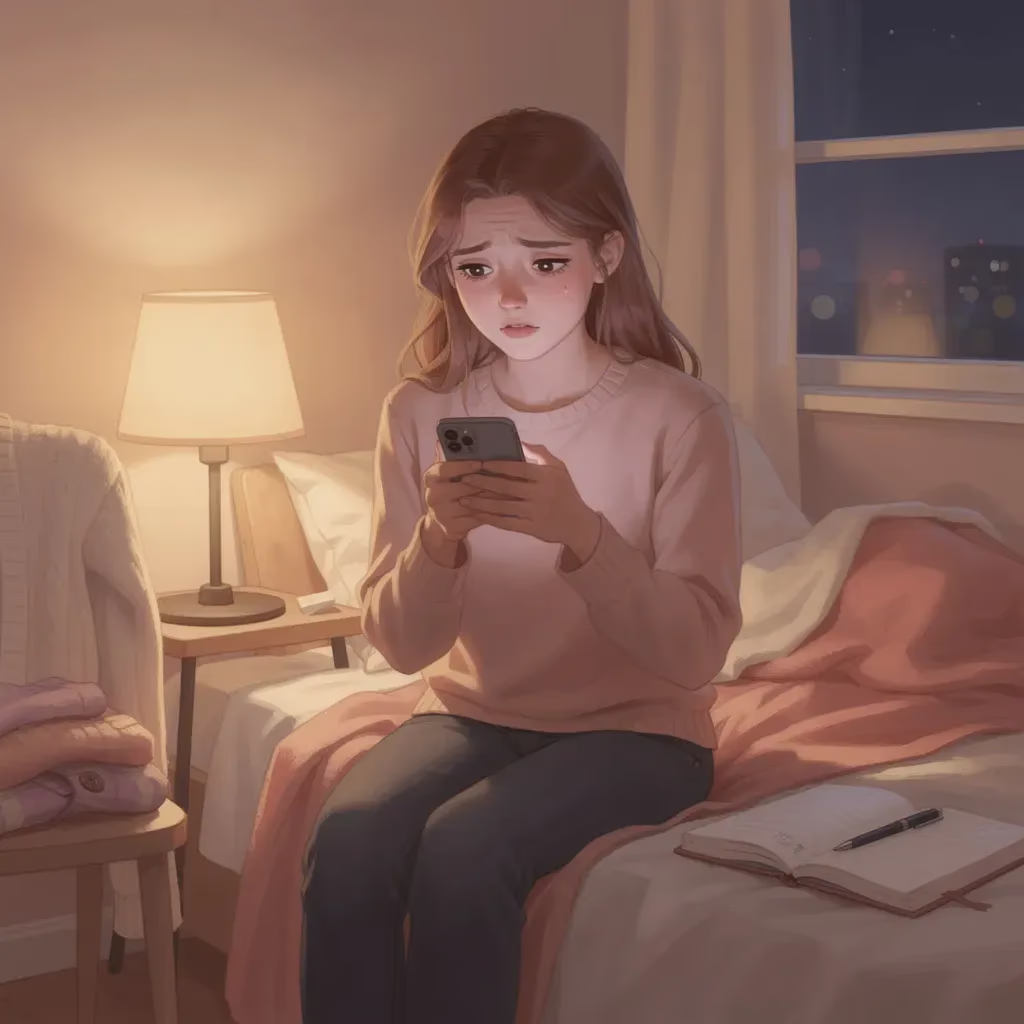
If you land in "In Dependency," please hear this first: this does not mean you're pathetic, broken, or too needy. It means your body learned that love can disappear. So now it stays on watch.
This is the result for the girl who has tried to be "low maintenance" and still ended up crying in the bathroom because a text felt cold. It's the result for the girl who keeps searching "am I codependent" and feels sick with shame while doing it.
You might love him. You might miss him. You might even have a lot of good moments. But if you also keep googling "what is co dependent relationship" because you feel like you're losing yourself, this result gives you language for what you're sensing.
In Dependency Meaning
Core Understanding
In Dependency, in this quiz, means your connection has started acting like the main place you get calm. When things are good, you feel a rush. When things are uncertain, you feel dread. Your body is basically saying: "Get closeness. Now. Fix it."
If you recognize yourself in this pattern, it usually shows up as relief chasing. One sweet text can make you feel high, like color comes back into the room. Then the feeling fades and you need more, not because you're greedy, but because the relationship isn't steady enough to build trust in your body.
This pattern often develops when you had to earn connection somewhere in your life. Maybe you had to be helpful, pretty, calm, funny, convenient. Many women with this type learned early that love can be inconsistent, and that it's safer to try harder than to risk being left.
Your body remembers the cost. It's why "waiting" doesn't feel neutral. Waiting feels like danger. Your throat tightens. Your stomach drops. Your mind goes into thought loops. You start writing that long text, then deleting it, then rewriting it, trying to find the perfect words that will make him stay.
And this is the part nobody says clearly enough: You can be a deeply loving person and still have a dependency pattern. Love is a feeling. Dependency is a cycle.
If the question in your head is "why am I codependent", you deserve a kind answer. Most of the time it comes down to this: your system learned that closeness had to be earned, and now it treats uncertainty like an emergency.
What In Dependency Looks Like
- Holding your breath for their reply: Your phone becomes the emotional scoreboard. You refresh, reread, and try to act normal while your chest feels tight.
- Over-explaining as a safety strategy: You write paragraphs so they won't misunderstand you. You think clarity will protect you, but it often just drains you.
- Apologizing for having needs: Even simple requests come out with a disclaimer. "Sorry, I don't want to be annoying, but..."
- Mood tied to their mood: If he's warm, you're light. If he's distant, you're heavy. It's like your system is taking orders.
- Fixing to avoid abandonment: You become the therapist, the planner, the peacemaker. You fix the vibe because silence feels unbearable.
- Confusing intensity with intimacy: The highs feel like proof. The lows feel like your fault. The cycle keeps you hooked.
- Walking on eggshells: You pay attention to tone, timing, emojis, punctuation. You can feel one word change in your body.
- Ruminating after every little shift: You replay the conversation like a movie. You try to find where you "ruined it."
- Accepting breadcrumbs: You take small contact and tell yourself it's enough, because the alternative is facing the emptiness.
- Losing your voice slowly: You stop bringing things up. You choose peace over truth. Your body keeps score anyway.
- Needing proof to feel okay: You ask questions that sound casual but are really panic management. "Are we okay?" "Do you miss me?" "Are you mad?"
- Fear of being alone driving choices: You stay in situations that exhaust you because solitude feels like falling.
- Self-worth outsourced to attention: If he chooses you, you feel valuable. If he doesn't, you feel like you disappear.
- Relief feels addictive: When he comes back, you feel a rush that quiets everything. Then you crave the next hit of safety.
If you're reading these and thinking, "Okay, so... what is co dependent relationship actually like day-to-day?" It's this. It's the daily cost of waiting, scanning, shrinking, and hoping.
How In Dependency Shows Up in Different Areas of Life
In romantic relationships:
You might feel like you're always monitoring the connection. You anticipate distance before it happens. If you're asking "am I codependent", it's often because your love has started to cost you sleep, appetite, and self-respect.
In friendships:
You can be the friend who always replies fast, always shows up, always says "it's fine." You might also feel hurt when your care isn't matched, but you swallow it.
At work:
People-pleasing can show up as over-delivering, taking on extra tasks, saying yes when you're drowning. You might fear disappointing people because disappointment feels like abandonment.
Under stress:
This is when the spiral is loudest. A small trigger can create a big cascade: phone checking, thought loops, imagining worst-case outcomes, then sending the message you promised yourself you wouldn't send.
What Activates This Pattern
- When someone's tone shifts and you don't know why
- When texts get shorter or slower
- When plans feel uncertain or last-minute
- When conflict isn't repaired quickly
- When you feel like you're "asking too much"
- When you sense inconsistency (warm one day, distant the next)
- When you're alone at night and your brain gets loud
The Path Toward More Calm (Without Becoming Cold)
- You don't have to stop loving hard: Your depth is not the problem. The problem is when love requires you to disappear.
- Your needs are allowed to exist: If you want consistency, that isn't being demanding. That's wanting emotional safety.
- Tiny shifts beat dramatic ultimatums: Women who heal this pattern start by noticing the moment they abandon themselves, and choosing one small act of self-respect instead.
- Build self-trust, not just reassurance: The goal isn't "never want reassurance." It's "I can calm myself enough to choose what is true."
- What becomes possible: You stop needing an "am I codependent quiz" every time he pulls away, because your steadiness starts living inside you, not inside his texting.
In Dependency Celebrities
- Olivia Rodrigo (Musician)
- Sabrina Carpenter (Musician)
- Selena Gomez (Musician)
- Taylor Swift (Musician)
- Jennifer Lawrence (Actress)
- Jenna Ortega (Actress)
- Anya Taylor-Joy (Actress)
- Lily Collins (Actress)
- Hailee Steinfeld (Actress)
- Rachel McAdams (Actress)
- Britney Spears (Musician)
- Adele (Musician)
- Miley Cyrus (Musician)
- Robert Pattinson (Actor)
- Shawn Mendes (Musician)
In Dependency Compatibility
| Other Type | Compatibility | Why it tends to feel this way |
|---|---|---|
| In Love | 😐 Mixed | The steadier partner can help, but only if the relationship doesn't become a constant reassurance job. |
| In Dependency | 😬 Difficult | Two anxious loops can amplify each other, creating more highs and lows unless both people build steadier habits. |
When you're stuck between "am I in love" and "am I codependent", it can feel like you're trying to solve a relationship with your body on fire. This quiz gives you a calmer way to see the pattern, name it, and choose your next step with clarity. If you've been searching "why am I codependent" or "what is co dependent relationship", you deserve answers that don't blame you.
A simple problem and a gentler solution
When you keep asking "am I codependent" and "am I in love" in the same week, it's usually because your heart is full but your safety feels shaky. The solution isn't to love less. It's to understand whether you're in mutual love or in a dependency loop that keeps you chasing reassurance. An "am I in love quiz" can be comforting, but this Relationship Insight quiz shows the pattern underneath. It helps you see what "what is co dependent relationship" looks like in real moments, not just definitions.
What you walk away with (the fast, real-life benefits)
- 💗 Discover why you keep taking an "am I in love quiz" and still feel unsure.
- 🌀 Understand the emotional logic behind "why am I codependent" without turning it into shame.
- 📱 Recognize your "am I codependent quiz" triggers (silence, tone shifts, slow replies) in a way that actually helps.
- 🧭 Spot what "what is co dependent relationship" looks like in texting, conflict, and repair.
- 🤍 Honor your needs with less apology and more steadiness.
- 🌿 Build a calmer baseline so "am I in love" stops feeling like a daily emergency question.
Where you are now vs what becomes possible
| Where you are now | What becomes possible |
|---|---|
| You keep checking your phone, then hating yourself for it. | You still care, but your calm doesn't depend on a notification. |
| You wonder "am I in love" but it doesn't feel answerable. | Love becomes clearer because safety becomes clearer. |
| You search "am I codependent quiz" after every wobble. | You recognize the wobble sooner and respond with self-respect. |
| You keep asking "why am I codependent" like it's a personal failure. | You see the pattern as protection, then choose a gentler way. |
| "What is co dependent relationship" feels scary to even read. | You can name the dynamic without panicking, and pick one tiny next step. |
Social proof (and the privacy question you might not want to ask out loud)
Join over 175,359 women who've taken this under 5 minutes quiz for private results. Your answers stay private, this is just for you.
FAQ
How do I know if I'm in love or in a dependency?
You can tell you're in love (not dependency) when the relationship adds safety and steadiness to your life, instead of controlling your nervous system. Dependency is when your bond starts to feel like oxygen: when they pull away, you panic, and when they come close again, you finally feel okay.
If you've been Googling things like "am I in love or dependent" or "is this love or attachment", you're not dramatic. You're trying to name something your body already recognizes.
Here are some grounded differences that usually show up in real life:
- Love feels steady, even when it's hard. You can miss them, you can want closeness, and you still feel like yourself. Dependency feels like your self disappears when they are distant.
- Love supports your dignity. You can bring up needs, boundaries, and concerns without fearing you'll be punished for it. Dependency often turns communication into bargaining: "If I say this, will they leave?"
- Love makes space for both people. You can have opinions, friendships, goals, and alone time without it threatening the relationship. Dependency can feel like you are constantly proving you're "safe" to keep.
- Love creates repair after conflict. Fights happen. The question is whether there is repair (accountability, reassurance, a plan) or whether you get stuck in a loop of anxiety, silence, and chasing.
A quick self-check that can be weirdly clarifying:
- When you're doing well (sleeping, eating, focused, laughing), does your relationship feel even better? That leans love.
- Or do you feel your best only when they are giving you attention? That leans dependency.
And something tender but true: dependency isn't always about "needy." Sometimes it's about inconsistency. A relationship that keeps you guessing trains your brain to scan for danger.
If you want a clearer mirror, a relationship insight quiz can help you separate "I'm deeply attached and invested" from "my peace depends on their behavior." It doesn't label you. It gives you language.
Is it love or just anxiety if I panic when he pulls away?
If you panic when he pulls away, that panic is anxiety first. It doesn't automatically mean you don't love him. It means your nervous system reads distance as danger, which is why so many women search "why do I panic when he pulls away" and "is it love or just anxiety" at 2 a.m.
Of course you panic. If you've ever had to earn closeness, your body learned that connection can disappear. So when his tone changes or he takes longer to respond, your brain tries to prevent abandonment by doing what it knows: overthinking, reaching, fixing, apologizing, chasing reassurance.
Here is the difference that matters:
- Love is the feeling of care, tenderness, respect, and wanting the best for them (and you).
- Anxiety is the alarm system that goes off when closeness feels threatened.
They can exist together. The problem is when anxiety becomes the driver of the relationship. That is where dependency can form.
Some common signs your panic is tied to dependency patterns (not your "personality being broken"):
- Your mood drops fast when he is distant, and improves instantly when he is warm again.
- You feel like you have to be "perfect" to keep him interested.
- You start interpreting neutral things as rejection (a short text, a late reply, being tired).
- You can't focus on work, friends, or your own life until you feel "okay with him" again.
What helps is checking for context:
- Is he actually pulling away a lot? If his behavior is inconsistent, your anxiety is a reasonable response to instability.
- Or is the distance normal life distance? Work, stress, needing alone time. If it's normal, then the work becomes helping your body tolerate the gap without spiraling.
A small, practical reframe: when you're panicking, your mind will ask "What did I do wrong?" A calmer question is: "What story is my body telling me right now, and is it current or old?"
A quiz can help you map whether you're experiencing love with anxious attachment symptoms, or whether you're sliding into dependency where closeness equals survival.
Why does his texting affect my mood so much?
His texting affects your mood because your brain has linked his responsiveness with safety. When the connection feels uncertain, your nervous system treats a delayed text like a threat. That is why "why does his texting affect my mood" is such a common, painfully honest question.
You're not shallow. You're not "crazy." You're someone who cares, and your body is trying to protect you from the possibility of disconnection.
Texting hits extra hard for a few reasons:
- It's intermittent reinforcement. If sometimes he's attentive and sometimes he disappears, your brain becomes hyper-focused on the next signal. This is the same mechanism that makes people check their phone over and over.
- It's ambiguous. A short reply could mean busy, annoyed, distracted, or nothing. Ambiguity is gasoline for an anxious mind.
- It becomes a proxy for love. If you've learned to measure closeness through availability, texting becomes a scoreboard: "Are we okay? Do I matter?"
This is where the love vs dependency question comes in. In love, texting is communication. In dependency, texting becomes emotional regulation. You use it to calm your body.
A gentle self-check:
- When he texts back, do you feel a wave of relief like you can finally breathe?
- Do you find yourself "holding your breath for their reply" and then crashing when it doesn't come?
Those are dependency signals, not because you're too much, but because you're relying on him to stabilize you.
Practical things that often help (without pretending you can just turn off your feelings):
- Look for patterns, not moments. One dry text isn't a relationship. A consistent pattern of coldness or inconsistency matters.
- Name what you actually need. Often it's not "text me constantly." It's "be predictable" or "reassure me when you're busy."
- Build a second anchor. Something that grounds you besides his phone: a friend, a routine, a walk, a playlist, a journal thread where you reality-check yourself.
If you want to understand whether this is anxious attachment inside real love, or emotional dependency creeping in, a relationship insight quiz can help you see your pattern clearly.
Am I too needy in my relationship, or are my needs normal?
Most of the time, "needy" is just the word women use when they feel guilty for having needs. Wanting consistency, reassurance, and effort is normal. If you've been searching "am I too needy in my relationship" or "am I the problem in my relationship", that alone tells me you've been carrying more self-blame than you deserve.
Here's a more honest way to separate healthy needs from dependency:
Healthy needs sound like:
- "I want to feel emotionally safe with you."
- "I need clarity when something changes."
- "I need repair after conflict."
- "I need mutual effort, not just me trying."
Dependency needs often sound like:
- "I need you to respond so I can calm down."
- "I need constant reassurance that you won't leave."
- "I need to be your favorite, always, or I'm not okay."
- "I need you to fix how I feel."
And here's the part that matters: dependency needs often develop when the relationship is unpredictable. If your partner gives love and then withdraws, it makes perfect sense that your needs get louder. Your body is trying to secure the bond.
A simple diagnostic question:
- Do you feel safer after you ask for what you need, because your partner meets you with care and follow-through?
- Or do you feel worse, because asking turns into criticism, distance, or you having to over-explain?
Love can hold needs. Dependency often turns needs into shame.
You are allowed to want a relationship where you don't have to audition for attention. You're allowed to want someone who doesn't make you feel like you're "asking for too much" when you're asking for basics.
If you want clarity, a relationship insight quiz can help you see whether you're experiencing love with normal attachment needs, or whether you're stuck in a dependency loop that keeps you proving yourself.
What is relationship dependency (and how is it different from codependency)?
Relationship dependency is when your emotional stability becomes overly tied to your partner's attention, approval, or closeness. Codependency overlaps, but it often centers more on over-functioning (caretaking, fixing, managing someone else's life) to feel secure. If you've been typing "what is relationship dependency" or "am I in love or codependent", you're already noticing the difference between love and survival.
Here are the cleanest distinctions:
Relationship dependency often looks like:
- Your mood rises and falls based on their behavior (texts, tone, affection).
- You feel panicky or empty when they need space.
- You tolerate less-than-you-deserve because being without them feels worse.
- You over-monitor the relationship ("Are we okay?") more than you experience it.
Codependency often looks like:
- You feel responsible for their emotions, choices, or healing.
- You keep the peace by shrinking your needs.
- You stay "useful" to stay loved.
- You get a sense of identity from being the one who holds everything together.
A lot of women experience both at the same time. You can be the caretaker and the one who is terrified of being left. That combo is exhausting because you are working two jobs: managing them and managing your anxiety.
Here is what dependency is not: it is not "loving too hard." Love is care with self-respect. Dependency is care with self-abandonment.
A practical way to tell:
- In love, you can miss them and still function.
- In dependency, absence (or perceived absence) can feel like emotional withdrawal symptoms.
This isn't about judging yourself. These patterns usually come from learning that closeness was unpredictable, or that you had to earn love by being easy, helpful, or perfect.
A quiz can help you pinpoint which pattern you lean toward so you stop treating everything like a personal flaw and start treating it like information.
What causes relationship dependency (and why do I need constant reassurance in relationships)?
Relationship dependency is usually caused by a mix of attachment wounds, inconsistent relationship experiences, and a nervous system that learned closeness can vanish. Wanting reassurance doesn't mean you're broken. It means your body is trying to prevent pain. That is why questions like "why do I need constant reassurance in relationships" and "what does anxious attachment feel like in love" show up again and again.
Common roots (that many women share) include:
- Inconsistency in past relationships. Hot-and-cold affection teaches you to chase signals of safety.
- Emotional unpredictability growing up. If love depended on moods, performance, or being "good," your adult brain may still treat love like something you can lose.
- Past betrayals or abandonment. Your system stays on alert because it remembers how blindsiding it felt.
- Low relational trust, not low self-worth. Sometimes you do value yourself, but you don't trust that love will be stable. So you try to secure it constantly.
Here is what's really happening in the reassurance loop:
- Something triggers you (late reply, distance, a fight).
- Your brain creates a story fast ("They're losing interest").
- Your body floods with anxiety.
- Reassurance calms the anxiety short-term.
- Your brain learns: "To feel okay, I need reassurance again."
That doesn't mean reassurance is "bad." In healthy love, reassurance is part of repair. The issue is when reassurance becomes the only way you can feel okay.
A gentle shift that helps: instead of asking "Why am I like this?" try "What does my anxiety think it is preventing?" Usually the answer is heartbreak, humiliation, or being replaced.
If you want more clarity on whether you're in love with anxious attachment patterns, or in dependency where reassurance is required to function, a relationship insight quiz can help you name it without self-blame.
How do I stop spiraling after a fight?
To stop spiraling after a fight, you need two things: nervous system soothing and clear repair signals. Spiraling usually isn't about the argument itself. It's about what the argument threatens: connection. If you've searched "how to stop spiraling after a fight", you're in very familiar company.
Of course you spiral. For anxious hearts, conflict can feel like a breakup preview. Your mind starts reviewing everything you said, your body goes into alarm, and suddenly you are trying to "fix it" fast so you can breathe again.
Here are strategies that actually match what is happening in your system:
1) Separate the fight from the meaningAfter a fight, your brain wants to decide: "Are we safe or not?"A more stabilizing question is: "Do we repair after conflict, consistently?" Healthy love isn't conflict-free. It's repair-rich.
2) Ask for a clear repair pointSpiraling thrives in uncertainty. You don't need a 3-hour talk right now. You need clarity like:
- "Are we okay, and when can we talk?"
- "I want to resolve this. Can we reconnect tonight?"If they can give you a specific time and follow through, your anxiety drops because consistency is safety.
3) Watch what your body doesIf you cannot eat, sleep, focus, or stop checking your phone, that can be a sign the relationship is sliding into dependency. Your body is telling you the bond is regulating you more than you're regulating yourself.
4) Reality-check the relationship patternOne fight doesn't define your relationship.A pattern of silent treatment, punishment, or disappearing does. If your partner withdraws to gain control, your spiral isn't a flaw. It's your system reacting to something real.
5) Give yourself a "good enough" containerYou don't have to solve everything tonight to be loved. You're allowed to pause the problem without losing the relationship.
If you want help identifying whether your post-fight spirals are anxious attachment inside real love, or a dependency pattern with poor repair, a quiz can help you see your dynamic clearly.
How accurate is an "am I in love or dependent" relationship insight quiz?
A good "am I in love or dependent" quiz is accurate in the way a mirror is accurate. It reflects patterns you might be too emotionally close to see clearly. It won't replace therapy or your real-life judgment, but it can absolutely help you name whether you're in love or in dependency based on consistent signs.
If you're taking a relationship insight quiz because you're tired of guessing, that makes perfect sense. When you're inside the relationship, your feelings are loud. Patterns are quieter. A structured quiz turns the volume down on the panic and up on the truth.
Here is what makes a quiz more reliable:
- It asks about patterns, not single moments. One clingy day doesn't mean dependency. A consistent cycle of panic, chasing, relief, repeat might.
- It separates love from regulation. Love is connection and care. Dependency is when the relationship becomes your main way to feel stable.
- It includes behavior + body cues. Quizzes that only ask "Do you love them?" miss the point. Your nervous system tells the story too.
- It gives you language you can use. The best outcome is not a label. It's clarity: "This is why I keep spiraling" or "This is why I can't tolerate distance."
Also, please hear this: if your result points to dependency, it doesn't mean you are "the problem." It means you're human, you got attached, and your system learned to grip tight. So many women live in that loop quietly.
A quiz is most useful when you treat it like a starting point:
- "What parts felt painfully accurate?"
- "What parts didn't fit?"
- "What would feel 2% safer for me in love?"
If you want a clear, gentle way to sort out is it love or attachment, this quiz can help you put words to what you've already been sensing.
What's the Research?
What science tells us about "love" vs. "dependency"
That panicky feeling when he pulls away (or even just texts a little colder) isn't random. It lines up with what attachment researchers have described for decades: humans are wired to seek closeness to an attachment figure when we feel uncertain or threatened. Attachment theory started with John Bowlby, who was trying to explain the intense distress children feel during separation, and it later expanded into adult relationships too (Fraley's overview of adult attachment research; Attachment theory basics; Attachment theory - Wikipedia).
In secure love, closeness actually supports your independence. Bowlby and later summaries describe the idea of a "secure base": when someone feels reliably there, you can explore your life more freely, not less (Simply Psychology on attachment and the secure base). In dependency, closeness can start to feel like oxygen. Your nervous system behaves like separation is danger, so you monitor, manage, and work to keep connection from slipping.
If you feel like your mood is basically being "run" by his attention, that's not you being dramatic. That's your attachment system doing its job, just in overdrive.
One more validating thing: even the concept of "codependency" is debated in psychology. Some experts argue it can stigmatize normal caring and bonding, especially in women (Psychology Today on codependency). So instead of labeling you, it's more useful to look at the pattern: is the relationship helping you become more you, or slowly costing you yourself?
The dependency pattern has a shape (and it isn't a character flaw)
Across definitions and clinical summaries, relationship dependency tends to show up as imbalance: one person over-functions (soothes, fixes, manages, sacrifices), and the relationship becomes emotionally one-sided or unstable (Mental Health America on co-dependency; PsychCentral signs of codependency; HelpGuide on codependency). A really common tell is exactly what so many women type into Google at 2 a.m.: "why does his texting affect my mood" or "is it love or just anxiety." Those are dependency questions, not because you're broken, but because your body is trying to get certainty from someone else's behavior.
Another related concept is enmeshment: when boundaries get so blurred that it becomes hard to tell where you end and the other person begins. It started in family systems theory (Salvador Minuchin), but it can show up in romantic dynamics too, especially if you learned early that love meant emotional merging, guilt, or responsibility for someone else's stability (Enmeshment - Wikipedia; Simply Psychology: enmeshment; Verywell Health: enmeshment).
What makes this extra confusing is that enmeshment can masquerade as loyalty or "we're just really close." Research descriptions emphasize that the difference is autonomy: healthy closeness supports separate identities; enmeshment erodes them (Simply Psychology: enmeshment definition and distinctions).
That "I can't tell what I want anymore" feeling is data. It's often what blurred boundaries feel like from the inside.
Also, you're not imagining how common this is. One major attachment-focused organization notes that over 32% of U.S. adults may experience an "attachment disturbance" pattern (their language), which is basically saying: a lot of us are trying to do love without ever being taught what secure love feels like (The Attachment Project). Even if you don't love that wording, the takeaway matters: you're not alone. This is the quiet conversation happening everywhere.
What "in love" tends to feel like in the body (and in real life)
When you are truly in love (the "In Love" side of this quiz), there can still be anxiety sometimes, but the relationship doesn't require anxiety to function. Love is allowed to be calm. Attachment science describes secure attachment as having a safe haven (comfort in distress) and a secure base (support for exploration), and that maps beautifully onto adult relationships too (Simply Psychology on attachment across the lifespan; Verywell Mind overview).
So practically, "In Love" often looks like:
- You can miss them without spiraling.
- A conflict feels uncomfortable, but not like an extinction-level threat.
- You don't have to earn basic kindness with perfect behavior.
- Your life gets bigger, not smaller.
On the "In Dependency" side, the bond can feel intense, but it often runs on uncertainty: intermittent reassurance, fear of being replaced, or the sense you have to manage the connection to keep it alive. Clinician summaries describe codependency (again, imperfect term, but useful shorthand) as a pattern where you consistently elevate the other person's needs above your own, and your emotional state starts tracking theirs (PsychCentral; Mental Health America).
Real love adds steadiness to your nervous system. Dependency makes your nervous system a full-time employee.
Why this matters (and how it helps you trust yourself again)
If you've been asking yourself, "am I in love or codependent" or "am I in love or dependent," the most important thing isn't picking the "right label." It's noticing what the relationship is training your brain and body to believe about love.
Attachment research talks about "internal working models": the expectations we carry about whether others will be there for us, and whether we are worthy of care. Those expectations get built early, but they can also be reshaped through later relationships and experiences (Simply Psychology on internal working models and change over time; Attachment theory - Wikipedia). So if your current relationship constantly triggers panic, it's not proof you're unlovable. It's often proof your system is stuck scanning for safety.
And a grounding nuance: even within the research world, scholars point out that these patterns are influenced by the wider environment, like stability and support, not just your personality or "what's wrong with you" (Contributions of attachment theory and research - PMC). That matters because it means you can stop moralizing your needs. You can start listening to them.
You're allowed to want a relationship that doesn't require you to shrink, perform, or beg for clarity.
While research reveals what many women experience when they're trying to tell the difference between being in love vs. being in dependency, your report shows which side you lean toward and which exact patterns are driving your reactions, so you can respond with self-trust instead of spiraling.
References
Want to go deeper? These are genuinely helpful reads if you're in that "I need answers" season:
- A Brief Overview of Adult Attachment Theory and Research (R. Chris Fraley)
- Attachment theory (Wikipedia)
- Attachment Theory In Psychology Explained (Simply Psychology)
- What Is Attachment Theory? (Verywell Mind)
- Contributions of Attachment Theory and Research (PMC)
- Co-Dependency (Mental Health America)
- Codependency (Psychology Today)
- Symptoms and Signs of Codependency (PsychCentral)
- Codependency: Signs of a Codependent Relationship (HelpGuide)
- Enmeshment (Wikipedia)
- What is Enmeshment? (Simply Psychology)
- Are You in an Enmeshed Relationship? Signs to Know (Verywell Health)
- The Attachment Project
Recommended reading (for when you want deeper clarity than an "am I in love quiz")
Sometimes taking the quiz gives you the "aha." Then you want something to hold onto. Something to read when your brain is trying to drag you back into the old loop of "am I codependent" and "maybe if I say it perfectly he'll stay."
These are the books that support Relationship Insight: Are You in Love or in a Dependency? without making you feel like a problem to fix.
General books (good for any result)
- Attached: The New Science of Adult Attachment and How It Can Help You Find - and Keep - Love (Amazon, Bookshop.org, AbeBooks) by Amir Levine - Clear language for why some connections feel steady and others feel like chasing.
- Hold Me Tight: Seven Conversations for a Lifetime of Love (Amazon, Bookshop.org, AbeBooks) by Sue Johnson - Helps you recognize protest behaviors and build repair that actually lands.
- Wired for Love: How Understanding Your Partner's Brain and Attachment Style Can Help You Defuse Conflict and Build a Secure Relationship (Amazon, Bookshop.org, AbeBooks) by Stan Tatkin - Makes the "threat vs connection" pattern feel obvious in daily moments.
- All About Love (Amazon, Bookshop.org, AbeBooks) by bell hooks - Re-centers love around respect, care, and dignity so suffering stops feeling romantic.
- Set Boundaries, Find Peace: A Guide to Reclaiming Yourself (Amazon, Bookshop.org, AbeBooks) by Nedra Glover Tawwab - Boundaries that still feel kind, especially if guilt hits hard.
- Boundaries in Dating: How Healthy Choices Grow Healthy Relationships (Amazon, Bookshop.org, AbeBooks) by Henry Cloud - Practical tools for keeping your sense of self intact while opening your heart to someone new.
- Codependent No More (Amazon, Bookshop.org, AbeBooks) by Melody Beattie - A foundational guide to recognizing when caretaking becomes self-abandonment and learning to reclaim your own life.
- Nonviolent Communication: A Language of Life (Amazon, Bookshop.org, AbeBooks) by Marshall B. Rosenberg - When you're trying to separate love from dependency, communication is often where the truth shows up.
For In Love types (protect the mutuality you have)
- Anxiously Attached: Becoming More Secure in Life and Love (Amazon, Bookshop.org, AbeBooks) by Jessica Baum - Keeps real love from turning into reassurance chasing when you're triggered.
- The Anxious Hearts Guide: Rising Above Anxiety, Fear, and Self-Doubt in Relationships (Amazon, Bookshop.org, AbeBooks) by Rikki Cloos - Practical help for the spirals that can show up even in good relationships.
- Self-Compassion: The Proven Power of Being Kind to Yourself (Amazon, Bookshop.org, AbeBooks) by Kristin Neff - Helps you stop punishing yourself for having needs.
- Running on Empty: Overcome Your Childhood Emotional Neglect (Amazon, Bookshop.org, AbeBooks) by Jonice Webb - If love feels new and scary because you never learned to feel held.
- Women Who Love Too Much: When You Keep Wishing and Hoping He'll Change (Amazon, Bookshop.org, AbeBooks) by Robin Norwood - A mirror for the moment love starts revolving around potential, not reality.
- Not Nice: Stop People Pleasing, Staying Silent, and Feeling Guilty... and Start Speaking Up, Saying No, Asking Boldly, and Unapologetically Being Yourself (Amazon, Bookshop.org, AbeBooks) by Aziz Gazipura - Helps you stay honest in love without the guilt hangover.
For In Dependency types (step out of the loop without going numb)
- Codependent No More (Amazon, Bookshop.org, AbeBooks) by Melody Beattie - Names the caretaking and self-abandonment loop with a lot of compassion.
- The New Codependency: Help and Guidance for Today's Generation (Amazon, Bookshop.org, AbeBooks) by Melody Beattie - Updates the pattern for modern life, especially the texting + availability pressure.
- Facing Codependence (Amazon, Bookshop.org, AbeBooks) by Pia Mellody, Andrea Wells Miller, J. Keith Miller - Goes deeper on where the pattern began and why choosing yourself can feel scary.
- Women Who Love Too Much (Amazon, Bookshop.org, AbeBooks) by Robin Norwood - Helps you stop measuring love by what you can tolerate.
- Whole Again: Healing Your Heart and Rediscovering Your True Self After Toxic Relationships and Emotional Abuse (Amazon, Bookshop.org, AbeBooks) by Jackson MacKenzie - For when detaching feels like withdrawal and you need a steady path back to you.
- How to Do the Work: Recognize Your Patterns, Heal from Your Past, and Create Your Self (Amazon, Bookshop.org, AbeBooks) by Nicole LePera - Connects the dots between past roles and present relationship patterns in a practical way.
P.S.
If you're still bouncing between "am I in love" and "why am I codependent," take this as permission to get clarity without shaming yourself for wanting closeness.