A gentle space to find your faith direction
Faith Compass: Why Do I Feel Spiritually Homeless?

Faith Compass: Why Do I Feel Spiritually Homeless?
If you've ever felt like faith is a room you can stand in but not exhale in, this is the gentler way to figure out what actually fits you (without rushing, performing, or betraying anyone).
What is my religion?

You know that weird ache when you try to be "a good faith person" but it feels like you're acting in a play you never auditioned for? Like everyone else got a script, and you're improvising with sweaty palms.
So you end up Googling things like what is my religion, or taking a what is my religion quiz, hoping someone will finally hand you a simple answer that makes your chest unclench. You might even whisper what should my religion be like it's a confession.
Faith Compass: What Religion Fits Me? is built for that exact moment. It doesn't shove you into a label. It helps you find your spiritual orientation (your natural way of connecting), then points you toward communities and traditions that tend to fit. This is also why so many women who type what religion best fits me end up feeling relief here, not pressure.
What religion best fits me (and why does this feel so hard)?
A lot of "what should my religion be" advice secretly assumes one thing: that everyone connects to the sacred the same way.
You don't. And you're not difficult for that.
Faith Compass looks at how you naturally do faith, not how you think you're supposed to.
This quiz uses six Faith Compass types:
Mystic Seeker
- Definition: You connect through mystery, meaning, and that feeling like "there's more going on here than I can explain."
- Key traits:
- You notice symbolism and synchronicities
- You crave depth more than rules
- You want space for questions without punishment
- Benefit: You stop shaming yourself for not fitting rigid certainty and start exploring traditions that actually honor your depth.
Ritual Keeper
- Definition: You connect through rhythm, ceremony, and repeatable practices that hold you when life is messy.
- Key traits:
- You feel calmer with structure
- You love seasons, rituals, prayers, routines
- You want a path that feels steady, not chaotic
- Benefit: You find forms of faith that help your body soften instead of constantly scanning for "am I doing it wrong?"
Philosophical Explorer
- Definition: You connect through thinking, study, and honest conversations that make faith feel intellectually clean (not manipulative).
- Key traits:
- You need things to make sense
- You ask "why" until you get to the root
- You don't want to fake certainty
- Benefit: You get permission to build a faith life that respects your mind instead of treating your questions like rebellion.
Heart Devotee
- Definition: You connect through love, tenderness, devotion, and feeling close to the Divine in a personal way.
- Key traits:
- You love with your whole chest
- You want a faith that feels relational
- You need gentleness more than debate
- Benefit: You learn what kind of tradition helps your love become steady, not self-erasing.
Community Builder
- Definition: You connect through belonging, shared care, and the feeling of "we're in this together."
- Key traits:
- You feel spiritually alive in warm groups
- You want faith to show up in real life (support, service, showing up)
- You notice when community is missing
- Benefit: You find communities that feel safe and mutual, not like you're the unpaid emotional support staff.
Nature Mystic
- Definition: You connect through the sacred in the everyday world: trees, oceans, seasons, dawn light, quiet awe.
- Key traits:
- You feel closest to God (or meaning) outside
- You trust experience more than speeches
- You need spaciousness, not crowds
- Benefit: You stop forcing yourself into loud spaces and start building a spiritual life that feels like coming home.
And yes: this is a Faith Compass quiz free option designed to be a soft starting point, not a lifetime contract.
One more thing that makes it different (and honestly, safer): it doesn't only ask about your type. It also looks at those quiet details most quizzes ignore, like:
- Whether you prefer inner knowing or outside authority
- Whether you recharge in community or in solitude
- Whether you want certainty or you can breathe in open questions
- Whether you want faith to become service, not just thoughts
That is why this feels less like "pick a team" and more like "find your fit." It makes the whole "what is my religion" spiral feel less like a test and more like a map.
6 ways knowing your Faith Compass type can make faith feel lighter (and more like yours)
- Discover why certain religious spaces made you tense, and why others made you breathe again (this is the real answer behind what religion best fits me).
- Understand what you actually need from faith, so what should my religion be stops feeling like a panic question and starts feeling like a gentle choice.
- Recognize whether you're craving community, solitude, structure, or freedom, so your next step is calmer than a random what is my religion quiz click.
- Honor your doubts without spiraling into guilt. You can keep your tenderness and still be honest about what is my religion for you, right now.
- Connect with traditions and communities that match your spiritual wiring, not your people-pleasing habits.
- Create a small 7-day experiment (one practice, one tiny step) so you can test fit in real life, not only in your head.
Jennifer's Story: The Night I Stopped Pretending I "Wasn't a Religion Person"

The thing that got me wasn't a sermon or a funeral or some dramatic moment in a hospital waiting room. It was a normal Tuesday night, standing in the bathroom, brushing my teeth, and realizing I was silently bargaining with the universe again. Like if I just thought the right thought hard enough, something would finally loosen in my life.
I remember spitting, staring at my own eyes in the mirror, and feeling this weird, embarrassed heat in my face. Because I'm 35. I have a job. I pay my bills. I can talk you through wound care and calm down a panicking family member without blinking. But I couldn't answer a simple question without my chest tightening: "What do you actually believe?"
I'm a CNA. The kind who knows patients' stories by heart. I remember who likes their blanket tucked in at the feet, who needs their meds with applesauce, who gets quiet when their daughter doesn't call. I say "I'm sorry" automatically, even when nothing is my fault. Sorry for asking clarifying questions. Sorry for taking up the nurse's time. Sorry for existing in the way people who are constantly scanning for irritation tend to exist.
For a long time, I told myself I didn't care about religion. I said it the way people say they don't care about high school drama. Casual. Above it. Like it was a phase other people went through.
But the truth was, I cared so much it made me nervous.
I was the person who would light a candle in my kitchen after a hard shift and feel something soften, then immediately feel stupid for it. I would save posts about "signs from the universe" and "angel numbers" and then delete them like someone might catch me being desperate. I'd go to a yoga class and feel calm for the first time all week, then walk to my car and think, "Is this allowed? Is this real? Am I making it up?"
And then there was the people part. That was the hardest.
Because belief wasn't just an idea in my head. It was community. It was choosing a room to walk into and hoping they wouldn't look at me like I was a fraud.
I had tried. I had sat in the back row of a church once and smiled too hard at the greeter, like I was trying to pass an audition. I had gone with Sarah, my friend, to a holiday service that was honestly lovely, and still spent the whole time doing this private math in my head: Are they watching me? Do I look like I know what I'm doing? Am I standing at the right time? Am I the only one who doesn't feel certain?
I wanted a spiritual home the way I wanted a person to stay. Badly. Quietly. With that specific fear that if I reached for it, it would disappear.
So I did what I always do when I can't make something land safely in my life. I turned it into research.
Podcasts. Book highlights. TikToks. Reddit threads. Wikipedia rabbit holes at 1:00 a.m. I'd scroll until my eyes burned, trying to find the "right answer" in a way that felt familiar from other parts of my life. Like if I gathered enough information, I could finally choose without risking being wrong.
But spirituality isn't like choosing a moisturizer. There's no before-and-after photo that proves you picked correctly.
A few weeks before I took Faith Compass: What Religion Fits Me?, my therapist asked a question that hit me in that soft spot behind my ribs.
She said, "When you say you don't know what you believe, do you mean you don't know what's true, or you don't know where you'd belong?"
I bit my lip. I did that thing where I tried to laugh it off, like it was casual. Like I wasn't carrying something tender.
And then I heard myself say, "I think I don't trust myself to pick. Like... I don't trust my own compass."
It was such an ugly little sentence. Not ugly like mean. Ugly like honest. Like walking around with your shirt inside out and finally noticing.
That night, after my shift, I sat on my couch and searched "quiz what religion fits me" with the same energy I used to have when I'd search "how long should it take someone to text back."
I wasn't looking for a personality label to post. I was looking for relief.
The Faith Compass quiz surprised me because it didn't feel like it was trying to trap me into a category. It asked about the things I never say out loud.
Do I crave structure or do I crave mystery? Do I need a community or do I feel safest alone? Do rituals calm me or make me feel watched? Do I want a God I can speak to, or a truth I can sit beside quietly? Do I need certainty to breathe?
Every question felt like someone had been standing in the corner of my life taking notes.
When I got my result, I just stared at the screen for a full minute. Not because it was magical. Because it was accurate in a way that made my throat tighten.
My Faith Compass type came back as something like "Mystic Seeker." Which, in normal-people words, basically meant: I wasn't confused because I was broken or flaky. I was confused because I kept trying to force myself into forms that were never built for how I experience the world.
It explained that some people connect to faith through clarity and doctrine, and some people connect through direct experience. Through awe. Through quiet, strange little moments that don't fit in a neat box. It also pointed out something I hadn't wanted to admit: I was trying to outsource my spiritual decisions the same way I'd outsourced emotional safety in relationships. I'd look for a system that would guarantee no one could reject me.
There was a line in the results that I screenshot and didn't show anyone. It said something about how I might be drawn to spiritual paths that leave room for mystery, personal exploration, and inner knowing. Not because I was commitment-phobic, but because my connection grows in spaces where I'm not being tested.
I cried a little. Not dramatic crying. Just that quick sting you get when something finally stops blaming you.
And then something shifted in the days after, in a way that felt annoyingly small but very real.
I stopped treating my spirituality like a courtroom where I had to present evidence. I started treating it like a relationship. One that could be built slowly. One that didn't require me to perform.
I did this one thing that sounds almost embarrassing in how simple it was. On my break at work, I'd sit in my car with my food and I wouldn't scroll. I'd open my notes app and write a sentence that started with: "Today, I felt close to something when..."
Not a prayer. Not a manifesto. Just data. That's what it felt like. Honest data.
"Today, I felt close to something when Mrs. K squeezed my hand and said my name like it mattered."
"Today, I felt close to something when the sky was pink and I couldn't explain why that made me want to be kinder."
"Today, I felt close to something when I didn't fix everyone's mood in the break room and nothing bad happened."
The longer I did it, the more I realized I had been having spiritual moments my whole life. I just didn't think I was allowed to call them that.
A month later, Sarah invited me to a small meditation group she sometimes went to. Normally I would have said yes and then spent three days panicking about what to wear and whether I'd look like an imposter. This time I still panicked, obviously. But I also had this tiny new thought in the background: I don't have to prove I'm worthy of being here. I'm just showing up.
So I went.
The room was small. Not fancy. A few mismatched cushions. A kettle in the corner. People talking softly like they didn't want to startle anyone. I sat near the wall because old habits die hard. My shoulders were up by my ears without permission.
At one point, the facilitator said something about how there are many ways to belong, and belonging doesn't always come from agreeing on every detail. Sometimes it comes from practicing sincerity together.
My body did that thing it does when I'm about to cry. Tight throat, hot eyes, the urge to swallow everything back down.
After, Sarah asked, "How was it?"
I almost said, "Good, sorry I was quiet." Because of course I did.
But instead I said, "It felt... normal. Like I wasn't being graded."
On the drive home, I realized that the quiz didn't hand me a religion like a prize. It handed me language for what I had been reaching for.
It helped me understand that my Faith Compass wasn't pointing to a single institution. It was pointing to a way of relating to the sacred that fit my nervous system. My sensitivity. My need for room to breathe.
I started reading again, but differently. Not in that frantic, prove-it way. I picked one tradition to learn about for a week, then another. I paid attention to what made my chest loosen instead of tighten. I paid attention to what made me feel more compassionate rather than more afraid.
I also tried something that was hard in a totally different way. I told a guy I'd been seeing, Thomas, the truth when he asked what I did on weekends.
I didn't say, "Nothing." I didn't pretend I was too cool for meaning.
I said, "I've been exploring spiritual stuff. Not in a weird way. More like... I think I need it."
He blinked, like he was surprised, but not in a disgusted way. Just surprised.
"Okay," he said. "Like church?"
And I laughed because of course that's what he pictured.
"Not exactly. I'm taking this quiz thing and trying different spaces. I'm trying to figure out what fits."
He nodded. "That's actually kind of... brave."
I don't know if Thomas will stick around. I don't even know if I want him to. But it was the first time I felt like I didn't have to hide the part of me that wants meaning. The part that wants a bigger container for all the caring I do.
Now, months later, I still don't have a neat label. I still have nights where I google things and start spinning, like maybe I missed the obvious answer again. I still feel that old fear that if I pick a path, I'll be trapped, or I'll disappoint someone, or I'll look stupid.
But the Faith Compass: What Religion Fits Me? quiz gave me something I didn't realize I was allowed to have: a starting point that didn't shame me for being uncertain. It made uncertainty feel like a doorway instead of a defect.
I still say "I'm sorry" too much. I still want reassurance. I still get nervous walking into any new community, spiritual or otherwise. But now I can tell the difference between "this isn't right for me" and "I'm scared of being seen." That distinction alone has made my life feel a little more honest.
- Jennifer B.,
All About Each Faith Compass type
| Faith Compass Type | Common names and phrases you might relate to |
|---|---|
| Mystic Seeker | spiritual-but-not-sure, mystery-lover, intuitive, "I feel it but can't prove it" |
| Ritual Keeper | tradition-comforted, routine-based faith, liturgy lover, "give me words to hold me" |
| Philosophical Explorer | thoughtful skeptic, study-driven, big-question energy, "I need it to make sense" |
| Heart Devotee | tender believer, devotional, prayerful, love-first, "I want closeness" |
| Community Builder | belonging-centered, service-and-people, fellowship-seeker, "faith should be lived together" |
| Nature Mystic | earth-honoring, outdoors prayer, awe-driven, "I meet God in the trees" |
Am I a Mystic Seeker?
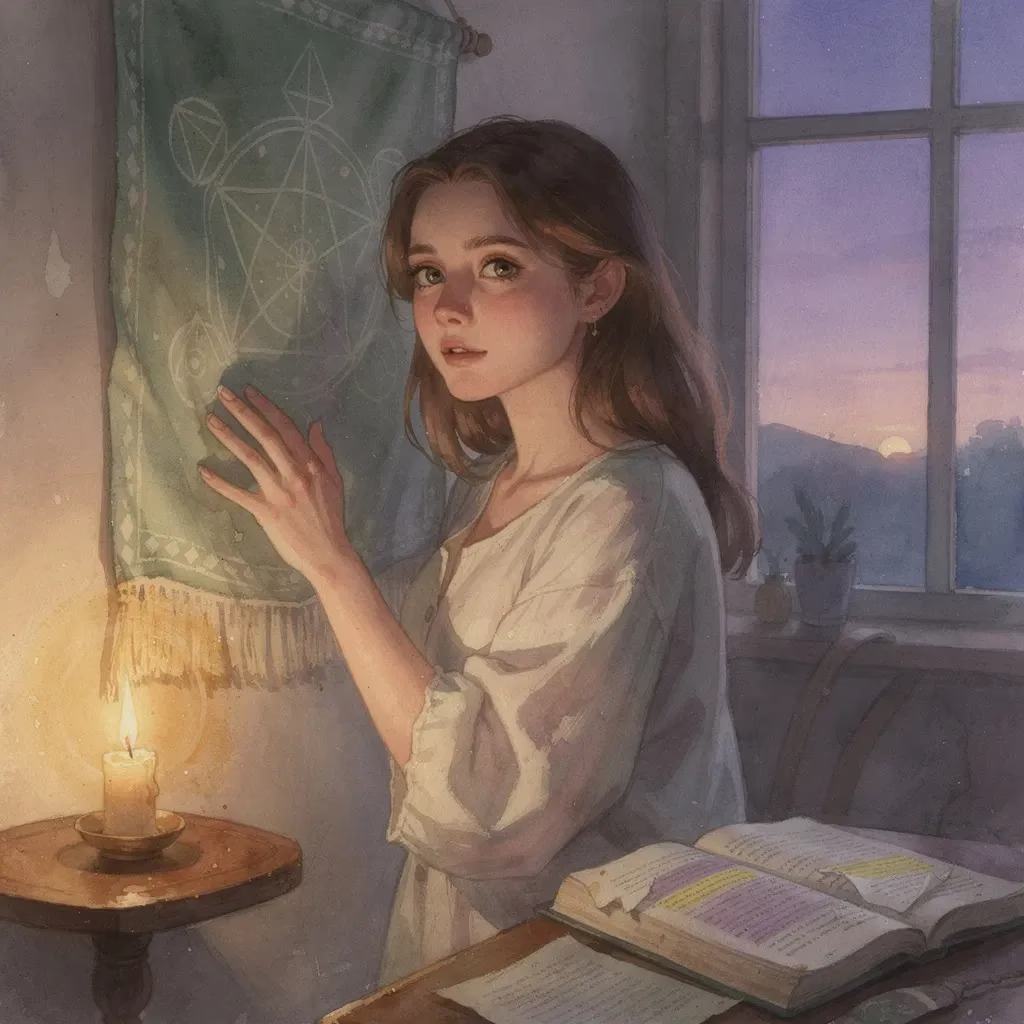
That feeling of being spiritually homeless can hit hardest when you're the kind of person who actually feels things. Like you walk into a space that claims to have all the answers, and your chest does that tight little "no" anyway.
If you've been asking what religion best fits me, but every answer feels too small, too rigid, too human, you might be a Mystic Seeker.
And no, that doesn't mean you're flaky. It often means you're honest. You're not willing to trade your soul's questions for someone else's certainty.
Mystic Seeker Meaning
Core Understanding
If you recognize yourself in this pattern, it usually looks like this: you want the sacred to be real, but you can't force yourself to pretend. You might crave God, meaning, presence, mystery, all of it. You just don't want it packaged in fear.
This pattern often emerges when you learned early that love and belonging were tied to "getting it right." Many women with Mystic Seeker energy grew up around faith that felt like a performance: say the right things, believe the right things, do not ask the wrong questions. So your spirit learned to search for truth in quieter places.
Your body remembers it too. That familiar feeling of being in a religious space and scanning faces, scanning rules, scanning for the moment you might be corrected. Your shoulders rise. Your jaw gets tight. You feel like you're bracing for a spiritual pop quiz. That is why "what is my religion" can feel like a loaded question, not a curious one.
What Mystic Seeker Looks Like
- You feel "pulled" by mystery: You get this soft, magnetic curiosity when something feels bigger than you. On the outside, you might look calm. Inside, you feel like you're leaning toward a door you can't fully open yet.
- You do not do well with forced certainty: When someone says, "It's simple, just believe," your stomach drops. You might nod to keep peace, but later you're up at 3am ceiling-staring, replaying the conversation.
- You crave meaning more than rules: You can follow practices if they feel alive, but you shut down when practices feel like obedience for obedience's sake. Others might call you "difficult." You're actually trying to stay honest.
- You sense symbolism everywhere: Lyrics, dreams, a phrase you overhear, a repeating theme in your life. You might keep it private because you don't want to sound weird. But it's one of your strongest guidance systems.
- You want spiritual intimacy without pressure: The idea of closeness to God feels beautiful. The idea of having to prove it to people feels exhausting. You might quietly separate "God" from "religious culture" in your mind just to survive.
- You learn through experience: A sunset can move you more than a lecture. You might feel guilty about that if you grew up thinking "real faith" looks like study and certainty.
- You fear choosing wrong: Not because you're shallow, but because you know how much belonging can cost. This is often why "what should my religion be" feels loaded. It's not a casual question for you.
- You are allergic to fear-based spirituality: Anything that uses threats, shame, urgency, or control makes your body go cold. Even if part of you wants to stay, your nervous system says "leave."
- You can love tradition and still question it: You might feel a strange tenderness toward old prayers, songs, or rituals. You just want them without the rigidity.
- You keep a private spiritual life: Journals, playlists, a candle, a quiet corner. People might assume you're not spiritual because you are not loud about it. You're often spiritual in a very intimate way.
- You struggle with spiritual loneliness: Because you rarely meet people who speak your language without trying to pin you down. So you can feel like you belong nowhere, even when you're surrounded.
- You get tired of explaining yourself: You don't want to debate your soul. You want to live it. But social pressure can make you feel like you owe a defense.
- You care about consent in spiritual spaces: You want leaders who do not push, guilt, or corner you. You can feel it immediately when a community respects boundaries.
- You want a faith that helps you heal: Not only intellectually, but emotionally. Something that meets you when you're tender, not only when you're strong.
How Mystic Seeker Shows Up in Different Areas of Life
In romantic relationships: You can be deeply devoted, but you do not do well with control. If someone pressures you to define things too fast, you might feel the same dread you feel when faith spaces pressure you to define your beliefs. You need closeness that leaves room to breathe.
In friendships: You might be the friend who asks the big questions at 1am. You hold other people's mysteries gently. The hard part is receiving that same gentleness back.
At work: You're often intuitive and creative, and you notice patterns others miss. But you can get drained by environments where you're expected to say the approved thing instead of the true thing.
Under stress: Your mind can spiral into meaning-making. "What does this mean about me?" "Is this a sign?" The growth edge is learning to hold your sensitivity as data, not a demand to solve everything right now.
What Activates This Pattern
- When someone acts like doubt is "badness"
- When spiritual leaders speak in absolutes and punish nuance
- That moment of being asked "So what do you believe?" in a tone that feels like a test
- When you feel pressured to commit before you feel safe
- When fear is used as motivation (even subtly)
- When you sense hypocrisy and you're expected to ignore it
The Path Toward Inner Peace
- You do not have to change who you are: Your openness to mystery is not a flaw. It's a spiritual gift. Growth is learning to protect it without hiding it.
- Small shifts, not dramatic transformation: Try one steady practice for 7 days. Not to prove anything. Just to see what settles your body.
- Boundaries are holy: You are allowed to leave spaces that spike your anxiety, even if other people call them "good."
- Women who understand this type often find: They stop chasing a perfect label and start building a spiritual home through small, honest choices.
Mystic Seeker Celebrities
- Florence Pugh - Actress
- Anya Taylor-Joy - Actress
- Kendall Jenner - Model
- Emma Watson - Actress
- Rooney Mara - Actress
- Joaquin Phoenix - Actor
- Rachel McAdams - Actress
- Winona Ryder - Actress
- Michelle Pfeiffer - Actress
- Keanu Reeves - Actor
- Ethan Hawke - Actor
- Tilda Swinton - Actress
Mystic Seeker Compatibility
| Other Type | Compatibility | Why it feels this way |
|---|---|---|
| Ritual Keeper | 🙂 Works well | Your mystery softens their rigidity, and their rhythm steadies your searching. |
| Philosophical Explorer | 😐 Mixed | You both love depth, but you can clash on felt sense vs prove it. |
| Heart Devotee | 🙂 Works well | Their warmth makes your searching feel safe, and your depth keeps it real. |
| Community Builder | 😐 Mixed | Community can nourish you, but only if it doesn't pressure you to perform. |
| Nature Mystic | 😍 Dream team | You both trust lived experience and awe, and you give each other spaciousness. |
Am I a Ritual Keeper?
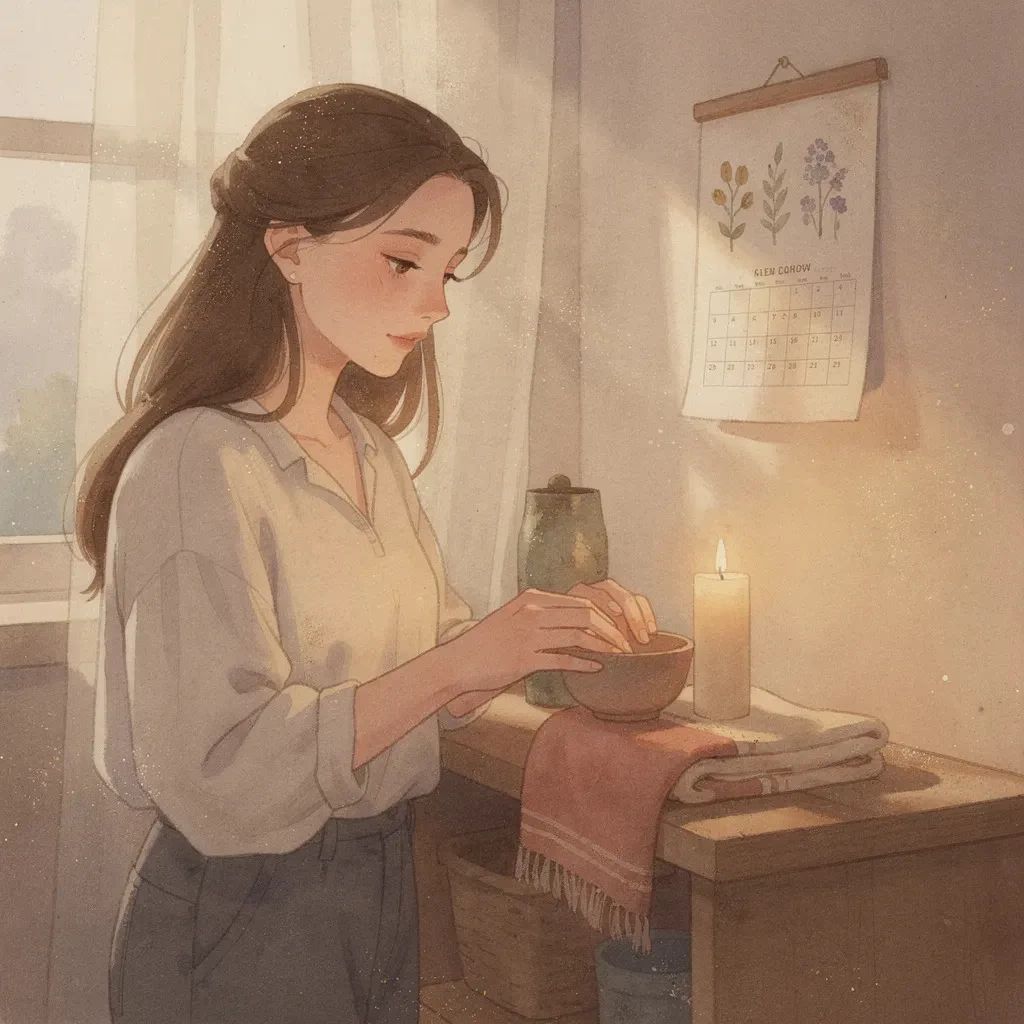
If you're the kind of person who feels calmer when there are words, steps, and a rhythm, you're not boring. You're not "too attached" to tradition. You're a Ritual Keeper.
A lot of women who type what should my religion be are really trying to ask something more tender: "Where can I go that will hold me when I'm not okay?"
If you've tried a chaotic, anything-goes spirituality and felt more anxious, not less, you might be relieved by this type. It can also explain why a random what is my religion quiz result never felt satisfying. You were missing the piece about structure.
Ritual Keeper Meaning
Core Understanding
Ritual Keeper means you connect through sacred rhythm. Repetition isn't empty for you. It's soothing. It's like your body finally knows where to put its hands, where to put its worry, where to put its longing.
This pattern often develops when life has felt emotionally unpredictable. Many Ritual Keepers learned that when people are inconsistent, routines can be faithful. You might have been the one who made your own stability: morning coffee, nightly shower, a playlist, a prayer you repeat, a walk you never skip. That is your wisdom.
Your body remembers the relief of structure. When you have a predictable practice, your shoulders drop. Your breathing deepens. Your thoughts stop racing so loudly. It's not about being strict. It's about feeling safe. This is also why "what is my religion" can quietly translate into "what can I actually live with day after day?"
What Ritual Keeper Looks Like
- You relax when someone gives you the words: If you're asked to pray spontaneously, you might freeze. But if someone hands you a prayer, you can finally be present.
- You love sacred seasons: Holidays, fasting periods, weekly gatherings, even the symbolism of colors and candles. It helps you track time in a way that feels meaningful, not chaotic.
- You feel guilty when you miss practice: Not because you're shallow, but because routine is how you stay steady. Missing it can feel like losing a handrail.
- You prefer clear containers: You do better when you know what a service will be like. Too much unpredictability can make you mentally scan for mistakes.
- You are sensitive to atmosphere: Lighting, music, ritual objects, the tone of a room. Your body can tell if a space is reverent or performative.
- You feel comforted by tradition: You might not agree with every doctrine, but you love the sense of lineage. It feels like being held by something older than your anxiety.
- You can struggle with communities that shame: If structure turns into control, you feel it immediately. Your body knows the difference between held and trapped.
- You like tangible practices: Standing, singing, lighting candles, repeating phrases. Doing something with your body helps your mind stop spiraling.
- You often carry responsibility: You may have been the good one, the dependable one. Ritual is where you finally get to rest inside someone else's care.
- You want gentle guidance: Not harsh rules, but clear direction. You want a path that doesn't make you guess.
- You value consistency in leaders: You do best with leaders who are stable and humble, not erratic and charismatic.
- You sometimes fear change: New religious spaces can feel like starting over socially. You might worry you'll do something wrong and look foolish.
- You are often secretly tender: Ritual can be the only place you let yourself cry. Because it feels safe enough.
- You can misread boredom: Sometimes steady feels boring at first if you've been living on adrenaline. Later you realize steady is what your body needed.
- You want faith to be livable: Not a series of dramatic highs. A steady life.
How Ritual Keeper Shows Up in Different Areas of Life
In romantic relationships: You often show love through reliability. You remember dates, you create traditions, you try to make life feel safe. When a partner is inconsistent, you can become anxious fast because your anchor gets yanked.
In friendships: You're the friend who checks in, who shows up, who brings soup. You might need friendships where care goes both ways, not only from you outward.
At work: You thrive with clear expectations. If the workplace is vague, your mind can spiral: "Am I doing enough?" Structure calms you.
Under stress: You reach for ritual. A short prayer. A repeated phrase. A routine shower. A candle. It's your way of returning to yourself.
What Activates This Pattern
- Unclear expectations and "we'll see" answers
- Being dropped into spontaneous religious environments with no guidance
- Leaders who change rules or vibes constantly
- Being shamed for wanting structure
- Feeling watched while you try to learn the rituals
- High-pressure demands dressed up as devotion
The Path Toward Inner Peace
- You do not have to apologize for needing rhythm: Your structure need is not controlling. It's your way of staying present.
- Choose traditions that separate structure from shame: Healthy structure gives you a handrail, not a leash.
- Let ritual serve you: If a practice starts feeling like self-punishment, that's information, not failure.
- Women who understand this type often find: They stop bouncing between extremes and build a steady spiritual life that actually holds them.
Ritual Keeper Celebrities
- Zendaya - Actress
- Anne Hathaway - Actress
- Amy Adams - Actress
- Reese Witherspoon - Actress
- Nicole Kidman - Actress
- Tom Hanks - Actor
- Hugh Jackman - Actor
- Denzel Washington - Actor
- Chris Evans - Actor
- Kristen Bell - Actress
- Emily Watson - Actress
- Pierce Brosnan - Actor
Ritual Keeper Compatibility
| Other Type | Compatibility | Why it feels this way |
|---|---|---|
| Mystic Seeker | 🙂 Works well | They bring depth; you bring steadiness, as long as nobody gets controlling. |
| Philosophical Explorer | 😐 Mixed | They can challenge your comfort with tradition, but you can ground their endless thinking. |
| Heart Devotee | 😍 Dream team | Shared warmth plus rhythm often feels like a safe spiritual home. |
| Community Builder | 🙂 Works well | Community gives you belonging, and your consistency strengthens the group. |
| Nature Mystic | 😐 Mixed | You may want more structure than they do, but you can meet in simple rituals outdoors. |
Am I a Philosophical Explorer?

You might be here because you're tired of being told "stop overthinking." Especially when the thing you're thinking about is your actual soul.
If you've Googled what is my religion and felt like every page either lectures you or tries to sell you a certainty you don't have, you might be a Philosophical Explorer.
This is the type for the woman who wants faith to be honest, coherent, and not emotionally manipulative. And yes, a what is my religion quiz can help, if it respects your mind. That's what Faith Compass is trying to do.
Philosophical Explorer Meaning
Core Understanding
Philosophical Explorer means your mind is one of your main doorways to meaning. You connect through understanding. Through good questions. Through seeing a belief tested and still standing.
This pattern often develops when you learned you can't rely on other people's certainty. Maybe you watched adults contradict themselves. Maybe you saw leaders misuse authority. So you learned to build internal stability through thinking: "If I can understand it, I can trust it."
Your body wisdom shows up as tension around vague answers. When someone speaks in sweeping statements, your stomach tightens. When someone says, "Don't question," your chest gets hot, like a boundary just got crossed. That's why "what should my religion be" can turn into a full-body stress response instead of a calm choice.
What Philosophical Explorer Looks Like
- You need clean logic: Not coldness. Clarity. When faith feels inconsistent, you feel unsettled. You might look skeptical. Inside, you're trying to feel safe.
- You respect humility: Leaders who admit complexity make you relax. Leaders who claim certainty about everything make you suspicious.
- You fear being tricked: Not because you're cynical, but because you're careful. You can feel it when a message is trying to hook you through guilt.
- You like frameworks: You enjoy comparing traditions, seeing differences, naming assumptions. It's how you answer "what religion best fits me" without panicking.
- You can feel alone in religious settings: If everyone is emoting and you're thinking, you might feel like the odd one out. You're not. You're just wired differently.
- You tend to research privately: Late-night rabbit holes, notes app full of questions, bookmarked lectures. You might not talk about it because you don't want to be argued with.
- You do not like performative spirituality: You want sincerity. If something feels like social theater, you mentally check out.
- You can struggle to commit: Because committing feels like closing a door on other truths. You might feel guilt about that. It's often just your honesty.
- You love debate with respect: You want conversation, not domination. When discussions turn into win/lose, you shut down or get sharp.
- You want faith to help with suffering: Not in a shallow way. In a way that actually makes life make more sense.
- You can intellectualize emotions: When you're hurt, you might analyze instead of feel. This is a protection, not a flaw.
- You are often deeply ethical: You care about what belief produces in real life. You want alignment between words and actions.
- You can feel spiritually restless: Because your standards are high. You're not trying to be difficult. You're trying not to lie to yourself.
- You might fear disappointing your family: Choosing a path can feel like a relational risk. This is why "what is my religion" is often a relationship question, not only a belief question.
- You secretly want softness too: Even if you lead with your mind, you still want comfort. You just want it without manipulation.
How Philosophical Explorer Shows Up in Different Areas of Life
In romantic relationships: You might need a partner who can talk about hard things without defensiveness. If someone shuts down conversations, you can spiral into thought loops: "Are we okay? What did that mean?"
In friendships: You're the friend who sends long voice notes with "I have a theory." You might crave friends who can hold big conversations without making it feel like a competition.
At work: You do well in roles that reward thinking and clarity. You can get drained by workplaces with unclear expectations, because ambiguity can feel like danger.
Under stress: You can over-research. You can try to think your way into safety. Growth is learning when your body needs comfort, not more information.
What Activates This Pattern
- Being told "just have faith" as a shut-down
- Contradictions and hypocrisy in leadership
- High-pressure recruitment tactics
- Feeling like questions are unwelcome
- Being forced into groupthink
- Vague spiritual language that avoids accountability
The Path Toward Inner Peace
- You are allowed to want intellectual integrity: Faith that requires you to turn off your brain isn't devotion. It's self-abandonment.
- Choose communities that welcome questions: Study circles, discussion groups, seminar-style spaces.
- Practice tiny embodied grounding: One small practice that brings you into your body can soften the endless mental loop.
- Women who understand this type often find: They can explore traditions without panic, because their process becomes a steady method, not a spiral.
Philosophical Explorer Celebrities
- Timothee Chalamet - Actor
- Andrew Garfield - Actor
- Saoirse Ronan - Actress
- Natalie Portman - Actress
- Joseph Gordon-Levitt - Actor
- Matt Damon - Actor
- Jodie Foster - Actress
- Ralph Fiennes - Actor
- Diane Keaton - Actress
- Alan Rickman - Actor
- David Bowie - Musician
- Maggie Gyllenhaal - Actress
Philosophical Explorer Compatibility
| Other Type | Compatibility | Why it feels this way |
|---|---|---|
| Mystic Seeker | 😐 Mixed | You can clash on proof vs mystery, but together you cover depth and honesty. |
| Ritual Keeper | 😐 Mixed | You might resist structure, but their practices can calm your mind when you're spiraling. |
| Heart Devotee | 🙂 Works well | Their warmth can soften your defenses, and your clarity can protect them from manipulation. |
| Community Builder | 🙂 Works well | Shared values and service can unite you, if community makes room for questions. |
| Nature Mystic | 🙂 Works well | Nature gives you quiet space to think, and their awe helps you feel, not only analyze. |
Am I a Heart Devotee?
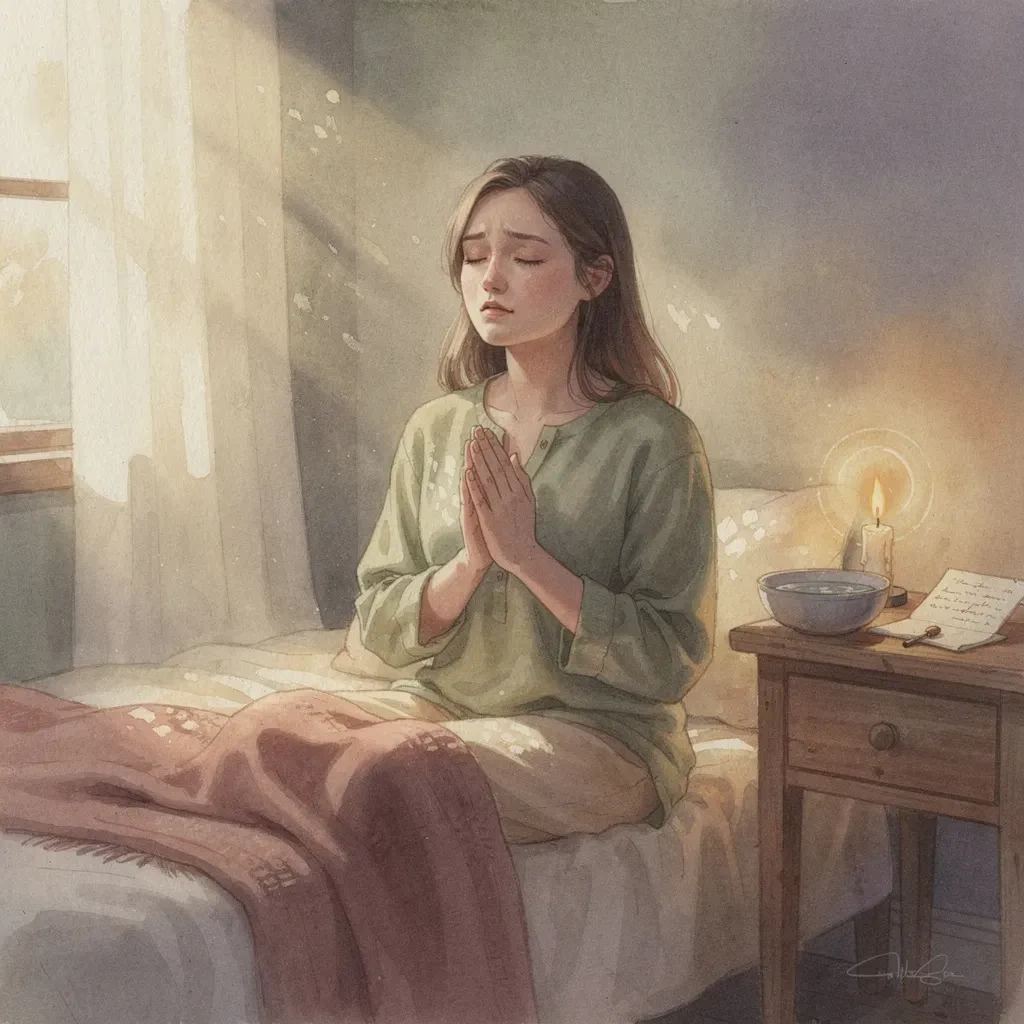
Some women are looking for a religion that makes sense. Some are looking for one that feels like home. Heart Devotees are usually looking for something even more personal: something that feels like love.
If your faith questions tend to show up right after heartbreak, loss, or loneliness, that makes sense. Your spirituality is relational. It's not an abstract hobby for you.
So when you ask what religion best fits me, you're often asking: "Where can I love without getting shamed for it?" And when you type what is my religion, what you might really want is: "Where can I be held?"
Heart Devotee Meaning
Core Understanding
Heart Devotee means your connection is love-forward. You want closeness. You want prayer to feel like talking to someone who actually cares. You want worship, if you do it, to feel like softness, not performance.
This pattern often develops when you learned to survive by being emotionally tuned in. Many Heart Devotees learned early to read moods, anticipate needs, and keep peace. So love became your language. In healthy faith spaces, that becomes a gift. In unhealthy spaces, it can get exploited.
Your body wisdom is strong here. When a faith space is kind, you feel your chest warm. You feel tears come easily. When a faith space is harsh, your body shrinks. Your stomach knots. You start apologizing without meaning to. That is why "what should my religion be" can feel like "where will my softness be safe?"
What Heart Devotee Looks Like
- You pray in a very human way: Not fancy. Honest. Sometimes messy. You might feel embarrassed about that if you grew up around formal prayer.
- You connect through music and emotion: A song can open you. A ritual can move you. People might judge that as too emotional. It's actually your doorway.
- You can attach to leaders: If a leader feels safe, you can bond fast. That isn't stupidity. It's longing. The key is choosing leaders who are humble and boundaried.
- You fear being abandoned by God: Especially if you've been abandoned or disappointed by people. You might interpret silence as rejection.
- You can feel guilty for wanting comfort: Like needing tenderness is weak. It's not. It's human.
- You give a lot: You volunteer, you care, you show up. Sometimes you do it so you feel worthy to belong.
- You crave reassurance: Not constant, but real. You do best in communities where reassurance is normal, not shamed.
- You want faith to heal your heart: You want it to help you forgive, soften, grieve, keep going. Not only to be right.
- You struggle with harsh doctrine: Fear-based teachings can make you spiral. Your body feels it as threat, not guidance.
- You love people deeply: Your empathy is huge. Sometimes you take on other people's pain like it's yours.
- You can confuse intensity with intimacy: A dramatic spiritual high can feel like closeness. Later you crash. Growth is learning steadiness.
- You can feel embarrassed by your devotion: Like you're too much. You're not. You just need the right container.
- You want rituals that feel personal: Lighting a candle for someone. Writing prayers. Blessing your day. Small acts of love.
- You want community, but safe community: You want closeness without gossip. Support without control.
- You want a religion that protects your tenderness: Not one that hardens you to survive.
How Heart Devotee Shows Up in Different Areas of Life
In romantic relationships: You love hard. Distance can feel like danger. If someone takes a long time to reply, your body can go into "did I do something wrong?" mode. Faith that teaches secure love (not fear) helps you regulate.
In friendships: You're often the emotional anchor. You listen. You remember details. You show up. The growth edge is allowing others to hold you too.
At work: You care about people, not just tasks. You can become the unofficial therapist. Boundaries matter, even if you feel guilty about them.
Under stress: You seek closeness. You may pray more, reach out more, or cling to routines that feel comforting. The danger is reaching for approval rather than support.
What Activates This Pattern
- When someone is cold or dismissive about emotions
- When love is framed as earned through obedience
- Being told you're too sensitive in spiritual spaces
- Silence after you reached out (to God or people)
- Feeling like you have to be perfect to be loved
- Leaders who use your empathy to extract free labor
The Path Toward Inner Peace
- You do not have to stop being tender: Your love is your strength. Growth is learning where to place it.
- Choose devotion without self-erasure: Faith spaces that honor boundaries protect your heart long-term.
- Build small reassurance rituals: A short daily prayer, a gratitude list, a candle. Not to perform. To be held.
- Women who understand this type often find: Their love becomes steadier, and they stop confusing guilt with holiness.
Heart Devotee Celebrities
- Hailee Steinfeld - Actress
- Ariana Grande - Singer
- Taylor Swift - Singer
- Adele - Singer
- Jennifer Lawrence - Actress
- Julia Roberts - Actress
- Meg Ryan - Actress
- Sandra Bullock - Actress
- Jennifer Aniston - Actress
- Dolly Parton - Musician
- Channing Tatum - Actor
- Josh Groban - Singer
Heart Devotee Compatibility
| Other Type | Compatibility | Why it feels this way |
|---|---|---|
| Mystic Seeker | 🙂 Works well | They give you depth without judgment, and you give them warmth without control. |
| Ritual Keeper | 😍 Dream team | Structure plus tenderness often creates true safety for your heart. |
| Philosophical Explorer | 🙂 Works well | Their clarity can protect your tenderness, if they stay emotionally present. |
| Community Builder | 😍 Dream team | Belonging and care feel natural, as long as you are not over-giving. |
| Nature Mystic | 🙂 Works well | Nature gives you quiet closeness and gentle awe without social pressure. |
Am I a Community Builder?
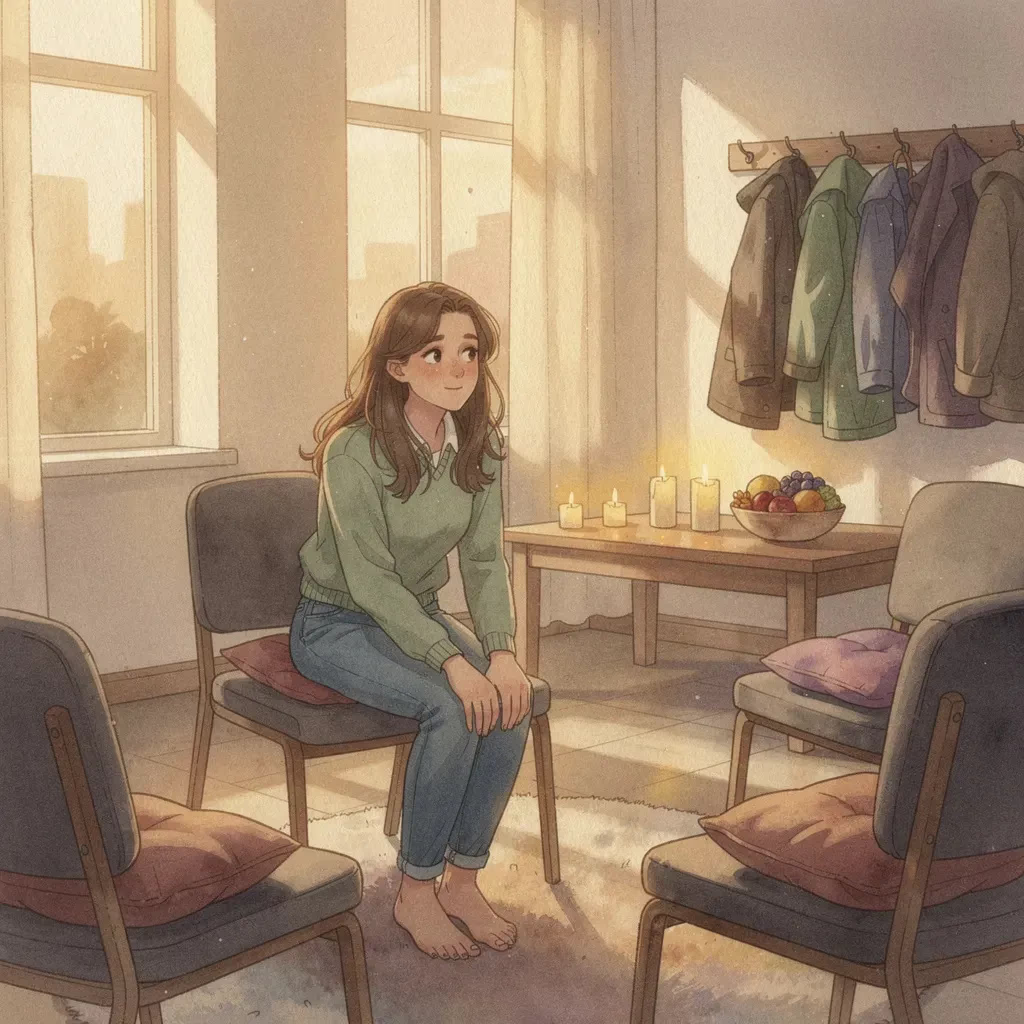
If you've ever walked into a service and thought, "Okay but... who would notice if I disappeared?" then yeah. You're probably here for community, not just belief.
Community Builders are the women who want faith to show up as people actually caring. Real support. Real showing up. Not just nice words.
If you're searching what religion best fits me, your compass might be pointing toward the kind of place where you can be known, not only taught. It can also explain why "what should my religion be" feels like a belonging question first.
Community Builder Meaning
Core Understanding
Community Builder means your spiritual life is relational. You connect to meaning through shared life: meals, service, rituals done together, people who know your name, people who check on you when you miss a week.
This pattern often develops when you learned (sometimes painfully) that being alone is hard for you. Not because you're weak. Because you're wired for connection. Many women with this type grew up being the peacemaker or caregiver. You learned closeness is safety. So spiritual loneliness can feel like actual danger.
Your body wisdom shows up in groups. In a healthy community, you exhale. You laugh. You feel your shoulders drop because you are not carrying everything alone. In a cold community, your stomach tightens and you start working to earn your place.
What Community Builder Looks Like
- You feel spiritually alive around safe people: Not crowds. Safe people. You can tell the difference instantly by how your body feels when you walk in.
- You crave consistency: You want a place you can return to. Being new over and over is exhausting.
- You tend to become the helpful one: You volunteer fast. You offer rides. You host. On the outside, you look generous. Inside, you might be trying to secure belonging.
- You can fear conflict: Disagreement can feel like rejection. You might swallow opinions to stay loved.
- You want faith to be lived: Service, care, justice, community support. You do not want spirituality that stays in the head.
- You notice who is left out: You feel the edges of a room. You sense when someone is alone. You often move toward them.
- You can get burned out: Because you over-give. You might do community until you are empty, then feel guilty for needing rest.
- You need emotional safety in leaders: Leaders who respect boundaries, who do not demand access to your life, who do not use guilt.
- You fear being judged: Especially if you're exploring outside your family's tradition. "What will they think?" can be louder than "what do I need?"
- You like shared rituals: Singing together, lighting candles together, communal prayers. It makes you feel held.
- You hate cliques: They spike your body signals. You can feel it when belonging is conditional.
- You want friendships that deepen: Not surface-level. You want to grow roots with people.
- You can confuse busyness with belonging: Being useful is not the same as being loved. This is a big growth edge for Community Builders.
- You want people to notice you: Not in an attention way. In a human way. Like "you matter here."
- You are a natural connector: You introduce people. You bridge groups. You create warmth. The right community will appreciate this without exploiting it.
How Community Builder Shows Up in Different Areas of Life
In romantic relationships: You might merge quickly when you feel safe. You want partnership that feels like a team. If a partner is inconsistent, your anxiety can spike because you rely on connection to feel grounded.
In friendships: You are often the organizer. You remember birthdays, you plan dinners, you check in. You might need friends who initiate too, so you're not always the one holding the social web.
At work: You often become the culture glue. You make people feel welcome. You can also become the one everyone unloads on. Boundaries are crucial here.
Under stress: You reach outward. You want to talk, process, be held. If support is not available, you can spiral into loneliness and self-blame.
What Activates This Pattern
- Feeling excluded or not invited
- Walking into a space where everyone already knows each other
- Being praised only for what you do, not who you are
- Leaders who demand loyalty as proof of faith
- Being guilted into constant volunteering
- When your absence is not noticed
The Path Toward Inner Peace
- You are allowed to belong without earning it: You do not have to be useful to be worthy.
- Choose community with mutual care: Look for shared responsibility, not one person carrying everything.
- Practice saying small honest no's: Not dramatic ones. Just enough to keep your energy.
- Women who understand this type often find: Their community life becomes nourishing instead of draining, because they stop buying belonging with burnout.
Community Builder Celebrities
- Simone Biles - Athlete
- Millie Bobby Brown - Actress
- Chrissy Teigen - Model
- Blake Lively - Actress
- Ryan Reynolds - Actor
- Drew Barrymore - Actress
- Goldie Hawn - Actress
- John Travolta - Actor
- Dwayne Johnson - Actor
- Chris Hemsworth - Actor
- Sally Field - Actress
- Matt LeBlanc - Actor
Community Builder Compatibility
| Other Type | Compatibility | Why it feels this way |
|---|---|---|
| Mystic Seeker | 😐 Mixed | You want people; they want space. It works if you honor each other's pacing. |
| Ritual Keeper | 🙂 Works well | Shared rhythm helps you feel held, and you bring warmth to their structure. |
| Philosophical Explorer | 🙂 Works well | Shared values can unite you, if they do not stay only in ideas. |
| Heart Devotee | 😍 Dream team | You both value closeness and care, just watch over-giving. |
| Nature Mystic | 😐 Mixed | They recharge alone; you recharge together. Small, gentle gatherings work best. |
Am I a Nature Mystic?
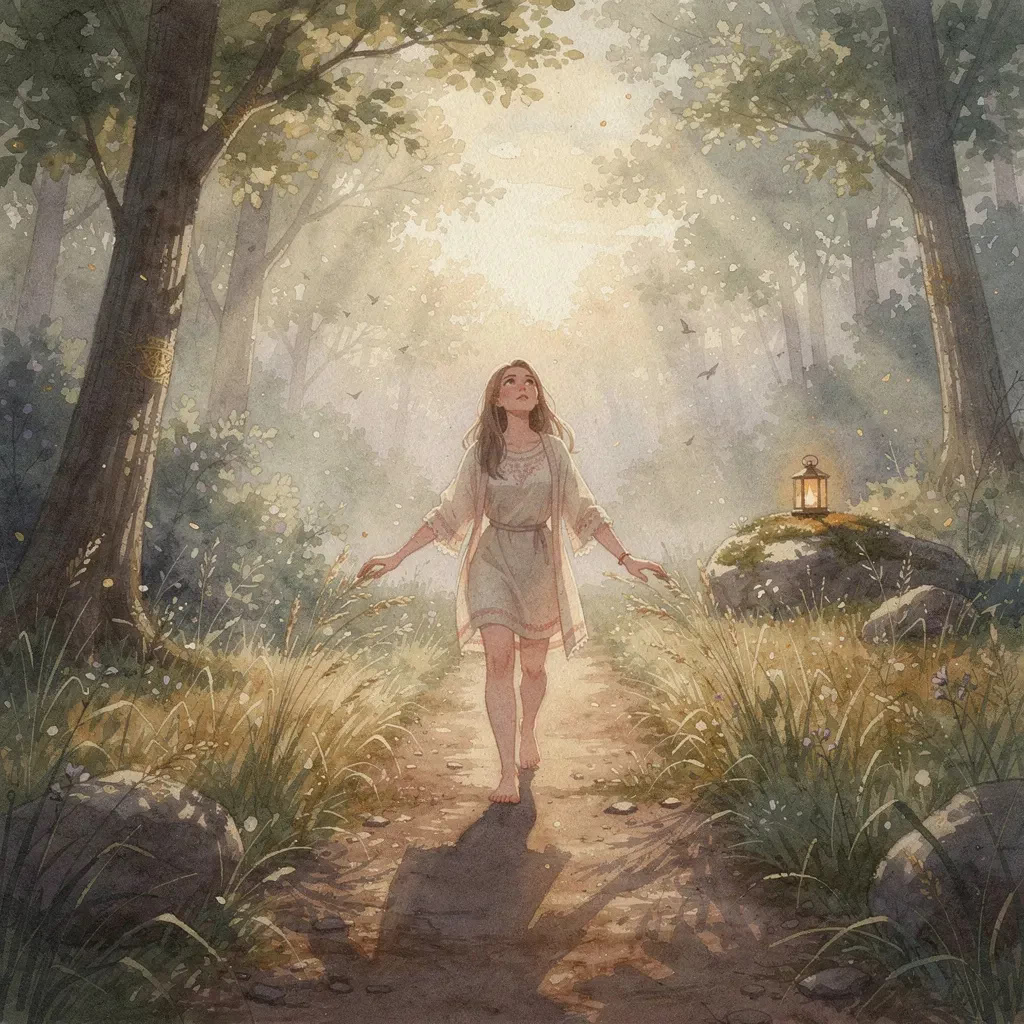
Nature Mystics are often the women who feel closest to the sacred when nobody is watching.
If you've been sitting in a religious space and thinking, "Why do I feel more peace on a random walk than I do in here?" that is not you failing at religion. That's information.
And if you keep asking what should my religion be, your answer might not be a building. It might be a practice. A rhythm with the earth. A community that honors the outdoors as sacred too. This is often the missing piece behind "what religion best fits me."
Nature Mystic Meaning
Core Understanding
Nature Mystic means the sacred shows up inside the world for you. Wind, trees, ocean, sunrise, the hush before snow. That is where your heart unclenches.
This pattern often develops when human spaces felt too loud, too evaluative, or too complicated. Many women with this type learned to regulate by going outside. Nature became the one place that didn't demand a performance. No one grades your devotion on a trail.
Your body remembers this safety. In nature, your breathing deepens. Your shoulders drop. Your eyes soften. You stop scanning faces and start sensing your own inner rhythm again. For you, "what is my religion" might be answered more by a feeling than a statement.
What Nature Mystic Looks Like
- Awe is your prayer: You might not use religious language, but you feel reverence. A sunset can make you cry. That is devotion, even if it's not labeled.
- You prefer spaciousness: Crowds can make you tense. It's not that you hate people. Your system just calms down in open air.
- You trust lived experience: If a belief doesn't produce peace, compassion, or steadiness, you question it. You do not want a faith that requires you to deny your own senses.
- You make meaning through seasons: You feel different in winter than summer. You might crave faith that honors that instead of demanding constant cheer.
- You are sensitive to hypocrisy: If a community talks about love but feels harsh, your body notices. You might leave quietly without drama.
- You love small rituals outside: A candle on a porch. A gratitude list under a tree. A walk as meditation.
- You can feel spiritually lonely: Because your kind of faith is hard to explain to people who expect religion to look like a building.
- You can feel guilt about not being religious enough: Especially if your family has a tradition. But your way of connecting is real.
- You value simplicity: You do not want complicated rules. You want practices that translate into daily life.
- You can be deeply ethical: You often care about stewardship, kindness, the web of life. Your spirituality shows up through how you treat the world.
- You like quiet community: If you do community, you prefer it small: hikes, circles, gentle gatherings, not intense crowds.
- You can struggle with rigid doctrine: Not because you're rebellious. Because it can feel disconnected from reality and experience.
- You are protective of your peace: You might need to learn you can protect it without disappearing from relationships.
- You want spirituality to be embodied: Walking, breathing, being present. Not only thinking.
- You feel at home outside: This is your strongest clue about what religion best fits me. Your home is where your body relaxes.
How Nature Mystic Shows Up in Different Areas of Life
In romantic relationships: You need partners who respect your need for alone time and outdoor time. If someone takes it personally, you can feel misunderstood and pressured to perform closeness instead of living it.
In friendships: You might prefer one-on-one friendships, slow and deep. You do not love constant group chats and social pressure. A friend who can walk with you and be quiet is gold.
At work: You might daydream about open air when you're stuck under fluorescent lights. You do best when you can take breaks outside or have a calming environment.
Under stress: You seek nature. You might drive to a park, sit in the car, and breathe. It's not avoidance. It's regulation. The growth edge is also building a few indoor practices for days you cannot get outside.
What Activates This Pattern
- Being trapped indoors for long stretches
- Loud, emotionally intense group settings
- Doctrine that dismisses lived experience
- Being mocked for finding God in nature
- Feeling pressured to attend religious events that drain you
- Feeling like you have to choose between your peace and your people
The Path Toward Inner Peace
- You are allowed to let nature be your sanctuary: You do not need permission for what already heals you.
- Find traditions that honor the earth: Some communities integrate outdoor ritual, seasons, and stewardship naturally.
- Build one tiny daily anchor: A short breath practice by a window. A candle at dusk. Something that keeps you connected even indoors.
- Women who understand this type often find: They stop trying to force themselves into loud spaces and start building a faith life that fits their actual needs.
Nature Mystic Celebrities
- Margot Robbie - Actress
- Daisy Ridley - Actress
- Jason Momoa - Actor
- Alicia Vikander - Actress
- Ryan Gosling - Actor
- Emily Blunt - Actress
- Chris Pine - Actor
- Cameron Diaz - Actress
- Matthew McConaughey - Actor
- Harrison Ford - Actor
- Robert Redford - Actor
- Jane Goodall - Conservationist
Nature Mystic Compatibility
| Other Type | Compatibility | Why it feels this way |
|---|---|---|
| Mystic Seeker | 😍 Dream team | Shared awe and spaciousness, with room for mystery and quiet. |
| Ritual Keeper | 😐 Mixed | You may resist their structure, but simple outdoor rituals can bridge the gap. |
| Philosophical Explorer | 🙂 Works well | Their clarity supports you, and your experience helps them soften into presence. |
| Heart Devotee | 🙂 Works well | Their love brings warmth, and your peace helps them feel held without pressure. |
| Community Builder | 😐 Mixed | You need alone time; they need togetherness. Small gatherings work best. |
If you're stuck in "what should my religion be" loops, here's the truth
If you're constantly Googling what religion best fits me or clicking a what is my religion quiz, you're not indecisive. You're trying to find safety and belonging at the same time, and that's a tender thing to carry. Faith Compass: What Religion Fits Me? helps you name the difference between a place that looks "right" and a path that actually fits your life.
A few small ways this quiz helps right away
- Discover what religion best fits me energy, without forcing a label.
- Understand what is my religion in a way your body agrees with.
- Recognize what should my religion be is often about belonging, not just belief.
- Clarify your next step with a what is my religion quiz that respects your pace.
- Connect to community options that feel safe, not performative.
- Explore what should my religion be with less guilt and more self-trust.
| Where you are now | What becomes possible |
|---|---|
| You keep asking "what is my religion" and feeling guilty that you can't answer cleanly | You get language for your spiritual style, so your questions feel like wisdom, not failure |
| You keep wondering "what should my religion be" because family expectations feel heavy | You learn how to explore slowly, with boundaries, without detonating relationships |
| You want a place to belong but fear being judged | You learn what kind of community is most likely to feel emotionally safe for you |
| You keep trying random "what religion best fits me" advice and nothing sticks | You get a personal compass built from your real needs: structure, freedom, community, solitude, certainty, mystery |
Join over 190,619 women who've taken this in under 5 minutes to feel less alone in their faith questions. Your answers stay private, and you get private results.
FAQ
What is the "Faith Compass: What Religion Fits Me?" quiz actually measuring?
It measures your spiritual "fit" across a few human things that matter more than labels: what you believe about the divine (or meaning), what practices help your nervous system feel steady, what kind of community feels safe, and how you make sense of suffering and purpose. In other words, it is a "what religion best fits me quiz" that looks at how you naturally relate to faith, not how well you can recite facts.
If you've ever felt that quiet pressure to pick the "right" path fast, this makes perfect sense. So many of us want belonging and certainty, but we are also terrified of choosing wrong and disappointing ourselves (or someone else). Faith exploration can feel like dating, in the worst way, because it pokes the same fear: "What if I commit and then realize I don't belong?"
Here's what's really happening under the surface. When people search "which religion matches my beliefs," they are usually trying to answer one of these deeper questions:
- "Where do I feel emotionally safe?"
- "Do I need structure, or do I need freedom?"
- "Do I connect through ritual, through ideas, through nature, through love, through community, or through mystery?"
- "Do I want a faith that tells me what is true, or one that invites me to keep exploring?"
So the Faith Compass quiz is less about stamping you with a permanent identity and more about revealing your current orientation. Think of it like a compass reading, not a cage.
You will see themes that align with one of six styles people tend to resonate with:
- Mystic Seeker: drawn to mystery, personal experience, direct encounter
- Ritual Keeper: steadied by tradition, rhythm, symbols, sacred repetition
- Philosophical Explorer: wants coherence, reasoning, ethics, big questions
- Heart Devotee: connects through love, devotion, prayer, intimacy with the divine
- Community Builder: finds faith through belonging, service, shared values
- Nature Mystic: meets the sacred outdoors, through seasons, awe, embodiment
None of these are "better." They are different ways of feeling held by life.
Practical way to use this: after you get your result, ask, "If I honored this style for 30 days, what would I do more of?" For a Ritual Keeper, that might be lighting a candle nightly. For a Philosophical Explorer, it might be reading one thoughtful essay a week. For a Community Builder, it might be visiting one welcoming group and staying only as long as you feel safe.
If you're curious and want a gentle starting point, this quiz is designed for faith exploration without judgment, especially if you've felt overwhelmed by options.
How do I know which religion matches my beliefs if I'm not sure what I believe yet?
You can still find a strong direction even if you are not sure what you believe yet. Most people do not start with a neat list of beliefs. They start with felt experiences: what makes them feel grounded, what makes them feel loved, what makes life feel meaningful.
If you're in that in-between place, it makes perfect sense. Uncertainty can feel like you are "failing" at spirituality, especially if you grew up around confident answers. But uncertainty is often the beginning of honesty. A lot of women are quietly asking "how to find the right spiritual path" while also thinking, "I don't even know what questions I am allowed to ask."
Here are a few clearer, gentler anchors than "belief statements":
What do you trust: experience, tradition, or reason?
- If you trust lived experience most, you may lean Mystic Seeker or Nature Mystic.
- If you trust tradition and continuity, Ritual Keeper often fits.
- If you trust logic, ethics, and coherence, Philosophical Explorer is common.
What kind of spiritual language feels safe?
- Personal God language can feel like home for Heart Devotees.
- Non-theistic or symbolic language can feel steadier for Philosophical Explorers or Mystic Seekers.
- Earth-based language often resonates with Nature Mystics.
What helps your nervous system settle?
This part matters more than people admit. Some of us calm down with structure (ritual, repetition, liturgy). Some of us calm down with freedom (silence, nature, meditation, journaling). Your body is giving you real data.What do you need more right now: belonging or space?
- If loneliness is the sharpest pain, Community Builder paths can be healing.
- If you have been overwhelmed by other people's expectations, solo practices can be a relief first.
A practical mini-exercise: think back to the last time you felt awe, relief, or tenderness. Where were you? What was happening? Who was there? That memory is often a clue about your "spiritual home base," even before you can name beliefs.
And here's permission you might need to hear plainly: you're allowed to explore before you commit. You are allowed to be unfinished. Discovering your authentic faith path is not a performance.
A "quiz to find my spiritual path" can help here because it gives you language for patterns you already live, even if you cannot articulate them yet. It is like having someone hold up a mirror without judging the reflection.
How accurate is a "what is my religion quiz" and can it really tell me what faith fits?
A "what is my religion quiz" can be surprisingly accurate at identifying what you are drawn to and what supports you. It cannot (and should not) "assign" you a religion like a diagnosis. The best use is clarity, not compliance.
If you've been burned by oversimplified personality tests, your skepticism is healthy. So many women have taken quizzes that felt like, "Pick a color, and now you're cured." Faith is more layered than that. You have history. Family. Culture. Trauma. Joy. Questions. A one-minute quiz cannot hold all of you.
Here's what accuracy looks like in this space:
- High accuracy for orientation: how you prefer to connect (ritual vs. nature vs. ideas vs. devotion vs. community vs. mystery)
- Moderate accuracy for next steps: what practices or environments you might try first
- Low accuracy for identity: what you "are" forever, or what tradition you must join
What makes a spiritual path quiz more trustworthy?
It asks about patterns, not trivia.
Your fit is about how you experience meaning, not whether you can name founders and holidays.It allows complexity.
Many people score high in two areas. That is normal. You might be a Philosophical Explorer with a Heart Devotee streak. Or a Community Builder who also needs Nature Mystic solitude.It gives you language you can verify in real life.
The best results make you think, "Wait, that is exactly how I am." Not "I guess that could be anyone."It does not pressure you.
Faith exploration without judgment is the whole point. If a quiz tries to scare you into a label, that is not spiritual. That is marketing.
A practical way to test your result: try one small experiment for a week. If you get Ritual Keeper, try a simple daily ritual (same time, same place, one repeated prayer or intention). If you get Nature Mystic, schedule one quiet walk with no podcast. If you get Community Builder, attend one gathering where service or support is central. Your body will tell you what feels nourishing.
The beautiful thing is that accuracy grows when you treat the quiz as a compass, then validate it with lived experience. You do not need perfect certainty to start. You just need one honest next step.
Am I allowed to change religions (or step away from the faith I grew up with)?
Yes. You are allowed to change religions, step away, return later, blend practices carefully, or take a long pause. Your spiritual life belongs to you, even if other people have big feelings about it.
If this question is even coming up for you, there is usually a lot underneath it. Guilt. Fear of disappointing family. Fear of being "wrong." Fear that love will be taken away if you choose differently. So many women are carrying this exact tension: "I want to be honest, but I also want to belong."
Here's what's important to understand. In many communities, religion is not only beliefs. It is identity, family culture, language, holidays, shared memories, and sometimes safety. Changing can feel like you are threatening the fabric of your relationships. That is why this is so emotionally loaded.
A few truths that can hold you steady:
Questioning is not betrayal.
Curiosity is a form of integrity. You are not being dramatic. You are responding to something real inside you.You can honor your roots without living inside them.
Some people keep cultural practices (music, food, holidays) while changing theology. Some keep the ethics while shifting the metaphysics. There is more than one way to be respectful.It is okay to move slowly.
You do not owe anyone a sudden announcement. You also do not owe endless explanations. Your timeline is allowed to be gentle.Safety matters.
If changing religions could risk your housing, finances, or physical safety, you are not "weak" for being careful. You are wise. Many people explore quietly first for this reason.Grief can be part of growth.
Even when a change is right, you might grieve the simplicity of belonging, or the version of you who believed easily. That grief does not mean you chose wrong.
Practical approach: separate "belief" from "belonging." Ask yourself, "What parts do I miss: the community, the music, the certainty, the rituals, the sense of God, the moral framework?" That helps you seek those needs in healthier places.
A free spiritual path quiz can give you a language for what you are actually seeking, which makes this whole process feel less like chaos and more like self-respect.
Why do I feel spiritually lost even when I'm doing all the "right" things?
You can feel spiritually lost even while doing all the "right" things because right actions without inner resonance create quiet disconnection. Your life can look faithful on the outside while your inner world feels untouched. That does not mean you're ungrateful or broken. It means your soul is asking for something truer.
If you know that feeling of going through motions and still feeling alone inside, of course you are tired. So many of us learned that spirituality is something you perform correctly to stay safe and loved. When you're anxiously attached, you can bring that same pattern into faith: trying to be "good" so you won't be rejected. It makes sense. It also exhausts you.
Here's what's really happening in a lot of cases:
Your practices might not match your spiritual style.
A Philosophical Explorer forced into purely emotional worship can feel empty. A Heart Devotee stuck in only intellectual debate can feel starved. A Nature Mystic in a fluorescent room every week can feel numb. Fit matters.You might be confusing compliance with connection.
Compliance is doing what is expected. Connection is feeling met. Many traditions have space for both, but if your inner life is never addressed, you can drift.Your nervous system might not feel safe.
Spirituality opens the heart. If you are in a community where you fear judgment, your body will stay guarded. That can feel like "I cannot feel God" when it is actually "I do not feel safe enough to soften."You might be in a season of deconstruction or maturation.
Sometimes faith evolves like relationships do. The early stage is intense certainty. The later stage is deeper, quieter, more honest. This can feel like loss before it feels like growth.
A practical step: write down the last three moments you felt spiritually alive, even tiny ones. Then circle what they had in common: was it beauty, ritual, silence, love, community, ideas, service, nature, mystery? Those common threads point you toward your natural pathway.
This is exactly where a "quiz to find my spiritual path" can be comforting. It helps you stop blaming yourself and start identifying what actually nourishes you.
How do I find the right spiritual community without feeling pressured or judged?
You find the right spiritual community by choosing spaces that respect your pace, your questions, and your boundaries. A healthy community makes you feel more like yourself, not less. Pressure is not devotion. Judgment is not guidance.
If you've ever walked into a group and immediately felt like you had to "act right" to be accepted, you are not imagining it. Many women are hyper-aware of micro-signals (tone, eye contact, who gets included). When you already carry abandonment fear, spiritual spaces can feel especially high-stakes. You are not too sensitive. You are picking up on belonging cues.
Here's a grounded way to do "spiritual community finder" energy in real life, without forcing yourself:
Start with low-commitment visits.
Attend once. No volunteering. No joining. No explaining your whole story. You are allowed to observe.Look for consent-based culture.
Healthy groups do not demand immediate intimacy. They do not push you to disclose. They do not punish questions. They do not rush you into membership to prove loyalty.Notice how they handle doubt.
Ask (even casually), "What is this community like with questions?" A mature community has language for uncertainty. An unsafe one shames it.Pay attention to power dynamics.
Are leaders accountable? Are there clear policies? Is there room for disagreement? Spiritual harm often comes from unchallenged authority.Check if your body unclenches.
This is practical and real. Do you breathe easier after? Do you feel more peaceful or more activated? Your nervous system is a wise advisor.Choose communities that match your Faith Compass style.
- Community Builder: service groups, mutual aid, small groups, shared meals
- Ritual Keeper: liturgical spaces, consistent practices, sacred calendar
- Nature Mystic: outdoor circles, contemplative hikes, seasonal gatherings
- Philosophical Explorer: study groups, interfaith discussions, ethics-centered communities
- Heart Devotee: prayer circles, devotion, music, compassionate warmth
- Mystic Seeker: contemplative groups, meditation, silence, mystical theology
A gentle permission: you do not have to stay somewhere just because they are nice. Nice is not the same as aligned. You are allowed to want a community that actually fits.
If you're trying to find belonging and you want a clearer starting point, the Faith Compass quiz can help you identify what kind of community will feel safest and most nourishing.
What if I relate to more than one religion (or more than one Faith Compass type)?
It is normal to relate to more than one religion, and it is common to resonate with more than one Faith Compass type. Most humans are not spiritually "single-origin." We are influenced by family, friendships, books, grief, love, travel, art, and seasons of life. Your openness is not confusion. It is capacity.
If you have ever worried, "Does this mean I'm fake?" or "Am I doing this wrong?" that worry makes perfect sense, especially if you were taught that certainty equals goodness. A lot of us internalized the idea that belonging requires a clean label.
Here's what's really going on when you relate to multiple paths:
Different traditions meet different needs.
You might love the ritual stability of one space (Ritual Keeper) and also crave nature-based awe (Nature Mystic). That can be a real, coherent spiritual life.Some people are bridge-builders by nature.
Philosophical Explorers often see connections across systems. Mystic Seekers often recognize shared contemplative experiences across religions.Your season might be shifting.
In one season, you need community. In another, you need solitude. Your "fit" can change as your life changes, without that invalidating who you were.
A practical way to handle this without spiraling:
Separate core beliefs from practices.
You can practice meditation without adopting every metaphysical claim. You can light a candle for intention without forcing yourself to define exactly what it "means."Create a "yes list" and a "not yet list."
Yes list: practices and spaces that feel nourishing right now. Not yet list: things you are curious about but not ready to claim. This keeps you honest without pressuring yourself.Avoid panic-joining.
When you are craving certainty, it is easy to commit quickly just to stop the anxiety. Give yourself time to see what is sustainable.
One more permission: you are allowed to explore without having your final answer. Discovering my authentic faith path often looks messy from the outside. Inside, it can be deeply sincere.
The Faith Compass quiz can help you name your strongest patterns so you understand why multiple traditions are pulling you. That turns "I am all over the place" into "Oh, I have a specific spiritual wiring."
After I take a "what religion best fits me quiz," what should I do next (without overwhelming myself)?
After you take a "what religion best fits me quiz," the best next step is one small, low-pressure experiment aligned with your result. You do not need to announce a new identity or overhaul your whole life. You need a gentle, real-world test that helps you feel what fits.
If you tend to overthink (especially at night), this is where overwhelm hits: "Now I have a result, and I have to do it perfectly." Of course that happens. When you are used to earning belonging, even spiritual exploration can turn into another performance.
Here's a simple, steady framework that works for most people:
Choose one practice for 7 days.
Keep it tiny on purpose. Your goal is consistency, not intensity.- Mystic Seeker: 10 minutes of silence, meditation, contemplative reading
- Ritual Keeper: one candle, one short prayer/intention, same time daily
- Philosophical Explorer: one short lecture/podcast or essay, then journaling
- Heart Devotee: a personal prayer, gratitude, devotional music
- Community Builder: one meetup, one service act, one supportive conversation
- Nature Mystic: one outdoor walk with attention to awe and senses
Choose one learning step, not ten.
If you are searching "how to find the right spiritual path," it is easy to binge information until you feel numb. Pick one book or one reliable resource. Let it be enough for now.Choose one community touchpoint (optional).
Not everyone is ready for community immediately. If you are, keep it low-stakes. If you are not, solo practice counts.Track three signals, not your whole identity.
After each practice, jot:- Did I feel calmer or more activated?
- Did I feel more connected to myself?
- Did I feel pressured, or free?
Give yourself a two-week "no big decisions" window.
This is a kindness. It keeps you from committing out of anxiety. It also keeps you from quitting out of fear.
The beautiful thing is that this approach makes your path feel like it is unfolding, not like you are forcing it. Tomorrow might feel 2% lighter. That is real progress.
If you have not taken the quiz yet, it can help you pick the right kind of first experiment instead of guessing. It is a free spiritual path quiz designed to give you clarity without judgment.
What's the Research?
What the research tells us about "What religion fits me?"
That late-night spiral of "Why doesn't my old faith feel like home anymore?" is way more common than people admit out loud. Religious identity is not just about what you believe in your head. Researchers describe it as a mix of belonging, meaning, and group membership that shapes how you see yourself and the world (Religious identity - Wikipedia; Religious identity (ScienceDirect Topics)).
And here is a grounding stat that makes a lot of women exhale: a substantial chunk of people change. Pew reports that about 35% of U.S. adults have moved on from the religion of their youth (switching to another faith or becoming unaffiliated) (Detroit Catholic summarizing Pew findings). Another Pew snapshot shows the U.S. has been relatively stable since 2020 at roughly 60-64% Christian and 28-31% unaffiliated (the "nones") (Pew Religious Landscape Study: Religious identity).
If you are taking a "What religion best fits me quiz" because you are scared you are betraying someone (family, a partner, your past self), research basically confirms: exploring is a normal part of identity development, especially in your 20s. The years from late teens through the 20s are literally described as a period of continued identity formation and shifting worldviews (Religious identity - Wikipedia).
Why "belonging" matters as much as belief
A lot of us were taught to treat religion like a list of doctrines you either accept or reject. But social science keeps pointing back to something more tender: community and identity can be the mechanism that makes religion feel stabilizing.
One study (using U.S. MIDUS data, 3,032 participants) found that religious social identity helps explain why service attendance is associated with better psychological well-being. In other words, it is not only "going to services" that matters. Feeling like you belong, like you are "one of us," may be part of what improves well-being (Religious Social Identity study - PMC). That also helps explain why faith can feel supportive for some people and stressful for others: if the community part feels rejecting, controlling, or unsafe, your nervous system will not read it as "home."
If you have an anxiously attached nervous system, it makes so much sense that you are not only asking "Which religion matches my beliefs?" You are also quietly asking "Where will I be held, not judged?" And that is not you being "too much." That is you being honest about what humans need.
This is also why "religious identity" and "religiosity" are not the same thing. You can identify with a tradition even if your participation changes (and participation often declines in emerging adulthood even when identity stays relatively stable) (Religious identity - Wikipedia). So if your attendance is inconsistent or you are in a questioning phase, that does not automatically mean your faith is fake or gone.
Spirituality vs religion: the research supports "both/and"
Another thing research keeps validating: spirituality is a broad category. For some people it is tied to organized religion. For others it is meaning, purpose, and connectedness without a formal institution (Spirituality - Psychology Today; What is Spirituality? (UMN Taking Charge)).
A widely used definition from Christina Puchalski (via the University of Minnesota's Bakken Center site) describes spirituality as how people seek meaning and experience connectedness to self, others, nature, and "the significant or sacred" (What is Spirituality? (UMN Taking Charge)). That matters for this "Faith Compass: What Religion Fits Me?" question because it gives you permission to evaluate a path by more than one dimension:
- Do you need doctrine and tradition?
- Do you need practices that regulate your nervous system?
- Do you need ethics and a life framework?
- Do you need community, service, or a sense of belonging?
- Do you need awe, mystery, and direct experience?
Comparative religion as a field exists basically because humans have been asking, "How do different traditions answer the same deep questions?" It systematically compares beliefs, practices, themes, and impacts across religions (Comparative religion - Wikipedia). And one detail I love from that scholarship: not every tradition treats religion as exclusive in the Western "pick one" way. Some religious cultures blend practices over time (Wikipedia uses examples like Buddhism and Chinese folk traditions blending, and the idea that not every tradition frames itself around salvation the same way) (Comparative religion - Wikipedia). That is a gentle reminder that your exploration does not have to look like a dramatic break-up. Sometimes it is more like learning a new language for the sacred.
You are allowed to change religions. You are also allowed to explore without instantly converting. This is not indecision. It is discernment.
How this connects to your Faith Compass results (and why the "types" make sense)
When a quiz like "What is my religion quiz" gives you a result type, it is usually trying to capture which spiritual needs are loudest in you right now, not handing you a forever-label.
Across research, scholars consistently treat religion as a mix of meaning-making, practice, identity, and community effects (Religious identity - Wikipedia; Comparative religion - Wikipedia). That maps cleanly onto the six Faith Compass styles:
- Mystic Seeker: drawn to direct experience of the sacred (mysticism, awe, "something more").
- Ritual Keeper: drawn to structure, rhythm, tradition, embodied practices.
- Philosophical Explorer: drawn to coherence, ethics, big questions, intellectual honesty.
- Heart Devotee: drawn to love, compassion, devotion, relationship with the divine.
- Community Builder: drawn to belonging, service, shared life, being held by a group.
- Nature Mystic: drawn to nature as sacred, interconnection, grounded spirituality.
Those are not random personality categories. They line up with what research keeps emphasizing: people relate to religion through different doorways (belief, practice, belonging, experience) (Spirituality - Wikipedia; Religious identity - Wikipedia).
The science tells us what's common in faith exploration. Your personalized report shows which doorway is most natural for you, and which one has been missing and making you feel spiritually lonely.
References
Want to go deeper without making it feel like homework? These are the sources I pulled from:
- Religious identity - Wikipedia
- Comparative religion - Wikipedia
- Spirituality - Wikipedia
- Religious identity (ScienceDirect Topics)
- Religious Social Identity as an Explanatory Factor... (PMC)
- Pew Research Center: Religious landscape study - Religious identity
- Pew report reveals why some Americans leave their childhood faith (Detroit Catholic)
- What Is Spirituality? (UMN Taking Charge of Your Wellbeing)
- Spirituality (Psychology Today)
- Comparative Religion | James S. Cutsinger (course overview)
- University of Washington JSIS: Comparative Religion
- Spirituality & Practice (multifaith resource hub)
Recommended reading (for when you want a calmer, deeper map)
If you keep circling questions like what is my religion and what should my religion be, a good book can feel like someone finally turning on a lamp. Not to tell you what to believe. To give you language, context, and a way to explore without spiraling.
General books (good for any Faith Compass type)
- The World's Religions (Amazon, Bookshop.org, AbeBooks) by Huston Smith - A respectful, readable overview that helps you compare traditions without flattening them.
- The Varieties of Religious Experience (Amazon, Bookshop.org, AbeBooks) by William James - Normalizes how different spiritual lives can feel inside a real human.
- The Case for God (Amazon, Bookshop.org, AbeBooks) by Karen Armstrong - Helps you separate "God" from the version of God you were taught to fear.
- God Is Not One (Amazon, Bookshop.org, AbeBooks) by Stephen Prothero - Clarifies what different religions actually aim to solve, so fit becomes more honest.
- How to Be Perfect (Amazon, Bookshop.org, AbeBooks) by Michael Schur - A gentle tour of ethics when you're trying to find a moral home too.
- How to Be a Perfect Stranger (Amazon, Bookshop.org, AbeBooks) by Stuart M. Matlins and Arthur J. Magida - Practical guidance for visiting services respectfully without feeling awkward.
- A History of God: The 4,000-Year Quest of Judaism, Christianity and Islam (Amazon, Bookshop.org, AbeBooks) by Karen Armstrong - A sweeping exploration of how ideas about the divine have evolved across cultures and millennia.
- Living Buddha, Living Christ (Amazon, Bookshop.org, AbeBooks) by Thich Nhat Hanh - This book is a soft bridge between traditions, written with deep respect and a focus on lived experience, not debate.
For Mystic Seeker types (if you crave mystery without shame)
- The Perennial Philosophy (Amazon, Bookshop.org, AbeBooks) by Aldous Huxley - A cross-tradition look at mystical threads that might make you feel less alone in your longing.
- Zen Mind, Beginner's Mind (Amazon, Bookshop.org, AbeBooks) by Shunryu Suzuki - Simple, steady practice for a mind that wants depth without performance.
For Ritual Keeper types (if rhythm is what calms you)
- To Bless the Space Between Us (Amazon, Bookshop.org, AbeBooks) by John O'Donohue - Blessings for thresholds, grief, and beginnings when you need words to hold you.
- Being Peace by Thich Nhat Hanh - Small repeatable practices that steady your day.
For Philosophical Explorer types (if your mind needs integrity)
- Faith After Doubt (Amazon, Bookshop.org, AbeBooks) by Brian D. McLaren - A modern map for growing past rigid certainty without losing your soul.
- The Righteous Mind (Amazon, Bookshop.org, AbeBooks) by Jonathan Haidt - Helps you understand why religious conversations get so emotionally explosive, and how to stay clear.
For Heart Devotee types (if you want devotion that feels like love)
- Searching for Sunday (Amazon, Bookshop.org, AbeBooks) by Rachel Held Evans - For when you want faith and belonging but you're tired of being hurt by religious culture.
- Inspired (Amazon, Bookshop.org, AbeBooks) by Rachel Held Evans - A gentler, warmer way to relate to sacred texts when you still have questions.
For Community Builder types (if belonging is the ache)
- The Art of Gathering (Amazon, Bookshop.org, AbeBooks) by Priya Parker - How to build community with purpose and boundaries so you do not burn out.
- Bowling Alone (Amazon, Bookshop.org, AbeBooks) by Robert D. Putnam - Language for why modern community feels frayed, and why you feel it so strongly.
For Nature Mystic types (if the outdoors is where you exhale)
- Braiding Sweetgrass (Amazon, Bookshop.org, AbeBooks) by Robin Wall Kimmerer - Reverence, reciprocity, and earth-based meaning that feels lived.
- After the Ecstasy, the Laundry (Amazon, Bookshop.org, AbeBooks) by Jack Kornfield - Keeps spirituality grounded when you fear picking a path and still feeling messy.
P.S.
If you're still whispering "what religion best fits me" at 2am, you deserve a kinder answer than pressure. Faith Compass is a soft place to start with a what is my religion quiz that respects you.