Friendship roles are real, even when nobody says them out loud.

Friendship Archetype: What Role Do You Play in Your Friend Group (And Why It Feels So Personal)?

Friendship Archetype: What Role Do You Play in Your Friend Group (And Why It Feels So Personal)?
If you've ever felt like your friendships come with a "job description"... this gives you the words for it (and the relief that comes after).
What is my Friendship Archetype (and what role do I play in my friend group)?

If you've ever Googled what type of friend am I quiz at 1:12am because you can't stop replaying a group hang, you're in the right place. This isn't "am I a good friend" in the judge-y way. It's the version that actually tells you why your friendships can feel so tender, so high-stakes, and weirdly... personal.
Your Friendship Archetype is basically the role your heart keeps taking in your group. The one you slide into without thinking, especially when the vibe shifts or someone needs something. And yes, it's normal that you keep wondering what kind of friend are you. So many women do, especially the ones who care deeply.
This Friendship Archetype quiz free is one of the only tests that doesn't just label you. It also looks at the hidden layers that shape your role, like boundary strength, reciprocity awareness, reassurance seeking, people pleasing, and comparison insecurity. That stuff matters because it changes how your archetype feels day-to-day. It's the difference between "I love my friends" and "I love my friends and I'm quietly exhausted."
Here are the five Friendship Archetypes you'll see in your results:
💗 Nurturer
- Definition: You're the emotional "home base" friend. When someone is spiraling, you become the soft place to land.
- Key traits: Deep comfort instincts, quick emotional attunement, steady presence.
- Why it helps to know: You learn how to be a good friend without making yourself the group's unpaid therapist. You also stop using "am I a good friend quiz" energy as your only proof of worth.
🧶 Connector
- Definition: You're the social glue. You keep people included, you keep the chat alive, you make the group feel like a group.
- Key traits: Initiating plans, introducing people, reading who's drifting.
- Why it helps to know: You can practice how to be good friends without feeling responsible for everyone's belonging. You also get clearer on what are the qualities of a good friend that you need back.
🧭 Advisor
- Definition: You're the friend people come to when they need clarity. You help others untangle messy situations and make choices.
- Key traits: Perspective, calm logic, "here's what I think is happening."
- Why it helps to know: You stop confusing being helpful with being on-call, and you learn what what makes a good friend looks like when you have needs too.
⚡ Catalyst
- Definition: You're the momentum friend. You pull people out of ruts, start adventures, and make life feel bigger.
- Key traits: Action energy, playfulness, pushing growth (gently or not-so-gently).
- Why it helps to know: You learn to create closeness without performing for approval, which is a big part of what does it mean to be a good friend in adult life. It also answers what makes someone a good friend when you're not the "sit and cry" friend.
🛡️ Protector
- Definition: You're the loyal guardian. You defend your people, show up when it matters, and you do not play about disrespect.
- Key traits: Fierce loyalty, high standards, strong "I got you" energy.
- Why it helps to know: You learn what makes someone a good friend without carrying the whole group's safety alone. You also stop spiraling into "am I a good friend" every time you set a boundary.
And yes, you can be a mix. A Nurturer with Protector energy feels like "soft but fierce." A Connector with Advisor energy feels like "social glue with good sense." That mix is the part that makes this feel scary-accurate, like your body goes "oh... that's me."
6 ways knowing your Friendship Archetype changes your friendships (without turning you into a cold boundary robot)

- Discover what kind of friend are you (without turning it into a pass/fail vibe).
- Understand why "am I a good friend" can feel like a full-body question, not just a thought.
- Recognize your pattern in real moments, like the group chat goes quiet and your stomach drops.
- Name what makes a good friend for you, not just what you've been told to provide.
- Protect your energy while learning how to be good friends in a way that actually lasts.
- Connect the dots between what makes someone a good friend and why you sometimes feel chosen... or replaceable.
If you're here because you're trying to figure out how to be a good friend, you're not behind. You're just tired of guessing. And if you're here because you took an am I a good friend quiz before and it made you feel judged, this is the opposite. This is the one that helps you understand your role, your patterns, and the daily cost when you overdo it.
Karen's Story: The Role I Played Without Realizing It

The moment that finally got me was stupidly small: my phone lit up with "Can you talk for a sec?" and my whole chest tightened like I was about to be graded.
Not because I didn't love my friends. I did. I do. But my brain went straight to triage. Who needs what? How fast? How do I make sure everyone leaves this interaction feeling okay? And then, right behind that: If I don't respond perfectly, will they pull away?
I'm 33, and I work as a legal secretary. I keep calendars clean, filings on time, and other people's emergencies from turning into actual chaos. I'm good at it in that quiet, invisible way that never gets applause. The problem is I bring that same energy into my friendships. I manage. I smooth. I anticipate.
And I reread my own texts obsessively before I hit send. Like if I can find the exact right wording, I can prevent someone from misunderstanding me. Like I can control the outcome. Like I can keep the connection safe.
It didn't look dramatic on the outside. It looked like being "the dependable one." The planner. The listener. The friend who always remembered birthdays and always checked in after a bad date and always had the right screenshot or meme at the right moment to lift the vibe.
Inside, it felt like walking around with my hands full all the time.
I'd be at brunch with Patricia, and I'd be laughing, but also watching the table like a weather report. Is she quieter than usual? Did I ask enough questions? Did I talk too much? Did I miss the moment where she got bored? Then I'd go home and replay little clips of it while washing dishes, like my brain was scanning for the exact second I ruined something.
In group chats, if the energy dipped for a few hours, I felt it in my body. I would start composing "light" messages to revive things. Not even because I had something to say, but because silence started to feel like rejection. Like proof I didn't belong as much as I thought I did.
The hardest part to admit was this: I wasn't only showing up for my friends. I was also showing up to keep my place.
If I'm the one who holds it all together, then I can't be the one who gets left out. Right? That's what my nervous system believed, anyway.
I had this one week where everything hit at once. One friend was spiraling over a situationship. Another was mid-family drama. Work had three hearings stacked back-to-back. And somewhere in there, I got a casual "sorry, I forgot to reply" from someone I had checked on twice.
It wasn't malicious. It wasn't a betrayal. It was just... a normal human delay.
But I sat on my couch that night with my phone in my hand and felt that old, familiar heat behind my eyes. The kind that comes when you realize you're doing the most and still feel like you're about to be forgotten.
I remember thinking, very plainly: I don't actually know who I am in this friend group if I'm not useful.
That thought scared me more than I'd like to say out loud.
A couple days later, I was driving to work, half listening to a podcast episode about understanding yourself and why certain patterns keep repeating in relationships. Not even romantic relationships. Just relationships. The host started talking about how friend groups unconsciously assign roles, and how some of us cling to those roles because they feel like safety.
I was sitting at a red light like, okay, rude. Why is this about me.
They mentioned a quiz about Friendship Archetypes, basically "What role do you play in your friend group?" and I remember thinking it would be some cute, silly label. Like "You're the one who brings snacks." Harmless.
I took it on my lunch break, hunched over my desk, trying to eat a sad salad and pretend I wasn't about to emotionally unravel in a professional environment.
The questions were not cute.
They were the kind of questions that make you stop chewing. Stuff like how you respond when there's tension, what you do when someone is upset, whether you feel responsible for keeping everyone close.
I got my result and just stared at my screen for a second.
It pegged me as a Protector.
Which, in normal-person words, felt like: I keep the peace. I take the hit. I patch the holes before anyone else even sees them. I notice every shift in tone and treat it like an emergency. I make myself the "safe" friend, the reliable friend, the one who never needs anything too loudly.
It wasn't insulting. It was unsettlingly accurate.
And it also explained why I was so tired in my friendships, even the good ones.
Because I wasn't just being kind. I was being on duty.
The quiz explained the Protector role like it's built from love, but also from fear. Fear that if you stop monitoring the room, something will fall apart. Fear that if you stop being the steady one, you won't be wanted.
I remember whispering, "Oh." Just that. Like something in me finally had a name.
What shifted wasn't overnight. It was more like... I started catching myself in the act.
The next time my friend texted "Can you talk for a sec?" I felt the same spike of adrenaline. My fingers started moving automatically, already preparing to be comforting, wise, available, endless.
And then I did something that felt almost ridiculous: I waited.
Not in a cold way. Not to punish anyone. I waited in the way you wait when you can feel yourself about to sprint, and you want to know if you're sprinting because you want to, or because you're scared.
I stared at my screen for maybe ten minutes. Which felt like an hour. I could feel my brain writing worst-case stories: she's upset with me, she's realizing I'm annoying, she's pulling away, she's going to stop inviting me, I'm going to be that friend who fades out.
Then I answered. But I answered differently.
I said: "I can talk in about 20. Are you okay? If this is urgent, call me."
It was so simple. It was so normal. It felt like a tiny rebellion.
And nothing bad happened. She said, "Totally. Not urgent." She didn't disappear. She didn't get mad. The world didn't end. My role didn't evaporate.
A week later, there was this small moment with Patricia that I still think about. We were at a coffee shop, and she was venting about a guy, and I did what I always do. I listened so hard I basically climbed into her story with her.
At some point she paused and said, "Wait, what's going on with you? You've been... quiet lately."
Old me would have said, "I'm fine!" instantly. Bright voice. Fast. Smooth. Move it along.
But my Protector brain was already tired that day. My body felt tired in that honest way where you can't pretend you're okay without feeling like you're lying.
So I said, "Honestly? I'm kind of burnt out. I think I've been carrying a lot."
My voice shook a little. I hated that it shook. I also didn't take it back.
Patricia leaned forward like she was seeing me in a new way. Not disappointed. Not annoyed. Just... present.
She said, "Why didn't you tell me?"
And I almost said, "Because I don't want to be a burden." But instead I said the truer thing: "I don't really know how to be the friend who needs things."
She nodded like she'd been waiting for me to say it.
We didn't have some movie moment where she promised she'd always be there and we cried in the coffee shop. It was quieter than that.
She asked what I needed. I told her I didn't even know. Then we talked about nothing for a bit, and it felt weirdly safe. Like I didn't have to earn the seat I was sitting in.
After that, I started noticing how often I was the emotional first responder in my friend group. How quickly I volunteered to mediate, to translate, to soften people's sharp edges so nobody felt uncomfortable.
Sometimes I still do it. I'm not cured. I'm not rebranded. I'm still me.
But now, when there's conflict brewing in the group chat, I can feel the old Protector impulse rise. The urge to write the perfect message that makes everyone calm down and love each other again.
And sometimes I let the chat sit. I let other people handle their own feelings. I let adults be adults. I let myself be a friend instead of a manager.
The weird thing is, that hasn't made me less loved. If anything, it has made my friendships feel more real.
Not easier. Real.
I still have nights where I scroll past old messages because I miss people and I want proof we're okay. I still catch myself drafting and redrafting a text like I'm negotiating peace treaties for a living. And I still get that little sting when I see friends hang out without me, even if it was spontaneous and not personal.
But at least now I can name what I'm doing.
I'm not just "too sensitive." I'm not just "the responsible one." I'm a Protector, and I learned to keep connection safe by holding it with both hands.
I'm practicing putting one hand down.
- Karen B.,
All About Each Friendship Archetype
| Friendship Archetype | Common names and phrases |
|---|---|
| Nurturer | "The mom friend", "the safe one", "the comfort friend", "the listener" |
| Connector | "The planner", "the glue", "the inviter", "the group chat starter" |
| Advisor | "The wise friend", "the fixer", "the reality check", "the strategist" |
| Catalyst | "The hype friend", "the spontaneous one", "the adventure starter", "the pushy but lovable one" |
| Protector | "The ride-or-die", "the defender", "the boundary friend", "the one who handles it" |
Am I a Nurturer?

You know that thing where someone texts "Can I call you?" and your whole body goes, "Yes." Even if you're exhausted. Even if you were finally about to wash your hair. If you're the Nurturer, your care turns on fast. It's almost automatic.
A lot of women searching what type of friend am I quiz are secretly hoping someone will say, "You're not too much." Nurturer energy is exactly that. You're not too much. You're just the friend who holds people.
If you've ever wondered am I a good friend because you couldn't fix someone's pain, Nurturer is your answer. Being a good friend isn't about fixing. It's about staying present. And that's something you already do. It also quietly answers what is a good friend when life gets messy.
Nurturer Meaning
Core understanding
If you recognize yourself in the Nurturer pattern, it usually means your default move in friendship is comfort. When someone is hurting, your brain goes straight to: "How do I make this feel safer for them?" That's not weak. That's leadership in a soft voice.
This pattern often develops when you learned, early on, that being emotionally steady kept relationships close. Maybe you were the "easy" one. Maybe you became the one who listens because it worked. Many women with Nurturer energy learned that love looks like being available. That's why you might search how to be a good friend like there's a perfect way to do it. You're trying to keep your place.
Your body remembers it too. It's that little tightening in your chest when you sense someone pulling away. It's the way you lean in, even if you promised yourself you'd stop doing that. It's not random. It's your heart trying to keep connection alive.
What Nurturer Looks Like
Being the first call: When something goes wrong, you get the late-night "are you awake?" text. You pick up because it feels like love to be chosen. Other people see you as reliable, but you feel that quiet pressure of "I can't drop the ball."
Comforting before thinking: You respond fast with reassurance, voice notes, long texts, "I'm here." Inside, your mind is already scanning for what they need. Outside, you look calm. Inside, you're hoping it lands and they don't drift.
Taking on the emotional temperature: If one friend is sad, the whole hangout feels different in your body. Your shoulders tighten and you get quieter, like you're trying not to make anything worse. People call you sensitive. You're actually just tuned in.
Over-explaining kindness: If you can't show up, you want to give a full essay so nobody feels rejected. You might type, delete, type again. People receive it as sweet. You feel like you're trying to prevent abandonment.
The "I'll check on her" reflex: You remember the friend who went quiet and you reach out. It's genuine care, but there's also a fear underneath: "What if nobody checks on her and she thinks we don't care?" You become the bridge.
Being everyone's secret keeper: Friends tell you things they don't say out loud in the group. You hold it gently. Then you carry it around like a backpack nobody sees.
Feeling guilty for having limits: Saying no can make your stomach flip. Even if you have a good reason, you still worry they'll decide you're not as "good" anymore. It's why am I a good friend quiz searches hit you hard.
Caretaking as closeness: You feel closest when you're needed. When everything is calm, you might feel oddly distant or unsure of your place. It's not because you love drama. It's because helping has been your "proof" of belonging.
Not wanting anyone to feel alone: You notice the one left out at dinner. You shift seats, you include them, you ask them questions. Everyone thinks you're friendly. You're actually trying to protect someone from that sharp social sting you know too well.
Absorbing feelings through your body: If a friend is stressed, you might get a headache or feel heavy. You go home and realize you're drained even though you barely talked. That's Nurturer empathy doing overtime.
Choosing harmony over honesty: If something hurt you, you might swallow it because conflict feels like risk. Then later, you replay it in bed, like "Why didn't I say something?" It's the daily cost of being the soft one.
Being the "relationship glue" in one-on-one: You do the check-ins, the birthdays, the thoughtful messages. It creates closeness. It also quietly trains people to rely on you for upkeep.
Worrying you're "too needy": Even when you need support, you might minimize it. You say "it's fine" when it's not. You fear that needing will make you less lovable.
Feeling hurt when it's not returned: You don't want to keep score, but your body keeps track. When you show up again and again and nobody asks how you are, it stings. That's reciprocity awareness waking up.
How Nurturer Shows Up in Different Areas of Life
In romantic relationships: You tend to be deeply giving. You notice shifts fast, and you can end up doing emotional maintenance before your partner even realizes something is off. Distance can feel like danger, and you may over-function to get closeness back.
In friendships: You're often the one teaching everyone how to be a good friend just by how you show up. You also risk becoming the friend who gives comfort and quietly hopes someone will read her mind back. You might ask yourself what does it mean to be a good friend and secretly mean, "Am I allowed to need things too?"
At work: You're the supportive coworker. You remember deadlines, you help new people settle in, you smooth awkward moments. The downside is you may take on extra tasks to keep things pleasant.
Under stress: Your care turns into urgency. You text more, you check in more, you try harder. Then you crash. You might feel resentful and ashamed for feeling resentful.
What Activates This Pattern
- When someone's tone shifts and you can't place it
- When you see your friends hanging without you
- When a friend reads your message but doesn't answer
- When someone says "I'm fine" in a weird way
- When you feel like you have to earn your spot
- When someone calls you "too sensitive"
- When you're the only one doing check-ins
The Path Toward More Ease (Without Losing Your Softness)
- You don't have to change who you are: Your warmth is a gift. Growth is keeping your needs in the room while you care.
- Small shifts, not personality surgery: When you feel the urge to rescue, give yourself a beat to ask, "Do I have the energy for this?"
- Ask for specific support: "Can you check on me tomorrow?" is healthier than hoping someone magically notices.
- Let people show you who they are: If a friendship only works when you're over-giving, it's not truly asking "what is a good friend," it's asking "who will accept my self-erasure?"
- What becomes possible: Nurturers who understand their role often build friendships that feel safer, steadier, and way less like a performance.
Nurturer Celebrities
- Tom Hanks - Actor
- Anne Hathaway - Actress
- Kristen Bell - Actress
- Octavia Spencer - Actress
- Jennifer Garner - Actress
- Florence Pugh - Actress
- America Ferrera - Actress
- Jamie Foxx - Actor
- Gugu Mbatha-Raw - Actress
- Daniel Radcliffe - Actor
- Dolly Parton - Singer
- Mr Rogers - TV Host
Nurturer Compatibility
| Other Type | Compatibility | Why it tends to feel this way |
|---|---|---|
| Connector | 😍 Dream team | You create emotional safety while they create social belonging, so the friendship feels warm and alive. |
| Advisor | 🙂 Works well | You bring heart and they bring clarity, but you may feel unseen if everything turns into "solutions." |
| Catalyst | 😐 Mixed | Their fast energy can excite you and also overwhelm you when you need gentleness and steadiness. |
| Protector | 🙂 Works well | You soften their edges and they protect your heart, but both of you can over-give and burn out. |
Am I a Connector?

If your group would literally dissolve into "we should totally hang soon" dust without you, welcome. Connector energy is the friend who keeps the friend group woven together. You're the one who remembers who's been quiet. You're the one who sends the "ok but seriously, what day works?" message.
A lot of Connectors find themselves searching how to be good friends because they feel responsible for the whole vibe. If you're nodding, yes. That's you. You make belonging happen. You might also keep asking what kind of friend are you because you can't tell if people love you or just love what you do.
And if you've ever asked what makes a good friend and then secretly wondered if you're only loved because you plan everything, this section is for you.
Connector Meaning
Core understanding
Connector means your instinct in friendship is: connect. You bridge people. You create moments. You make "we" happen. In group dynamics, that's power. It's also invisible labor, which is why you can feel drained and under-appreciated.
This pattern often develops when you learned early that closeness needs momentum. Many women with Connector energy grew up noticing who was included and who wasn't. You became someone who can sense social weather changes fast, and you learned to fix it with action.
Your body remembers it like a little buzz. When the group is quiet, you feel restless. When someone is left out, you feel it like an itch. You don't do it for attention. You do it because disconnection feels painful.
What Connector Looks Like
Keeping the group chat alive: You drop the meme, the voice note, the "wait you guys." It's fun, but it's also maintenance. If nobody responds, you feel that micro-panic: "Did I annoy them?"
Initiating plans you wish someone else would: You say "let's do brunch," then you actually make it real. Others think you're naturally social. Inside, you might be thinking, "If I don't, no one will."
Including the quiet friend: You notice when someone goes silent. You ask them questions in the group so they can re-enter without awkwardness. You do it because you know what it feels like to drift.
Feeling weirdly responsible for everyone getting along: If two friends are tense, you start smoothing. You send separate messages. You try to interpret tone. You become the unofficial mediator.
Being everyone's "plus one" friend: You can fit into different circles and make people feel comfortable. It's a gift. It can also feel like you belong everywhere and nowhere.
Hating awkward silences: You fill the space. You tell stories. You ask questions. People love you for it. You go home and wonder if you talked too much.
Overthinking invitations: You want to invite everyone because leaving someone out feels cruel. Sometimes that makes events feel bigger than you wanted, and you quietly resent it.
Being the "celebration coordinator": You plan birthdays, group gifts, little surprises. You love seeing people feel loved. Then you notice nobody does it for you and you feel that sting.
Getting anxious when the group shifts: New partners, moves, new jobs. You feel the drift coming, and your body goes into "fix it" mode.
Connecting through activity: You bond through shared experiences: dinners, trips, concerts. You might struggle with slower, deeper one-on-one talks if you're afraid of feeling "too much."
Being the emotional translator: You say things like "I don't think she meant it like that" because you want peace. It's kind. It's also exhausting.
Feeling like love has to be earned through effort: This is the tender part. If you stop planning, do you still matter? That's why am I a good friend quiz searches hit you. You're looking for reassurance that you belong even when you're not hosting.
Having a huge heart for community: You genuinely want people to have each other. You build chosen family. That's rare.
Burning out quietly: You keep showing up until you suddenly can't. Then you disappear for a bit and feel guilty for disappearing.
How Connector Shows Up in Different Areas of Life
In romantic relationships: You often bring your partner into your world and help them feel included. You may also over-manage the social calendar because you fear losing momentum and closeness.
In friendships: You are the person teaching everyone what does it mean to be a good friend through inclusion. Your growth edge is letting friendships prove themselves without you always holding the thread. This is the moment you stop treating what is a good friend like it only means "always be available."
At work: You're the person who welcomes new coworkers, starts the group project chat, remembers birthdays. People trust you. You can also take on too much because you're good at coordinating.
Under stress: You chase connection. You text more. You plan more. If you feel ignored, you might spiral into "am I annoying?" even if you did nothing wrong.
What Activates This Pattern
- When people stop replying in the group chat
- When plans fall through last-minute
- When you see friends doing things without you
- When you feel like you're always the initiator
- When someone is new and changes the group dynamic
- When conflict is happening but nobody says it
- When you feel like "the extra" friend
The Path Toward More Secure Belonging
- You're allowed to stop being the engine: Friendship isn't only real if you're driving it.
- Try "one invitation, then pause": Send the invite. Let the group meet you halfway.
- Name your needs directly: "I'd love if someone else picked the day" is allowed.
- Pick quality over coverage: You don't have to include everyone every time to be kind.
- What becomes possible: Connectors who shift from anxious effort to intentional connection build friendships that feel mutual. That's how to be good friends without burning out.
Connector Celebrities
- Mindy Kaling - Writer
- Jimmy Fallon - TV Host
- Taylor Tomlinson - Comedian
- Simu Liu - Actor
- Gwen Stefani - Singer
- Drew Carey - TV Host
- Milla Jovovich - Actress
- Jessica Alba - Actress
- Keke Palmer - Actress
- Freddie Prinze Jr - Actor
- Blake Lively - Actress
- James Corden - TV Host
Connector Compatibility
| Other Type | Compatibility | Why it tends to feel this way |
|---|---|---|
| Nurturer | 😍 Dream team | You create inclusion and they create emotional safety, so the group feels like home. |
| Advisor | 🙂 Works well | They help you slow down and think, but you may feel boxed in if everything becomes "analysis." |
| Catalyst | 🙂 Works well | You bring people, they bring energy, but watch the "always on" burnout together. |
| Protector | 😐 Mixed | You want harmony and they want fairness; it works when both respect each other's style. |
Am I an Advisor?

Being the Advisor is having friends come to you mid-meltdown and somehow you can say one sentence that makes everything feel less scary. It's not that you don't feel things. It's that you can hold the whole picture.
If you've ever typed what is a good friend and felt annoyed because every article says "listen" and "be there" (and you're like, "I do that, but can we also solve the problem?"), yup. Advisor.
And if you constantly worry am I a good friend when you tell someone the truth instead of just validating them, let me say it clearly: honesty can be love. It's also part of what makes someone a good friend, even when it feels risky.
Advisor Meaning
Core understanding
Advisor means your friendship role is clarity. You help people think straight when they're emotionally foggy. You spot patterns. You name what isn't being said. People come to you because your presence feels like a flashlight.
This pattern often develops when you learned that understanding people was how you stayed safe and close. Many women with Advisor energy became "the wise one" early. You learned to be composed, to make sense of chaos, to calm others down.
Your body remembers it as steadiness. Even when you're nervous, you can show up calm. Then later, when you're alone, the emotion hits. Advisors often look fine publicly and then have the 3am ceiling-staring replay privately.
What Advisor Looks Like
Being the "talk it through" friend: People call you and suddenly you're mapping their whole situation. You ask good questions. You summarize. They feel relief. You feel useful.
Offering perspective without being cold: You can validate and still say, "But is that okay?" Others see you as grounded. Inside, you worry you'll be misunderstood as harsh.
Seeing patterns other people miss: You notice when the same friend keeps dating the same person in a different outfit. You notice when the group dynamic repeats. You hold back sometimes because you don't want to sound like you're judging.
Carrying responsibility for outcomes: If someone ignores your advice and gets hurt, you feel it deeply. You think, "I should have said it differently." That "should" can get loud.
Being the friend who sends voice notes: You explain. You clarify. You give steps. People save your messages. You wonder if anyone is saving space for you.
Over-functioning in crisis: When someone is panicking, you become calm and practical. You might even feel a little numb because you're in "help mode." Then later you feel drained.
Feeling safest when you're useful: This is the tender part. If you're not providing guidance, do you still belong? It's why what does it mean to be a good friend can feel like a personal question for you.
Having strong standards: You care about respect, honesty, and growth. You don't love vague friendships. You want real.
Struggling to ask for help: When it's your turn, you might minimize. "It's not a big deal." You fear being a burden because you're used to being the stable one.
Being the "fixer" when you don't mean to: Someone vents and your brain goes, "Okay, here's the plan." Sometimes they wanted comfort, not a roadmap. You learn this the hard way.
Getting exhausted by repeated problems: When a friend keeps making the same choices, you can feel compassion fatigue. You might pull away to protect yourself, then feel guilty.
Holding truth and tenderness together: You're good at saying, "I love you, and this is not okay." That is a quality of a good friend, even if it feels risky.
Overthinking your delivery: You replay texts to make sure you didn't sound too blunt. You soften your language. You add emojis. You try to make truth feel safe.
Being everyone's therapist-ish friend: People label you that because you help. You didn't ask for that job. It can make you feel trapped.
How Advisor Shows Up in Different Areas of Life
In romantic relationships: You communicate clearly and value emotional maturity. You may get frustrated with partners who avoid hard conversations. If you're anxious-leaning, you might over-explain to prevent misunderstanding.
In friendships: You are the friend who teaches others how to be a good friend by modeling honesty and repair. Your growth edge is letting people support you without you packaging your feelings into a "lesson." A huge part of how to be good friends for you is learning to receive.
At work: You're the teammate who creates structure: "Here's what we need, here's the plan." People rely on you. You can accidentally become the manager when you wanted to be a peer.
Under stress: You go into problem-solving. Then you crash. You might feel disconnected from your own needs until your body forces you to notice.
What Activates This Pattern
- When someone asks for advice but ignores it
- When you're pulled into drama you didn't create
- When a friend wants emotional labor daily
- When your honesty is labeled as "too intense"
- When you're expected to be calm all the time
- When you feel like your worth = usefulness
- When you're asked to mediate conflicts
The Path Toward More Balance
- Your clarity is a gift, not a debt: You don't owe it endlessly.
- Ask "Do you want comfort or a plan?": It protects you and meets them better.
- Practice being messy with safe people: You can belong without being the stable one.
- Let silence do some work: You don't have to fill every gap with guidance.
- What becomes possible: Advisors who keep their wisdom and add boundaries stop Googling am I a good friend after every hard conversation, because they trust their own heart.
Advisor Celebrities
- Keanu Reeves - Actor
- Viola Davis - Actress
- Natalie Portman - Actress
- Idris Elba - Actor
- John Krasinski - Actor
- Emily Blunt - Actress
- Michelle Yeoh - Actress
- Dev Patel - Actor
- Sandra Oh - Actress
- Hugh Jackman - Actor
- Meryl Streep - Actress
- Oprah Winfrey - Media Mogul
Advisor Compatibility
| Other Type | Compatibility | Why it tends to feel this way |
|---|---|---|
| Nurturer | 🙂 Works well | They bring warmth and you bring clarity, but you need to remember to soothe, not only solve. |
| Connector | 🙂 Works well | They create community and you create direction, but you may feel overwhelmed by constant social movement. |
| Catalyst | 😐 Mixed | Their big energy can feel inspiring or chaotic; it depends on whether they respect your pace. |
| Protector | 😍 Dream team | You see the truth and they defend it, creating a friendship that feels safe and loyal. |
Am I a Catalyst?
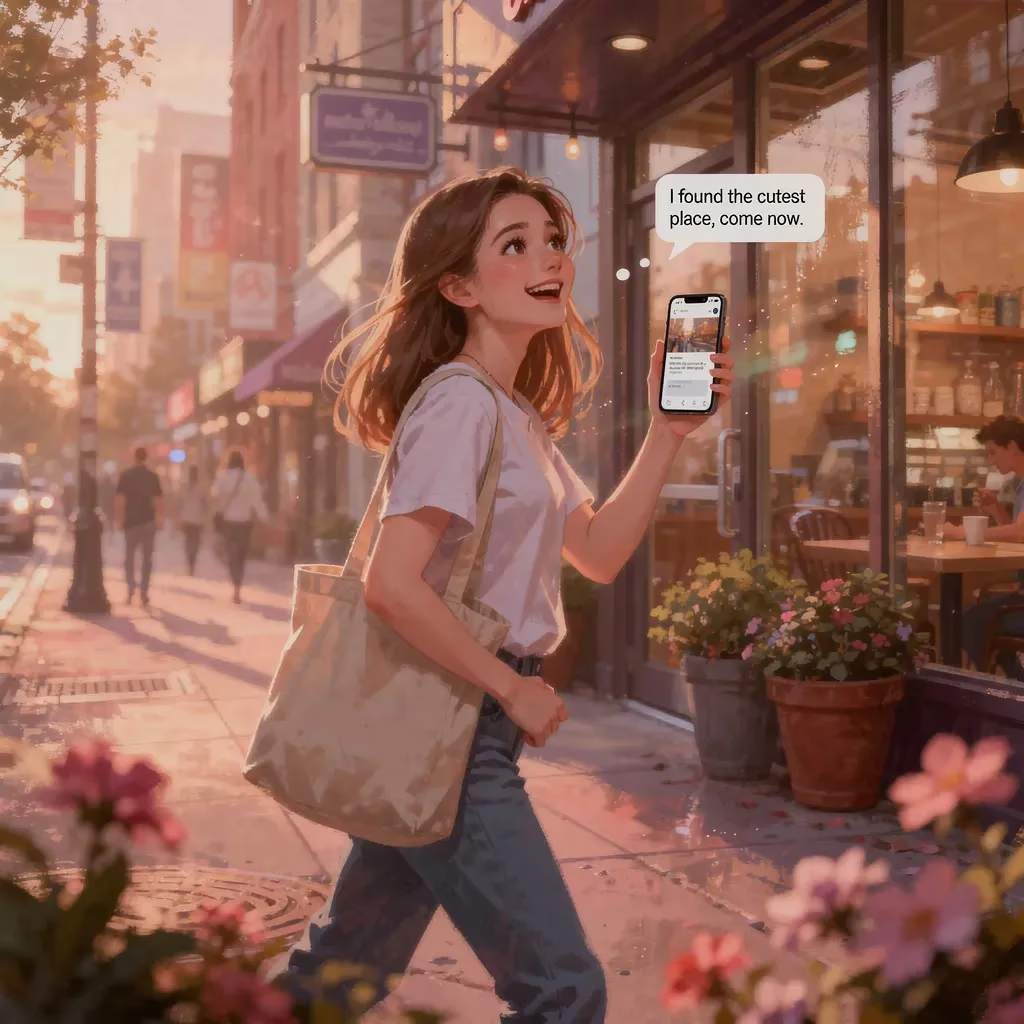
Catalyst friends make life feel like it's still happening. You're the one who says, "Get dressed, we're going." You're the friend who pulls people out of ruts, even if they're grumpy at first.
If you've ever Googled how to be a good friend because you worry you're "too much" or "too pushy," I get it. Catalyst energy can be misunderstood. But your impact is real. You bring momentum and hope.
And if you've ever wondered what makes someone a good friend when you're not the soft comfort friend, here's the truth: sometimes being a good friend is reminding someone they're still alive.
Catalyst Meaning
Core understanding
Catalyst means your friendship role is momentum. You create experiences. You start the trip. You suggest the class. You make the playlist. You move energy through the group.
This pattern often develops when you learned that stagnation feels unsafe. Many women with Catalyst energy grew up in environments where emotions got heavy fast, so you learned to bring light, movement, possibility. It's not shallow. It's survival and joy mixed together.
Your body remembers it as restless energy. When things feel stuck, you feel it in your legs, your hands, your chest. You want motion. You want newness. You want the group to feel alive and connected.
What Catalyst Looks Like
Being the initiator of fun: You plan the trip, the theme night, the spontaneous coffee run. People see you as confident. Inside, you might be using action to keep closeness from fading.
Hype with a tender core: You hype your friends up because you genuinely believe in them. You are the voice saying, "You're not stuck." You might also worry they'll outgrow you or forget you if you're not bringing value.
Pushing growth (sometimes too fast): You say, "Block him." "Quit the job." "Come with me." It's love, but it's also intensity. Some friends feel inspired. Some feel pressured.
Being allergic to awkward heaviness: When a hangout gets quiet and sad, you try to lift it. Others think you're avoiding feelings. Sometimes you are. Sometimes you're trying to protect the room.
Connecting through doing: You bond through experiences. Sitting and talking can feel vulnerable. Moving side-by-side feels safer.
Taking rejection personally: If you suggest plans and people bail, it can hit hard. You might spiral into am I a good friend and "am I annoying?" even if it was just scheduling.
Making people feel chosen: You invite people into your world. You remember what they like. You show them new places. That's not small. That's belonging.
Getting bored in stagnant friendships: If a friendship never grows, you feel restless. You want depth or movement, not just habit.
Being the friend who starts fresh chapters: New city? New job? New breakup era? You're there saying, "We can make this beautiful."
Over-functioning with enthusiasm: You can accidentally become the entertainer. You might feel like you have to keep the energy up so people stay connected.
Deep sensitivity under the sparkle: Catalysts are often sensitive. You can feel when your energy isn't landing, and it can make you second-guess yourself.
Loving big and loud: You show up with excitement. You post, tag, share. Some people adore it. Some people are quieter. Learning that difference helps you stay close to both.
Feeling unseen when you're struggling: Because you usually bring the good vibe, people might miss when you're not okay. You might hide it because you don't want to dampen the group.
Craving friends who meet your energy: When someone matches your momentum, you feel safe. When they don't, you can feel like you're too much.
How Catalyst Shows Up in Different Areas of Life
In romantic relationships: You bring fun and fresh energy. You may fear routine and interpret it as fading love. You thrive with partners who enjoy growth and can also offer steadiness.
In friendships: You help everyone learn how to be good friends by making time together happen. Your growth edge is letting friends say no without you taking it as rejection.
At work: You start things. You volunteer. You pitch ideas. People like your energy, but you may feel frustrated with slow systems.
Under stress: You either go into frantic action or you disappear to protect your pride. Either way, the core need is reassurance that you're still wanted.
What Activates This Pattern
- When your invitations get ignored
- When the group feels "stuck" or boring
- When friends say you're "too much"
- When your excitement isn't returned
- When plans fall through repeatedly
- When you feel like you're performing
- When you sense you're not being chosen
The Path Toward More Steady Connection
- You can keep your sparkle and add boundaries: You don't have to host your way into belonging.
- Practice asking, not pushing: "Would you want to do this?" lands better than "Come on, you have to."
- Let people be different: Quiet friends can still love you deeply.
- Build in rest: Catalyst energy is powerful, and it needs recovery.
- What becomes possible: Catalysts who understand their pattern stop asking what kind of friend are you in a worried way. They start asking it in a confident way, because they trust their role.
Catalyst Celebrities
- Dua Lipa - Singer
- Billie Eilish - Singer
- Chris Hemsworth - Actor
- Gal Gadot - Actress
- Hailee Steinfeld - Actress
- Bruno Mars - Singer
- Lady Gaga - Singer
- Cameron Diaz - Actress
- Justin Timberlake - Singer
- Madonna - Singer
- Serena Williams - Athlete
- Gordon Ramsay - Chef
Catalyst Compatibility
| Other Type | Compatibility | Why it tends to feel this way |
|---|---|---|
| Nurturer | 😐 Mixed | They may want slower comfort while you want forward motion, but it can be beautiful with respect. |
| Connector | 🙂 Works well | They gather people and you energize them, just watch burnout and over-responsibility. |
| Advisor | 😐 Mixed | You move fast and they think deeply; the friendship works when you don't feel judged and they don't feel rushed. |
| Protector | 🙂 Works well | They bring loyalty and structure to your big energy, and you help them soften and enjoy life. |
Am I a Protector?

Protector energy is loyal in a way that's hard to explain unless you have it. You're not interested in shallow closeness. You want real. You want safe. You want consistent. And if someone hurts your friend, your blood pressure has opinions.
If you've ever searched what are the qualities of a good friend because you're trying to understand why you get so intense about loyalty, it's because loyalty is your love language in friendship.
And if you worry am I a good friend because you're direct, because you call things out, because you're not the "go with the flow" type, listen: protecting the relationship is still love.
Protector Meaning
Core understanding
Protector means your friendship role is loyalty and safety. You're the friend who shows up when it's hard, not only when it's fun. You defend people. You notice unfairness. You hold a line.
This pattern often develops when you learned that not everyone is safe, and someone needs to be paying attention. Many women with Protector energy grew up having to be strong or having to be the one who handles things. You learned to scan for risk and act fast.
Your body remembers it as intensity. Your shoulders square when something feels off. Your jaw tightens. You get that heat in your chest when someone's being disrespectful. It's not "drama." It's your system saying, "This matters."
What Protector Looks Like
Being the one who speaks up: When someone is being treated badly, you name it. Others might stay quiet to keep peace. You feel peace is fake if it's built on someone getting hurt.
Loyalty as a promise: When you say "I've got you," you mean it. You show up for moves, breakups, family emergencies. People rely on you because you actually follow through.
High standards for respect: You can't unsee patterns. If a friend keeps being flaky, you notice. If someone uses people, you notice. It can make you look "strict," but you're protecting the group's trust.
Quiet monitoring: Even when you're having fun, part of you is watching. Who looks uncomfortable? Who is being left out? Who is pushing boundaries? You scan because you care.
Struggling with vulnerability: Protectors can be tender, but showing need can feel risky. You might share your loyalty and effort instead of your softer feelings.
Feeling protective of your place: If you're anxious-leaning, you might worry about being replaced. Then loyalty becomes not just love, but fear management. That can make you cling tighter than you want.
Not tolerating disrespect: You're the one who will confront the rude boyfriend, the mean coworker, the friend who talks behind backs. Others may call it intense. You call it basic decency.
Being misunderstood as "controlling": Sometimes you aren't controlling. You're trying to keep things safe. The growth edge is letting people make their own mistakes without you carrying the consequences.
Showing love through action: You pick people up, you handle logistics, you make sure everyone gets home safe. You might not always be the mushy friend, but you are the steady friend.
Having a hard time with flaky friendships: When someone cancels last minute, it can feel like disrespect. Your body takes it personally. You might distance yourself to protect your heart.
Being the friend who remembers betrayals: Not because you're petty. Because your system is trying to prevent repeat pain. You trust slowly but deeply.
Protecting others and forgetting yourself: You can become everyone's shield and then wonder why you're tired and lonely. "Everyone's rock. Who holds me?" is a very Protector sentence.
Getting activated by unfairness: If someone is singled out, talked over, or mocked, you feel heat rise. You want to fix it immediately.
Wanting clear loyalty signals: You feel safer when people show consistency. That's why you care about follow-through. It's not clingy. It's your system wanting proof.
How Protector Shows Up in Different Areas of Life
In romantic relationships: You are loyal and protective. You expect respect. If trust is shaky, you can become hyper-alert and direct. You do best with partners who are consistent and honest.
In friendships: You embody what makes someone a good friend through loyalty and defense. Your growth edge is asking for softness and support, not only giving it. It's also learning that what does it mean to be a good friend includes repair, not perfection.
At work: You protect your team. You speak up in meetings. You notice unfair dynamics. People may appreciate you quietly, even if they don't say it enough.
Under stress: You get sharper. You may pull back to avoid being hurt or you may confront quickly. Later, you might feel regret and replay the conversation.
What Activates This Pattern
- When someone disrespects your friend
- When you sense gossip or exclusion
- When plans change without communication
- When someone breaks trust
- When you feel like you're being used
- When you have to "prove" your place
- When you see someone being unfair
The Path Toward Softer Safety
- You can keep your standards and soften your grip: Standards are love. Control is fear. You don't have to choose fear.
- Name your needs in plain language: "I need consistency" is more effective than silent distance.
- Let loyalty be mutual: If you always defend everyone, you never get defended.
- Choose friends who repair: The right people don't punish you for honesty.
- What becomes possible: Protectors who understand their pattern stop Googling what is a good friend for reassurance. They start trusting their own read of loyalty.
Protector Celebrities
- Hailey Bieber - Model
- Tom Holland - Actor
- Chris Evans - Actor
- Scarlett Johansson - Actress
- Denzel Washington - Actor
- Sandra Bullock - Actress
- Beyonce - Singer
- Jason Momoa - Actor
- Angelina Jolie - Actress
- Matt Damon - Actor
- Julia Roberts - Actress
- Dwayne Johnson - Actor
Protector Compatibility
| Other Type | Compatibility | Why it tends to feel this way |
|---|---|---|
| Nurturer | 🙂 Works well | They soften you and you steady them, but both need to avoid over-giving. |
| Connector | 😐 Mixed | You want loyalty and clarity; they want harmony and inclusion. It works when you respect each other's goals. |
| Advisor | 😍 Dream team | You protect the bond and they protect the truth, so trust builds fast. |
| Catalyst | 🙂 Works well | They bring lightness and you bring safety, as long as neither tries to "fix" the other. |
If you're stuck in the loop of am I a good friend and what kind of friend are you, it's usually because your friend group role has become a survival strategy. This quiz gives you a mirror that feels kind, not cruel. It also shows you how to be a good friend without disappearing, because the real answer to what makes a good friend includes you too.
A few things this Friendship Archetype quiz makes easier quickly
- Discover what type of friend am I quiz answers that actually match your real life.
- Understand what makes someone a good friend without turning it into perfection.
- Recognize how to be good friends while keeping your needs in the room.
- Name what does it mean to be a good friend in your specific friend group.
- Stop the "am I a good friend quiz" spiral after every vibe shift.
- Clarify what are the qualities of a good friend you personally need back.
Where you are now vs what becomes possible
| Where you are now | What becomes possible |
|---|---|
| You overthink the group chat and wonder if you said something wrong. | You understand your role, so silence doesn't automatically mean rejection. |
| You keep asking "what is a good friend" like it's a rulebook you have to pass. | You define what a good friend looks like in a way that includes you. |
| You give and give, then feel guilty for wanting anything back. | You notice imbalance earlier and ask for reciprocity without the shame spiral. |
| You try to be low-maintenance so nobody leaves. | You feel secure enough to be honest, even when you need support. |
Join 213,527 women who've taken this in under 5 minutes. Your answers stay private, and your results are for you, not your group chat.
FAQ
What is a friendship archetype (and what does "what role do I play in my friend group" actually mean)?
A friendship archetype is the pattern you tend to fall into in your friendships, basically the role you naturally play in your friend group when everyone is stressed, celebrating, spiraling, planning, or falling apart. It is not a box you live in forever. It is more like your default setting under pressure.
If you have ever caught yourself thinking, "Why am I always the one doing this?" you already understand the concept. This is exactly what a "What role do I play in my friend group quiz" is trying to put words to.
Here is what "role" usually means in real life friend group dynamics:
- What people come to you for. Are you the one they text when they need comfort, advice, hype, protection, or a push?
- What you automatically offer. Some of us soothe. Some of us solve. Some of us connect the dots between people. Some of us ignite action.
- What you feel responsible for. Harmony? Truth? Everyone getting along? Making sure nobody is left out? Making sure nobody gets walked on?
- How you act when conflict shows up. Do you mediate, withdraw, go into fixer mode, go into loyalty mode, or go into "say the hard thing" mode?
- What it costs you. This part matters. The role you play often comes with a hidden price tag: overgiving, overfunctioning, emotional exhaustion, or feeling invisible.
In this Friendship Archetype framework, the roles are: Nurturer, Connector, Advisor, Catalyst, and Protector. Each one is a real kind of strength. Each one can also turn into a self-erasing pattern if you have been carrying your friendships on your back.
Something I want you to hear clearly: having a "role" does not mean you are being fake. It usually means you learned a reliable way to belong. So many women learned early that being useful, agreeable, or strong kept them safe in relationships. Of course those instincts show up with friends too.
A friendship personality test can help because it gives you language. Language creates choice. Choice creates relief.
How do I know what kind of friend I am (without overthinking every little interaction)?
You can usually tell what kind of friend you are by looking at your most repeated moments, not your most intense ones. Patterns show up in the everyday stuff: who you text first, what you do when someone is upset, and what you feel guilty about.
If your brain immediately went, "Wait, but what if I'm secretly a bad friend," you are not alone. So many of us take friendship seriously, and that can turn into over-scanning for proof we are "doing it right." The truth is: you can learn a lot about yourself without putting yourself on trial.
Here are a few quick ways to self-check, gently, like you would for a friend you love:
1) Notice what people consistently ask you for.
- If they come for comfort, reassurance, and "can you stay on the phone with me?", you may lean Nurturer.
- If they come for introductions, invites, and "who can I talk to about this?", you may lean Connector.
- If they come for clarity, strategy, and "tell me what you think," you may lean Advisor.
- If they come for motivation, courage, and "push me to do it," you may lean Catalyst.
- If they come for backup, loyalty, and "I need you in my corner," you may lean Protector.
2) Notice your default in group settings.Friend group dynamics quiz questions often revolve around: Do you host, facilitate, mediate, analyze, or defend? In a group chat, do you smooth things over, pull people in, offer solutions, call out the elephant in the room, or step in when someone is being treated unfairly?
3) Pay attention to what drains you.This is the part we skip, especially if we are used to earning closeness by being helpful.
- You might be a Connector if you love bringing people together but feel crushed when no one else plans.
- You might be an Advisor if you give great guidance but feel resentful when people ignore it, then come back crying.
- You might be a Nurturer if you can feel everyone's emotions but struggle to name your own needs.
4) Ask one simple question: "What do I do when I'm scared of being left out?"This is where your role becomes crystal clear. Some of us overgive. Some of us perform. Some of us go quiet. Some of us get tough. None of it makes you toxic. It makes you human.
A "What type of friend am I quiz" can be helpful here because it reflects your patterns back to you in a way that is hard to see from inside your own head.
How accurate is a friendship personality test? (Like... should I trust a "what makes a good friend" quiz?)
A friendship personality test is accurate in the way a good mirror is accurate. It does not tell you who you are forever. It reflects what you tend to do most often, especially under stress or in groups. The best quizzes are pattern-based, not label-based.
It makes perfect sense to be cautious. If you have spent years trying to be the "right" kind of friend, the idea of being scored can feel weirdly high-stakes. Like one result could confirm your worst fear. That is not what a healthy "What makes a good friend" quiz is for.
Here is what makes a "friendship personality test" more trustworthy:
It focuses on behaviors, not morality.
- Good: "When a friend is upset, I tend to troubleshoot."
- Not helpful: "I am a good friend / bad friend."
It accounts for context.Your role can shift depending on the friend group, your season of life, and your stress level. Someone can be a Connector in college and a Protector after a breakup. That is not inconsistency. That is adaptation.
It names strengths and costs.Real insight includes both:
- What you bring to friendships (your gifts).
- What you tend to carry alone (your hidden burden).
It gives you language you can use.The point is not to collect a label. The point is to walk into your friendships with more self-trust. When you can say, "I go into Advisor mode when I feel helpless," you suddenly have options.
A lot of people search "Am I a good friend quiz" when they are actually looking for reassurance. If that is you, I get it. Many of us have been the friend who replies fast, shows up, remembers birthdays, and still worries we are not enough. That anxiety is not proof you are failing. It is often proof you care deeply.
Use a quiz like a starting point:
- Take what feels true.
- Ignore what does not fit.
- Look for the pattern underneath the wording.
If you want something that points to your real role in your friend group (not a judgment of your worth), this kind of quiz is built for that.
Why do I always end up being the "therapist friend" or the responsible one?
You keep ending up as the therapist friend or the responsible one because you have a combination of empathy, emotional attunement, and follow-through that other people feel immediately. In Friendship Archetype terms, this often shows up as Nurturer energy (soothing, steady, present) or Advisor energy (clear, grounded, wise).
Of course it happens to you. You are the one who can sense the shift in someone's tone. You remember what they said three months ago. You know how to hold a crisis without making it about you. People feel safer with you. That is a gift.
It is also exhausting, especially when the care only flows one direction.
Here are a few common reasons this pattern sticks, even when you are tired of it:
1) You learned that love = being useful.
So many women were praised for being "mature," "easy," or "the strong one." When that is the role that got you closeness, your nervous system keeps repeating it in friendships. Not because you are codependent. Because it worked.
2) You are good at emotional labor, so it gets outsourced to you.
This is a big one in friend group dynamics. If you naturally ask thoughtful questions and regulate other people's feelings, the group unconsciously assigns you the "keeper of the peace" job.
3) You feel guilty when you do less.
If stepping back makes you spiral ("Are they mad? Do they still like me?"), you will keep showing up beyond your capacity. Not because you want attention. Because uncertainty feels unsafe.
4) You might be surrounded by people who take more than they give.
This is the part we do not love admitting, but it is real. Sometimes your "role" is not just who you are. It is also the ecosystem you are in.
Practical way to check if this role is healthy for you:
- When you support someone, do you feel connected afterward?
- Or do you feel used, invisible, or weirdly anxious?
You deserve friendships where your depth is met, not mined.
A "What do I bring to friendships" lens helps here. It shows you what you naturally offer, and where you might be over-functioning without realizing it.
Can my role in my friend group change over time? Or am I stuck being this person forever?
Yes, your role in your friend group can change over time. Most women experience shifts based on life stage, healing, confidence, boundaries, and even just changing environments. You are not stuck.
If the idea of changing your role brings up guilt, you are in good company. A lot of us worry that if we stop being the Nurturer, the Planner, the Fixer, or the Peacekeeper, we will stop being lovable. That fear makes sense if closeness has ever felt conditional in your life.
Here is what usually changes first (and what does not):
What does not change overnight:
- Your core temperament: empathy, sensitivity, intensity, protectiveness, curiosity.
- Your values: loyalty, honesty, depth, fun, community.
What can absolutely change:
- Your reflex to overgive.
- How quickly you jump in to rescue.
- How much you apologize for having needs.
- Who you choose to invest in.
- The kind of people you surround yourself with.
Many women notice their friendship archetype "maturing" rather than flipping:
- A Nurturer becomes a Nurturer who can say, "I love you, and I can't do a 2 a.m. crisis call tonight."
- An Advisor becomes an Advisor who asks, "Do you want comfort or solutions?" instead of assuming responsibility.
- A Connector becomes a Connector who lets others share the planning load.
- A Catalyst becomes a Catalyst who encourages without pushing past people's readiness.
- A Protector becomes a Protector who defends without burning herself out.
Also, different groups pull different roles out of us. In one circle, you are the funny Connector. In another, you are the steady Advisor. That is not being fake. That is being responsive to the room.
A helpful reframe: your role is not your identity. It is your strategy for closeness. Strategies can be updated.
If you want a clear snapshot of what your current default is right now (not five years ago, not in your toughest season), a "friend group dynamics quiz" can help you see it without spiraling.
What if I'm worried I'm the toxic friend? (Is there an "am I the toxic friend quiz" that's actually helpful?)
If you are worried you are the toxic friend, that concern alone is usually a sign you are not casually harming people. Most genuinely toxic behavior is defended, denied, or justified. Self-reflection is a green flag.
A lot of people search "Am I the toxic friend quiz" when they are really asking: "Am I too much? Did I mess everything up? Are they going to leave?" That fear hits hard, especially if you tend to replay conversations at 3 a.m. and look for the one wrong sentence.
So yes, quizzes can be helpful. The helpful ones do not shame you. They help you separate three different things that often get tangled:
1) Normal human needsWanting reassurance, closeness, reciprocity, or clarity is not toxic. It is human.
2) Unhealthy copingThis is where patterns can cause harm, usually unintentionally:
- Guilt-tripping instead of directly asking for reassurance
- Testing friends to "see if they care"
- Keeping score because you feel unsafe
- Venting without consent, then feeling rejected if they set a limit
3) Mismatched friendshipsSometimes you are not toxic. You are just pouring into people who do not have the capacity to meet you. Then you feel needy, and they feel pressured, and everyone leaves feeling misunderstood.
Here are a few grounded signs you are in the "needs + coping skills" zone (not "I'm a villain" zone):
- You apologize a lot, even when you did not do anything wrong.
- You panic when a friend is slower to reply.
- You over-explain because you are trying to prevent rejection.
- You go above and beyond, then feel hurt when it is not returned.
That is not toxicity. That is anxiety and attachment and learned survival strategies showing up in friendship.
If there is one thing that helps immediately, it is shifting the question from "Am I bad?" to "What do I do when I feel unsafe in connection?" That is where your Friendship Archetype reveals itself. Nurturers overgive. Advisors over-solve. Protectors get sharp. Connectors chase harmony. Catalysts push for movement.
Understanding your role helps you keep your gifts without letting fear drive the car.
How do I be a good friend without people-pleasing or burning out?
Being a good friend without people-pleasing comes down to one truth: real friendship includes you, not just the version of you that is useful, easy, and always available. Good friends are caring. They are also honest about their capacity.
If you have been the "reliable one" for years, burnout can sneak up quietly. It often looks like resentment, avoidance, or that numb feeling when someone texts and you instantly feel tired. Of course you do. Your body is keeping score of every time you showed up while abandoning yourself.
Here are a few ways to practice "How to be a good friend" energy without self-erasing, especially if your nervous system equates boundaries with rejection:
1) Separate kindness from availability.
Kindness: "I care about you."
Availability: "I can talk right now."
You can offer the first without forcing the second.
Examples:
- "I want to hear you. I can't call tonight, but I can tomorrow after work."
- "I care. I don't have the bandwidth for a deep dive right now."
2) Ask what kind of support they want.
This is magic for Advisors and Nurturers.
- "Do you want comfort or brainstorming?"
- "Do you want me to listen or help you make a plan?"
It keeps you from overworking and keeps them from feeling managed.
3) Offer a container, not your entire life.
You can be supportive without being on-call.
- "I can chat for 15 minutes."
- "I can help you write the text, then I need to log off."
4) Track reciprocity without weaponizing it.
A healthy friendship has give-and-take over time. It does not have to be perfectly equal in every week, but it should feel balanced across seasons. If you constantly feel like the only one holding the relationship together, that is important data.
5) Let your role evolve.
Your Friendship Archetype (Nurturer, Connector, Advisor, Catalyst, Protector) is your natural strength. Burnout happens when that strength becomes your only way to belong.
So the goal is not "stop being you." The goal is "be you with support."
A "What makes a good friend" lens helps you see what you already do well, and where you might be overextending out of fear instead of love.
How can knowing my friendship archetype help my friendships in real life?
Knowing your friendship archetype helps because it gives you a clear map of what you bring to friendships, what you tend to overdo, and what you secretly need but rarely ask for. It turns vague anxiety into specific insight. That is where change becomes possible.
So many women walk around thinking, "I'm bad at friendships," when the real issue is usually: "I'm playing a role that made sense for survival, not one that supports me now." A friendship archetype is a way to name that role without shaming yourself.
Here is what it can change in real life, fast:
1) You stop taking everything personally.
If you are a Connector and someone declines an invite, you might spiral into "They hate me." When you know your pattern, you can say, "My brain equates participation with safety." That alone reduces the panic.
2) You communicate better, because you understand your defaults.
- Nurturers learn to ask for care without apologizing.
- Advisors learn to offer guidance without carrying the outcome.
- Catalysts learn when encouragement turns into pressure.
- Protectors learn how to defend without hardening.
- Connectors learn to maintain connection without over-managing the group.
3) You choose friends more intentionally.
This one is huge. A lot of friend pain comes from mismatched expectations.If you are always the one doing the emotional labor, you can start prioritizing friends who reciprocate. If you are always the one "keeping it real" and people keep pulling away, you can look for friends who value honesty.
4) You build a friend group that actually supports you.
Friend group dynamics are not random. Roles form. When you know your role, you can intentionally invite balance:
- "Can someone else plan next time?"
- "I could use advice too."
- "I want to share something, but I'm not looking for solutions."
5) You stop confusing your worth with your usefulness.
This is the quiet heartbreak for a lot of us. We become the helper, the fixer, the inviter, the protector, and we start believing love is something we earn.
Knowing what you bring to friendships helps you keep your gift while also making room for your needs.
If you want a clear read on your current pattern, a "What type of friend am I quiz" is a simple way to get language for it, especially if you have been stuck in the same dynamics for years.
What's the Research?
Why "friend group roles" feel so real (and aren't just in your head)
That moment when you're looking around at your friend group and thinking, "Wait... why am I always the one doing this?" It makes perfect sense. Friendship roles form because groups quietly need different things, and we tend to fall into the lane we're best at.
Across research on friendship and interpersonal relationships, scholars describe close relationships as shaped by things like reciprocity, self-disclosure, and the balance of support over time, not just "vibes" (Friendship - Wikipedia; Interpersonal relationship - Wikipedia). In other words: your role isn't random. It's an ongoing pattern of what you offer, what others accept, and what the group comes to rely on.
One of the most underrated truths here is that friendship isn't only emotional. It's also logistical: who initiates, who plans, who notices, who repairs, who protects. A helpful summary of interpersonal relationship dynamics points out that relationships vary in intimacy, reciprocity, and power distribution (Interpersonal relationship - Wikipedia). That "power distribution" piece matters in friend groups more than people admit. If you're always the planner, you end up with a certain kind of influence, but also a certain kind of burden.
If you've been the one holding things together, your exhaustion is data. It's your nervous system clocking a real pattern, not you being "too sensitive."
And yes, roles can deepen because of our attachment patterns. Attachment theory explains that early experiences shape "working models" about whether people show up, whether closeness is safe, and whether you have to work for love (Verywell Mind: What Is Attachment Theory?; Simply Psychology: Attachment Theory; Fraley: Adult Attachment Theory Overview). For an anxiously attached person, it can feel soothing (in the short term) to become essential in the group, because essential feels like "less likely to be left."
How roles form: proximity, repetition, and the "default friend"
A really practical factor in "what kind of friend are you" is just... who is nearby and repeatedly present. Social psychology has long described the proximity principle (also called propinquity): we form bonds more easily with people we see often, because familiarity lowers the barrier to connection (Proximity principle - Grokipedia). That same mechanism shapes roles inside groups too. If you're the one who consistently shows up, you become the default.
Classic work on proximity and friendship patterns found that physical closeness predicted who became friends in shared housing contexts (Proximity principle - Grokipedia). Translate that to your life now: roommates, coworkers, classmates, the friends of your partner, the people who always go to the same weekly workout. Repeated exposure builds familiarity, and familiarity builds expectations. Expectations build roles.
This is one reason a "What role do I play in my friend group quiz" feels weirdly accurate sometimes. You're not being boxed in. You're seeing the result of repetition.
Research summaries on maintaining interpersonal relationships emphasize behaviors like openness, active listening, and empathy as core ingredients for trust over time (Verywell Mind: How to Maintain Interpersonal Relationships). Those behaviors often map onto the roles we recognize instantly in a friend group:
- The one who checks in (hello, Nurturer energy)
- The one who organizes the hang (Connector energy)
- The one who gives advice and clarity (Advisor energy)
- The one who pushes everyone into growth and bold choices (Catalyst energy)
- The one who keeps things safe and handles crisis (Protector energy)
These aren't "types of people" as much as patterns of contribution. And patterns can change.
If you've been the "default friend" for years, it's not because you were born to carry everyone. It's because you kept showing up, and the group adapted around your reliability.
The 5 friendship archetypes (and what research says they provide)
Friendship research often describes bonds as involving mutual enjoyment, support, and practical help, not just emotional closeness (Friendship - Wikipedia). That lines up with why these five archetypes work so well in real friend groups: each one provides a different kind of stabilizing resource.
Here are the five archetypes your results are based on, with the "why it matters" underneath:
NurturerYou provide emotional regulation for the group. You're the soft landing. Friendship and mental well-being research summaries link supportive relationships to better well-being outcomes (Friendship - Wikipedia). When you're a Nurturer, you often become the person others associate with relief.
ConnectorYou provide group cohesion. You're the planner, the introducer, the one who makes sure people don't drift too far apart. Friendship formation is influenced by opportunities for contact and repeated exposure (hello again, proximity and familiarity) (Proximity principle - Grokipedia). Connectors manufacture those opportunities.
AdvisorYou provide clarity. In real life, this looks like perspective-taking, honest feedback, and emotional intelligence. Relationship guidance sources consistently emphasize communication and active listening as foundational for healthy connection (Torrens University: Tips to build strong interpersonal relationships; Verywell Mind: How to Maintain Interpersonal Relationships). Advisors often do this naturally, but it can slide into being everyone's unpaid therapist if there's no reciprocity.
CatalystYou provide movement. You're the one who says, "We are not staying stuck." You help friends try new things, leave bad situations, take the trip, apply for the job, finally text the person. Under the umbrella of interpersonal processes, psychologists describe relationships as shaped by the interplay between people that can promote or hinder growth and connection (Penn State Psychology: Interpersonal Processes). Catalysts tend to promote change in the system.
ProtectorYou provide safety. You notice threats, power dynamics, and emotional risk. Attachment theory describes caregivers (and later, attachment figures) as a "safe haven" during distress and a "secure base" for exploration (Simply Psychology: Attachment Theory; Verywell Mind: Attachment Theory). Protectors often recreate that function inside friend groups.
None of these roles are "more evolved." They're different ways of loving people.
Your archetype isn't about being a better friend. It's about seeing the shape of how you care, and what it costs you when no one shares the weight.
Why it matters (especially if you're anxious and always scanning for shifts)
If you have any anxious attachment tendencies, friendship roles can become a sneaky way to manage abandonment fear. Not consciously, but in the body. If you're the Nurturer, you might equate being needed with being safe. If you're the Connector, you might equate being the glue with being valued. If you're the Advisor, you might equate being useful with being kept. If you're the Protector, you might equate preventing conflict with preventing loss.
Attachment research explains that early bonds shape expectations about others' reliability and our own worthiness (Fraley: Adult Attachment Theory Overview; Verywell Mind: What Is Attachment Theory?). So when you're taking a "What type of friend am I quiz," what you're often really asking is: "How do I keep my place? How do I make sure I'm not the expendable one?"
Also, it's normal to underestimate how much people like you. Friendship research summaries discuss the "liking gap," where people tend to think others like them less than they do (Friendship - Wikipedia). So the 3am spiral of "Did I talk too much?" or "Were they annoyed?" isn't proof you're failing. It's a known social-perception pattern that hits sensitive, conscientious women especially hard.
Understanding your archetype helps because it turns vague anxiety into something specific you can work with: "Oh. I'm over-functioning in the group again." "Oh. I keep taking responsibility for everyone's feelings." "Oh. I only feel secure when I'm the one providing value."
The science tells us what's common in friend group dynamics. Your report reveals what's true for you specifically, including where your strengths are helping the group and where you might be quietly overextending.
References
Want to go down the rabbit hole (in a good way)? Here are some genuinely helpful places to read more:
- Friendship (Wikipedia)
- Interpersonal relationship (Wikipedia)
- Interpersonal relationships (Wikipedia)
- Verywell Mind: How to Maintain Interpersonal Relationships
- Penn State Psychology: Interpersonal Processes
- APA Dictionary: Interpersonal Relations
- Proximity principle (Grokipedia)
- Verywell Mind: What Is Attachment Theory?
- Simply Psychology: Attachment Theory In Psychology Explained
- R. Chris Fraley: A Brief Overview of Adult Attachment Theory and Research
- Torrens University: 7 tips to build strong interpersonal relationships
- Attachment theory (Wikipedia)
Recommended Reading (for when you want to go deeper)
If you're still turning over questions like what makes a good friend or what does it mean to be a good friend, these books can help you build friendships that feel steady, mutual, and real.
A quick note: the list below comes from the book recommendations database attached to this quiz. It did not include ISBN-13 numbers, so links aren't available here. (No guessing. No made-up ISBNs.)
General books
- Friendship (Amazon, Bookshop.org, AbeBooks) by Lydia Denworth - A big-picture, evidence-based look at why friendship matters and why drift doesn't always mean rejection.
- Frientimacy (Amazon, Bookshop.org, AbeBooks) by Shasta Nelson - A practical framework for building closeness through consistency, vulnerability, and shared meaning.
- The Other Significant Others (Amazon, Bookshop.org, AbeBooks) by Rhaina Cohen - Permission to treat friendship as a real, central relationship.
- We Should Get Together (Amazon, Bookshop.org, AbeBooks) by Kat Vellos - The real-life mechanics of adult friendship (invites, follow-through, transitions).
- How to Know a Person (Amazon, Bookshop.org, AbeBooks) by David Brooks - Skills for seeing people well and making them feel emotionally met.
- Platonic (Amazon, Bookshop.org, AbeBooks) by Marisa G. Franco, PhD - If you have ever felt like friendship should be easier than it is, this book helps you feel understood instead of judged.
- Set Boundaries, Find Peace: A Guide to Reclaiming Yourself (Amazon, Bookshop.org, AbeBooks) by Nedra Glover Tawwab - Every role in a friend group benefits from learning boundaries that are kind, clear, and sustainable.
- The Gifts of Imperfection: Let Go of Who You Think You're Supposed to Be and Embrace Who You Are (Amazon, Bookshop.org, AbeBooks) by Brene Brown - Friendship gets easier when you stop auditioning for belonging.
For Nurturer types (keep your softness, stop self-erasing)
- Set Boundaries, Find Peace (Amazon, Bookshop.org, AbeBooks) by Nedra Glover Tawwab - Clear boundary language that protects your warmth.
- The Joy of Being Selfish (Amazon, Bookshop.org, AbeBooks) by Michelle Elman - Permission to have needs without the guilt spiral.
- Codependent No More (Amazon, Bookshop.org, AbeBooks) by Melody Beattie - Separating love from over-responsibility.
- Self-Compassion (Amazon, Bookshop.org, AbeBooks) by Kristin Neff - Learning to treat your own needs like they matter.
- Not Nice (Amazon, Bookshop.org, AbeBooks) by Aziz Gazipura - Assertiveness skills when honesty feels scary.
- The Disease to Please (Amazon, Bookshop.org, AbeBooks) by Harriet B. Braiker - Spotting the "I'll be easy so you won't leave" bargain.
- El Valor Del Miedo by Gavin De Becker - Trusting your gut when your kindness overrides your instincts.
For Connector types (stay connected without carrying the whole group)
- Never Eat Alone and Other Secrets to Success (Amazon, Bookshop.org, AbeBooks) by Keith Ferrazzi - Systems for staying connected without anxious over-effort.
- The Art of Gathering (Amazon, Bookshop.org, AbeBooks) by Priya Parker - Hosting with intention so your effort lands and doesn't drain you.
- Codependent No More (Amazon, Bookshop.org, AbeBooks) by Melody Beattie - Catching when care turns into management.
- Book of Boundaries (Amazon, Bookshop.org, AbeBooks) by Melissa Urban - Scripts for staying kind without being on-call.
- Nonviolent Communication (Amazon, Bookshop.org, AbeBooks) by Marshall B. Rosenberg - Clean language for needs and repair.
For Advisor types (clarity without being everyone's help desk)
- Set Boundaries, Find Peace (Amazon, Bookshop.org, AbeBooks) by Nedra Glover Tawwab - Boundaries for the friend everyone relies on.
- Book of Boundaries (Amazon, Bookshop.org, AbeBooks) by Melissa Urban - Scripts when you stop over-explaining.
- Not Nice (Amazon, Bookshop.org, AbeBooks) by Aziz Gazipura - Breaking the "approval = safety" habit.
- Codependent No More (Amazon, Bookshop.org, AbeBooks) by Melody Beattie - Care without self-erasure.
- Self-Compassion (Amazon, Bookshop.org, AbeBooks) by Kristin Neff - Building an inner voice that soothes you too.
- Nonviolent Communication (Amazon, Bookshop.org, AbeBooks) by Marshall B. Rosenberg - Asking for what you need without panic.
- The Gifts of Imperfection (Amazon, Bookshop.org, AbeBooks) by Brené Brown - Belonging without performing.
For Catalyst types (keep the spark, stop performing for closeness)
- We Should Get Together (Amazon, Bookshop.org, AbeBooks) by Kat Vellos - Community-building that doesn't rely on you doing everything.
- The Art of Gathering (Amazon, Bookshop.org, AbeBooks) by Priya Parker - Making moments meaningful without overfunctioning.
- The Joy of Being Selfish (Amazon, Bookshop.org, AbeBooks) by Michelle Elman - Boundaries when guilt hits.
- Not Nice (Amazon, Bookshop.org, AbeBooks) by Aziz Gazipura - Direct asks and tolerating discomfort.
- Drama Free (Amazon, Bookshop.org, AbeBooks) by Nedra Glover Tawwab - Stepping out of emotional triangles.
- Codependent No More (Amazon, Bookshop.org, AbeBooks) by Melody Beattie - Letting go of managing the group's emotional weather.
For Protector types (loyalty with softness and recovery)
- Not Nice (Amazon, Bookshop.org, AbeBooks) by Aziz Gazipura - Assertiveness without spiraling afterward.
- The Joy of Being Selfish (Amazon, Bookshop.org, AbeBooks) by Michelle Elman - Boundaries as relationship-saving, not relationship-ending.
- Codependent No More (Amazon, Bookshop.org, AbeBooks) by Melody Beattie - Care without control.
- The Set Boundaries Workbook (Amazon, Bookshop.org, AbeBooks) by Nedra Glover Tawwab - Practice reps for guilt-heavy boundaries.
- Burnout (Amazon, Bookshop.org, AbeBooks) by Emily Nagoski and Amelia Nagoski - Your body keeping score, and how to recover.
- The Assertiveness Workbook (Amazon, Bookshop.org, AbeBooks) by Randy J. Paterson - Scripts and practice when your mind goes blank.
- Attached (Amazon, Bookshop.org, AbeBooks) by Amir Levine - Recognizing clingy-overhelping as a closeness grab, not a character flaw.
- Self-Compassion (Amazon, Bookshop.org, AbeBooks) by Kristin Neff - Building an inner "safe friend" voice.
P.S.
If you're still asking what type of friend am I quiz in your head after every hangout, you deserve the relief of clarity. This is how to be good friends without losing yourself.