A Gentle Boundaries Check

Boundaries Check: Am I Disappearing In My Relationships?

Boundaries Check: Am I Disappearing In My Relationships?
If you've ever felt the dread before saying "no", this is a gentle way to see where you keep leaving yourself behind, and what it would take to come back.
"Am I losing myself in my relationship?"

You know that moment when you realize you've been saying "I'm fine" so often you barely remember what "fine" even means? Like your life has turned into a series of tiny adjustments around someone else's mood, schedule, and needs.
This Boundaries Check is for that exact moment. It's not here to scold you for caring. It's here to help you see, clearly, where your self goes in relationships, and what keeps pulling you away.
And yes, if you're quietly Googling am I codependent 1000 55 at 2am, you're not alone. So many women land here because the line between "I'm loving" and "I'm disappearing" gets blurry fast.
Boundaries Check quiz free includes six patterns (your self-loss style):
- Dissolved: You merge so deeply you stop feeling your own yes/no.
- Key signs: "Whatever you want" as default, shrinking your needs, panic when you might upset them
- Benefit: You get language for where you vanish, and a tiny first step to come back
- Accommodator: You give, give, give, then feel quietly angry (and guilty for feeling it).
- Key signs: over-helping, swallowing discomfort, resentment that shows up later
- Benefit: You learn how to ask without apologizing for existing
- Chameleon: You adapt so well you can look "easygoing", even while your chest feels tight.
- Key signs: mirroring preferences, editing yourself mid-sentence, overthinking after every hangout
- Benefit: You start building a steady inner compass that doesn't change based on their reaction
- Awakening: You're starting to see it. You're not gone, but you're not fully back yet.
- Key signs: stronger opinions, shaky follow-through, guilt hangovers after boundaries
- Benefit: You get a plan for making boundaries real without going to war
- Navigator: You can love deeply without self-erasing. You're learning "both/and".
- Key signs: clear preferences, repair after conflict, balance of closeness and space
- Benefit: You strengthen what's already working and spot red flags faster
- Guardian: You protect yourself well, sometimes so well it turns into walls.
- Key signs: independence that can feel lonely, shutting down, keeping needs private
- Benefit: You learn how to let people in without handing them the keys to your peace
This is also why the quiz goes beyond the usual "just set boundaries" advice. It's one of the only tests in the world that looks at the stuff underneath, like:
- Tolerating disappointment (can you let them be annoyed without undoing your boundary?)
- Self-silencing (how often you swallow your truth to keep closeness)
- Self-care permission (whether rest feels earned or allowed)
- Resentment buildup (the quiet anger bill you pay later)
- Self-trust (believing your own memory and instincts)
- Decision agency (taking up space in everyday choices)
- Reciprocity expectation (expecting love to move both ways)
- Overexplaining (the essay you write so you don't feel "selfish")
If you're searching am I codependent quiz 390 11 because you want an answer that actually makes sense in real life, you're in the right place. And if you're asking why am I codependent 170 18, we're going to talk about that too, without making you feel broken.
What changes when you know your boundaries pattern (and stop guessing)

- 💗 Discover the real reason you keep asking "am I codependent 1000 55", and get a name for your pattern that actually fits your day-to-day life.
- 🧭 Understand how your body reacts to conflict (tight throat, stomach drop), so you stop auto-abandoning yourself.
- 🫶 Honor your needs without spiraling into guilt, even if you've spent years thinking needs = "too much".
- 🗣️ Find words that are simple and clean (so boundaries don't turn into an essay), especially if you're taking an "am I codependent quiz 390 11" and still feel confused.
- 🌿 Nurture a relationship with yourself that doesn't disappear the second someone seems disappointed, which is the real relief behind "why am I codependent 170 18".
Susan's Story: The Night I Heard Myself Say "I Don't Know" (And Meant It)

The worst part was how fast I said it.
Jason asked what I wanted to do that weekend and I heard myself go, "Whatever you want," like it was nothing. Like I was easy. Like I was chill. Like I didn't have a body that was already tensing up because I knew I'd spend the whole weekend trying to be the version of me that makes him happiest.
I'm 30, and I work as a fundraiser. Which is basically a job built on caring a lot, being persuasive without being pushy, and somehow always knowing what to say to make people feel safe saying yes. I am good at it. Too good, sometimes. I can sense a mood shift in a room before anyone else notices. I can hear hesitation in a sentence that sounds supportive.
And then I go home and do the exact same thing in my relationship.
My friends thought I was fine. I always looked fine. I was the friend who remembered birthdays, who sent the "how did it go?" text after interviews, who brought snacks in my bag like some kind of emotional paramedic. I was also the friend who could not, for the life of me, answer the question "What do you need?" without my mind going blank.
With Jason, it started out sweet. Like, genuinely sweet. He was 22, younger than me, and I told myself it was refreshing because he was light. Fun. Less complicated than the guys I'd dated who turned everything into a power struggle.
But somewhere in that lightness, I started disappearing.
Not in a dramatic way. More like a slow, quiet evaporation.
It looked like me saying yes to plans when I wanted a night alone. It looked like me watching a movie I didn't like, laughing at parts that weren't funny, then feeling weirdly hollow after. It looked like me editing texts three times so I wouldn't sound "too much." It looked like me going quiet when something bothered me, because I didn't want to be "that girl" who ruins the vibe.
And the private part, the part I didn't tell anyone, was the way my brain kept score.
Not his score. Mine.
How many times did I say sorry today?How many opinions did I swallow?How many times did I check his face to see if he was okay with me?
I would catch myself doing it mid-conversation. I'd be talking about my day, and if his eyes drifted for half a second, my chest would tighten and I'd speed up, like I had to earn his attention back. Then later I'd replay it, sitting at my kitchen table, trying to pinpoint where I lost him. Like it was a test and I failed.
It didn't help that he wasn't cruel. If he was cruel, the math would be easier. It's harder when someone is mostly kind, mostly present, mostly trying. Because then the voice in your head goes, "See? You're the problem. You're the one making it heavy."
I didn't call it losing myself. I called it being flexible. Being supportive. Being understanding. Being mature.
But the truth was, I couldn't find myself in my own sentences anymore.
There was this moment, a few weeks before I took the quiz, where he said, "Babe, you're so easy to be with." And he meant it like a compliment. His smile was real.
And I felt this cold little drop in my stomach because my first thought was: Of course I am. I don't make you deal with me.
That thought stayed. It sat in my chest like a pebble I couldn't swallow.
I think I finally admitted to myself that night that something wasn't romantic about how much I was bending. It was just... familiar. Like I'd done this before. Like my body already knew the script even if my brain kept trying to rewrite it.
I found the Boundaries Check quiz in the least dramatic way possible. Not during a breakup. Not after some huge fight.
It was on a random Tuesday, after work, when I was half-watching a video while answering emails. One of my coworkers (Angela, 27, the kind of girl who actually takes her lunch break and doesn't apologize for it) had sent it in our group chat with a message like, "This made me feel called out, lol."
I almost didn't click. I'm weirdly skeptical of things that promise clarity because I've spent so much time being the person who looks fine. Clicking felt like admitting I wasn't.
But I did it anyway, sitting on my bed with my laptop, still in my work clothes, shoes kicked off, hair coming loose. I remember my phone was face-up next to me. I kept glancing at it out of habit, waiting for his text. Like my nervous system didn't know how to be off-duty.
The questions were simple, but not in a fluffy way.
They were the kind of simple that makes your throat tighten because you can tell exactly what they're pointing at.
Do you feel responsible for other people's feelings?Do you avoid conflict even when something matters to you?Do you struggle to name what you want?Do you feel guilty when you prioritize yourself?
I wasn't even trying to be honest at first. I could feel myself wanting to pick the "reasonable" answers. The ones that made me seem balanced.
Then something in me got tired.
So I answered like I actually live.
The results didn't feel like a personality label. They felt like someone had been standing quietly in the corner of my life taking notes.
It basically spelled out the thing I could never articulate: I wasn't choosing closeness. I was choosing safety. And my definition of safety was "no one is upset with me."
The quiz put words to something I only knew as a sensation. That tight chest when someone is quiet. That automatic urge to smooth things over. That fear that if I ask for too much, they'll decide I'm not worth the trouble.
It also hit me that my boundaries weren't "bad." They were just... missing. Or maybe they were there, but I kept stepping over them before anyone else had the chance.
I sat there staring at the screen for a long time. Not crying exactly. More like my eyes got hot and I kept swallowing. Like my body was trying to process the relief and the embarrassment at the same time.
Because it was relief, too.
Relief that there was a reason I felt so tired in relationships. A reason I could be loved and still feel anxious. A reason "just communicate" had never helped me because I didn't even know what I was trying to communicate.
That week, I didn't transform into some boundary queen. I wish. My personality does not do overnight reinventions.
What happened instead was smaller and way messier.
The first thing I did was start pausing before I answered questions. Not in a strategic way. More like, I'd feel the impulse to say "whatever you want" and I'd go quiet for a second longer than normal.
It was awkward. I hated it. My brain kept screaming, Say something. Don't be difficult.
But I started doing it anyway.
Jason texted one night: "Wanna come over? We can just chill."
My thumbs typed yes. Then stopped.
Because I realized I didn't want to. I wanted to be alone. Not because I was mad, not because I was pulling away, but because my skin felt buzzy from the day and I needed quiet.
So I wrote, "I want to stay in tonight. Can we do tomorrow?"
That was it. One sentence. No ten-line explanation. No apology essay. Just a preference, stated like it had the right to exist.
When I hit send, I felt like I'd thrown a glass onto a tile floor. I literally waited for the crash. My body braced for the punishment, for the withdrawal, for the vibe shift that would mean I messed up.
He replied: "Yeah of course. Sleep well."
And my brain didn't trust it at first. I reread it three times, looking for the hidden irritation. I even zoomed in on the punctuation like a psycho. Like, was that "of course" annoyed? Was he being cold?
But nothing else happened. The world stayed standing.
The second thing was harder. It wasn't about plans. It was about me realizing I had been volunteering my emotional labor like it was my rent.
He'd come to me stressed about something, and I would immediately go into fixer mode. I'd start offering solutions, managing his mood, telling him what to do, basically trying to get him back to okay as fast as possible because I couldn't relax until he was okay.
After the quiz, I caught myself doing it one night. He was venting about a friend, and I was already halfway into a speech about how he should handle it when I stopped.
I said, "Do you want advice or do you just want me to listen?"
I swear the sentence felt foreign in my mouth. Like I borrowed it from someone more secure than me.
He blinked, then laughed a little. "Uh. Just listen. I'm annoyed. I don't need a plan."
So I sat there. I listened. I didn't try to rescue him from his feelings.
And something kind of wild happened. I didn't feel responsible for carrying it.
I still felt the old anxiety. I still wanted to smooth it out. But I didn't act on it. Which, for me, was huge.
The most intense moment was a couple weeks later, when he did something small that normally would've made me swallow my feelings.
We were supposed to meet for dinner. He was late. Not late like ten minutes, late like forty-five, and he didn't tell me until I texted to check in. I was sitting there with my menu open and my water sweating on the table, staring at the door every time it opened. My face was neutral, but my chest felt tight and hot.
Old me would've done this thing where I pretend I'm not bothered, then act extra cheerful when he arrives so he doesn't feel guilty. I'd tell myself I'm being understanding. But really I'd be teaching my body that I don't matter.
He came in, breathless, and said, "Sorry. Traffic was insane."
I felt the reflex. The "It's fine, don't worry!" already rising in my throat.
Instead I said, "I'm glad you're here, but I was sitting alone for a while. Next time can you text me when you're running late?"
My voice shook a little. I hated that it shook. I kept my hands under the table because they were trembling.
He looked surprised. Not angry. Just surprised.
Then he said, "Yeah. You're right. I should've."
And I didn't feel instantly calm, because I don't work like that. My nervous system doesn't accept a good response as proof that I'm safe. Not immediately.
But I felt something else.
I felt present in my own life.
After that, things didn't magically become easy. I still have nights where I'm tempted to over-explain. I still have moments where I monitor his tone like it's my job. I still catch myself thinking, If I say no, he'll stop liking me.
But there's a difference now. I can see it happening in real time.
I can feel the exact moment I'm about to abandon myself to keep the peace. And sometimes, not always, I can choose not to.
The weirdest part is how grief shows up in this process. I didn't expect that. I thought boundaries would feel empowering all the time. Sometimes they just feel sad, because they remind me of how long I went without them. How many versions of me were built to be acceptable instead of honest.
Jason and I are still together. Some days are really good. Some days I feel that old fear flare up and I want to clamp down and be easy again. I'm not proud of it, but it's true.
The quiz didn't fix me. It just gave me a mirror that didn't flinch.
Now when someone asks what I want, I still hesitate. But I'm learning to stay in the pause long enough to hear myself answer.
- Susan W.,
All About Each Boundaries Check type
Before we go deep, here's the quick "map". If you're skimming because you have 2% battery and a lot of feelings, this helps.
| Type | Common names and phrases |
|---|---|
| Dissolved | "I don't know what I want", "Whatever you want", "I disappear in love", "I lose myself" |
| Accommodator | "The nice one", "The helper", "I give too much", "Resentment later" |
| Chameleon | "Easygoing", "I adapt", "I match their vibe", "Who am I without them?" |
| Awakening | "I'm learning boundaries", "I can feel my no", "I speak up then panic" |
| Navigator | "Balanced love", "Mutual effort", "I can be close and still be me" |
| Guardian | "Independent", "I don't need anyone", "I keep walls up", "Safe but lonely" |
Am I Dissolved?
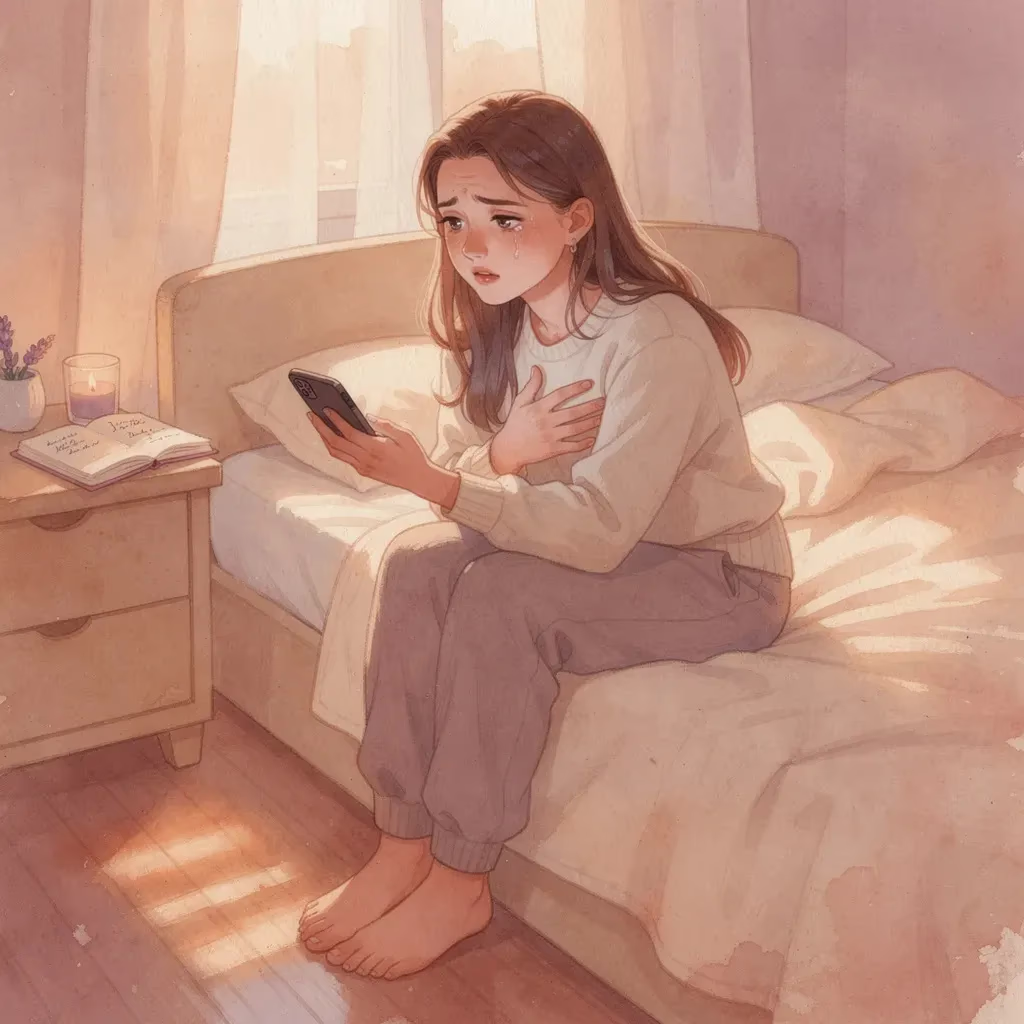
Somewhere along the way, "being low-maintenance" stopped being a cute trait and started being your whole personality in love. You tell yourself you're just flexible. But inside, it can feel like you're constantly checking where you stand, and adjusting so you don't get left.
If you keep searching am I codependent 1000 55, Dissolved is often the pattern that makes you feel the most exposed. Not because you're weak. Because you love hard, and your whole system learned that closeness is safer when you're agreeable.
This pattern can look calm on the outside. You might even be the one telling your friends, "It's fine, I'm chill." Meanwhile, you're doing 3am ceiling-staring math: how much do I need to give to keep this steady?
Dissolved Meaning
Core Understanding
If you recognize yourself in Dissolved, your boundaries don't just feel "weak". They feel foggy. Like you can't find the edges of where you end and the relationship begins. It's less "I say yes to everything" and more "I don't even know what my no would be until later."
This pattern often emerges when love has felt conditional at some point. Not always in a dramatic way. Sometimes it was subtle: praise for being helpful, for being "the easy one", for never making things complicated. Many women with this pattern learned early that needs create tension, and tension risks connection. Of course you adapted.
Your body remembers it. Dissolved shows up as holding your breath when you speak, a tight stomach when someone is quiet, a rush to explain yourself when someone seems even mildly off. It's not random. It's your system trying to keep you safe by keeping you agreeable.
This is also why Dissolved types end up taking an am I codependent quiz 390 11 and feeling both seen and not fully helped. You don't need a label as much as you need a map back to yourself. That's what this Boundaries Check is built to do.
What Dissolved Looks Like
- "Whatever you want" as a reflex: Your mouth says it before you've checked in with yourself. Later, you're staring at the menu thinking, "Wait, I hate this place." Others see easygoing. You feel slightly invisible.
- Borrowing someone else's certainty: If they sound confident, you follow their lead. Your opinions get quieter around strong personalities, especially in dating. Inside, it feels like relief mixed with loss.
- Over-checking their mood: A delayed reply can make your chest tighten. You scroll back through the thread for clues. On the outside you act normal, but inside you're bracing for impact.
- Agreeing to avoid the awkwardness: You say yes to plans, favors, and emotional labor because "it's not a big deal." Your shoulders slowly creep up toward your ears. The cost shows up later as exhaustion.
- Needs that arrive late: In the moment, you genuinely can't access what you want. Then you're alone and suddenly it's all there: anger, sadness, clarity. You wonder why you can't be "consistent."
- Apologizing for existing: You say "sorry" for asking a question, for taking up time, for needing reassurance. People think you're polite. Your body feels small.
- Making it okay even when it's not: Someone crosses a line and you smooth it over. You rationalize: "They're stressed." Later, you feel numb and slightly resentful, but you blame yourself for it.
- Over-functioning in the relationship: You're the planner, the emotional translator, the reminder system. It looks like love. It feels like a job you can't clock out of.
- Fear of being "too much": You have a need and immediately imagine them leaving. So you shrink it, soften it, wrap it in jokes. On the outside it's cute. Inside it's lonely.
- Confusing intensity with closeness: Big feelings feel like proof. You might chase the highs and accept the lows because it feels familiar. Your body is tired from riding the wave.
- Losing routines that used to be you: You stop seeing friends, stop hobbies, stop dressing a certain way. You say it's just busy. The truth is you're orbiting them.
- Guilt when you choose yourself: Rest feels selfish. Saying no feels mean. Even when your body is begging for a break, you push through and call it loyalty.
- Needing reassurance like oxygen: If you don't get it, you spiral. You might text again, or you might go quiet and hope they notice. Either way, you're not resting.
- Overexplaining as a safety move: You write a paragraph to justify a simple boundary. You do it so they won't be mad. You end up feeling even more exposed.
- A quiet identity question: You ask yourself, "Do I even know what I like?" It's not dramatic. It's a low hum that shows up when you finally have space.
How Dissolved Shows Up in Different Areas of Life
In romantic relationships: You can become the relationship's emotional weather app. If they're warm, you're okay. If they're distant, you're panicking. Conflict feels like a cliff edge, so you negotiate yourself down until there's nothing left to negotiate.
In friendships: You're the one who checks in, remembers birthdays, listens for hours. You might feel proud of how much you care. You also might feel hurt when nobody notices you're running on empty.
At work or school: You say yes to extra tasks, pick up slack, avoid asking for extensions even when you're drowning. You worry that needing help will make you "difficult." Your body pays in headaches, tension, burnout.
Under stress: You default to appeasing. Your thoughts get loud ("Did I mess up?"). Your body gets urgent. You might backtrack on boundaries, or you might go numb and shut down your preferences.
What Activates This Pattern
- Waiting for a reply that takes longer than usual, and your chest starts doing that tight, hot thing.
- A tone shift you can't explain, like one-word answers or less warmth than normal.
- Being asked what you want when you haven't practiced having an answer.
- Someone being disappointed in you, even mildly.
- Conflict in the air, even if nobody is yelling, just that cold quiet.
- Feeling replaced when they choose friends, work, or hobbies over you.
- Being called needy (even as a joke), and it lands like a bruise.
The Path Toward Feeling Solid Again
- You don't have to become "hard": Your softness is not the problem. The shift is letting your softness include you.
- Start with micro-preferences: Small choices train your system to tolerate having an opinion. Coffee order. Movie. Weekend plan.
- Practice tolerating their disappointment: Discomfort isn't danger. It's how boundaries become real.
- Replace overexplaining with one clean sentence: Not because you're cold, but because clarity is kindness.
- What becomes possible: You stop using "why am I codependent 170 18" as the only explanation for your pain. You start saying, "Oh. I know what I need. And I can hold it."
Dissolved Celebrities
- Drew Barrymore - Actress
- Katie Holmes - Actress
- Ginnifer Goodwin - Actress
- Mandy Moore - Actress
- Christina Aguilera - Singer
- Hilary Duff - Actress
- Emmy Rossum - Actress
- Zooey Deschanel - Actress
- Kristen Bell - Actress
- Lucy Hale - Actress
- Selena Gomez - Singer
- Ariana Grande - Singer
- Anne Hathaway - Actress
- Britney Spears - Singer
Dissolved Compatibility
| Other Type | Match | Why it feels this way |
|---|---|---|
| Accommodator | 😐 Mixed | Two givers can accidentally create a relationship where nobody states needs clearly. |
| Chameleon | 😬 Difficult | Both of you may adapt instead of being real, so the relationship feels close but unstable. |
| Awakening | 🙂 Works well | Awakening energy can model small honest requests, but you both must tolerate discomfort. |
| Navigator | 🙂 Works well | Navigator steadiness helps you feel safe, and you learn balance by being with balance. |
| Guardian | 😕 Challenging | Guardian distance can trigger your fear loops and make you chase reassurance harder. |
Am I an Accommodator?

Accommodator is the pattern where you can look like the kindest, easiest, most "stable" friend or partner... while quietly feeling like you're doing emotional labor nobody even notices.
This is the type that often lands you on why am I codependent 170 18 searches, because you're not clinging. You're not dramatic. You're just always the one adjusting, fixing, smoothing, understanding. And then one day you realize: your life is built around not upsetting anyone.
If you've taken an am I codependent quiz 390 11 and felt like the results were too extreme, Accommodator might finally feel accurate. It's not chaos. It's slow self-erasure with a smile.
Accommodator Meaning
Core Understanding
Accommodator means your boundaries aren't absent. They're just buried under guilt and the dread before conflict. You often know what you want. You can feel it in your body (that quiet "no" in your chest). You just don't say it, because you can already picture the disappointment on their face.
This pattern often emerges when being "good" meant being helpful, agreeable, emotionally mature, and low-need. Many women learned that love is earned by being easy to be around. Not too sensitive. Not too demanding. Not inconvenient. Of course you learned to accommodate.
Your body remembers. Accommodator energy shows up as jaw clenching when you say yes, a heavy fatigue after being "fine", and a flare of resentment when someone assumes you'll handle it. That resentment is not you being mean. It's your boundaries trying to exist.
If you keep wondering am I codependent 1000 55, a big part of the answer might be simpler than you expect: your care became a strategy. Not because you're manipulative. Because care felt like the safest way to keep connection.
What Accommodator Looks Like
- Doing it before anyone asks: You anticipate needs like it's your job. You refill the emotional tank for everyone else. Then you wonder why nobody ever checks on you.
- Saying yes while your stomach drops: Your mouth agrees, your body protests. Later, you replay the moment and feel annoyed at yourself for not speaking.
- Being the "reasonable" one: You mediate, translate emotions, and keep things calm. Others see maturity. You feel alone with the weight.
- Guilt as a control button: The second you consider a boundary, guilt rushes in. You imagine being selfish, unlovable, "too much". So you comply to get relief.
- Resentment buildup: You can be sweet all week, then suddenly snap over something tiny like dishes or a late text. The snap isn't about the dishes. It's about the pattern.
- Over-giving to prevent being left: You might not call it fear, but you act like if you stop providing, the connection might weaken. So you keep providing.
- Apologizing for needs: You start with "Sorry, but..." even for basic requests. Your voice might get smaller as you speak.
- Being hyper-aware of other people's comfort: You notice when someone is bored, stressed, annoyed, tired. You adjust instantly. You rarely ask, "How am I doing?"
- Letting plans default to them: You pick the restaurant they like, the hangout that suits them, the schedule that fits them. You tell yourself you don't mind. Your body keeps score.
- Being "understanding" past your limit: You make excuses for behavior that hurts you. You think compassion means tolerating. You end up depleted.
- Avoiding conflict like it's a breakup threat: Even gentle disagreement can spike your anxiety. You'd rather swallow it than risk distance.
- Taking responsibility for moods: If they're quiet, you feel responsible to fix it. If they're upset, you feel like you caused it, even when you didn't.
- Overexplaining to be safe: You try to make your boundary impossible to argue with. You give evidence. You soften it. You still feel guilty.
- Quiet fantasies of escaping: Sometimes you imagine being alone, not because you don't love them, but because you crave a day where nobody needs you.
- Feeling invisible in your own life: You look at your calendar and realize it's full of other people's priorities. Your own wants feel like an afterthought.
How Accommodator Shows Up in Different Areas of Life
In romantic relationships: You often become the caretaker role without agreeing to it. You monitor tone, plan comfort, fix misunderstandings, and keep things smooth. Intimacy can feel like earning closeness through effort instead of receiving love through mutuality.
In friendships: You're the one who shows up when others cry. You might be the "therapist friend." If you ever pull back, you feel guilty, even when you're exhausted.
At work or school: You accept extra tasks because you're reliable. You avoid asking for what you deserve (pay, credit, flexibility) because you don't want to be "difficult." Then you feel stuck.
Under stress: You appease harder. You over-apologize. You become even more helpful to regain safety. Later, you crash. Your body feels heavy and your patience is thin.
What Activates This Pattern
- Being asked for "one more thing" when you're already at your limit.
- Someone being disappointed and you instantly want to fix it.
- A partner saying "You're overreacting", and you start doubting yourself.
- Conflict where you can't predict the outcome, even if it's small.
- Feeling like you're replaceable unless you stay useful.
- Having to choose yourself (rest, alone time, friends) over them.
- Being told you're selfish for having a boundary.
The Path Toward Feeling Respected (and Respected by You)
- Name resentment as a boundary signal: It's not a flaw. It's information.
- Build one clean request: Short, kind, specific. No essay. No apology tour.
- Practice tolerating disappointment: This is the bridge out of chronic accommodation.
- Treat rest as allowed: Self-care permission is a skill, not a luxury.
- What becomes possible: You stop living in "why am I codependent 170 18" confusion. You start expecting reciprocity like it's normal.
Accommodator Celebrities
- Jennifer Garner - Actress
- Reese Witherspoon - Actress
- Amy Adams - Actress
- Michelle Williams - Actress
- Shakira - Singer
- Sandra Oh - Actress
- Carey Mulligan - Actress
- Dakota Johnson - Actress
- Kristen Wiig - Actress
- Keri Russell - Actress
- Jennifer Hudson - Singer
- Julia Stiles - Actress
- Mary Louise Parker - Actress
- Emily VanCamp - Actress
Accommodator Compatibility
| Other Type | Match | Why it feels this way |
|---|---|---|
| Dissolved | 😐 Mixed | You may both default to over-giving, which makes needs stay unspoken and resentment grow. |
| Chameleon | 😕 Challenging | You accommodate while Chameleon adapts, so nobody anchors the truth and the relationship drifts. |
| Awakening | 🙂 Works well | Awakening can bring more honesty, but you must stop rescuing the discomfort. |
| Navigator | 😍 Dream team | Navigator normalizes mutual effort, which helps you relax out of caretaker mode. |
| Guardian | 😐 Mixed | Guardian limits are firm, which can feel safe, but emotional distance can trigger your guilt. |
Am I a Chameleon?

Chameleon is that thing where you can be with almost anyone, anywhere, and somehow become exactly what the moment needs. People call you easy to be around. Magnetic. Warm.
And yet, when you're alone, there's often a hollow question: "Okay, but who am I when I'm not adjusting?"
If you've ever taken an am I codependent quiz 390 11 and felt like the answer depends on the day, that's very Chameleon. Because your boundaries aren't consistent. They change based on who you're with, and how safe you feel.
Chameleon Meaning
Core Understanding
Chameleon means your connection skills are so strong they can override your self-connection. You don't just compromise. You mirror. You absorb preferences, tone, values, even humor, because your system equates fitting in with staying close.
This pattern often emerges when belonging felt earned. Many women with this type learned to scan and adapt: read the room, keep the vibe good, be what people like. It may have started as a smart survival strategy. Now it can feel like identity fog.
Your body remembers. Chameleon shows up as a quickened pulse when you realize you disagreed, a tight throat when you want to say no, and that "hangover" after social time where you replay everything you said.
If you're asking am I codependent 1000 55, Chameleon is one of the sneakiest answers because it can look like confidence from the outside. Inside, it often feels like performing closeness.
What Chameleon Looks Like
- Mirroring preferences automatically: They love hiking, suddenly you're "outdoorsy." They hate texting, suddenly you "don't care" either. Others see compatibility. You feel like you're renting your personality.
- Editing yourself mid-sentence: You start to share an opinion, see their face shift, and immediately soften it. You might laugh it off, "I'm kidding." Your body feels that small pinch of self-betrayal.
- Being fun until you're alone: In the moment you're charming and present. Later, you feel drained and strangely sad. It's the cost of performing closeness.
- Confusing connection with agreement: You equate harmony with safety. So you smooth over differences instead of letting them exist. The relationship feels calm, but not fully real.
- Overexplaining boundaries: When you do set a limit, you bring a whole story so it doesn't feel like rejection. You hope they'll understand. You end up feeling exposed.
- Changing communication style to match: If they're dry, you get dry. If they're romantic, you get romantic. It can feel like intimacy, but it can also feel like you disappeared.
- Needing feedback to know you're okay: A "goodnight" text can calm your whole system. No text can make you spin. It looks like caring. It feels like your mood is outsourced.
- Avoiding being "difficult": You swallow discomfort so you don't ruin the vibe. Your chest tightens, you smile anyway, and later you wonder why you feel resentful.
- Being unusually good at reading micro-signals: You notice timing, tone, eye contact, silence. It's not you being crazy. It's pattern recognition from years of adapting.
- Taking on other people's emotional weather: If they're anxious, you become anxious. If they're distant, you become extra helpful. Your system tries to match to stay close.
- A shifting sense of identity: Your likes, style, even goals can change depending on the relationship. Friends might say, "You've changed." Inside, you feel exposed.
- Avoiding direct asks: You hint, you hope, you wait. Asking feels like risk. If you do ask, you cushion it with jokes.
- Post-conversation spirals: You replay your words at night. "Did I sound needy? Too intense?" It's exhausting and constant.
- Feeling safest with strong personalities: When someone is decisive, you can attach to their certainty. It feels calming. It also makes you smaller.
- Self-doubt in your own choices: Even small decisions can feel shaky. You might ask, "Do you like this?" because you're used to calibrating.
How Chameleon Shows Up in Different Areas of Life
In romantic relationships: You become what you think they want, especially early on. You might be the "cool girl" version of yourself. Then, when real needs appear, you feel panic: "If I'm honest, will they leave?"
In friendships: You're supportive and adaptable. You can be the glue in groups. You might also feel like nobody knows the real you, because you rarely take the risk of showing her.
At work or school: You can be a social chameleon: different versions with different groups. It helps you succeed. It can also lead to burnout because you're constantly managing perception.
Under stress: Your adaptability becomes overdrive. You over-apologize, over-explain, and try to fix the vibe. If it doesn't work, you might shut down and feel numb.
What Activates This Pattern
- Meeting someone new and feeling like you need to impress them.
- A slight change in tone and you instantly try to correct yourself.
- Group settings where you don't know your place yet.
- Being asked a direct preference ("Where do you want to eat?") and your mind goes blank.
- Someone acting distant and you start shape-shifting to earn closeness.
- Hearing "You're different lately" and feeling exposed.
- Feeling judged (even subtly), and you immediately self-edit.
The Path Toward Feeling Like You Again
- Your sensitivity is data, not damage: The goal isn't to stop noticing. It's to include your own signals in what you notice.
- Practice one honest preference per day: Small truth builds a stable self.
- Stop negotiating your needs down to zero: A boundary doesn't need a court case to be valid.
- Build self-trust through follow-through: Tiny commitments to yourself, kept consistently, change everything.
- What becomes possible: You stop wondering "why am I codependent 170 18" every time you attach. You start feeling solid enough to be loved as you are.
Chameleon Celebrities
- Zendaya - Actress
- Hailee Steinfeld - Actress
- Lily Collins - Actress
- Camila Cabello - Singer
- Sabrina Carpenter - Singer
- Anna Kendrick - Actress
- Vanessa Hudgens - Actress
- Mila Kunis - Actress
- Emma Roberts - Actress
- Sarah Michelle Gellar - Actress
- Winona Ryder - Actress
- Alicia Silverstone - Actress
Chameleon Compatibility
| Other Type | Match | Why it feels this way |
|---|---|---|
| Dissolved | 😬 Difficult | The relationship can become all adaptation and no truth, which creates anxiety and identity fog. |
| Accommodator | 😕 Challenging | You may both keep the peace, then feel unseen because nobody is naming needs directly. |
| Awakening | 🙂 Works well | Awakening brings honesty that helps you stabilize, if you tolerate discomfort together. |
| Navigator | 😍 Dream team | Navigator steadiness gives you space to be real without fear that honesty = abandonment. |
| Guardian | 😐 Mixed | Guardian limits can feel grounding, but emotional distance may trigger your shape-shifting. |
Am I Awakening?

Awakening is the phase where you start noticing yourself again. It's the first time you realize, "Wait... I don't actually have to agree. I don't have to manage their mood. I don't have to disappear to be loved."
And then, immediately after that realization, your body might still panic when you try to act on it. That's Awakening. The truth is getting louder, but the fear hasn't caught up yet.
If you're asking why am I codependent 170 18, Awakening is often the moment you finally see the emotional logic. Not to blame anyone. Just to understand how you got here, and how to change without breaking your heart.
Awakening Meaning
Core Understanding
Awakening means your sense of self is returning, but your boundaries are still shaky in real time. You can sense your yes/no more clearly. You might even express it. Then the guilt hits. The fear hits. The "Did I ruin everything?" hits.
This pattern often emerges after a tipping point: burnout, heartbreak, a friendship that drained you, or just one too many moments of feeling invisible. Many women with this type didn't suddenly become "strong." They just got tired of abandoning themselves.
Your body remembers both stories at once. Part of you feels relief when you speak up. Another part feels danger. You might feel a rush of heat, shaky hands, a stomach flip after setting a boundary. That's not you being dramatic. That's your system learning something new.
If you keep wondering am I codependent 1000 55, Awakening can feel like the beginning of "Oh. I get it." Not the end. The beginning.
What Awakening Looks Like
- A new honesty that surprises you: You hear yourself say, "Actually, I don't want that." It feels scary and freeing at the same time. Others might look shocked. You feel like you finally existed.
- Boundary hangovers: After you speak up, you replay it for hours. You worry you sounded mean. Your body stays wired, like you need reassurance to survive your own boundary.
- Saying no, then negotiating: You set a limit and then immediately soften it. "But if you really need me, I can..." Your system wants to keep connection safe.
- Noticing resentment sooner: You catch the early signs: tight jaw, irritation, fatigue. Instead of exploding later, you start wondering what you actually need.
- Micro-acts of self-care: You take a nap without earning it. You say no to a plan. It feels rebellious. It also feels like coming home.
- Feeling angry for the first time: Not explosive anger. Clear anger. Like, "That wasn't okay." It can scare you because you were trained to be pleasant.
- Choosing yourself and feeling guilty: You pick your needs and the guilt tries to punish you. You still do it. That's growth.
- Naming what you want: You can say preferences, but your voice might shake. You might add extra explanations to protect the other person's feelings.
- Asking for reciprocity: You start noticing imbalance. You don't want one-way love anymore. This is huge.
- Seeing patterns across relationships: It's not just "this one person." It's a theme. You feel grief and clarity at once.
- Testing safe honesty: You pick lower-stakes moments to practice. You might start with friends before partners, or work before family.
- Tolerating a little discomfort: You can handle a little awkward silence now. Not always, but sometimes. That's the new muscle.
- Self-trust returning: You believe yourself more. You stop outsourcing your reality. Even if you still doubt, you bounce back faster.
- A sharper filter for red flags: Love bombing, inconsistency, guilt trips feel different now. You see them sooner.
- Longing for a different kind of love: You want ease. You want mutual effort. You don't want to earn a place.
How Awakening Shows Up in Different Areas of Life
In romantic relationships: You start asking for what you need. You might still fear it will push them away. If the relationship is healthy, this can deepen intimacy. If it's not, you'll notice how much the relationship depended on you staying small.
In friendships: You begin to pull back from one-sided dynamics. You stop being the only one who initiates. It can feel lonely at first, then freeing.
At work or school: You might finally speak up in meetings, ask for clarity, or set time boundaries. You might still overthink afterward, but you do it anyway.
Under stress: Old habits try to pull you back. You might appease, over-explain, or backtrack. The difference is you notice faster. You repair faster. You come back to yourself sooner.
What Activates This Pattern
- Setting a boundary and then feeling that immediate guilt wave.
- Someone saying "You're being selfish" and your old training lights up.
- A partner getting cold after you asked for something.
- Seeing unfairness and feeling anger in your body.
- Being ignored when you finally express a need.
- Having to hold the line instead of explaining it to death.
- Thinking about leaving and feeling the fear of being alone.
The Path Toward Steady Boundaries
- You can go slow: Awakening is not a personality makeover. It's practice.
- Anchor your boundary in one sentence: Short, kind, firm. No courtroom evidence.
- Expect the guilt, don't obey it: Guilt is an old alarm, not a moral fact.
- Follow through in tiny ways: Consistency builds self-trust faster than intensity.
- What becomes possible: You stop asking "am I codependent quiz 390 11" like it's a verdict. You start living like you belong to yourself.
Awakening Celebrities
- Emma Watson - Actress
- Florence Pugh - Actress
- Brie Larson - Actress
- Jessica Alba - Actress
- Rachel McAdams - Actress
- Natalie Portman - Actress
- Jennifer Lawrence - Actress
- Scarlett Johansson - Actress
- Mindy Kaling - Writer
- Pink - Singer
- Alicia Keys - Singer
- Claire Danes - Actress
Awakening Compatibility
| Other Type | Match | Why it feels this way |
|---|---|---|
| Dissolved | 🙂 Works well | Your growing voice can help Dissolved reconnect to preferences, if you avoid rescuing. |
| Accommodator | 🙂 Works well | You both care deeply, and you can model cleaner asks that reduce resentment. |
| Chameleon | 😐 Mixed | You want steadiness, Chameleon adapts. Honesty helps, but it can feel shaky at first. |
| Navigator | 😍 Dream team | Navigator supports your growth without punishing you for needing time and reassurance. |
| Guardian | 😐 Mixed | Guardian limits can be grounding, but distance may trigger your fear loops unless the pace is named. |
Am I a Navigator?

Navigator is the pattern most of us secretly wish we could bottle. Not because it's perfect, but because it's calm. It's the "I can love you and still be me" kind of calm.
If you're here because you're asking am I codependent 1000 55, Navigator might not be your result. Still, it can be a north star. It shows what boundaries look like when they're not mean, and not a panic response. They're just normal.
Navigator is the "both/and" type: you can want closeness and also protect your life. You can be kind and also be clear.
Navigator Meaning
Core Understanding
Navigator means you have a stronger inner compass. You can sense what you want, express it, and follow through without turning your needs into a crisis. That doesn't mean you never feel anxious. It means you don't let anxiety run the relationship.
This pattern often develops when you've had at least some experiences of safe repair. Someone could be disappointed and still love you. You could disagree and still be chosen. Many Navigators also learned, sometimes the hard way, that disappearing isn't love.
Your body remembers safety. Navigator energy feels like breathing normally during hard conversations, a steady chest, and the ability to tolerate silence without spiraling. When you set a boundary, you might still feel discomfort, but you don't immediately backtrack to get relief.
This is why people who score Navigator-like in an am I codependent quiz 390 11 often feel a different question underneath: "How do I keep this balance, especially when someone tries to pull me into old patterns?" The Boundaries Check helps you keep it.
What Navigator Looks Like
- Clear preferences without drama: You can say what you want without making it a moral issue. Others see confidence. You feel simple clarity.
- Boundaries that sound kind: Your no isn't a weapon. It's information. You don't over-explain because you trust your needs are valid.
- Mutual effort as the baseline: You notice reciprocity naturally. If you're always the one initiating, it stands out. You don't have to convince yourself it's fine.
- Repair after conflict: You can come back after tension. You don't need perfect harmony to feel secure. You can say, "That didn't feel good," and stay present.
- Tolerance for disappointment: You let someone be annoyed without making it your emergency. You don't collapse, chase, or punish. You hold steady.
- Self-care permission: Rest isn't earned. You treat your time like it matters. You don't apologize for being a person.
- Decision agency: You don't default to "whatever you want" out of fear. You can choose. You can also compromise without losing yourself.
- Emotional autonomy: Their mood doesn't fully decide your worth. You can care about them without becoming them.
- Trusting your reality: If something feels off, you explore it. You don't instantly assume you're wrong. You ask questions and listen to your gut.
- Healthy closeness: You want connection, but you don't confuse closeness with constant access. You can be apart and still feel bonded.
- Direct communication: You can say hard things in simple language. You don't use hints as a strategy.
- Not over-managing: You don't run the relationship like a project. You co-create it. That frees up so much energy.
- Choosing aligned relationships: You pay attention to values, effort, and how you feel around them. You don't chase potential as proof.
- Guilt that doesn't run the show: You might feel a twinge of guilt. You don't obey it. You choose what respects you.
- Staying yourself in love: Your friendships, interests, and routines stay alive. Your life expands with love, it doesn't shrink.
How Navigator Shows Up in Different Areas of Life
In romantic relationships: You want closeness and you can ask for it directly. When conflict appears, you can stay in the conversation without disappearing. You also notice when a relationship isn't mutual, and you don't keep paying the emotional bill alone.
In friendships: You give and receive. You can support without rescuing. You don't take it personally if someone needs space, and you don't abandon yourself to keep someone close.
At work or school: You can collaborate without over-functioning. You can say, "I can do this by Friday, not tomorrow." You advocate for yourself without spiraling afterward.
Under stress: You might feel activated, but you come back to your center faster. You use support, routines, and self-trust instead of people-pleasing or shutting down.
What Activates This Pattern
- Repeated inconsistency from someone you care about.
- One-way effort where you're always initiating.
- Disrespect of a boundary after it's been stated clearly.
- Silent treatment or emotional punishment.
- Being pushed to over-explain your needs.
- Feeling like your no is being negotiated instead of respected.
The Path Toward Staying Balanced
- Keep choosing "clear over perfect": Clarity keeps relationships honest.
- Protect your self-care like it's a promise: It keeps your identity solid.
- Stay curious, not self-blaming: If something feels off, explore it.
- Let reciprocity be non-negotiable: Love should move both ways.
- What becomes possible: If you came here wondering "why am I codependent 170 18", you start realizing the real goal isn't the label. It's a relationship where you don't have to disappear.
Navigator Celebrities
- Viola Davis - Actress
- Margot Robbie - Actress
- Simone Biles - Athlete
- Keira Knightley - Actress
- Kate Winslet - Actress
- Jennifer Connelly - Actress
- Julia Roberts - Actress
- Meryl Streep - Actress
- Allison Janney - Actress
- Serena Williams - Athlete
- Emma Stone - Actress
- Rachel Weisz - Actress
Navigator Compatibility
| Other Type | Match | Why it feels this way |
|---|---|---|
| Dissolved | 🙂 Works well | Your steadiness reduces panic loops, and you can invite honest preferences gently. |
| Accommodator | 😍 Dream team | You normalize reciprocity, so Accommodator can stop over-giving and relax. |
| Chameleon | 🙂 Works well | You create safety for consistent truth, helping Chameleon stop shape-shifting. |
| Awakening | 😍 Dream team | You support growth without punishment, making boundaries feel less scary. |
| Guardian | 😐 Mixed | You value connection, Guardian values protection. It can work with honest needs and patience. |
Am I a Guardian?

Guardian is the pattern where your boundaries are not the issue. Your boundaries work. The question is: do they work in a way that still lets you feel loved, seen, and connected?
A lot of Guardians end up on am I codependent 1000 55 searches because they feel confused by the label. You're not begging. You're not clinging. You're just tired of being the one who holds everything. So you protect yourself. Sometimes you protect yourself so well that love can't quite reach you.
Guardian isn't cold. It's cautious. It's what happens when you learned that closeness can cost you.
Guardian Meaning
Core Understanding
Guardian means you learned to create safety through self-reliance. You might be the strong one. The dependable one. The one who doesn't ask for much. Inside, there can be a longing to be cared for, but asking feels risky, so you keep it contained.
This pattern often emerges when depending on others felt unreliable. Many women with this type learned: "If I need people, I get disappointed." So you became your own backup plan. That is a strength. It just has a cost.
Your body remembers. Guardian energy shows up as tension in your shoulders when someone gets too close, a shutting down feeling when conflict appears, and a quick urge to detach rather than negotiate. It's not you being heartless. It's you staying safe.
People who search why am I codependent 170 18 with a Guardian pattern often aren't codependent in the stereotype sense. The deeper question is: "Why does love feel like pressure?" The Boundaries Check helps you see whether your protection is serving you or isolating you.
What Guardian Looks Like
- Being capable to the point of loneliness: You handle everything. People assume you're fine. Inside, you sometimes wish someone would notice without you asking.
- Strong boundaries, guarded feelings: You can say no. You might not share the deeper reason why. It keeps you safe, but it can also keep you unseen.
- Discomfort with neediness (yours and theirs): When someone gets clingy, your body tightens. When you feel needy, you feel embarrassed. So you shut it down.
- Keeping your inner world private: You might journal, think, process alone. Others see composed. You feel like nobody really knows you.
- Independent routines as protection: Your solo habits are sacred. If a relationship starts consuming them, you feel trapped. You pull back hard.
- Low tolerance for emotional chaos: You don't want drama. When someone is inconsistent, you get exhausted quickly. You may detach rather than chase.
- Anger that becomes distance: When you're hurt, you can go quiet. You might not yell. You just move your heart back.
- Not asking for reassurance: Even if you want it, you don't ask. You tell yourself you don't need it. Then you feel disconnected.
- High standards for respect: You notice red flags quickly. You don't tolerate obvious disrespect. This is a gift.
- Over-functioning in silence: You might still do too much, but you won't complain. Then you quietly withdraw when you hit the limit.
- Avoiding vulnerability until it's "safe enough": You might take a long time to open up. Others can misread you as uninterested. You're actually careful.
- Hard to receive help: When someone offers support, you say "I'm good." Receiving can feel like owing.
- Testing people (without meaning to): You watch to see if they show up without being prompted. If they don't, you confirm your story: "See, I can't rely on anyone."
- Protecting your time fiercely: You set boundaries around availability. It helps your peace. It can also limit closeness if it's too rigid.
- A quiet desire for mutuality: You don't want to be rescued. You want partnership. You want someone who can meet you, not drain you.
How Guardian Shows Up in Different Areas of Life
In romantic relationships: You may prefer slow closeness. Too much intensity can feel unsafe. You might look calm, but inside you're tracking, "Is this person stable? Will they respect me?" If they push, you pull back. If they respect your pace, you soften.
In friendships: You're loyal and steady. You might have fewer close friendships, but deeper ones. You may struggle to ask for help, so friends might not realize when you're struggling.
At work or school: You're reliable and self-directed. You don't like unclear expectations. You can also end up carrying responsibility because you don't trust others to do it right.
Under stress: You detach. You get quiet. You may shut down emotionally to avoid being overwhelmed. Sometimes you disappear a little, not to punish, but to regain control.
What Activates This Pattern
- Someone pushing past your no, even subtly.
- Love bombing or intensity early on, which feels like pressure.
- A partner who needs constant reassurance, which can feel draining.
- Being misunderstood as cold or distant, when you're actually protecting.
- Conflict that feels messy, where emotions are high and unclear.
- Feeling trapped by expectations of constant availability.
- Being asked to explain your boundary like it's negotiable.
The Path Toward Softening Without Losing Safety
- You don't have to drop your boundaries: The goal is warmth with limits, not openness without protection.
- Practice one small ask: Not a huge vulnerability dump. One clear request for support.
- Let safe people prove themselves: You can move slowly and still allow closeness to grow.
- Name feelings earlier: Not because you're wrong to be guarded, but because repair builds connection.
- What becomes possible: You stop living in the extremes of "I need nobody" vs "am I codependent quiz 390 11." You find your middle: connected and protected.
Guardian Celebrities
- Jennifer Aniston - Actress
- Courteney Cox - Actress
- Emily Blunt - Actress
- Rosamund Pike - Actress
- Charlize Theron - Actress
- Kate Beckinsale - Actress
- Jodie Foster - Actress
- Sigourney Weaver - Actress
- Diane Keaton - Actress
- Michelle Pfeiffer - Actress
- Jamie Lee Curtis - Actress
- Sandra Bullock - Actress
Guardian Compatibility
| Other Type | Match | Why it feels this way |
|---|---|---|
| Dissolved | 😕 Challenging | Your distance can trigger their fear loops, and their chasing can trigger your shutdown. |
| Accommodator | 😐 Mixed | They may over-give to earn closeness, and you may accept it without realizing the cost. |
| Chameleon | 😐 Mixed | Chameleon adapts to you, which can feel easy, but it can also hide the truth you need. |
| Awakening | 😐 Mixed | Awakening wants closeness and honesty, but your pace may feel slow unless you communicate it. |
| Navigator | 😐 Mixed | Navigator can handle your limits, but you must let warmth and vulnerability exist too. |
When you stop guessing, things get quieter fast
If you're stuck in the "am I codependent 1000 55" loop, it's usually because you've been trying to fix a pattern without knowing what pattern you have. An am I codependent quiz 390 11 can be a first step, but it rarely shows you the exact moment you start disappearing. This Boundaries Check does. It also answers the deeper question, why am I codependent 170 18, in a way that feels like understanding, not diagnosis.
What you get from the Boundaries Check (the short version)
- Discover why you keep googling am I codependent 1000 55 after the same kind of relationship.
- Understand what your am I codependent quiz 390 11 results are actually pointing to (identity fog, guilt, conflict fear).
- Recognize the moments you over-explain, over-give, or backtrack on boundaries.
- Honor your needs without turning it into a guilt spiral.
- Connect with language that helps you ask for reciprocity (without begging for it).
- Create a simpler, kinder boundary plan you can actually follow.
Where you are now vs what becomes possible
| Where you are now | What becomes possible |
|---|---|
| You say yes, then feel resentful later. | You can say no kindly and still feel connected. |
| You overthink every text and tone shift. | You trust yourself, even when someone is moody. |
| You don't know what you want until you're alone. | You can feel your yes/no in real time. |
| You keep asking "am I codependent 1000 55" to make sense of the pain. | You get a clear pattern, plus micro-steps that match your real life. |
| You're scared boundaries will cost you love. | You learn that real love doesn't require you to disappear. |
Join 230,691 women who've taken this 5 minutes (or under 5 minutes) Boundaries Check to finally understand what's happening. Your answers stay private and your private results are just for you.
FAQ
How do I know if I'm losing myself in a relationship?
You might be losing yourself in a relationship when your life gets quieter in all the wrong ways: fewer opinions, fewer plans that are just yours, fewer moments where you feel like "me." It often looks like love on the outside, but it feels like shrinking on the inside.
If this question is on your mind, it makes perfect sense. So many of us were taught (directly or indirectly) that being "easy" keeps people close. So we adapt. We smooth edges. We edit ourselves. And then one day you realize you haven't heard your own voice clearly in a while.
Here are signs that show up again and again when someone is drifting into self-abandonment:
- Your choices revolve around their reactions. You catch yourself thinking, "Will this upset them?" before "Do I even want this?"
- You feel responsible for their mood. You scan their tone, their face, their texting speed. Your nervous system acts like it's your job to keep things calm.
- You over-explain and apologize constantly. Even when you've done nothing wrong, you feel the urge to soften, justify, and make it easier for them to accept you.
- You say yes when your body says no. This is a big one. You agree, then feel resentment or emptiness later.
- Your friendships and interests fade. Not because you don't care, but because you are spending all your energy maintaining closeness and avoiding conflict.
- You can't access your own preferences quickly. Someone asks what you want to eat, do, watch, or plan, and your mind blanks. You default to "Whatever you want."
- You feel anxious when you're not "needed." If you're not actively helping, fixing, soothing, or proving your love, you feel a little panicky.
A lot of women searching "am I losing myself in my relationship quiz free" are not being dramatic. They're noticing a real pattern: their identity starts to orbit someone else's needs and emotions.
One gentle self-check that helps: ask, "If I removed their opinion from the room, what would I choose?" If that question feels surprisingly hard, it doesn't mean you're broken. It means you've been practicing disconnection from yourself for a long time, probably as a way to stay loved.
A quiz can't diagnose your life, but it can give language to what you're already sensing and help you see your specific pattern clearly.
Am I codependent, or am I just caring?
You're not "too much" for caring deeply. The difference is this: caring still includes you. Codependence slowly removes you from the equation.
This question hits a nerve for so many women because we've been praised our whole lives for being supportive, understanding, accommodating. Then we end up googling "am I codependent" at 2am, wondering why love feels so anxious and exhausting.
Here is the simplest, clearest distinction:
- Caring sounds like: "I care about you, and I care about me too."
- Codependence sounds like: "I will manage your feelings so you don't leave, even if it costs me."
Some signs your "care" might be sliding into codependence (and yes, it can be subtle):
- You feel guilty for having needs. You might even ask "is it selfish to have boundaries" because part of you believes boundaries equal rejection.
- You confuse love with earning. You over-function (planning, fixing, anticipating) because it feels safer than being vulnerable and simply asking.
- You tolerate what hurts you to keep connection. You minimize your discomfort because the bigger fear is distance, conflict, or abandonment.
- You feel calm only when they're calm. Your inner peace is outsourced to their approval.
- You take responsibility for things that aren't yours. Their bad mood, their choices, their lack of effort somehow becomes your project.
And here's the part I really want you to hear: codependence isn't a character flaw. It's a strategy. Usually it started when being tuned into someone else was the safest way to be loved, or at least not punished.
If you're wondering "why am I codependent" or taking an "am I codependent quiz," you're not looking for a label. You're looking for relief. You're looking for a way to love without disappearing.
A helpful micro-check is this: after you support them, do you feel warm and connected, or do you feel drained and resentful? Resentment is often your boundary trying to get your attention.
Our Boundaries Check quiz helps you see where your caring is healthy and where it turns into self-erasure, so you can start coming back to yourself without shutting your heart down.
Why do I always put others first, even when it hurts me?
You put others first because at some point, it worked. It helped you feel safe, liked, chosen, or at least not rejected. And now it's a habit your nervous system reaches for automatically, even when it costs you.
If you've searched "why do I always put others first," you already know the truth on a body level: you can be exhausted and still keep showing up for everyone. That is not because you're weak. It's because you're wired for connection, and you've learned that connection requires self-sacrifice.
Here are a few common roots of chronic self-abandonment (and you might see more than one):
- You were rewarded for being "easy." Being low-maintenance got you praise. Having needs got you eye rolls, guilt, or withdrawal.
- You learned to anticipate feelings to avoid conflict. If someone in your life was unpredictable, your sensitivity became survival. You got good at reading the room.
- Your worth became linked to usefulness. You feel lovable when you're helping, fixing, supporting, or being the "strong one."
- You fear being a burden. So you downplay your needs until they come out as anxiety, resentment, or numbness.
- You equate boundaries with rejection. Saying no feels like you're hurting someone, so you say yes and hurt yourself instead.
This is why "how to stop being a people pleaser" is not just a mindset switch. People-pleasing often lives in your body. Your heart races. Your throat tightens. Your brain starts writing a script to keep everyone happy.
One micro-shift that starts rebuilding you: ask, "If I say yes to this, what am I saying no to?" Maybe it's sleep. Maybe it's your friendships. Maybe it's your own emotional stability.
A lot of women feel ashamed that they "can't change." But change starts with naming your pattern accurately. Some women are more like the Accommodator (you keep the peace by over-giving). Others are the Chameleon (you shape-shift to match what will be loved). Some feel more Dissolved (you genuinely can't find yourself under all the caretaking). None of these are failures. They're strategies that kept you connected.
The Boundaries Check quiz helps you pinpoint which pattern you lean toward, so you're not trying random boundary advice that never fits your real life.
Why can't I say no to people without feeling guilty?
You struggle to say no because your brain and body learned that "no" might cost you closeness. The guilt is not proof you're selfish. It's proof you've been trained to prioritize other people's comfort over your own needs.
If you've ever typed "why can't I say no to people" into your phone and felt a little embarrassed about it, you're in very good company. A lot of us don't fear the word no. We fear what happens after: the silence, the disappointment, the shift in tone, the feeling that we did something "bad."
Here are a few reasons guilt shows up so strongly:
- You confuse boundaries with being mean. Many women were taught that kindness means constant access.
- You over-identify with being "the reliable one." Saying no threatens your identity as the helper, the peacemaker, the good friend, the good girlfriend.
- You grew up managing other people's emotions. If someone got upset, it became your job to fix it. So now, someone else's discomfort feels like your responsibility.
- You have an anxious attachment loop. Your system reads disapproval as danger, so you comply to restore safety.
- You've had boundaries punished before. Maybe not dramatically, but through sarcasm, guilt-trips, withdrawal, or being labeled "selfish."
Something that helps is separating guilt from danger. Guilt can feel like danger when you've been conditioned to keep the peace. That doesn't mean you're doing something wrong.
A practical way to practice without panic is to start with "soft no's" that still honor you:
- "I can't this week, but I hope it goes well."
- "That doesn't work for me."
- "I need to think about it and get back to you."
- "I want to help, but I don't have the capacity."
No over-explaining required. People who respect you will adjust. People who benefit from your lack of boundaries will protest. That protest is information.
If you're taking a "boundaries check quiz" or wondering which pattern you have, the quiz can help you understand if you're more of an Accommodator (guilt-driven yes), a Chameleon (approval-driven yes), or in an Awakening phase (you're starting to see it, but the guilt is loud).
How accurate are "am I losing myself in my relationship" or "am I codependent quiz" results?
A good quiz can be surprisingly accurate at reflecting patterns, but it should be used for insight, not as a diagnosis or a final verdict. The most accurate quizzes help you name behaviors and emotional habits you might be normalizing.
It makes sense to question this. When you're already doubting yourself in relationships, you don't want another thing telling you you're "wrong." So here's what accuracy really means in this space.
What a quiz can do well:
- Spot repeating patterns you might not connect on your own (people-pleasing, over-functioning, self-silencing).
- Give language to your experience, especially when you've been minimizing it.
- Show you your default coping strategy under stress (like fawning, fixing, disappearing, performing).
- Offer a framework so you're not stuck in "Is it me? Is it them? Am I crazy?"
What a quiz cannot do:
- Prove your partner is good or bad.
- Replace therapy, especially if there's trauma, emotional abuse, or ongoing fear.
- Capture every detail of your relationship context.
Accuracy goes up when questions are behavior-based, specific, and emotionally realistic. For example, it's more useful to ask, "Do you feel anxious when they don't reply?" than "Are you codependent?"
If you're searching "am I losing myself in my relationship quiz free," what you're often looking for is a mirror. Something that says, "You're not imagining it." A well-designed quiz does that by organizing your answers into a pattern you can recognize.
Our Boundaries Check quiz also uses result types to make the insight more personal. Some women land in Dissolved (your needs have been offline for a while). Some land in Awakening (you're seeing the pattern and starting to want different). Some land in Navigator (you can hold boundaries, but certain triggers still pull you off-center). Those distinctions matter because the right next step is different for each.
The real test of usefulness is this: after reading your results, do you feel more clear, more compassionate toward yourself, and more able to choose your next move? That's the kind of accuracy that changes your life.
What causes weak boundaries in relationships?
Weak boundaries are usually caused by adaptation, not laziness or lack of willpower. They often come from learning that keeping people happy kept you safe, connected, or chosen.
If you've ever wondered, "Why can't I set boundaries like other people?" there is nothing wrong with you. Your boundary system was shaped by your history, your attachment patterns, and the kind of relationships you've been in.
Here are some common causes of weak boundaries (and why they make so much sense):
- People-pleasing as protection. If conflict felt scary growing up, your system learned to prevent it by being agreeable.
- Anxious attachment and fear of abandonment. When closeness feels fragile, boundaries can feel like you're risking the relationship.
- Low practice with needs. If no one asked what you wanted or respected your no, you didn't get to build that muscle.
- Being praised for self-sacrifice. Especially for women, "good" often meant accommodating. Over time, that becomes your default.
- Past relationships that punished boundaries. If you've dated someone who guilt-tripped you or withdrew affection when you spoke up, your body remembers.
- Confusing empathy with responsibility. You can understand someone else's feelings without making them your job to fix.
This is where so many women get stuck: they hear "boundaries are kindness," but their body hears "boundaries are danger." So you freeze, cave, or over-explain.
A practical way to start rebuilding boundaries without going into panic is to identify your three most common boundary leaks:
- Time (overcommitting, instant replies, always available)
- Emotional labor (being the therapist, the fixer, the regulator)
- Physical or relational pace (moving faster than you actually want to)
Then ask: "Where do I feel the most resentment?" Resentment is often the first flare your boundary system sends up.
Our Boundaries Check quiz helps you pinpoint the specific flavor of boundary struggle you have, because "how to stop being a people pleaser" looks different for an Accommodator than it does for a Chameleon, and different again for a Guardian (someone who protects others well but can still ignore her own limits).
How do I stop being a people pleaser without losing relationships?
You stop being a people pleaser by shifting from "keeping the peace" to "telling the truth with care." The relationships that are healthy will adjust. The ones that require you to disappear will get shaky, and that tells you something important.
This question usually carries a deeper fear: "If I'm not convenient, will I still be loved?" Of course that fear is loud, especially if love has felt conditional for you.
Here's what helps: people-pleasing is not the same as kindness. People-pleasing is often fear management. Kindness can include honesty, limits, and mutual respect.
Practical ways to change the pattern without blowing up your life:
- Delay your yes. Instead of agreeing immediately, try, "Let me check my schedule and get back to you." This protects you from automatic compliance.
- Name your preference in low-stakes moments. Pick the movie. Choose the restaurant. Say "I actually don't love that" about something small. This rebuilds your identity.
- Practice "disappointing" people who are safe. Start with friends who respect you. Let them hear a no and watch the relationship survive. Your body learns from evidence.
- Reduce over-explaining. Over-explaining often invites negotiation. A clean no is kinder than a resentful yes.
- Expect discomfort. Not because you're doing it wrong, but because you're retraining a nervous system that equates boundaries with rejection.
A lot of women discover they have a specific role in relationships: the peacekeeper, the helper, the one who adjusts. Your result type in this Boundaries Check can clarify that role. An Awakening woman is often right at the edge of change, she can feel the cost of people-pleasing but still fears the fallout. A Navigator has more skill but still gets pulled off course when love feels uncertain. A Guardian can protect others fiercely and still struggle to protect her own time, energy, and body.
The goal isn't to become cold or detached. It's to become real. Real love can handle real you.
If you're ready for a gentle starting point, the quiz can show you where your people-pleasing lives and what kind of boundaries will feel most natural for you.
What should I do after I realize my boundaries are too accommodating?
After you realize you're too accommodating, the next step is not a dramatic confrontation. The next step is rebuilding trust with yourself in small, consistent ways, especially in the moments you usually override your needs.
If you've found yourself thinking, "I am too accommodating in relationships" and feeling a wave of shame, I get it. But shame won't build boundaries. Self-respect will. And self-respect grows through tiny decisions that tell your nervous system, "I'm safe with me."
Here are the most helpful next moves, in a grounded order:
- Identify your top 2 boundary drains. Usually it's time, emotional labor, or physical/sexual pace. The point is focus. Changing everything at once makes you panic and backslide.
- Write down your "early no signals." For many women it's a tight chest, instant fatigue, irritability, or that feeling of wanting to disappear. Your body often knows before your mind does.
- Choose one sentence you can repeat. Something simple like, "That doesn't work for me," or "I can't commit to that." Repetition builds safety.
- Track what happens when you honor yourself. Not what you think will happen. What actually happens. Healthy people adjust. Unhealthy dynamics escalate.
- Expect pushback (and don't interpret it as failure). If someone is used to your constant yes, your no will feel like a loss of control. That reaction gives you information about the relationship.
If you're wondering "is it selfish to have boundaries," the honest answer is no. Boundaries are how love stays clean. Without them, love turns into obligation, anxiety, and resentment.
Your Boundaries Check results can also help you choose the right repair. If you're more Dissolved, you might start with reconnecting to preferences before you tackle big conversations. If you're an Accommodator, you might focus on guilt tolerance. If you're a Chameleon, you might focus on not shape-shifting under pressure. If you're in Awakening, you might focus on steady, tiny experiments. If you're a Navigator or Guardian, you might refine boundaries in the places you still overgive.
You're allowed to want relationships where you don't have to earn your place.
What's the Research?
Why "Losing Yourself" Happens (And Why It Makes Sense)
That moment when you realize your whole day is organized around their mood, their schedule, their needs. Or when you can list what they like, what they hate, what triggers them... but you genuinely cannot answer, "What do I need right now?" If that's you, it isn't because you're "too much" or "too needy." It's because your nervous system learned that closeness can be something you earn.
Across research and clinical summaries, personal boundaries are basically the lines that define where you end and someone else begins. Not in a cold way, but in a "I still exist in here" way. One simple definition that helps a lot is that boundaries are about your actions and responses, not controlling someone else's behavior. That's the core idea in overviews of personal boundaries. If you're trying to control them, you're exhausted. If you're choosing what you'll do, you get your life back.
A lot of us were subtly trained out of boundaries early. Psych Central describes how many people are taught to "bend and mold" to make others comfortable, which is exactly the kind of conditioning that later makes saying no feel like you're being mean or selfish (Psych Central). Stanford Student Affairs frames boundaries as what helps determine what is and isn't okay in relationships, and they connect it directly to trust and safety, not selfishness (Stanford Student Affairs).
And if you grew up in a home where you had to track everyone's emotions, or keep peace, or be "the good one," this pattern can slide into adulthood as something that looks like love. Family systems research uses the term "enmeshment" for relationships where emotional boundaries get so blurred that autonomy gets squeezed out. Enmeshment was originally described in family systems theory as diffuse boundaries and over-involvement that can interfere with independent development (Wikipedia: Enmeshment; Simply Psychology: What is Enmeshment?). That hyper-attunement you call "caring" can also be a survival skill that never got to retire.
Boundaries vs. "Codependency" vs. Enmeshment (So You Can Name What You're In)
So many women google things like "am I codependent" or take an "am I codependent quiz" because they're trying to name the ache: "Why does it feel like I'm disappearing?"
Here's the cleanest way to think about it:
- Healthy connection: You care about them. You still have access to yourself.
- Codependent-ish patterns: You start organizing your mood, decisions, and self-worth around them.
- Enmeshment: The emotional separation gets so thin that it becomes hard to tell whose feelings are whose.
Psych Central describes codependency as persistently prioritizing someone else over you, often to the point that your mood depends on how they behave. They even quote a therapist describing the key line: caring crosses over into trying to direct or control someone (Psych Central: signs of codependency). That "where do I end and they begin?" feeling is basically the headline.
A really important nuance, because I don't want you walking away with shame: Psychology Today points out that "codependency" isn't a formal clinical diagnosis, and the term can be overused in a way that stigmatizes normal human bonding (Psychology Today: Codependency). You're not broken for wanting closeness. The problem is when closeness requires you to shrink.
Mental Health America describes co-dependency as a learned emotional and behavioral pattern that can make relationships one-sided or emotionally destructive (Mental Health America). Wikipedia's overview also emphasizes common elements like self-sacrifice, suppression of one's emotions, and a focus on others' needs (Wikipedia: Codependency). The through-line is not "you care too much." It's that your care is getting exchanged for safety, approval, or stability.
Enmeshment is related, but slightly different. It's more about the system (often family patterns) that trained you to merge. Enmeshment is described as an extreme emotional closeness where boundaries can become blurred or non-existent, impacting autonomy (Simply Psychology: Enmeshment; Wikipedia: Enmeshment). And yes, it can show up in romantic relationships too, not just with parents.
What the Research Says Boundaries Actually Do (Hint: They Lower Stress)
If boundaries have felt like a cruel, clinical concept, this part matters: research-based health sources connect boundary problems directly to stress and anxiety.
Mayo Clinic Health System explains a principle they call the "law of relationships": you can't control what others think, feel, or do, and you're responsible for what you think, feel, and do. They also connect anxiety and stress to taking responsibility for other people's emotions and behaviors, which is basically what "losing yourself" feels like in real life (Mayo Clinic Health System). Your anxiety isn't random. It's what happens when your heart is trying to manage two nervous systems at once.
Psych Central also notes that boundary violations can create discomfort, and that discomfort can spiral into anxiety and relationship fallout over time (Psych Central). This is why you can be in a relationship that looks "fine" from the outside, yet your body feels constantly keyed up.
And boundaries aren't only about romantic relationships. Stanford's resource explicitly includes friends, co-workers, bosses, and family, because losing yourself often happens in multiple places at once. It's a whole relational style, not one person "making you" this way (Stanford Student Affairs).
One more piece that helps women like us stop blaming ourselves: boundaries are shaped by personality, culture, and context. So if you come from a family or community where being "good" meant being accommodating, it makes total sense that boundaries feel like betrayal at first (PositivePsychology.com). That discomfort is not proof you're doing something wrong. It's proof you're doing something new.
Why This Matters for Your Relationships (And Your Sense of Self)
When you're losing yourself, the first thing that usually disappears isn't your partner. It's your clarity. Your preferences. Your friendships. Your hobbies. Your rest. Then you start living in a state of constant micro-calculation: "What should I say so they don't pull away?"
Research and clinical guidance consistently frames boundaries as protective for well-being and relational trust, not as punishment. Boundaries help define what is okay, communicate needs, and create safety in relationships (Stanford Student Affairs; Psych Central). Boundaries aren't mean. They're the foundation of genuine kindness, including kindness to you.
Also, boundaries are not the same thing as demands or ultimatums. A boundary is a course of action you take to care for yourself when something happens, rather than trying to force the other person to behave differently. That distinction is emphasized in general definitions of boundaries (Wikipedia: Personal boundaries) and echoed in practical writing about how boundaries are "not a demand of someone else" (Salt + Roe). This is why boundaries can actually reduce conflict long-term. They move you out of begging/over-explaining mode and into self-trust mode.
One of the hardest truths is that setting boundaries can mean letting people misunderstand you. Salt + Roe puts it plainly: you can't control what people think, and boundary-setting often requires being okay with someone having a story about you that isn't true (Salt + Roe). That is brutal for an anxiously attached nervous system. It's also where freedom starts.
And here's the piece I want you to hold gently: these patterns show up across so many women who are quietly over-functioning in relationships. The science tells us what's common; your personalized report shows which pattern is most likely shaping you right now (Dissolved, Accommodator, Chameleon, Awakening, Navigator, or Guardian), and where your own sense of self is already trying to come back online.
References
Want to go a little deeper? These are genuinely useful reads if you're exploring boundaries and the "am I losing myself in my relationship quiz free" kind of questions:
- Personal Boundaries: Types and How to Set Them | Psych Central
- Are You Codependent? Signs and Symptoms | Psych Central
- Setting Boundaries for Well-Being | Mayo Clinic Health System
- Trust, Safety, and Respect: The Importance of Boundaries | Stanford Student Affairs
- How to Set Healthy Boundaries and Build Positive Relationships | PositivePsychology.com
- Why Are Boundaries Important in Your Personal Life? | Salt + Roe
- Personal Boundaries (overview)
- Codependency (overview)
- Enmeshment (overview)
- What Is Enmeshment? | Simply Psychology
- Enmeshment: Healing Steps and Signs | Verywell Health
- Co-Dependency | Mental Health America
Recommended reading (if you want more than a quiz result)
If this Boundaries Check has you thinking "Okay... this is bigger than one relationship," books can be a gentle next step. Not because you need to become a different person. Because you deserve language, tools, and a mirror that doesn't shame you.
General books (good for any Boundaries Check type)
- Set Boundaries, Find Peace (Amazon, Bookshop.org, AbeBooks) by Nedra Glover Tawwab - Clear, modern scripts for boundaries that still sound like you.
- Codependent No More (Amazon, Bookshop.org, AbeBooks) by Melody Beattie - Helps you see where care turns into self-erasure, and how to come back to yourself.
- The Assertiveness Workbook (Amazon, Bookshop.org, AbeBooks) by Randy J. Paterson - Practice-based tools for asking, declining, and handling pushback without spiraling.
- Nonviolent Communication: A Language of Life (Amazon, Bookshop.org, AbeBooks) by Marshall B. Rosenberg, Deepak Chopra - A structure for honest requests and boundaries that still feel kind.
- Stop People Pleasing (Amazon, Bookshop.org, AbeBooks) by Hailey Magee - A modern guide to breaking the over-giving and resentment cycle.
- Where to Draw the Line (Amazon, Bookshop.org, AbeBooks) by Anne Katherine - A clear primer on the different kinds of boundaries (time, emotional, physical) and how to spot yours.
- What a Time to be Alone (Amazon, Bookshop.org, AbeBooks) by Chidera Eggerue - A permission slip to choose yourself without apologizing.
- Attached: The New Science of Adult Attachment and How It Can Help You Find - and Keep - Love (Amazon, Bookshop.org, AbeBooks) by Amir Levine - A clear, accessible guide to adult attachment styles and how they shape the way you love and connect.
For Dissolved types (when you want your edges back)
- The Book of Boundaries (Amazon, Bookshop.org, AbeBooks) by Melissa Urban - Script-forward support for holding your line when your brain goes blank.
- Women Who Love Too Much (Amazon, Bookshop.org, AbeBooks) by Robin Norwood - A mirror for over-investing and confusing intensity with intimacy.
- Facing Codependence (Amazon, Bookshop.org, AbeBooks) by Pia Mellody, Andrea Wells Miller, J. Keith Miller - Helps you understand the roots of self-erasure and rebuild self-trust.
For Accommodator and Chameleon types (when guilt runs your choices)
- The Disease to Please (Amazon, Bookshop.org, AbeBooks) by Harriet Braiker - Names the guilt and fear of rejection behind people-pleasing, with practical tools to tolerate discomfort.
- Not Nice (Amazon, Bookshop.org, AbeBooks) by Aziz Gazipura - Helps you speak up without punishing yourself afterward.
- Radical Acceptance (Amazon, Bookshop.org, AbeBooks) by Tara Brach - Builds inner safety so boundaries stop feeling like betrayal.
- Self-Compassion (Amazon, Bookshop.org, AbeBooks) by Kristin Neff - Especially helpful for the post-boundary guilt spiral.
For Navigator types (when you keep getting pulled into caretaking)
- Stop Caretaking the Borderline or Narcissist (Amazon, Bookshop.org, AbeBooks) by Margalis Fjelstad - For the "walking on eggshells" pattern and stepping out of emotional management.
- Setting Boundaries with Your Adult Children (Amazon, Bookshop.org, AbeBooks) by Allison Bottke - Useful if family dynamics pull you into responsibility you never agreed to.
For Awakening types (when you're ready to practice, not just think)
- The Set Boundaries Workbook (Amazon, Bookshop.org, AbeBooks) by Nedra Glover Tawwab - Prompts and exercises for real life moments where guilt hits.
For Guardian types (when protection is starting to feel like loneliness)
- When I Say No, I Feel Guilty (Amazon, Bookshop.org, AbeBooks) by Manuel J. Smith - Direct verbal tools for holding your line without escalating.
P.S.
If you're still wondering why am I codependent 170 18, it's usually not a mystery flaw. It's a pattern you learned. This Boundaries Check makes it visible.