Core Emotion: Your Love Has A Center
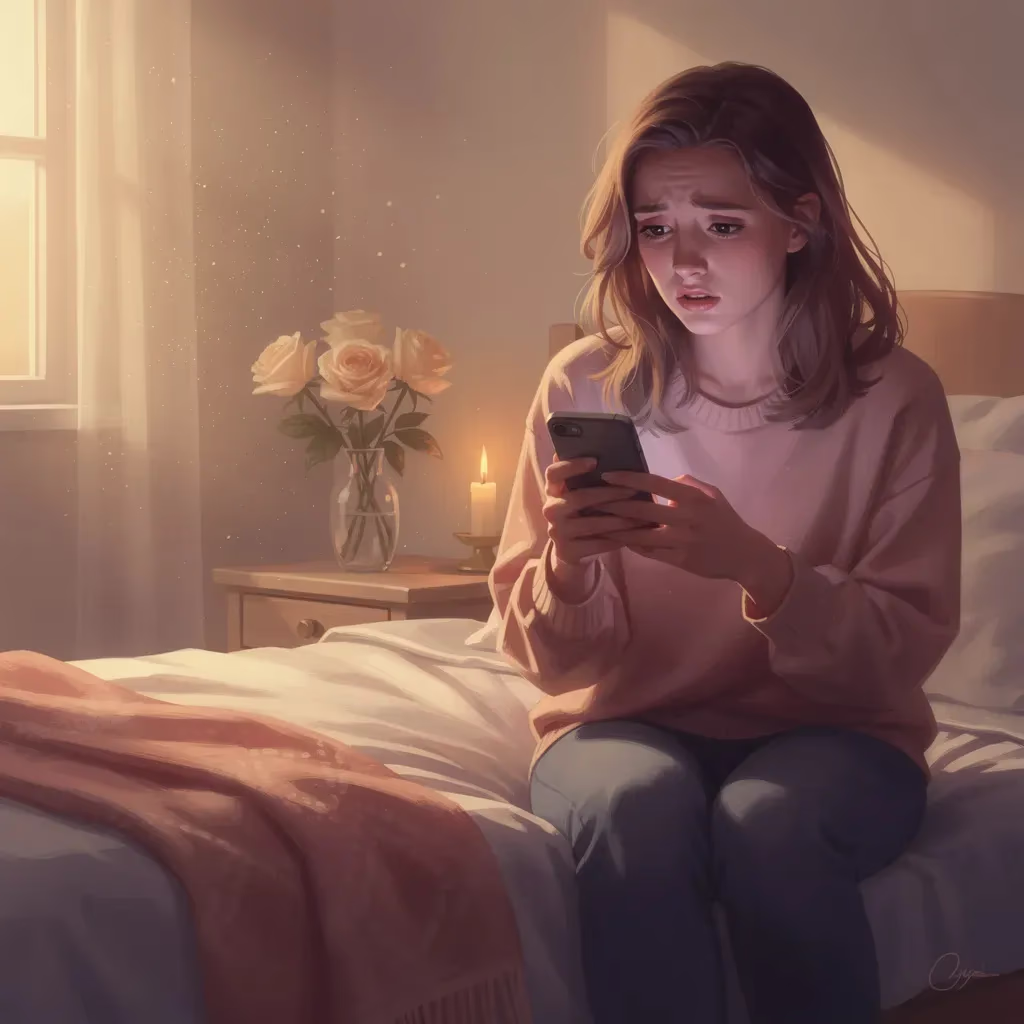
Core Emotion: Which Emotion Shapes the Way You Love?

Core Emotion: Which Emotion Shapes the Way You Love?
If love keeps turning into a guessing game, this helps you name what your heart reaches for first, so you can stop over-explaining and start choosing what feels real.

What is my core emotion in love?
You know when you keep Googling things like "how do you know you love someone" or "how to know if you're in love" because your feelings are loud, but your certainty is shaky? That isn't you being dramatic. That's your heart trying to get a clean answer in a messy situation.
This quiz helps you name the core emotion that shapes the way you love. Not what you say you want. Not what you think you "should" want. The thing you reach for first when love gets real: Joy, Security, Passion, Growth, or Compassion.
And because two people can have the same core emotion but look totally different in real life, this is one of the only quizzes that also picks up your emotional style, like whether you're more expressive or reserved, reactive or steady, intense or gentle, dramatic or subtle, sensitive or resilient.

Core Emotion quiz free, but not shallow. This isn't about gaming "how you make someone fall in love with you." It's about understanding what makes you feel loved, and what makes you spiral when you don't.
Here are the five Love Lenses you might land in:
🌞 Joy: Love feels real when it feels light. You bond through laughter, shared moments, and that "we just get each other" sparkle.
- Key signs: playfulness, inside jokes, craving ease
- Benefit: you stop mistaking stress for depth, and learn how to know if you love someone without needing drama to prove it
🧣 Security: Love feels real when it feels steady. You bond through consistency, follow-through, and the calm of not wondering where you stand.
- Key signs: wanting clarity, noticing patterns, valuing reliability
- Benefit: you learn how to know if you're in love without needing constant reassurance to calm your chest
🔥 Passion: Love feels real when it feels intense. You bond through chemistry, devotion, and a connection that feels like it matters.
- Key signs: depth, longing, "all-in" energy
- Benefit: you learn the difference between chemistry and chaos, so "how do you know you love someone" stops feeling like a panic question
🌿 Growth: Love feels real when it helps you expand. You bond through learning, new experiences, and becoming better together.
- Key signs: curiosity, future-thinking, craving progress
- Benefit: you stop chasing "how you make someone fall in love with you" and start choosing someone who grows with you
🤍 Compassion: Love feels real when it feels tender. You bond through empathy, emotional closeness, and being deeply seen.
- Key signs: caring fast, reading moods, wanting emotional safety
- Benefit: you learn how to know if you love someone without disappearing into caretaking
5 ways knowing your Core Emotion can change your love life (without turning you into a different person)

- Discover the difference between being attached and being in love, so "how to know if you're in love" feels clearer in your body, not just in your head.
- Understand why "how do you know you love someone" keeps looping for you, especially when someone is inconsistent.
- Recognize what you actually need (joy, steadiness, intensity, growth, or tenderness) so "how to know if you love someone" stops depending on the last text you got.
- Name the patterns behind "how you make someone fall in love with you," and swap them for connection that doesn't require performing.
- Choose partners faster (and kinder), because your Love Lens makes incompatibility obvious before you're emotionally invested.
Angela's Story: The Emotion I Was Calling "Love"

At 11:38, my phone lit up. No name. Just the little preview bubble: "hey sorry ive been weird lately."
And my whole body did that thing where it goes tight, like I have to earn the next message. Like if I answer wrong, the door closes.
I was sitting at my kitchen table, still in yesterday's sweatpants, staring at the screen like it was a tiny judge. I didn't even pick it up. I just stared. Then I started picking at my cuticle without realizing I was doing it, like my hands had to bleed a little to match the feeling in my chest.
I'm 30, and I work as a medical office coordinator. Which means I spend my days smoothing things over. People show up scared or annoyed or in pain, and I translate, schedule, reassure, apologize for delays that aren't my fault, catch mistakes before they become emergencies. I am good at noticing tension before someone even says a word. It's basically my job.
It's also how I love.
Because outside of work, in dating, I do the same thing. I track tone. I track response time. I track punctuation like it's weather. If a text ends with a period, my brain goes, "We're mad." If it takes longer than usual, my brain goes, "We're leaving." If they sound tired, I make it about me. Not out loud. Quietly. Internally. Like a private panic.
So I try to fix it before it's real.
I send the perfect reply. The easygoing reply. The "no worries!" reply that is technically polite and emotionally dishonest.
I convince myself I'm being chill, but really I'm performing calm so I don't get left.
And here's the part I never say: sometimes I scroll up through old messages looking for proof that I didn't imagine the connection. Like a little detective in my own relationship, collecting evidence that I matter. It's humiliating. It's also the only way I know how to soothe myself in the moment.
With my last situationship, it got so bad that I could tell you the exact average time he took to answer when he was "in it" versus when he was pulling away. I didn't even mean to learn it. I just... absorbed it. Like my nervous system took notes.
I kept telling myself I was intense because I cared. That I was "good at love" because I noticed things. That I was loyal.
But I also felt like I was constantly bracing for the floor to drop out from under me.
One night, after I sent a message and watched it sit there on delivered, I had this sudden, clear thought: I do not know what it feels like to love without being afraid.
I didn't cry. I just stared at my ceiling and felt this heavy, familiar shame. Like, really? Still? At 30?
The next day at lunch, I ate a sad salad in the break room. My coworker Amanda was talking about her boyfriend. She mentioned a quiz that "weirdly called her out," and she sounded more relieved than embarrassed.
She slid her phone over to me like, "Here. Take it. It's called 'Core Emotion: Which Emotion Shapes the Way You Love?'"
Normally I would have rolled my eyes. Not because I'm above quizzes, I love a quiz, but because I was tired of anything that felt like it would tell me to "communicate better" when I already communicate like I'm trying to keep a bomb from going off.
But I had this quiet curiosity that day. Like maybe I needed words for what was happening.
I took it in tiny chunks between calls. A question here, a question there. It wasn't asking me what kind of girlfriend I am. It was asking what I feel underneath all my efforts. What I chase. What I avoid. What I think love is supposed to cost.
And I kept clicking answers that made me feel exposed. Not in a dramatic way. In a plain, uncomfortable way. Like reading my own browser history.
When I got my result, I actually laughed out loud. Not because it was funny. Because it was so obvious once it was in front of me.
My core emotion came back as Security.
Which, in normal words, basically meant: I don't just want connection. I want to know we're okay. I want consistency. I want the ground to stay still. I want to stop scanning for the exit sign.
And suddenly a bunch of my "personality traits" looked different.
The over-texting wasn't me being annoying. It was me trying to close the gap between uncertainty and safety.
The apologizing wasn't politeness. It was a bid to keep the peace so nobody walks away.
The overthinking wasn't intelligence. It was fear wearing a smarter outfit.
It also said something that made my stomach drop, in the way truth does when you haven't been ready for it: I tend to equate security with reassurance from the other person, instead of security inside the connection.
That was the line that stuck.
Because I realized I had been using people as a thermostat for my own anxiety. If they were warm, I was warm. If they were cold, I froze. If they were inconsistent, I became frantic.
I walked back to my desk afterward and felt weirdly quiet. Like I'd been living in a loud room and someone turned the volume down.
I didn't become a different person overnight. I wish I could tell you I suddenly stopped caring and became effortlessly secure and mysterious. I did not. I went back to my life. I still checked my phone too much. I still had that impulse to send a follow-up text. I still wanted to keep love from slipping through my hands.
But I started doing this thing that was so small it felt stupid.
When I wanted to send the extra message, the "just checking in!" message, I waited ten minutes.
Not as a strategy. Not to manipulate. More like... I gave the feeling a little room. I let it exist without immediately turning it into action.
Those ten minutes were excruciating at first. I would pace. I would open my notes app and type the message there instead. I'd draft it, delete it, draft it again. I'd argue with myself like, "You're being normal. People text. You're allowed to text." Then another voice would be like, "You're trying to make him prove something."
Sometimes I still sent the text. But the difference was I knew why.
And sometimes, I didn't.
A few weeks later, I was seeing this guy, James. It was early. Nothing dramatic. We were in that fragile stage where you're still pretending you're not attached yet.
He didn't answer for most of an afternoon. Not on purpose, I don't think. He was probably busy. But my body didn't care about logic. My body cared about patterns.
I felt my throat get tight. That heat behind my eyes. The urge to do something. I typed: "Everything okay?" Then I stared at it.
Ten-minute rule.
I put my phone down on the counter and tried to act like a normal adult. I unloaded the dishwasher. I wiped a spot off the stove that did not need wiping. I checked the lock on my front door like someone was coming to take my dignity away.
At minute eight I picked my phone back up. Still no message. My brain started offering me stories: he met someone else. I was too much. I came on too strong. I said something weird when I talked about my job. He realized I'm not fun.
Then the quiz language floated back up, annoyingly calm: Security.
This isn't about him. This is about your system trying to get certainty.
So instead of texting, I did something I almost never do. I told the truth to myself in a way that wasn't dramatic.
I opened my notes app and wrote: "I feel scared. I want reassurance. I don't have it right now. I'm still okay."
It wasn't a magical mantra. It didn't fix me. But it slowed the spiral enough for me to choose.
When James finally texted later, it was literally: "Sorry, got pulled into something at work. Wanna grab dinner tomorrow?"
No secret meaning. No hidden rejection. Just... life.
I still had that aftershock though, like my body had run a marathon and my brain was trying to pretend we hadn't.
So the next time I saw him, I tried something else. Not a big talk. Not an emotional dump. Just one sentence.
We were sitting in his car outside my apartment, and he was telling me about his week, and I could feel myself wanting to be the cool girl, the easy girl, the girl who never needs anything.
Instead I said, kind of awkwardly, "If I ever seem quiet after you take a while to text, it's not because I'm mad. I get anxious sometimes. I'm working on it."
I expected him to pull back. I expected that look people get when they feel like your feelings are going to become their job.
But he just blinked and said, "Oh. Thanks for telling me. I can be spacey with my phone. If you need a heads up, just ask."
And I remember sitting there thinking: wait. That was... it?
No punishment. No withdrawal. No "why are you like this." Just information.
It didn't solve everything. The next week I still had a moment where I stared at my phone too long and drafted a message I didn't send. I still had the reflex to apologize when I hadn't done anything wrong. I still had nights where I replayed a conversation and wondered if my tone sounded needy.
But the difference is I finally had a map for what was happening.
Security wasn't a flaw. It was the thing my heart organizes itself around.
And honestly, realizing that changed the question I ask in relationships.
I used to ask, silently: "How do I make them stay?"
Now I ask: "Do I feel safe being real here?"
I don't have it figured out. I still get that tight feeling when a text takes too long. I still catch myself reaching for reassurance like it's oxygen. But now, when that feeling shows up, it doesn't mean I'm doomed. It just means my core emotion is asking for steadiness, and I'm learning how to give some of that steadiness to myself, even before anyone else does.
- Angela T.,
All About Each Core Emotion Type
| Core Emotion Type | Common names and phrases you might relate to |
|---|---|
| Joy | "The fun one", "the mood-lifter", "I just want it to feel easy", "best-friend love", "laughing together" |
| Security | "The steady one", "the planner", "tell me where I stand", "I need consistency", "I want to feel safe" |
| Passion | "The all-in one", "deep-feeler", "chemistry matters", "I crave intensity", "big love energy" |
| Growth | "The evolving one", "future-focused", "let's build something", "I need movement", "I want us to learn" |
| Compassion | "The tender one", "the nurturer", "I feel everything", "I just want to be understood", "soft love" |
Am I Joy?

Love, for you, is supposed to feel like air in your lungs again. Not a performance. Not a constant "did I mess it up?" math problem. When your core emotion is Joy, you're not chasing shallow fun. You're chasing the deep relief of a relationship that doesn't make you tense up all day.
A lot of Joy-led hearts end up secretly Googling "how do you know you love someone" because the world tells you real love has to be heavy. So when it feels light, your brain goes, "Wait... is this real?" It is. Lightness can be real. Peace can be real.
You might also be the one who tries to keep things upbeat, even when you're hurting. Not because you're fake. Because part of you believes: if you keep it sweet, you stay lovable.
Joy Meaning
Core Understanding
When Joy shapes the way you love, you experience connection as shared aliveness. It's that feeling where your shoulders drop, your laugh comes back, and being around him makes the day feel easier. Psychologists talk about relationships thriving when there are lots of positive moments (not perfect, just warm and frequent). Your system is tuned to that.
This pattern often develops when you learned early that being pleasant kept things smooth. Maybe conflict felt unsafe, or attention felt conditional. So you got good at bringing the light back. Many women with this Love Lens learned: "If I can keep it fun, we won't fall apart." That isn't silly. That's survival with a smile.
Your body remembers it as a quick shift: your stomach unclenches when the vibe is good. You feel buzzy and alive when you're connected. But if the tone drops, you can feel it instantly, like the room temperature changed and you're pretending you don't notice.
You might recognize a specific loop: you feel close, you feel happy, and then you start questioning whether you're "really" in love. That's why "how to know if you're in love" can feel like a constant background tab in your brain. It's not because you're shallow. It's because you want certainty, and you're used to people acting like calm love isn't "real" love.
What Joy Looks Like
Chasing the "easy exhale": You know the exact feeling when your chest loosens and you can finally be yourself. Others see you as fun and magnetic. Inside, you're looking for proof that love can be safe and light at the same time.
Turning awkward into playful: When there's tension, you instinctively crack a joke, send a meme, or change the subject. He might think you're unfazed. You're actually trying to protect the connection from going cold.
Feeling guilty for being sad: If you're upset, you might apologize for it too fast. Your inner rule is "don't ruin the mood." The cost is that you end up alone with feelings that deserved a place at the table.
The "are we okay?" scan: You'll read his face like it's subtitles. If his energy is off, your brain starts rewriting the whole relationship. This is why you end up searching "how to know if you love someone" after one weird date, because your nervous system treats vibe shifts as danger.
Romance as friendship-plus: You fall hardest when it feels like best friends who kiss. Others see it as cute. For you it's sacred, because it means you can relax.
Big on shared rituals: Little traditions matter a lot: Sunday coffee, silly playlists, your "thing." If those disappear, you feel unmoored. It's not clingy. It's your love language in action.
Avoiding heavy conversations until you can't: You might delay the talk because you want things to stay sweet. Then it builds and spills out at 11:47 p.m. when you're already tired. This is common for Joy-led women, especially if you've been told you're "too much" when you ask for clarity.
Trying to fix the vibe fast: If he's distant, you might send something cute or flirty to pull him back. From the outside it looks casual. Inside it's "please come back to me."
Confusing stability with boredom at first: Calm can feel unfamiliar when you're used to emotional spikes. You might mistake adrenaline for chemistry, then realize later it was anxiety. Learning "how to know if you're in love" for you often means learning what calm attraction feels like.
Being the emotional sunscreen: You absorb heat so everyone else can stay comfortable. He might love that about you. You might end up exhausted and resentful if your joy becomes a job.
Thriving with presence: When he shows up consistently, your joy becomes effortless. You don't have to perform. You just are.
Needing room for softness: When you can be goofy and also cry without punishment, you bond fast. The right partner makes space for both.
Replaying moments to check if it's real: You can have a great night, then still lie awake thinking, "Was I too much? Was that too easy?" That's the shadow side of being told that love has to hurt to count.
How Joy Shows Up in Different Areas of Life
In romantic relationships: You create warmth quickly. Dates feel easy, conversation flows, and you bring a sense of "we're already a team." If he goes cold, it can feel like someone turned off the lights. You might try to win the warmth back instead of naming what you need, and that can keep you stuck in "how do you know you love someone" spirals because you're measuring love by the vibe.
In friendships: You're often the planner, the hype friend, the one who sends the "I miss you" text first. People love you for it. The hard part is receiving the same care without feeling like you're asking for too much.
At work/school: You smooth conflict, make group projects feel lighter, and can be the social glue. The risk is over-functioning emotionally, especially if you take responsibility for everyone's mood and then go home depleted.
Under stress: Your default is "be fine." You might keep laughing while your stomach is tight. When stress stacks up, you can crash hard, like the joy battery hit 0% overnight.
What Activates This Pattern
- When someone's tone shifts and you don't know why.
- When plans get canceled last minute and you're left staring at your phone.
- When you feel like you have to entertain to stay wanted.
- When he replies with one-word texts after being sweet.
- When you sense you're "less fun" than you used to be.
- When you try to talk seriously and get brushed off.
The Path Toward More Ease (Without Losing Your Spark)
- You don't have to earn love with brightness: Your joy is a gift. It's not your rent.
- Small shifts, not dramatic transformation: The moment you feel the vibe change, you can try naming it gently instead of fixing it. That alone changes your life.
- Let calm count as chemistry: Learning how to know if you love someone, for you, often means letting steadiness feel romantic.
- Choose reciprocity over applause: Women who understand their Joy lens start picking partners who add to the joy, not just consume it.
- What becomes possible: When your joy isn't a mask, you stop chasing "how you make someone fall in love with you" and start letting love come toward you.
Joy Celebrities
- Zendaya (Actress)
- Hailee Steinfeld (Actress)
- Florence Pugh (Actress)
- Millie Bobby Brown (Actress)
- Emma Stone (Actress)
- Blake Lively (Actress)
- Anna Kendrick (Actress)
- Amy Adams (Actress)
- Rachel McAdams (Actress)
- Cameron Diaz (Actress)
- Julia Roberts (Actress)
- Meg Ryan (Actress)
- Goldie Hawn (Actress)
Joy Compatibility
| Other type | Compatibility | Why it tends to feel this way |
|---|---|---|
| Security | 😍 Dream team | Your lightness + their steadiness creates a relationship that feels both fun and safe. |
| Growth | 🙂 Works well | You keep things alive while they keep things moving, as long as "progress" doesn't replace presence. |
| Compassion | 🙂 Works well | You bring brightness and they bring tenderness, but you both must avoid overgiving. |
| Passion | 😐 Mixed | The spark can be huge, but intensity can start to feel like pressure if it turns into drama. |
Am I Security?

If Security is your core emotion, you don't want constant romance speeches. You want something simpler, and honestly braver: consistency. The kind where you don't have to decode everything. The kind where you can relax into your life without love feeling like it's about to vanish.
You're the one who might keep searching "how to know if you love someone" because you don't trust the highs. You've learned that chemistry can be real and still not be safe. So your heart asks a different question: "Will he show up tomorrow the same way he showed up today?"
If you've ever wondered "how to know if you're in love" and your answer is "when I'm not anxious around him," you're not alone. So many women are wired exactly like this.
Security Meaning
Core Understanding
Security-led love is love filtered through reliability. Not because you're boring. Because you're tuned to what lasts. When psychologists talk about secure bonds, a big piece is predictability: you know what the relationship is, you know where you stand, and repair actually happens when there's conflict.
This pattern often emerges when love has felt inconsistent at some point. Maybe you had to become self-reliant early. Maybe affection came with conditions. Many women with this Love Lens learned to value follow-through because it was the missing piece: someone said they cared, but their actions didn't match. So now your heart pays attention to actions first.
Your body signals are clear: your shoulders drop when he is consistent. Your stomach tightens when things are vague. You might feel a quiet panic when a message goes unanswered for hours, not because you're needy, but because uncertainty hits your nervous system like an alarm.
A Security lens can also make you feel "too serious" in modern dating. You might watch other girls float through situationships and wonder why you can't. You can. You just don't want to. Your heart wants a home base, not a guessing game.
What Security Looks Like
Needing clarity to relax: You don't love "we'll see." You love plans. Others might call you a planner. You call it wanting to breathe.
Checking for consistency: You notice patterns: response time, tone, whether he keeps promises. To him it might look like you're "paying attention." You are. You're building trust based on evidence.
Feeling love as calm: Love shows up as steadiness, not fireworks. This is why "how do you know you love someone" can feel confusing, because your version of love can be quiet and deep.
Overthinking when things are vague: If he says "I'm busy" without context, your brain starts filling in blanks. That's not you being irrational. It's your system trying to protect you from investing in uncertainty.
Wanting reassurance without begging: You don't want to chase him for it. You want him to offer it naturally. You want to be chosen without having to earn it.
Sensitive to broken promises: One canceled plan can hit harder than it "should." It's because it touches your core need: reliability equals safety.
Being loyal once you're in: When you commit, you're steady. You're not entertaining five options. You're building something. You show love in ways people can depend on.
Holding it together outwardly: You might look calm while your mind is doing the relationship spreadsheet. You don't want drama. You want clarity.
Tolerating less ambiguity: You might struggle with situationships because they keep you in constant question mode. You can feel your chest tighten even reading the word "casual."
Feeling tender during repair: When conflict is handled well, you soften fast. Repair is your love language. "We can talk about it and still be okay" is the dream.
Worrying you're asking for too much: If you've been called needy, you might shrink your needs. Then resentment grows quietly. This is where "how to know if you love someone" turns into "why does love cost me so much?"
Protecting your heart with practicality: You ask the real questions: Are we exclusive? What's your intention? Do you want kids? To some, that's intense. To you, it's respect for your future self.
Reading silence as danger: If he goes quiet, your body might go tight and hot. You might start cleaning, scrolling, refreshing your messages, anything to get relief from the uncertainty.
How Security Shows Up in Different Areas of Life
In romantic relationships: You want the relationship to feel like a safe place, not a constant audition. You're happiest with a partner who communicates clearly, follows through, and doesn't punish you for having needs. Distance without explanation can trigger the spiral fast, and that's usually when you end up searching "how to know if you're in love" like you're trying to solve the relationship with logic.
In friendships: You're the friend who remembers birthdays, checks in, and shows up. You also notice when effort is one-sided, even if you don't say it out loud.
At work: You thrive with clear expectations. Ambiguity drains you. If a boss says "we need to talk," your stomach can drop until you know what's happening.
Under stress: You can become hyper-aware of any sign that stability is slipping. You might seek reassurance, over-explain, or try to lock things down fast to feel safe again.
What Activates This Pattern
- When he gets distant without explanation.
- When plans change last minute and you feel like you don't matter.
- When you feel like you're in a gray area, not clearly chosen.
- When you have to guess what he means instead of hearing it.
- When communication becomes inconsistent (sweet one day, cold the next).
- When you feel like you're the only one trying.
The Path Toward More Security (The Real Kind)
- Your needs are allowed: Wanting consistency is not too much. It's the minimum for healthy love.
- Ask earlier, not louder: The sooner you name what you need, the less likely you are to hit the panic point.
- Let actions answer questions: If you're constantly searching "how do you know you love someone," check whether you feel safe. That answer matters.
- Choose steadiness over potential: Women who honor their Security lens stop settling for "maybe" and start receiving "of course."
- What becomes possible: You stop trying to master "how you make someone fall in love with you" and start receiving love that is consistent on a random Tuesday.
Security Celebrities
- Emily Blunt (Actress)
- Natalie Portman (Actress)
- Keira Knightley (Actress)
- Lily Collins (Actress)
- Daisy Ridley (Actress)
- Michelle Pfeiffer (Actress)
- Sarah Jessica Parker (Actress)
- Salma Hayek (Actress)
- Tom Hanks (Actor)
- John Krasinski (Actor)
- Denzel Washington (Actor)
- Henry Cavill (Actor)
Security Compatibility
| Other type | Compatibility | Why it tends to feel this way |
|---|---|---|
| Joy | 😍 Dream team | Their warmth and your steadiness create a relationship you can actually relax inside. |
| Compassion | 😍 Dream team | You offer stability while they offer tenderness, as long as both avoid over-functioning. |
| Growth | 😐 Mixed | You want consistency while they want movement, but clear agreements can make it beautiful. |
| Passion | 😕 Challenging | Intensity can feel thrilling, but inconsistency can hit your system hard. |
Am I Passion?

Passion-led love is not "chaos." It's depth. It's devotion. It's the part of you that doesn't want a half-hearted maybe. You want the kind of connection that feels like it matters, in your body, not just in words.
And yes, this is the Love Lens that can make you Google "how do you know you love someone" at 3 a.m. because your feelings are huge and your fear is, too. When you feel a shift, your mind tries to get control by getting answers.
You might also be the one who wonders "how you make someone fall in love with you" because you can sense potential. You can sense what a relationship could be. The tricky part is learning when potential is real and when it's just you doing all the emotional work.
Passion Meaning
Core Understanding
When Passion shapes the way you love, your connection system runs on intensity and meaning. You feel chemistry fast. You bond deeply. You want the relationship to have emotional gravity. Psychologists often describe how strong emotional intensity can create fast attachment, especially when someone is unpredictable. It's not your fault. It's how bodies bond.
This pattern often develops when you learned that love was something you had to chase, prove, or earn. Many women with this Love Lens learned early: the strongest connections are the ones you have to fight for. So now calm can feel suspicious. Steady can feel like "do they even care?" That isn't because you're broken. It's because your system learned to associate intensity with closeness.
Your body signals are loud: your heart races, your skin feels hot, your appetite changes, your focus narrows. When connection feels threatened, your chest can tighten and your mind can spiral. That "please don't leave" energy can show up as over-texting, over-explaining, or trying to pull him closer fast.
Passion-led love often gets misunderstood. People see your big feelings and assume you're unstable. The truth is simpler: you love with your whole chest. Your sensitivity is data, not damage. The skill is learning to tell the difference between a love that is deep and a love that is just loud.
What Passion Looks Like
Falling fast, feeling deep: You can go from "this is fun" to "I think this matters" quickly. Others might call it intense. You call it honest. The risk is bonding to potential before you've seen consistency.
Sensitivity to distance: If he pulls back, you feel it in your body immediately. He might think it's subtle. Your system treats it like an emergency.
Needing depth, not small talk: You want real conversations. Surface-level connection drains you. You want to know what he fears, what he wants, what he hides.
Over-explaining to be understood: When you're scared, you might write paragraphs. You're trying to make him see you clearly enough to stay.
Wanting proof you matter: "How to know if you're in love" can feel like "how to know if I matter to him." That is the tender truth for many Passion-led women.
Craving physical closeness: Touch feels grounding. A hug can calm you more than a speech. When you don't get it, you can feel untethered.
Romanticizing the connection: You see the best in him. You fill in gaps with hope. It's beautiful, and it's also how you can stay too long when your needs aren't being met.
Feeling anger as a cover: When you're hurt, it can come out sharp. Not because you're mean. Because anger feels safer than admitting "I'm scared you'll leave."
Intensity in repair: You want the conversation now. You want to fix it now. Waiting feels unbearable because your body doesn't do "maybe later" well.
Confusing chemistry with compatibility early on: You can be attracted to inconsistency because it spikes intensity. Learning how to know if you love someone for you often means checking: do I feel safe, or do I feel activated?
Loyalty that runs deep: When you commit, you commit with your whole chest. You don't do half-love.
Big reassurance needs (but hidden): You might act independent, but inside you need to hear: "I'm here. I'm not going anywhere."
Creative, romantic gestures: You express love with meaning: playlists, letters, little rituals. You want love to feel alive.
How Passion Shows Up in Different Areas of Life
In romantic relationships: You want closeness, intensity, and emotional honesty. You're at your best with a partner who can meet you with warmth and steadiness, not defensiveness. If he's inconsistent, your Passion can turn into chasing, and then you start asking "how do you know you love someone" like you're trying to diagnose your own heart.
In friendships: You're the friend who feels things deeply. You notice when someone is off. You can also overextend, trying to be the one who holds everyone.
At work: Passion can look like being all-in, ambitious, and deeply invested. The downside is over-identifying with feedback. If someone is critical, it can land like rejection.
Under stress: You can spike quickly. Your mind runs scenarios. Your body wants immediate repair. This is where you might start searching "how to know if you're in love" because you're trying to tell the difference between love and fear.
What Activates This Pattern
- When he takes longer to respond than usual.
- When affection drops without explanation.
- When you feel like you're the only one initiating.
- When you sense you're being kept at arm's length.
- When you ask for reassurance and get joked at or dismissed.
- When you feel replaceable.
- When intimacy is offered, then withheld.
The Path Toward More Peace (Without Dimming Your Fire)
- Your intensity is not a flaw: It's devotion and depth. The goal is directing it toward someone safe.
- Let consistency be the proof: "How to know if you love someone" becomes clearer when you look at how he treats you over time, not just how he makes you feel in one moment.
- Slow the bonding, not the heart: You don't have to stop feeling. You can give feelings time to be informed by reality.
- Choose mutuality: Women who understand their Passion lens stop asking "how you make someone fall in love with you" and start asking "does he show love in a way I can actually receive?"
- What becomes possible: You get to keep your fire and finally feel steady inside it.
Passion Celebrities
- Anya Taylor-Joy (Actress)
- Dua Lipa (Singer)
- Rihanna (Singer)
- Nina Dobrev (Actress)
- Lea Michele (Actress)
- Penelope Cruz (Actress)
- Eva Mendes (Actress)
- Jessica Biel (Actress)
- Ryan Gosling (Actor)
- Ian Somerhalder (Actor)
- Sandra Bullock (Actress)
- Monica Bellucci (Actress)
Passion Compatibility
| Other type | Compatibility | Why it tends to feel this way |
|---|---|---|
| Compassion | 😍 Dream team | You bring depth and they bring tenderness, creating emotional closeness that feels nourishing. |
| Security | 🙂 Works well | Their steadiness can calm your system while your passion keeps love alive. |
| Growth | 😐 Mixed | You want intensity while they want expansion, but shared goals can bond you strongly. |
| Joy | 😐 Mixed | Joy can soothe you, but you might fear it isn't serious enough unless you talk needs openly. |
Am I Growth?

Growth-led love is love that feels like movement. Not running away. Not never being satisfied. More like: "When I'm with you, I become more myself." You want a relationship that expands your world, your confidence, your future.
If you've ever asked "how to know if you love someone" and your answer sounded like "I want to build with him," that is Growth. If you've Googled "how you make someone fall in love with you," sometimes it's because you believe the right connection is something you can create with enough effort. That's a beautiful instinct. It just needs boundaries.
This Love Lens is often the one that realizes patterns first. You're the one who can be mid-spiral and still think, "Okay, something in me keeps choosing this. Why?"
Growth Meaning
Core Understanding
When Growth shapes the way you love, your heart bonds through shared evolution. You want conversations that stretch you. Experiences that feel new. A relationship where both of you keep choosing each other, and keep choosing to grow. Psychologists talk about long-term couples staying connected through novelty and shared goals. Growth-led love is naturally wired for that.
This pattern often develops when you learned to rely on your own development for stability. Maybe love felt unpredictable, so you built your identity through learning, achievement, and self-improvement. Many women with this Love Lens learned: if I become better, I'll be safer. So in relationships, you can fall into the habit of fixing, optimizing, or coaching.
Your body signals show up as restlessness when you feel stuck. You might feel a buzzing under your skin when things get repetitive. But you also feel deeply alive when you're building something with someone: a trip, a project, a future plan, a shared dream.
Growth also has a softer side people miss. It's not only "more, more, more." It's a hunger for honesty. It's you wanting love that can handle real conversations, real change, real life. It's why "how to know if you're in love" can land differently for you. You know you're in love when you're not shrinking.
What Growth Looks Like
Future-thinking in the early stages: You naturally imagine what this could become. Others call it moving fast. For you, it's clarity. You want to know where something is going.
Craving emotional and intellectual stimulation: You need more than attraction. You want depth and curiosity. A partner who asks questions, not just compliments.
Turning pain into lessons: After conflict, you look for meaning. You want to understand what happened and improve. This is a superpower, unless you're doing it alone.
Attracting "potential" partners: You can see the good in someone who isn't fully ready. You fall in love with who he could be, and then you wonder why you're exhausted.
Self-growth as a love strategy: When love feels shaky, you might work on yourself harder. It's not wrong to grow. It's just painful when growth becomes a way to earn love.
Needing progress talks: You like check-ins. "How are we doing?" "What do we want?" This is how you feel connected.
Feeling impatient with stagnation: If a relationship loops the same fights without repair, you feel hopeless fast. You want movement, not repetition.
Romanticizing the "we built this" story: You love the idea of building a life together. It's deeply romantic to you, in a grounded way.
Big courage around honesty: You're willing to have hard talks if it means growth. You might still be scared, but you do it anyway.
Confusing anxiety for a growth edge: Not every uncomfortable relationship is a growth opportunity. Sometimes it's just a mismatch, and your body knows.
Seeking partners who expand your world: You feel love when he introduces you to new ideas, places, or experiences. It makes you feel alive.
Strong self-reflection: You can see your patterns. You can name what you do. You can feel both proud and tired of being the one who always sees it first.
Building plans to calm uncertainty: If you're unsure where you stand, you might start making goals in your head. It looks ambitious. It's often you trying to make love feel less slippery.
How Growth Shows Up in Different Areas of Life
In romantic relationships: You want a partner who evolves with you. You're drawn to men who are curious, emotionally open, and willing to build. If he's avoidant or stuck, you can become the one dragging the relationship forward. That's when you might Google "how do you know you love someone" because you're trying to understand why you're still attached to effort.
In friendships: You're the friend who sends the podcast, the book, the "this made me think of you" message. You encourage growth in others, sometimes forgetting to rest.
At work/school: You thrive with learning and challenge. You might overachieve to feel safe. Praise can feel like relief.
Under stress: You can become controlling, not because you're rigid, but because you want a plan. You might also obsess over "what did this mean?" which is why you end up googling "how to know if you're in love" when the relationship feels uncertain.
What Activates This Pattern
- When you feel like you're growing and he isn't.
- When you keep having the same fight with no repair.
- When you feel like you're doing all the emotional work.
- When you're stuck in a situationship with no direction.
- When he avoids future conversations.
- When you feel like your needs are "too much" because they involve real change.
The Path Toward More Freedom (The Soft Kind)
- You can grow without earning love: Growth is for you, not to be chosen.
- Let him show you his pace: "How to know if you love someone" gets clearer when you stop pushing and start observing.
- Choose shared effort: A relationship should not feel like a self-improvement project you're running alone.
- What becomes possible: Women who honor their Growth lens stop trying "how you make someone fall in love with you" and start building love with someone who already wants to be there.
- Let love be a partnership, not homework: You deserve to be met, not managed.
Growth Celebrities
- Saoirse Ronan (Actress)
- Margot Robbie (Actress)
- Alicia Vikander (Actress)
- Natalie Dormer (Actress)
- Kristen Bell (Actress)
- Joseph Gordon-Levitt (Actor)
- Eddie Redmayne (Actor)
- Jason Segel (Actor)
- Emma Watson (Actress)
- Kate Hudson (Actress)
- Timothee Chalamet (Actor)
- Andrew Garfield (Actor)
Growth Compatibility
| Other type | Compatibility | Why it tends to feel this way |
|---|---|---|
| Growth | 😍 Dream team | You both value becoming, so the relationship feels alive and future-facing. |
| Joy | 🙂 Works well | Joy keeps growth from feeling like pressure, while growth keeps joy from feeling shallow. |
| Security | 😐 Mixed | You want expansion while they want stability, but shared plans can satisfy both. |
| Passion | 😐 Mixed | The connection can feel powerful, but you both must avoid turning love into intensity + self-work overload. |
Am I Compassion?

Compassion-led love is the kind that notices. The tiny shifts. The unspoken feelings. The "I'm fine" that isn't fine. You love by attuning. By caring. By holding space.
And here's the part nobody says out loud: Compassion-led women often end up searching "how do you know you love someone" because you can love almost anyone if you're not careful. Your heart is big. Your empathy is fast. You can bond with pain, not just with compatibility.
If you've ever wondered "how to know if you're in love" but your answer is "I just want him to feel safe with me," that is compassion. It's beautiful. It just needs to come with self-respect so you don't disappear.
Compassion Meaning
Core Understanding
When Compassion shapes how you love, connection feels like emotional closeness and care. You want to be understood, and you want to understand him. You feel loved when someone is gentle with your feelings, not just impressed by you. Psychologists often describe healthy relationships as emotionally responsive. Compassion-led love is built for responsiveness.
This pattern often develops when you learned that being emotionally helpful kept you connected. Many women with this Love Lens were praised for being "mature" or "easy" or "the one who understands." So you got good at caretaking. Not because you're weak, but because it worked.
Your body signals show up as heaviness when you're carrying too much. You might feel it in your shoulders, like they live up near your ears. You might feel that 3 a.m. ceiling-stare where you replay his tone and wonder if you did something wrong. Your system is always tracking connection.
Compassion can also create a very specific heartbreak: you can feel deeply bonded, while quietly feeling alone. Because you keep holding him, but nobody is holding you. That's why "how to know if you love someone" can get tangled with guilt. You might think: if I stop being helpful, will he stop choosing me?
What Compassion Looks Like
Feeling other people's moods in your body: You sense shifts before words happen. Others call you intuitive. You sometimes feel exhausted by the constant emotional data.
Over-explaining to prevent conflict: You try to be understood perfectly so nobody gets upset. He might think you're being extra. You're trying to keep the bond safe.
Caretaking as a reflex: If he's stressed, you jump in. You offer solutions, reassurance, comfort. It's loving. It becomes painful when it's one-way.
Struggling to ask for what you need: You might feel guilty having needs. You can name everyone else's feelings, but yours get pushed to the end of the line.
Staying longer than you should: You see his potential and his pain. You want to help him heal. This is where love can start to feel like labor.
Deep loyalty and softness: When you love, you love gently and fully. You offer patience, warmth, and emotional safety.
Taking responsibility for his feelings: If he's upset, you assume it's your fault. Not because you're self-centered, but because your nervous system learned: if they're okay, I'm okay.
Wanting emotional responsiveness: You don't need perfection. You need care. You need repair. You need "I hear you" energy.
Feeling hurt when you're unseen: If he doesn't notice your effort, it can feel like heartbreak. You didn't want applause. You wanted to feel met.
Being the safe place: People come to you. Men open up to you. The risk is attracting partners who want a therapist, not a girlfriend.
Romanticizing emotional intimacy: Emotional closeness is your love language. You can confuse deep talks with deep commitment.
Needing tenderness during conflict: If conflict gets harsh, you shut down or over-apologize. You want softness, even when things are hard.
Mind-reading as protection: You anticipate needs, moods, and reactions. It looks like caring. Underneath, it's often you trying to prevent abandonment.
How Compassion Shows Up in Different Areas of Life
In romantic relationships: You want emotional safety and closeness. You're happiest with a partner who is kind, responsive, and willing to meet you emotionally. If he's dismissive, you can start doing all the emotional work, then feel depleted. This is where you might keep searching "how do you know you love someone" because you're trying to figure out if love is supposed to feel this lonely.
In friendships: You're the one people call when they're falling apart. You're supportive and steady. The work is letting others show up for you too, without feeling like a burden.
At work/school: You're often the peacemaker. You notice interpersonal dynamics and try to smooth them. This can be a gift, and it can also be draining if you feel responsible for everyone's emotional experience.
Under stress: You can get reactive or self-silencing depending on the situation. Your mind might loop on "did I upset him?" which is why "how to know if you're in love" can become tied to guilt and responsibility, instead of mutual care.
What Activates This Pattern
- When you sense disappointment in someone's tone.
- When someone is emotionally inconsistent (warm, then cold).
- When you're the only one doing emotional repair.
- When you feel like your needs will cause conflict.
- When you're told you're too sensitive.
- When someone shares pain and you feel pulled to rescue.
The Path Toward More Balance (Compassion That Includes You)
- You can care without carrying: Love isn't supposed to feel like a job you never clock out of.
- Your needs are not an inconvenience: The right partner welcomes them.
- Ask for responsiveness, not perfection: This is how you learn how to know if you love someone, because love feels like being met.
- What becomes possible: Women who understand their Compassion lens stop trying "how you make someone fall in love with you" through overgiving, and start receiving love that is mutual.
- Let receiving be part of your love: You don't have to be useful to be worthy.
Compassion Celebrities
- Selena Gomez (Singer)
- Jennifer Garner (Actress)
- Ariana Grande (Singer)
- Anne Hathaway (Actress)
- Emma Thompson (Actress)
- Mandy Moore (Singer)
- Katie Holmes (Actress)
- Hilary Duff (Singer)
- Carrie Underwood (Singer)
- Gwyneth Paltrow (Actress)
- Drew Barrymore (Actress)
- Alicia Silverstone (Actress)
Compassion Compatibility
| Other type | Compatibility | Why it tends to feel this way |
|---|---|---|
| Security | 😍 Dream team | Their steadiness lets your tenderness relax, and your empathy makes the relationship feel emotionally safe. |
| Compassion | 🙂 Works well | You understand each other deeply, but both must avoid overgiving and forgetting your own needs. |
| Joy | 🙂 Works well | Joy lifts your heaviness while your tenderness deepens their lightness, if you both communicate needs. |
| Passion | 😐 Mixed | Intensity can feel like closeness, but you may end up caretaking if emotional spikes replace repair. |
If love keeps making you ask "how do you know you love someone" and "how to know if you love someone," the problem usually isn't that you're clueless. It's that your core emotion is steering the wheel while you're trying to make decisions with logic alone. This quiz gives you a name for what your heart is reaching for, so "how to know if you're in love" stops feeling like a haunted question and starts feeling like something you can answer with clarity.
- Discover how do you know you love someone, without confusing anxiety for chemistry.
- Understand how to know if you love someone, using your Love Lens (not texting timing).
- Recognize how to know if you're in love, by what feels steady in your body.
- Learn how you make someone fall in love with you, and what happens when you stop performing and start choosing mutual effort.
- Honor your core emotion (Joy, Security, Passion, Growth, Compassion) and ask for what you need without over-explaining.
The opportunity (when you're ready)
You don't have to change your personality to have a healthier love life. You just need language for what you've been feeling the whole time. When you know your core emotion, you stop treating every relationship like a test you might fail, and you start treating it like information. You start noticing, earlier, who is actually a match for your system. And you start letting "how do you know you love someone" be answered by real consistency, not by panic. You also stop turning "how you make someone fall in love with you" into a job, because you can finally see what is mutual and what is you chasing.
Join over 155,541 women who've taken this under 5 minutes quiz for clarity, with private results (your answers stay private).
FAQ
What does "core emotion" mean in love?
Your core emotion in love is the primary feeling your nervous system organizes around when you get close to someone. It is the emotional "lens" that shapes how you bond, what you notice, what you fear, and what you need to feel safe.
If you have ever Googled "how do you know you love someone" and felt more confused afterward, this is often why. Love is real. But the way your body experiences love is filtered through your core emotion.
Here is what that means in real life:
- Your core emotion shows up fastest when you feel vulnerable. Early dating, after conflict, during distance, when someone is "different" over text.
- It can feel like chemistry, intuition, or "just who I am," but it is usually a pattern your brain learned to use to keep you connected and protected.
- It does not mean you are broken. It means your system has a preferred way of coping with uncertainty in relationships.
One easy way to spot your core emotion: look at what happens the moment you feel the tiniest shift.
- Do you reach for lightness, laughter, and closeness to calm the tension? That can point toward Joy.
- Do you crave clarity, consistency, and reassurance that you are not about to lose them? That can point toward Security.
- Do you intensify, pursue, or feel most alive when things feel charged? That can point toward Passion.
- Do you try to "figure it out," fix it, or turn it into a lesson so you can be better? That can point toward Growth.
- Do you soften, understand, and carry their feelings (sometimes at your own expense)? That can point toward Compassion.
Here is the part so many of us were never taught: a core emotion is not just a mood. It is a relationship strategy. It influences what you interpret as love (and what you interpret as danger). So you can be deeply in love and still feel anxious, hyper-aware, or "too much" sometimes.
And once you know your core emotion, you stop treating every relationship moment like a mystery. You start seeing a map.
How do I know what my primary love emotion is?
You can usually identify your primary love emotion by looking at what you do when you feel uncertain, not when everything is perfect. Your core emotion shows itself most clearly in the exact moments you start wondering, "Did I say something wrong?" or "Why does this feel off?"
This is also why a lot of "how to know if you love someone" advice falls flat. Most advice focuses on big gestures. Your core emotion shows up in tiny moments: a delayed reply, a slightly different tone, a plan that gets changed.
A simple way to find your core emotion is to track three things for a week or two:
- Your first emotional spike
- What hits first: fear, excitement, urgency, guilt, pressure to improve, pressure to keep things positive?
- Your automatic story
- The meaning you assign fast. Examples:
- "They're pulling away." (Security)
- "I need to make this fun again." (Joy)
- "I need more intensity to feel close." (Passion)
- "I need to understand what this is teaching me." (Growth)
- "They're struggling, I should be gentler." (Compassion)
- The meaning you assign fast. Examples:
- Your reflex move
- What you do next:
- Ask for reassurance, check, double-text, over-explain (often Security)
- Crack a joke, shift the vibe, become extra charming (often Joy)
- Pursue, escalate, test, or chase "proof" of desire (often Passion)
- Analyze, research, self-improve, try to "earn" stability (often Growth)
- Soften, rescue, minimize your needs, caretake (often Compassion)
- What you do next:
If you are someone who has taken a "how to know if you're in love quiz" and felt like the results were too generic, you are not alone. A good "what is my emotional love style" approach looks at your stress patterns, your attachment behaviors, and what you think love is supposed to feel like.
One more clue that is weirdly accurate: your core emotion tends to be the thing you crave from a partner, and the thing you feel panicked without. Not because you are needy, but because your nervous system learned "this is what keeps love close."
If you want something more concrete, a structured "relationship emotional drivers quiz" can help you name your pattern without spiraling. The relief is in the clarity.
What are the signs you're in love vs attached or anxious?
Being in love can coexist with anxiety, especially if your core emotion is sensitive to uncertainty. So the question is not "Do I feel calm?" The better question is: "Do I feel cared for, respected, and safe enough to be myself, even when I'm scared?"
If you keep searching "how do you know you love someone" at 2 a.m., you are in very good company. So many women are trying to separate love from panic, especially when their hearts are real but their nervous systems are loud.
Here are some grounded differences that help:
Signs you are in love (healthy love):
- Your care is steady, not only activated by threat.
- You feel more like yourself over time, not less.
- Conflict feels uncomfortable but not catastrophic. You might still get anxious, but you can repair.
- Your body can relax sometimes. Not always. But sometimes.
- You can imagine a future with them that includes your needs, not just their approval.
Signs it might be anxious attachment (or anxiety-driven bonding):
- Your strongest feelings spike when they pull away, get distant, or seem busy.
- You feel relief when they reassure you, then the relief fades quickly.
- You monitor their tone, texts, and micro-changes like your safety depends on it.
- You over-function: over-explain, over-give, overthink, over-apologize.
- You feel like you are constantly trying to "earn" security.
Signs it might be attachment without enough compatibility:
- You miss them intensely, but you do not feel seen when you are together.
- You feel more bonded after uncertainty than after closeness.
- The relationship has high chemistry, but low emotional safety.
- You keep trying to make it work because leaving feels like losing oxygen, even if staying hurts.
This is where your core emotion matters. For example:
- A Security-driven love style can interpret silence as danger, even when nothing is wrong.
- A Passion-driven style can mistake intensity for intimacy.
- A Compassion-driven style can confuse caretaking with connection.
- A Growth-driven style can treat love like a performance review.
- A Joy-driven style can avoid hard truths because heaviness feels like "we're failing."
None of this means you do not love them. It means you deserve love that does not require you to abandon yourself to keep it.
If you want a clearer mirror, a "why do I love this way quiz" can help you separate true connection from old survival patterns, gently.
What causes me to love this way? Is it learned or personality?
Most of the way you love is learned, and your personality decides how you adapted. That combination becomes your core emotion in love. So yes, your upbringing, past relationships, and emotional environment matter. And no, it is not "all your fault." It is your system doing what it learned to do to keep connection.
If you have ever asked yourself, "why do I love this way" and felt a little ashamed even asking, please hear this clearly: patterns are not character flaws. They are protection strategies.
Here are the most common places a core emotion comes from:
Early emotional training
- Not always trauma. Sometimes it is subtle.
- If love felt inconsistent, Security becomes a big driver.
- If emotions in your home were heavy, Joy can become a way to keep everyone okay.
- If attention came through drama or intensity, Passion can become the "proof" of love.
- If you were praised for being mature, helpful, or responsible, Growth and Compassion can become your love language and your burden.
Past relationship conditioning
- Being ghosted, cheated on, or breadcrumbed teaches your body to expect sudden loss.
- Being with someone emotionally unavailable teaches you to chase clarity, passion, or improvement to "win" love.
Your nervous system sensitivity
- Some of us are just more emotionally attuned. That is not weakness.
- High sensitivity can make your core emotion louder. You pick up on shifts fast, and your body reacts fast.
Cultural messaging
- Women are taught to be "easy," "cool," and "understanding."
- That pushes Joy and Compassion into overdrive, even when you need Security or honest conflict.
What changes everything is realizing: your core emotion is not your destiny. It is your starting point. When you know your emotional love blueprint, you can keep the gift of it, and stop paying the cost.
A good "emotional love blueprint test" can help you name what is learned, what is temperament, and what is just your heart trying to be held.
Can your core emotion in love change over time?
Yes. Your core emotion can shift over time, especially as you experience safer relationships, do healing work, or simply grow into yourself. What usually stays consistent is your sensitivity to certain triggers, but your response to them can become calmer, clearer, and more self-trusting.
If you have ever taken a "which emotion shapes how you love quiz" and worried, "Great, am I stuck like this forever?", you are not. Patterns are sticky. They are not permanent.
Here is how change tends to look in real life:
- The trigger still happens, but it does not hijack you as long.
- You recover faster after a spiral, even if you still spiral sometimes.
- You ask for what you need with less apologizing and less over-explaining.
- You choose partners differently, because your body starts to recognize consistency as attractive, not boring.
- Your core emotion becomes a strength, not a survival mode.
What helps your core emotion shift?
- Corrective emotional experiences
- Being with someone who repairs, follows through, and does not punish your feelings.
- Learning emotional skills
- Co-regulation, boundaries, and repair conversations.
- Not in a robotic way. In a "I can be real and still be loved" way.
- Grieving old stories
- The story that you must be perfect to be chosen.
- The story that asking for reassurance is "too much."
- Building self-trust
- Not confidence like a slogan, but evidence. "I can handle disappointment. I can handle silence. I can handle truth."
A lot of us start with one dominant emotion (like Security or Compassion) and slowly integrate others (like Joy and Growth) as we feel safer. That integration is the goal, not becoming a totally different person.
If you want help seeing what is stable vs what is changing, a "what is my primary love emotion" quiz can give you a starting snapshot, then you can compare later as you grow.
How does my core emotion affect my relationships (and who I attract)?
Your core emotion affects your relationships by shaping what you interpret as love, what you tolerate, and what you chase. It can also influence who feels familiar to you, which is often the real reason we keep repeating "types" of partners.
If you have ever wondered "why do I attract the same kind of person?" this is usually the missing piece. Your emotional love blueprint is quietly steering the ship.
Here is how it can show up:
- Joy-led love can attract partners who like how easy you are to be around, but sometimes those partners lean on you to keep things light. Then you end up carrying the emotional weight alone.
- Security-led love can attract partners who enjoy being needed. But if they are inconsistent, your nervous system gets hooked on trying to stabilize the relationship.
- Passion-led love can attract intensity. That can be gorgeous when it is healthy. It can also pull you toward hot-and-cold people because your system reads volatility as aliveness.
- Growth-led love can attract projects. People who want to be "understood" and "improved" can flock to you. Then you end up doing emotional labor instead of receiving love.
- Compassion-led love can attract people who need care. Sometimes that is mutual and beautiful. Sometimes it becomes one-sided, and your needs go quiet to keep them okay.
None of this is about blaming you. So many of us learned love through adaptation: "If I am useful, I will be kept." "If I am chill, I will not be left." "If I try harder, it will work." These are heartbreakingly logical strategies.
The practical upside of knowing your core emotion is choice:
- You can tell the difference between "familiar" and "safe."
- You can spot when a partner is rewarding your pattern instead of meeting your needs.
- You can communicate earlier, instead of waiting until you are desperate.
If you want a clear mirror for your pattern, a "relationship emotional drivers quiz" can help you name what you are drawn to and why, so dating and relationships feel less like guessing.
How accurate are quizzes like "what is my emotional love style"?
A good "what is my emotional love style" quiz can be surprisingly accurate at describing your patterns, especially if it asks about real situations (conflict, distance, reassurance, repair) rather than vague personality traits. It is not a diagnosis, and it will not replace therapy. But it can absolutely give you language for what your body already knows.
If you have tried a "how to know if you're in love quiz" before and felt like it only asked surface-level questions, you are not imagining it. Accuracy comes from two things: the quality of the questions, and your willingness to answer honestly, not aspirationally.
Here is what makes an emotional love blueprint test more trustworthy:
- It focuses on patterns, not labels
- The best quizzes reflect your behavior under stress, not who you want to be on your best day.
- It includes trade-offs
- Real patterns have strengths and costs. If a result is all positive, it is usually fluff.
- It accounts for context
- Your "love style" may look different in a secure relationship vs a confusing one. A good quiz will pick up on that difference.
- It gives you next steps
- Not "this is who you are forever," but "this is what helps you feel safe and connected."
To get the most accurate result, it helps to answer from a specific relationship (current or recent) where you felt emotionally activated. Not your calmest friendship. Not your fantasy relationship. The real one where you were waiting for a reply and suddenly your chest felt tight.
And if you are worried you will "rig" the quiz by overthinking every question, welcome to the club. Many of us do that. The best approach is: answer quickly, then trust the pattern that repeats.
If you want a clearer picture of your own emotional drivers, this "which emotion shapes how you love quiz" was designed for exactly that kind of self-honesty, without shaming you for it.
How can I use my core emotion to love better (without losing myself)?
You use your core emotion to love better by treating it like information, not instructions. It tells you what you are needing, fearing, and protecting. It does not get to make every decision for you. That is how you keep your deep capacity for love without disappearing inside it.
If you are the kind of woman who loves hard and then feels embarrassed for needing reassurance, or feels guilty for wanting more, this is the path back to yourself. Not by loving less. By loving with boundaries and clarity.
Here is a practical way to apply your core emotion in daily life:
Translate the emotion into a need
- Joy might be: "I need play and warmth, not constant seriousness."
- Security might be: "I need consistency and follow-through."
- Passion might be: "I need aliveness and honest desire, not lukewarm ambiguity."
- Growth might be: "I need progress and repair, not denial."
- Compassion might be: "I need mutual care, not one-sided emotional labor."
Name your trigger earlier
- Not in a dramatic way. In a simple, human way: "When plans change last minute, I feel unsettled."
Ask for a specific repair
- Instead of begging for reassurance or swallowing your feelings, try a request your partner can actually meet:
- "Can you text me when you get home?"
- "Can we pick a day this week to talk?"
- "Can you tell me what you meant by that?"
- Instead of begging for reassurance or swallowing your feelings, try a request your partner can actually meet:
Watch for your self-abandonment sign
- For so many of us, the warning sign is subtle:
- Over-explaining
- Apologizing for having feelings
- Saying "it's fine" when it is not
- Getting quiet to keep the peace
- Trying to "earn" love through effort
- For so many of us, the warning sign is subtle:
The gentlest shift is this: your core emotion becomes your compass, not your cage. You stop using love to prove your worth. You start using love to practice being real.
If you want help naming your exact pattern and what supports you most, a "why do I love this way quiz" can turn all that confusion into a simple framework you can actually use.
What's the Research?
The "Core Emotion" Idea: Love Is a Bond, and Bonds Run on Feelings (Not Logic)
That moment when you realize you have been holding your breath waiting for their response... that is not you being "dramatic." That is your nervous system doing its job.
Across psychology and neuroscience, emotions are understood as fast, whole-body states that combine what you feel inside, what your body does, and what you’re pulled to do next (text them, pull away, over-explain, shut down, reach for reassurance). Authoritative overviews describe emotions as multi-part experiences, not just "moods" or "thoughts" (subjective feeling + body changes + behavior) (Verywell Mind, Wikipedia: Emotion, Grokipedia: Emotion). Research summaries also highlight that emotions help regulate arousal, direct attention, and motivate behavior, basically your built-in guidance system (Psychology Today: Emotions).
So when we talk about "core emotion" in love, we are talking about the emotional signal your system leans on most when it tries to create closeness and keep you safe. In this quiz framework, those core emotional drivers show up as five patterns: Joy, Security, Passion, Growth, and Compassion.
One big reason this matters: attachment science has shown that our earliest "bonding lessons" shape expectations about closeness, reliability, and what love costs us. Adult attachment research is built on the idea that the same bonding system from childhood also shows up in our adult relationships (R. Chris Fraley’s overview of adult attachment research, Verywell Mind: Attachment Theory, Wikipedia: Attachment theory).
If you’ve ever thought, "Why do I love this way even when I know better?", science confirms it’s often a learned nervous-system pattern, not a lack of self-control.
Why Your Love Style Can Feel So Intense: Emotion + Attachment = Your "Relationship Autopilot"
A lot of us were taught to treat love like a decision you make with your brain. But relationship science keeps pointing back to something simpler and more honest: love is heavily shaped by emotional systems that are protective and automatic.
Attachment theory describes how early caregiver consistency (or inconsistency) influences how we handle closeness, separation, and reassurance later. The foundation is that humans bond for safety and regulation, and those early patterns can leave a "working model" for how relationships operate (Simply Psychology: Attachment Theory Explained, Wikipedia: Attachment theory). That is why you can be smart, self-aware, and still spiral at 3am replaying a two-word text.
What’s also validating: adult attachment isn’t framed as "who’s to blame." It’s a motivational system. Fraley explains adult attachment research as being guided by the assumption that the same system that bonds infants and caregivers also shapes adult romantic bonds (Fraley).
This is where "core emotion" becomes so useful. Instead of only labeling yourself anxious/avoidant/secure, you can ask: "What emotion is steering my love moves right now?"
- If your core emotion is Security, your love system scans for steadiness, predictability, commitment cues.
- If your core emotion is Passion, your love system scans for chemistry, intensity, aliveness, being chosen.
- If your core emotion is Compassion, your love system scans for need, tenderness, repair, emotional caretaking.
- If your core emotion is Growth, your love system scans for expansion, honesty, becoming, learning through love.
- If your core emotion is Joy, your love system scans for lightness, play, mutual delight, feeling safe enough to exhale.
And yes, emotions have bodily timelines. Paul Ekman’s group notes emotions tend to be relatively brief (often not longer than an hour), and if something lingers for days it may be more mood-like (Paul Ekman Group: Universal Emotions). That matters because sometimes what we call "being in love" is actually being stuck in a prolonged state of anxiety, hypervigilance, or longing.
You’re not too sensitive. You’re responding normally to an emotional system that learned it had to stay alert to keep love close.
The Five Core Emotions in Love (Joy, Security, Passion, Growth, Compassion) and What They Protect
One of the most grounding things research does for us is normalize that emotions are functional. Emotions exist because they prepare you to act. Even the ones you hate feeling. Broad emotion frameworks describe emotions as adaptive states that shift attention and behavior in response to what feels personally significant (Britannica: Emotion, Grokipedia: Emotion).
So if you’ve been judging your love patterns, it might help to reframe them as protection strategies:
Joy
Joy, in emotion research, is typically a positive-valence experience that opens us up. Dimensional models like valence and arousal describe emotions partly by how pleasant and energized they feel (Wikipedia: Emotion). When Joy is your core emotion in love, you’re protecting connection through play and ease. You want love to feel like "we like each other," not like an emotional exam.
Security
Attachment frameworks put safety and secure-base dynamics at the center of bonding: feeling you can rely on someone, and that closeness won’t cost you your dignity (Wikipedia: Attachment theory, Verywell Mind: Attachment Theory). When Security is your core emotion, you’re protecting stability, predictability, and trust. You’re not "needy." You’re trying to build a nervous system that can finally rest.
Passion
Passion is the "activated" side of love: desire, attraction, pursuit. Emotion science recognizes desire as a commonly discussed affective state, and broader relationship summaries note that romantic relationships include passion as a key component (Wikipedia: Interpersonal relationship). When Passion is your core emotion, you’re protecting aliveness and being chosen.
Growth
Emotions don’t just react, they guide learning. Emotion research emphasizes that emotions influence attention and decision-making (Psychology Today: Emotions, Wikipedia: Emotion). When Growth is your core emotion, you’re protecting meaning. You want love that makes you braver, more honest, more you.
Compassion
Caregiving and nurturance are deeply tied to attachment systems, and attachment theory explicitly discusses caregiving bonds alongside attachment bonds (Wikipedia: Attachment theory). When Compassion is your core emotion, you’re protecting tenderness, repair, and emotional responsibility. This can be beautiful. It can also turn into over-functioning if you become the only one doing the emotional labor.
That hollow feeling of giving everything and still feeling like it’s not enough often isn’t a character flaw. It’s what happens when compassion gets used as a survival strategy instead of a shared value.
Why This Matters in Real Life (And Why a Quiz Can Actually Help)
If you’ve ever Googled "how to know if you love someone" or even fallen into a "how to know if you're in love quiz" spiral, you were probably not looking for trivia. You were looking for relief. For language. For something to finally make sense.
Here’s what the research-backed lens offers: when you can name what your emotional system is prioritizing, you can stop interpreting every relationship moment as a referendum on your worth.
It also helps you spot mismatches earlier:
- A Security core emotion paired with someone who thrives on ambiguity can feel like constant low-grade panic.
- A Passion core emotion paired with someone who avoids intensity can feel like rejection.
- A Compassion core emotion paired with someone who takes and takes can quietly hollow you out.
- A Growth core emotion paired with someone who resists reflection can feel like you’re dragging the relationship uphill alone.
- A Joy core emotion paired with someone chronically negative can make you feel guilty for wanting lightness.
And because interpersonal relationships are dynamic systems that change over time, your core emotion can get louder or quieter depending on context, stress, and the partner you’re with (Wikipedia: Interpersonal relationship). That means your patterns are not destiny. They’re information.
The science tells us what many women experience in love. Your report shows which core emotion is driving your choices, what it’s protecting, and where your unique path to safer love starts.
References
Want to go down the rabbit hole in a calm, helpful way? These are solid reads:
- What Are Emotions? (Verywell Mind)
- Emotions (Psychology Today)
- Universal Emotions (Paul Ekman Group)
- Emotion (Wikipedia)
- Emotion (Britannica)
- Emotion (Grokipedia)
- Attachment Theory (Verywell Mind)
- Attachment Theory Explained (Simply Psychology)
- Attachment Theory (Wikipedia)
- A Brief Overview of Adult Attachment Theory and Research (R. Chris Fraley)
- Interpersonal Relationship (Wikipedia)
- Interpersonal Mechanisms Linking Close Relationships to Health (PMC)
Recommended reading (for when you want to go deeper)
Sometimes the most comforting thing is realizing: there is a reason you keep asking "how to know if you're in love." Your core emotion is trying to protect you. These books give language, tools, and real-world examples so you can stop guessing and start choosing.
General books (good for any Core Emotion type)
- Attached (Amazon, Bookshop.org, AbeBooks) by Amir Levine - Helps you see the difference between genuine connection and that activated, anxious pull that feels like love.
- Hold Me Tight (Amazon, Bookshop.org, AbeBooks) by Sue Johnson - Teaches bonding conversations for repair, reassurance, and closeness without spiraling.
- The Seven Principles for Making Marriage Work (Amazon, Bookshop.org, AbeBooks) by John Mordechai Gottman, Nan Silver - Practical relationship habits that protect love over time.
- Nonviolent Communication (Amazon, Bookshop.org, AbeBooks) by Marshall B. Rosenberg - Turns big feelings into clear needs and doable requests.
- The Body Keeps the Score (Amazon, Bookshop.org, AbeBooks) by Bessel van der Kolk - Connects relationship triggers to body memory so you can stop blaming yourself for reacting.
- Atlas of the Heart (Amazon, Bookshop.org, AbeBooks) by Brene Brown - Gives you better words for what you're feeling, which changes how you ask for love.
- Come as You Are (Amazon, Bookshop.org, AbeBooks) by Emily Nagoski, Blanca Gonzalez Villegas - Helps you understand how stress and safety shape desire and closeness.
- Wired for Love (Amazon, Bookshop.org, AbeBooks) by Stan Tatkin - Shows how couples can build safety on purpose instead of hoping it happens.
For Joy types (keep your sparkle, lose the pressure)
- The Happiness Trap (Amazon, Bookshop.org, AbeBooks) by Russ Harris - Helps you stop treating happiness like a performance requirement in love.
- Emotional Agility (Amazon, Bookshop.org, AbeBooks) by Susan David - Builds skill with hard feelings so your joy can be real, not forced.
- Permission to Feel (Amazon, Bookshop.org, AbeBooks) by Marc Brackett - Expands emotional vocabulary so you can be honest without losing warmth.
- Book of Joy (Amazon, Bookshop.org, AbeBooks) by Desmond Tutu, Douglas Carlton Abrams, Tenzin Gyatso - A grounded take on joy that includes real life, not denial.
- Codependent No More (Amazon, Bookshop.org, AbeBooks) by Melody Beattie - Untangles joy from over-functioning and people-pleasing.
- The Nice Girl Syndrome (Amazon, Bookshop.org, AbeBooks) by Beverly Engel - Supports boundaries so your sweetness stays free, not obligatory.
For Security types (build steadiness from the inside out)
- Anxiously Attached (Amazon, Bookshop.org, AbeBooks) by Jessica Baum - Practical tools for the relationship math brain and the "waiting for the text back" body.
- The Power of Attachment (Amazon, Bookshop.org, AbeBooks) by Peter A. Levine, Diane Poole Heller, Susan Hanfield - Helps build safety and repair without clinging.
- Self-Compassion (Amazon, Bookshop.org, AbeBooks) by Kristin Neff - Softens the inner voice that says your needs are too much.
- Mindful Self-Compassion Workbook (Amazon, Bookshop.org, AbeBooks) by Kristin Neff, Christopher K. Germer - Exercises for when insight is there but your body still panics.
- The Anxiety and Phobia Workbook (Amazon, Bookshop.org, AbeBooks) by Edmund J. Bourne - Coping skills that can reduce spirals during uncertainty.
- Burnout (Amazon, Bookshop.org, AbeBooks) by Emily Nagoski, Amelia Nagoski - Helps your body complete the stress cycle so love feels safer again.
For Passion types (keep the fire, choose the safe)
- Facing Love Addiction (Amazon, Bookshop.org, AbeBooks) by Pia Mellody - Helps you spot when longing and intensity are running the relationship.
- Women Who Love Too Much (Amazon, Bookshop.org, AbeBooks) by Robin Norwood - Clarifies the overgiving-chasing cycle without shaming you.
- Anxiously Attached (Amazon, Bookshop.org, AbeBooks) by Jessica Baum - Modern tools for soothing intensity and communicating needs clearly.
- The Journey from Abandonment to Healing (Amazon, Bookshop.org, AbeBooks) by Susan Anderson - Support for the deep ache of rejection and the loop of trying to get closure.
- Not the Price of Admission (Amazon, Bookshop.org, AbeBooks) by Laura S. Brown - Challenges the belief that suffering is required to be loved.
- Insecure in Love (Amazon, Bookshop.org, AbeBooks) by Leslie Becker-Phelps - Helps you stop scanning for danger and start building self-trust.
For Growth types (stop turning love into a project)
- Set Boundaries, Find Peace (Amazon, Bookshop.org, AbeBooks) by Nedra Glover Tawwab - Scripts for growth without guilt.
- The Joy of Being Selfish (Amazon, Bookshop.org, AbeBooks) by Michelle Elman - Permission to have needs without apologizing for them.
- Facing Codependence (Amazon, Bookshop.org, AbeBooks) by Pia Mellody, Andrea Wells Miller, Keith Miller - Goes into why "fixing" can feel like love.
- How to Do the Work (Amazon, Bookshop.org, AbeBooks) by Nicole LePera - Practices for changing patterns when you're tired of repeating them.
- Whole Again (Amazon, Bookshop.org, AbeBooks) by Jackson MacKenzie - Rebuilding selfhood after emotionally chaotic connection.
- Not Nice (Amazon, Bookshop.org, AbeBooks) by Aziz Gazipura - Helps with people-pleasing and fear of disappointing others.
For Compassion types (care without collapsing)
- Set Boundaries, Find Peace (Amazon, Bookshop.org, AbeBooks) by Nedra Glover Tawwab - Keeps your softness while protecting your time and energy.
- The Set Boundaries Workbook (Amazon, Bookshop.org, AbeBooks) by Nedra Glover Tawwab - Turns insight into repeatable boundary practice.
- Codependent No More (Amazon, Bookshop.org, AbeBooks) by Melody Beattie - Helps you separate love from rescuing.
- Women Who Love Too Much (Amazon, Bookshop.org, AbeBooks) by Robin Norwood - Names the "if I love harder, it will be safe" storyline.
- Self-Compassion (Amazon, Bookshop.org, AbeBooks) by Kristin Neff - Redirects tenderness back to you, where it belongs too.
- Adult Children of Emotionally Immature Parents (Amazon, Bookshop.org, AbeBooks) by Lindsay C. Gibson - Helps you see where caretaking became your attachment strategy.
- Burnout (Amazon, Bookshop.org, AbeBooks) by Emily Nagoski, Amelia Nagoski - Gentle help for the body exhaustion that comes from constant emotional labor.
P.S.
If you keep searching "how to know if you're in love," you deserve an answer that feels steady in your body, not just a late-night spiral.