A Gentle Map of the Mom You'd Be

Mom Personality: What Kind Of Mom Would You Be When You're Tired And Still Trying To Get It Right?

Mom Personality: What Kind Of Mom Would You Be When You're Tired And Still Trying To Get It Right?
If you've ever whispered "am I a good mom" in your head, this is a softer way to answer it: with honesty, warmth, and a type that actually fits you.
What kind of mother are you?
That question, "what kind of mother are you", can hit way deeper than it sounds.
Because you're not really asking for a cute label. You're asking for relief. You're asking, "If I'm overwhelmed, if I'm sensitive, if I'm the kind of person who replays conversations in the shower... what type of mom am I going to be?"
This Mom Personality quiz free is built for the real version of that question. Not the Pinterest version. It's for the you who wants love and steadiness in the same home. It also quietly answers the questions behind the questions, like "what is my parenting style" and "what kind of parent am I quiz" energy, without turning you into a stereotype.
And yes, it still gives you a clear result type (because you deserve clarity). But it also maps the parts most quizzes ignore: your meaning, legacy, ease, wonder, mastery, community, creativity, adventure, and healing. That's the stuff that decides what motherhood feels like in your bones.
Here are the Mom Personality types you might get:
🌷 Nurturer
- What it is: You create safety through warmth, comfort, and emotional closeness.
- Key traits: you notice feelings fast; you soothe with presence; you care deeply.
- Benefit: You help a child feel "I'm safe with you" even on the messy days.
🧭 Anchor
- What it is: You create safety through steadiness, routines, and follow-through.
- Key traits: you're consistent; you make the day feel predictable; you handle logistics without panic.
- Benefit: You turn chaos into calm, especially when everyone else is spinning.
🏋️♀️ Coach
- What it is: You create safety through growth, capability, and "I believe in you" energy.
- Key traits: you teach skills; you encourage independence; you don't rescue instantly.
- Benefit: You raise kids who feel strong, trusted, and able.
🕊️ Harmonizer
- What it is: You create safety through peace, emotional attunement, and keeping the vibe gentle.
- Key traits: you read the room; you hate conflict; you want everyone okay.
- Benefit: Your home can feel like a soft landing for big feelings.
🌿 Trailguide
- What it is: You create safety through freedom, flexibility, and "we'll figure it out" confidence.
- Key traits: you adapt quickly; you value exploration; you don't over-control.
- Benefit: You model brave living without turning life into a strict schedule.
🛡️ Protector
- What it is: You create safety through watchfulness, preparation, and strong boundaries.
- Key traits: you plan ahead; you notice risks; you hold limits even when it's uncomfortable.
- Benefit: Your child feels held by your steadiness, especially in a loud world.
🧱 Realist
- What it is: You create safety through practical clarity, directness, and "we can handle this" logic.
- Key traits: you don't spiral easily; you prefer solutions; you keep things simple.
- Benefit: You reduce drama and give your child a grounded home base.
🔥 Alchemist
- What it is: You create safety through repair, emotional honesty, and cycle-breaking love.
- Key traits: you reflect; you apologize with integrity; you're trying to do it differently.
- Benefit: You turn hard moments into healing moments, without demanding perfection.
If you came here by typing "what kind of mom am I quiz" or "what kind of parent am I quiz", you're in the right place. If you're looping on "am I a good mom" even before you're a mom, you're also in the right place. This is a map, not a verdict.
5 Ways Knowing Your Mom Personality Can Change How Motherhood Feels (Even Before You Have Kids)

- 💗 Discover what type of mom am I, so you stop guessing what you'd be like under pressure.
- 🧠 Understand what is my parenting style when you're tired, overstimulated, and still trying to be kind.
- 🧩 Recognize why "am I a good mom" shows up as a thought loop, and what actually calms it.
- 🧺 Create routines and boundaries that fit you, not someone else's internet-perfect version of motherhood.
- 🌙 Honor the parts of you that need ease, support, and space so you can love without disappearing.
- 🤝 Connect to language you can use with a partner or co-parent, so you're not carrying everything alone.
Karen's Story: The Mom I Thought I Had to Be

The panic hit in the baby aisle. Not because anything was wrong. Because there were too many "right" options, and I could suddenly feel my brain trying to predict a future I don't even have yet.
One second I'm holding a tiny pair of socks, the next I'm doing the mental math of: If I'm not the kind of mom who buys the organic ones, does that mean I'm already failing? Like the universe is taking notes.
I'm 27. I work as a marketing coordinator, which is basically a job built on anticipating people. Their reactions, their preferences, their complaints, their unspoken expectations. I spend my days translating vague feedback into something that makes everyone feel taken care of. I also reread my own texts too many times before I hit send, like I'm defusing a bomb instead of asking my friend what time dinner is.
And lately, "mom" has been sitting in the back of my mind like an unopened tab I can't close.
I'm not pregnant. I'm not even trying right now. But I'm in that age zone where people start casually saying things like, "When you have kids..." like it's a scheduled appointment. My friends send baby shower invites. My TikTok is suddenly a parade of gentle parenting, crunchy parenting, strict parenting, Montessori shelves, lunchbox hacks, and one oddly aggressive lady insisting that if your toddler eats a beige food, you're basically raising a raccoon.
I started collecting information like it would make me feel safe.
It did not.
Instead, I would lie in bed and picture scenarios like a disaster planner: my kid crying in public, my kid getting bullied, my kid having anxiety like me, my kid looking at me with that specific disappointment that feels like being exiled. I'd be fine all day, and then at night my brain would run through the highlight reel of everything I've ever done wrong with another human.
What scares me isn't diapers or sleep deprivation. It's the idea that motherhood turns into another performance. Another place where I have to get an A+ to earn the right to feel okay.
Because I already know my pattern.
I read rooms the way some people read captions. I'm always scanning: Is everyone comfortable? Did I say too much? Are they pulling away? Did I miss something? If someone is quiet, I automatically assume I caused it. If someone is annoyed, my body treats it like an emergency.
So the thought of having a kid, a tiny person whose emotional weather changes every five minutes, made my chest feel tight in a way I couldn't really explain to anyone without sounding insane.
My friend Angela is 29 and has a one-year-old. She loves her baby in that feral, devoted way that makes you believe in something bigger than yourself. She's also honest in a way that's rare. She doesn't do the highlight reel.
One night we were on FaceTime while she bounced the baby on her hip, hair in a messy clip, looking like she hadn't sat down since 2022. I made some joke about how I'm "not mom material" because I get overwhelmed in Target.
She gave me this look. Not judgment. Recognition.
"You're going to do that thing where you try to be every kind of mom at once," she said. "You're going to exhaust yourself before the baby even gets here."
I laughed, because obviously. Also, because it was too accurate.
After we hung up, I opened my notes app and typed: What kind of mom would I be?
Then I deleted it. Then I retyped it. Then I googled it like a normal person with normal hobbies.
I landed on a self-help blog post about identity and caretaking. It was one of those pieces that feels like it was written by someone hiding under your bed, in the nicest way. It talked about how some of us don't just care. We manage. We anticipate. We take emotional attendance.
At the bottom was a link: "Mom personality: What kind of mom would you be?"
It looked like a silly quiz. I clicked anyway. Because apparently my coping skill is "find a label, hold it like a talisman."
The first few questions felt harmless. Like, okay, cute. Then it started getting specific in a way that made my stomach flip.
Questions about how I'd respond to a tantrum. How I'd handle criticism from family. Whether I trust my instincts or look for outside confirmation. Whether I'm more likely to soothe, structure, teach, or protect.
And I realized something uncomfortable: I wasn't answering as my real self.
I was answering as the version of me that I think would be acceptable.
The version of me that never inconveniences anyone. The version that doesn't get angry. The version that can handle everything with a calm voice and a color-coded routine. The version that won't ever mess up and make someone leave.
So I stopped. I went back. I answered again, slower, with the truth.
When the results came up, my throat actually tightened. Not dramatic crying, but that hot, prickly feeling behind your eyes when you feel seen and you weren't expecting it.
It told me my strongest match was the Harmonizer.
Which, in normal words, basically meant: I'd be the mom who feels everyone's feelings, who can sense the temperature of a room before anyone speaks, who wants home to feel safe and soft and connected. The mom who remembers the little things. The mom who makes sure nobody feels left out.
Also, the mom who could accidentally teach her kid that peace matters more than honesty, because she is so good at smoothing everything over.
I stared at that line for a long time.
Because that was my whole life in one sentence.
It wasn't insulting. It wasn't a diagnosis. It was just... accurate. Like someone finally pointed at the thing I do constantly and said, "This makes sense."
There were other types too, and reading them felt like reading different ways motherhood could look without being a moral ranking system. The Nurturer sounded like warmth as a language. The Anchor sounded like steadiness you could lean on. The Coach sounded like someone who turns mistakes into growth. The Protector sounded fierce and boundary-clear. The Realist sounded grounded, not performative. The Trailguide sounded adventurous and trusting. The Alchemist sounded like the mom who helps a kid make meaning out of mess.
For the first time, "what kind of mom would I be?" didn't feel like a trap question.
It felt like a mirror.
The weirdest part was what happened after. Not instantly. Not in a montage. Just in small moments where I caught myself doing my usual thing.
A few days later, my mom called and did her classic routine: a gentle comment disguised as a suggestion disguised as a fact. Something about how "kids need structure" and "you can't spoil them" and "back in my day..."
Normally I would laugh and agree and absorb it like gospel, then quietly panic later about whether I'm already failing at a future child.
Instead I said, "Yeah, I hear you." And then I added, very calmly, "I think I'd want a house that's emotionally safe. Structure matters, but so does connection."
There was a pause.
I held my breath, because my nervous system loves a dramatic pause.
My mom said, "Well... that's true."
And I swear to God, it felt like a level unlocked.
Not because I changed her. Because I heard myself. I didn't disappear to keep the conversation smooth. I stayed in the room as myself.
At work, I started noticing the same pattern. My boss would send a vague message like "Can we talk?" and my brain would instantly sprint to worst-case scenarios. I'd start drafting apologies for problems I didn't even know existed. I'd preemptively volunteer to fix everything.
This time, I pulled up the quiz results again on my lunch break. The Harmonizer description had this line about how I default to preventing conflict instead of letting it be information.
So I tried something embarrassing and simple. I waited ten minutes before responding. Just sat there. Let my body settle instead of performing emergency emotional labor.
The meeting ended up being about a client schedule change. Nothing catastrophic. My brain had written a whole tragedy for no reason.
That night I told Angela about it.
"I think I'm going to be one of those moms who needs to learn not to manage everyone's emotions," I said, half-joking, half-horrified.
Angela smiled, bouncing the baby. "Good. Awareness is literally the whole game."
Over the next few weeks, I kept noticing how often I was trying to earn a gold star from invisible judges. In parenting content, in conversations, even in my own daydreams about the future.
I started keeping a note in my phone titled: "Not a test."
It had tiny entries.
"Not a test: saying no to extra work."
"Not a test: letting someone be annoyed."
"Not a test: having an opinion."
And yes, it felt corny. I do not care. It worked.
The biggest shift wasn't that I suddenly became confident. I did not. I still spiral. I still think about how I'd handle a toddler screaming in a grocery store like it's an interview question.
But the quiz gave me a new frame: my instincts aren't automatically wrong. My care isn't automatically a problem. And if I'm the Harmonizer type, that doesn't mean I'm destined to become a martyr mom who smiles through resentment.
It means I have a tendency.
It means I can choose how I use it.
Sometimes I catch myself picturing the future and trying to pre-solve it like a spreadsheet. I still do that thing where I rehearse conversations. I still feel my stomach drop when I imagine disappointing someone.
But now, when I think about becoming a mom someday, the feeling is different. Less like stepping onto a stage. More like building a home. A real one. With noise, mess, repair, laughter, and a lot of learning.
I don't have it figured out. I'm not suddenly immune to other people's opinions. I still want everyone to be okay.
I just know something I didn't know before: I can be a deeply caring mom without making myself disappear. And that feels like the first honest thing I've let myself believe about motherhood in a long time.
- Karen B.,
All About Each Mom Personality Type
| Mom Personality Type | Common names and phrases you might relate to |
|---|---|
| Nurturer | "The soft place to land", "feeling-first", "heart-led mom" |
| Anchor | "Routine queen", "steady home", "predictable and calm" |
| Coach | "Capability builder", "growth mindset mom", "teach-first" |
| Harmonizer | "Peacekeeper", "gentle vibe", "please don't fight" |
| Trailguide | "Go with the flow", "big world energy", "let's explore" |
| Protector | "Safety first", "prepared and watchful", "boundary holder" |
| Realist | "No fluff", "practical love", "keep it simple" |
| Alchemist | "Cycle breaker", "repair-forward", "healing home" |
What kind of mom am I quiz: Am I a Nurturer?
You know that thing where you can feel someone's mood before they say a word? If you're a Nurturer, that's not you being "too much." That's your love showing up as attention.
A lot of women taking a what kind of mom am I quiz secretly hope they'll get something that says, "You're warm. You're safe." And then they immediately worry, "But will I burn out? Will I get walked all over? Am I a good mom if I need space?"
If you're searching what is my parenting style, and you keep landing on advice that sounds either cold or overly permissive, Nurturer energy is the middle path when it's supported well: comfort with enough limits to protect you too.
Nurturer Meaning
Core Understanding
If you recognize yourself in the Nurturer pattern, your default is connection-first. When a child is upset, your system wants closeness. You want eye contact, a soft voice, and that felt sense of "I'm with you." That's your superpower.
This pattern often develops when you learned early that feelings mattered, or you learned early that feelings weren't safely held, so you became the one who holds them now. Many women with Nurturer energy were the friend everyone texted at 3am. You got good at being a safe place because someone needed you to be, or because you wished someone had been that for you.
Your body remembers disconnection as danger. So when there's crying, sulking, or a child looking at you like you're the villain of bedtime, your chest can tighten and your mind can sprint: "Fix it, fix it, fix it." That's not weakness. It's a very old love reflex.
What Nurturer Looks Like
Comfort comes first: When emotions spike, you move toward, not away. You might kneel down, soften your voice, and want to name the feeling. Other people see you as gentle. Inside, you're trying to stop the spiral before it becomes a rupture.
The apology reflex: Even when you set a fair limit, you may catch yourself over-explaining. "I'm sorry, I just..." shows up because you want them to feel safe with you. You might notice your stomach drop when someone is disappointed, even if you did the right thing.
You can't ignore a cry: A child crying can feel like an alarm inside you. Your shoulders tense, your attention narrows, and you want to solve it fast. You might struggle to "wait it out" because waiting feels like abandonment.
You're fluent in reassurance: You know exactly what to say to help someone feel less alone. You might offer, "I'm right here" before anyone asks. In real life, this can look like you jumping in during sibling conflict to soothe everyone at once.
Love looks like presence: You measure goodness by how emotionally available you are. If you're depleted, you can feel guilt because you can't show up the same way. That's where the "am I a good mom" thought loop gets loud.
Your softness has edges (when you're supported): When you have enough rest and help, you can hold boundaries without going cold. You can say, "I hear you, and it's still bedtime." It's steady, not harsh.
Your softness collapses (when you're alone): When you're doing everything, your limits can turn into negotiations. You might give "five more minutes" ten times because the conflict feels unbearable. You're not inconsistent because you don't care. You're inconsistent because you care so much you're scared of being the bad one.
You take moods personally: If someone is grumpy, you may feel responsible. You might replay your tone from earlier, wondering if you caused it. This shows up as quiet self-blame after normal kid behavior.
You do emotional labor automatically: You notice who's overwhelmed before anyone says it. You'll prep snacks, pack extra items, anticipate meltdowns. On the outside, you look on top of things. Inside, you're exhausted from being on watch.
You crave closeness even while needing space: You can want a child to feel safe with you and also want five minutes of silence. The conflict can create resentment, then guilt for feeling it. That's a very common Nurturer cycle.
You are a repair natural: If you snap, you want to reconnect quickly. You'll be the first to say, "That wasn't fair. I'm sorry." This is a strength, not a flaw. Repair teaches safety.
You can forget you exist: When caregiving is activated, your needs can disappear from your mind. You might realize at 2pm you haven't eaten, or at 10pm you haven't sat down. Nurturers often ask "what kind of mother are you" and secretly mean "will I survive myself?"
You worry about repeating pain: You're often motivated by healing. You don't want to pass down what hurt you. That can be beautiful, and it can also create pressure to be perfect.
How Nurturer Shows Up in Different Areas of Life
In romantic relationships: You're affectionate, loyal, and deeply tuned in. Distance can feel like a threat, not a neutral moment. If your partner is quiet, your mind can fill in blanks fast, and you might chase reassurance instead of asking directly.
In friendships: You are the comfort friend. People tell you things they don't tell anyone else. You might struggle to receive the same care back, partly because you're used to being "fine," and partly because asking feels risky.
At work: You're often the teammate who smooths tension. You remember birthdays, you check in, you anticipate needs. Under stress, you can over-function, then crash hard after.
Under stress: You might get teary, snappy, or overly responsible. You might clean, organize, or "fix" because fixing feels like control. If you're searching what kind of parent am I quiz, this is the stress signature: caring becomes urgency.
What Activates This Pattern
- When someone is upset with you, even if the limit was fair.
- When you hear crying or whining, and your body reacts like it's an emergency.
- When you get criticized, especially by family, because you already feel pressure.
- When you're touched-out, and you still feel like you have to be warm.
- When you don't get time alone, and your irritation scares you.
- When a partner isn't emotionally present, and you feel alone holding the load.
The Path Toward More Steady Warmth
- You don't have to change who you are: Your tenderness is a gift. The shift is letting your boundaries protect that gift, not threaten it.
- Small shifts, not a personality makeover: Instead of over-explaining, try one clean line, then repeat it. The first time feels terrifying. The tenth time feels like freedom.
- Support is not optional for you: Nurturer love is powerful, and it burns through energy. Women who understand their Nurturer type often feel calmer when they build a real "village plan" instead of white-knuckling alone.
- Repair beats perfection: Your child doesn't need a flawless mom. They need a mom who comes back.
Nurturer Celebrities
- Jennifer Garner - Actress
- Drew Barrymore - Actress, Host
- Florence Pugh - Actress
- Halle Bailey - Singer, Actress
- America Ferrera - Actress
- Mila Kunis - Actress
- Alicia Silverstone - Actress
- Julia Roberts - Actress
- Meg Ryan - Actress
Nurturer Compatibility
| Other type | Match | Why it feels this way |
|---|---|---|
| Anchor | 😍 Dream team | Their steadiness holds your softness, and your warmth softens their structure. |
| Alchemist | 🙂 Works well | Both value feelings and repair, but you may need clear boundaries to avoid over-carrying. |
| Coach | 😐 Mixed | You may want comfort first while they lean to skills first, but it can balance beautifully with communication. |
| Harmonizer | 🙂 Works well | Deep empathy on both sides, just watch the "no one wants conflict" loop. |
| Trailguide | 😐 Mixed | Their flexibility can soothe you, but you may crave more predictability than they naturally offer. |
| Protector | 🙂 Works well | You bring softness, they bring safety. The growth edge is not letting fear run the house. |
| Realist | 😕 Challenging | Their directness can feel cold to you unless they learn to translate love into words you can feel. |
What kind of mom am I quiz: Am I an Anchor?
If you're an Anchor, your love shows up as reliability. You're the one who remembers the snacks, the appointments, the permission slip, and the "we'll do this the same way every time so it feels safe" rhythm.
A lot of women who Google what is my parenting style are secretly craving this kind of steadiness. Not because they're controlling. Because chaos is draining. And modern life already feels like 17 tabs open in your brain.
If you've ever thought, "am I a good mom if I'm stricter than other people?" Anchor energy says: yes. Boundaries can be love. Consistency can be tenderness.
Anchor Meaning
Core Understanding
Anchor is the type that makes a home feel predictable. When things are tense, you're the one who says, "Okay. Here's the plan." Kids often relax around you because your energy says, "I can handle this."
This pattern often develops when you had to grow up fast, or you saw what happens when no one is in charge. Many women become Anchors because their nervous system learned that structure equals safety. It's not about being rigid. It's about avoiding the panic of unpredictability.
Your body signals show up as a "tighten and organize" response. When you're stressed, you might move faster, talk more firmly, and focus on tasks. That's you trying to keep everyone okay.
What Anchor Looks Like
Routine as love: You build rhythms because they reduce daily friction. You might do the same bedtime steps every night. Other people see "organized." Inside, you feel calmer when you know what's next.
Limits feel kind (to you): You're okay being the "mean mom" for five seconds if it prevents a bigger mess later. You might say no without 12 explanations. Your care is in the follow-through.
You're the default stabilizer: When others flake, you step in. It can look like competence. It can also become invisible pressure. You might resent being the only adult who remembers everything.
You prefer clear expectations: Ambiguity makes you edgy. "We'll see" can feel like a setup for chaos. You'd rather decide, communicate, then move on.
You notice patterns: You track what leads to meltdowns (hunger, late bedtime, too many transitions). You adjust the day proactively. This is a skill. It's also a mental load.
You can sound sharp when stressed: Not because you don't care. Because urgency makes your voice tighten. Later you might feel guilty and wonder, "am I a good mom if my tone gets firm?"
You value fairness: You want rules that make sense. You might explain the "why" once, then hold the line. Your kid learns consistency, not randomness.
You struggle with last-minute changes: A sudden switch can spike irritation. You might feel your jaw clench when plans shift. Your system wants reliability.
You're protective of rest: You're more likely to schedule downtime than to "hope it happens." You might block off Sunday mornings, or insist on nap time.
You feel responsible: If something goes wrong, you think it's on you. You might take ownership of everyone's feelings in the house, then feel alone.
You keep things functioning: You can parent while managing 50 logistics. You are capable. You also deserve not to be the only one capable.
You can accidentally over-control: When your anxiety spikes, you may clamp down. It can look like more rules, fewer choices, faster consequences. The growth edge is softening without losing leadership.
How Anchor Shows Up in Different Areas of Life
In romantic relationships: You're loyal and steady, but you may carry the planning. You might feel safest when commitments are clear. If your partner is inconsistent, it can trigger resentment fast.
In friendships: You're dependable. You show up. You might have fewer friendships, but they're solid. The tricky part is letting people support you without feeling awkward.
At work: You're the person people trust. You might be the "get it done" teammate. Under stress, you can take over instead of delegating.
Under stress: You can get rigid. You might speak in short sentences, feel tight in your shoulders, and focus on control. Your reset is often a clean plan plus a real break.
What Activates This Pattern
- When plans change suddenly and you have no time to adjust.
- When someone else is inconsistent, and you're left holding consequences.
- When the house feels chaotic, noise, mess, rushing.
- When you're criticized for being "too strict."
- When you're carrying the whole mental load.
- When a child pushes limits repeatedly, and you worry it'll spiral.
The Path Toward More Easeful Steadiness
- Your structure is a gift: You're allowed to like routines. The shift is keeping them supportive, not punishing.
- Softness can live inside firmness: You can say no and still be kind. You don't have to choose.
- Women who understand their Anchor type often feel lighter when they build shared systems, shared responsibility, and shared recovery time.
- Repair keeps you human: A quick "My tone was sharp. Let's try again" protects connection without abandoning leadership.
Anchor Celebrities
- Serena Williams - Athlete
- Keira Knightley - Actress
- John Legend - Singer
- Kristen Wiig - Actress
- Emily Blunt - Actress
- Chris Pratt - Actor
- Denzel Washington - Actor
- Michelle Yeoh - Actress
- Viola Davis - Actress
Anchor Compatibility
| Other type | Match | Why it feels this way |
|---|---|---|
| Nurturer | 😍 Dream team | Your steadiness supports their tenderness, and they keep your structure warm. |
| Realist | 🙂 Works well | Both value clarity and follow-through, just remember feelings still need space. |
| Coach | 🙂 Works well | Shared respect for growth and limits, with different approaches to comfort and routine. |
| Protector | 🙂 Works well | Safety and structure align, but watch anxiety turning into over-control. |
| Harmonizer | 😐 Mixed | Their conflict-avoidance can frustrate you, but your steadiness can soothe them. |
| Trailguide | 😕 Challenging | Your need for predictability can clash with their love of flexibility and spontaneity. |
| Alchemist | 😐 Mixed | Deep repair energy meets structure. Great if you both avoid perfection pressure. |
What kind of mom am I quiz: Am I a Coach?
Coach energy is the kind of love that says, "I believe you can handle this." Not in a harsh way. In a steady, confidence-building way.
If you're asking what type of mom am I, and you've always been the friend who gives the pep talk, the strategy, the "okay, what's our next step?" you might be a Coach.
Sometimes Coach moms worry they'll seem cold. Or they worry that if they're not constantly soothing, they're failing. That's usually where the "am I a good mom" question sneaks in. Coach love is real love. It's just expressed as building strength.
Coach Meaning
Core Understanding
If you recognize yourself in the Coach pattern, you lead through capability. You teach, you guide, you encourage independence. You're not afraid of a little struggle because you know struggle can become confidence.
This pattern often develops when you learned to cope by improving. Many women become Coaches because competence felt like safety. You learned, "If I get better, I'll be okay." That can become a powerful parenting style when it's softened with warmth.
Your body signals might show up as forward momentum. When things get hard, you might feel a surge of energy to act, solve, train, and plan. It feels stabilizing to you. It can feel intense to others if you don't slow it down.
What Coach Looks Like
"Teach mode" reflex: When a child struggles, your first instinct is to coach through it. You might offer steps, choices, and strategies. Inside, you're trying to build a skill, not just stop a moment.
You praise effort: You notice progress. You say things like "You kept going" instead of only "Good job." People see you as encouraging. You feel proud watching someone become capable.
You don't rescue instantly: You can tolerate frustration without panicking. You might wait a beat before intervening. That can look like confidence. It's also a boundary around your energy.
You can slip into pressure: When you're anxious, your encouragement can start to feel like pushing. Your jaw tightens, your voice gets more directive. Later, you might wonder if you were too much.
You value independence: You want your child to try, explore, and solve. You might offer "You can do it, I'm right here" instead of doing it for them. This creates long-term confidence.
You handle conflict more easily: You can hold a limit without collapsing into guilt. You may not need to over-explain. This is a strength, especially if you're used to people-pleasing.
You care about mastery: You like learning parenting skills. You might be the type to read one solid book and actually use it. Your love shows up as "I'm willing to get better."
You can miss the emotional doorway: Sometimes a child needs comfort before coaching. If you go straight to steps, they may feel unseen. This is not because you're uncaring. It's because your love language is capability.
You recover quickly: After a hard moment, you want to repair and move forward. You may prefer solutions over long emotional processing. That can be helpful, as long as feelings aren't skipped.
You are future-oriented: You think, "What am I teaching them for life?" That's beautiful. It can also turn into pressure if you treat every moment like a lesson.
You respect boundaries: You tend to honor "no" and teach it. You want your child to have a voice. You might be strong about consent and autonomy.
Your fear is failing them: Under the surface, Coach moms often carry a quiet fear: "If I don't prepare them, the world will hurt them." That fear can drive over-managing.
How Coach Shows Up in Different Areas of Life
In romantic relationships: You can be supportive and motivating. You may want to fix problems quickly. If your partner wants to vent, you might offer solutions when they want comfort.
In friendships: You're the friend who helps people make plans and take steps. You may be less comfortable with "we're just crying for an hour" unless you have space for it.
At work: You're often leadership material. You set goals and follow through. Under stress, you can become impatient with inefficiency.
Under stress: You might get controlling or overly directive. Your reset is often stepping back and asking, "Do they need comfort or coaching right now?"
What Activates This Pattern
- When you see your child struggling, and you want to prevent pain.
- When you feel judged, like other moms will think you're doing it wrong.
- When things are inefficient, especially rushing out the door.
- When you feel behind, and your mind goes into "catch up" mode.
- When emotions feel endless, and you want an endpoint.
The Path Toward Warm Leadership
- You don't have to soften into passivity: Growth is adding warmth, not losing strength.
- Pause for the feeling first: A simple "That's hard" before the strategy changes everything.
- Women who understand their Coach type often find they can keep high standards while releasing pressure and perfection.
- Your child can feel loved and challenged: That's a powerful combination.
Coach Celebrities
- Simone Biles - Athlete
- Michael B. Jordan - Actor
- Tom Holland - Actor
- Natalie Portman - Actress
- Chris Evans - Actor
- Jessica Chastain - Actress
- Will Smith - Actor
- Sandra Oh - Actress
- Matt Damon - Actor
Coach Compatibility
| Other type | Match | Why it feels this way |
|---|---|---|
| Trailguide | 😍 Dream team | Both value independence and resilience, and you can help each other balance structure and freedom. |
| Anchor | 🙂 Works well | Shared leadership and consistency, with different approaches to comfort and routine. |
| Realist | 🙂 Works well | Practical, clear, and steady. Just keep emotional softness in the mix. |
| Nurturer | 😐 Mixed | You may lead with skills while they lead with comfort, but together it can be very balanced. |
| Protector | 😐 Mixed | Strong boundaries align, but anxiety can make both of you clamp down if unchecked. |
| Harmonizer | 😕 Challenging | Their conflict-avoidance can frustrate you, and your directness can overwhelm them. |
| Alchemist | 🙂 Works well | Repair and growth combine well, as long as you don't turn healing into a performance. |
What kind of mom am I quiz: Am I a Harmonizer?
Harmonizer energy is the part of you that wants everyone okay. Not fake-okay. Real-okay. You want harmony, and you'll work hard to keep it.
If you've ever taken a what kind of parent am I quiz and felt like the "discipline" options sounded too harsh, but the "anything goes" options sounded too chaotic, Harmonizer is that middle place. You want kindness and cooperation. You also tend to fear conflict more than you admit.
Harmonizers are often the women who ask "am I a good mom" because they worry that upsetting their child is the same thing as harming their child. It's not. A child being mad at you is not proof you failed.
Harmonizer Meaning
Core Understanding
If you recognize yourself in the Harmonizer pattern, you create safety through emotional peace. You track tone, mood, and tension. You're great at soothing. You're also great at preventing explosions, sometimes at your own expense.
This pattern often develops when conflict felt unsafe in your earlier life. Many women with Harmonizer energy learned: "If I keep things calm, I'll be loved. If I upset someone, I might lose them." That's not dramatic. That's a protective strategy.
Your body remembers tension. A raised voice, a slammed door, even a sharp sigh can make your stomach drop. So you do what you do best: you smooth, you soften, you mediate.
What Harmonizer Looks Like
Reading micro-shifts: You notice tiny changes in tone, timing, and facial expression. Others miss it. You don't. This can look like intuition. It can also make you tired.
Over-explaining to keep peace: You give context, reasons, and reassurance. You want your child to understand you're not being mean. In real life, this can become a 5-minute bedtime boundary speech.
You feel responsible for feelings: If someone is upset, you feel it as your job to fix it. Your chest can tighten until the mood is repaired. This is love plus fear.
You avoid power struggles: You'll do almost anything to keep it from escalating. You might negotiate or distract instead of holding a firm no. It works short term. It can cost you long term.
You're gentle in tone: Even when you're firm, you try to stay soft. People experience you as kind. Inside, you're often monitoring whether your kindness is "enough."
Guilt spikes fast: If your child cries after you say no, you might immediately second-guess. Your mind goes, "Maybe I should have..." The "what is my parenting style" question often shows up right after.
You carry the emotional climate: You feel like the thermostat. If everyone's mood is off, you work harder. You might forget you're allowed to be in a mood too.
You're excellent at repair: You can name what happened. You can validate feelings. You can say, "We got off track." That's a powerful skill in motherhood.
You can get resentful quietly: When you keep the peace by self-abandoning, resentment builds. It might show up as irritability, tears in the bathroom, or snapping over something small.
You crave community: Harmonizers often feel better with a village. Doing motherhood alone can make your nervous system feel unsafe.
How Harmonizer Shows Up in Different Areas of Life
In romantic relationships: You may over-function emotionally. You might avoid bringing up needs until you're overwhelmed. If your partner is upset, you may try to fix instead of letting them feel.
In friendships: You're the glue. You check on people. You remember details. You might struggle to ask for help because you don't want to be "a burden."
At work: You're often the mediator. You can smooth team tension. Under stress, you may take on extra tasks to avoid disappointing anyone.
Under stress: You might fawn. You might people-please. You might feel shaky and panicky during conflict. Your reset is allowing someone else's discomfort without making it your emergency.
What Activates This Pattern
- When someone's tone shifts and you don't know why.
- When your child is mad at you after a boundary.
- When you sense disapproval from family or other parents.
- When conflict gets loud, even if it's normal.
- When you're asked to be firm and your body says "danger."
- When you're overstimulated and feel yourself about to snap.
The Path Toward Calm With Boundaries
- You don't have to become harsh to be firm: Your softness can hold limits.
- Let disappointment be normal: A child being upset is a developmental moment, not a rejection of you.
- Women who understand their Harmonizer type often feel freer when they practice one clean boundary sentence and stop negotiating their worth.
- Keep repair simple: A short repair is sometimes more regulating than a long explanation.
Harmonizer Celebrities
- Selena Gomez - Singer, Actress
- Kristen Bell - Actress
- Emma Stone - Actress
- Ariana DeBose - Actress
- Mandy Moore - Actress, Singer
- Zooey Deschanel - Actress
- Katie Holmes - Actress
- Winona Ryder - Actress
- Drew Carey - Host, Comedian
Harmonizer Compatibility
| Other type | Match | Why it feels this way |
|---|---|---|
| Nurturer | 😍 Dream team | Shared emotional attunement and warmth creates deep safety, as long as someone holds limits. |
| Anchor | 😐 Mixed | Their firmness can soothe you, but it can also trigger your conflict fear if it feels sharp. |
| Alchemist | 🙂 Works well | Repair-forward energy matches you, and they can help you face conflict gently. |
| Trailguide | 🙂 Works well | Their flexibility can reduce tension, and you can add emotional steadiness. |
| Coach | 😕 Challenging | Their direct coaching style can feel like pressure unless they lead with warmth first. |
| Protector | 😐 Mixed | Safety focus aligns, but fear can make the home feel tight if not balanced with ease. |
| Realist | 😕 Challenging | Their bluntness can feel like disapproval unless they learn your emotional language. |
What kind of mom am I quiz: Am I a Trailguide?
Trailguide moms are the ones who make life feel bigger. Not louder. Bigger. You're the "let's try it" energy. The "we'll figure it out" energy.
If you've been searching what type of mom am I and you keep bouncing between wanting freedom and fearing chaos, Trailguide is that beautiful middle. You don't need constant structure to feel safe, but you still care about safety.
A lot of Trailguides also secretly fear being seen as irresponsible. That's usually why "am I a good mom" shows up. You're not careless. You're flexible. And flexibility is a skill.
Trailguide Meaning
Core Understanding
If you recognize yourself in the Trailguide pattern, you lead with autonomy and adventure. You want your child to explore, try, risk a little, and learn. You value experience over perfection.
This pattern often develops when you felt boxed in, or when you learned that life is unpredictable so you might as well be adaptable. Many Trailguides are women who grew stronger by changing plans quickly. That adaptability becomes a parenting strength.
Your body signals often show up as spaciousness. When things get intense, you try to create room: go outside, change the scene, reset the energy. You regulate through movement and options.
What Trailguide Looks Like
You welcome curiosity: You're okay with questions and experiments. A messy craft doesn't scare you. It can even feel like joy. You build a home where exploration is normal.
You don't cling to rigid schedules: You like a rhythm, not a strict plan. If nap time shifts, you adapt. Others may see it as "go with the flow." Inside, it's competence: you can handle the unknown.
You value independence: You might encourage a child to try climbing, pouring, or solving. You stay close enough to help, but you don't hover. You want "I can do it" confidence.
You can underestimate how comforting predictability is: Sometimes kids need the same routine again and again. Your growth edge is adding a little more structure when needed.
You bring lightness: You can turn a hard day into a new story. You might say, "Okay, we're resetting." Your energy helps a child not feel trapped by their worst moment.
You struggle with repetitive demands: The daily grind can wear you down. You might feel irritated by constant small tasks. You're not unloving. You're novelty-driven.
You're good at repair: You tend to apologize easily and move forward. You don't like staying stuck in shame. That protects connection.
You prioritize ease: You don't want motherhood to feel like a punishment. You might create simpler systems, fewer activities, more breathing room.
You can be inconsistent under stress: When overwhelmed, you may abandon routines entirely. Then you feel behind. That's where "what is my parenting style" spirals start.
How Trailguide Shows Up in Different Areas of Life
In romantic relationships: You value freedom and trust. You need a partner who doesn't micromanage you. You may avoid partners who feel controlling.
In friendships: You're fun and supportive. You may be the friend who says, "Let's go." You also may need friends who respect your need for space.
At work: You're adaptable and creative. You can thrive in dynamic environments. Under stress, you may avoid overly rigid systems.
Under stress: You may flee routines, seek movement, or change the environment. Your reset is often nature, fresh air, and a new plan that feels like possibility.
What Activates This Pattern
- Feeling trapped by a rigid schedule.
- Too many rules that feel arbitrary.
- Being judged as "too relaxed."
- Repetitive conflict that feels like the same argument every day.
- A partner who micromanages or second-guesses you.
- Overstimulation indoors without a reset option.
The Path Toward More Grounded Freedom
- You don't have to become structured to be safe: You can stay you and still build a few anchor points.
- Consistency can be tiny: One bedtime ritual. One boundary phrase. That's enough.
- Women who understand their Trailguide type often feel more confident when they treat structure as support, not restriction.
- Your gift is courage: When you pair courage with a couple of steady routines, it's magic.
Trailguide Celebrities
- Zendaya - Actress
- Reese Witherspoon - Actress, Producer
- Jason Momoa - Actor
- Ryan Reynolds - Actor
- Blake Lively - Actress
- Mila Jovovich - Actress
- Cameron Diaz - Actress
- Will Ferrell - Comedian
- Matthew McConaughey - Actor
Trailguide Compatibility
| Other type | Match | Why it feels this way |
|---|---|---|
| Coach | 😍 Dream team | Shared belief in capability and growth, with your flexibility balancing their direction. |
| Alchemist | 🙂 Works well | Their repair focus pairs well with your reset energy and openness to change. |
| Harmonizer | 🙂 Works well | You can help them loosen tension, and they can help you slow down emotionally. |
| Nurturer | 😐 Mixed | Your independence focus can trigger their closeness needs, but it can also balance beautifully. |
| Anchor | 😕 Challenging | Their structure can feel restrictive, and your flexibility can feel unreliable to them. |
| Protector | 😐 Mixed | Safety matters to both, but you may disagree about risk and freedom. |
| Realist | 🙂 Works well | Practical simplicity plus your openness can create an easy, grounded home. |
What kind of mom am I quiz: Am I a Protector?
Protector energy is love with a watchful eye. You're not trying to control everything. You're trying to keep people safe.
If you've ever searched what kind of mother are you and felt embarrassed because your brain always runs worst-case scenarios, you're not alone. So many women do this. Especially women who learned early that safety wasn't guaranteed.
Protector moms can be incredibly warm. The difference is you feel responsible for preventing harm. That's also why "am I a good mom" can become a constant background question for you.
Protector Meaning
Core Understanding
If you recognize yourself in the Protector pattern, you create safety through vigilance and boundaries. You notice risks quickly. You plan. You prepare. You would rather prevent a meltdown than "learn from it later."
This pattern often develops when you had to be careful, or when you experienced unpredictability and your system decided, "Never again." Many Protectors became the alert one in their family. It was adaptive. It was smart.
Your body signals show up as scanning. You might notice your shoulders tense in new environments. You might feel your stomach drop when a situation feels unsafe. Your system is trying to keep you and your child protected.
What Protector Looks Like
Safety planning: You bring what's needed. You check exits. You pack extra. People see you as responsible. Inside, you're trying to calm a very loud internal alarm.
Strong boundaries: You're willing to be disliked for safety. You might say no firmly. You hold consequences. This can be deeply stabilizing for kids.
You struggle with uncertainty: "We'll see" can feel like danger. You prefer clear rules and clear expectations. You don't want surprises.
You can read danger in small things: A tone shift, a new adult, a risky playground setup. You notice. Sometimes it's accurate. Sometimes it's your nervous system remembering old fear.
You protect feelings too: You might anticipate emotional harm as much as physical harm. You might intervene early in social situations to prevent rejection.
You can become over-involved: If you fear something bad happening, you may hover. You might jump in quickly. Later you wonder if you did too much.
You can feel guilty for being firm: Even with strong boundaries, you might still ask, "am I a good mom if my child cries?" Protector guilt is real. You want safety and closeness.
You're sensitive to criticism: If someone implies you're overreacting, it can feel invalidating. You might clamp down more, or go quiet and ruminate.
You're loyal: You will defend your child fiercely. You will advocate. You will show up. Your love is strong, not fragile.
You can struggle to relax: Even during calm moments, part of you is braced. You might find it hard to fully enjoy, because you're scanning for what could go wrong.
How Protector Shows Up in Different Areas of Life
In romantic relationships: You may test for reliability. You want a partner who is steady and responsible. If someone is inconsistent, your fear spikes.
In friendships: You're protective of your people. You might give advice and warnings. You might struggle to trust new friendships quickly.
At work: You're often prepared and conscientious. Under stress, you can become perfectionistic, because mistakes feel costly.
Under stress: You tighten. You control. You might get snappy. Your reset is safety plus support: someone else taking over so your body can unclench.
What Activates This Pattern
- New environments with unknown people.
- Feeling dismissed, like you're being told you're "too sensitive."
- A child doing something risky, and everyone else acting casual.
- A partner not taking safety seriously.
- News stories that spike your fear.
- Lack of support, when you feel alone on watch.
The Path Toward Calm Protection
- You don't have to stop caring: You're allowed to be safety-minded. The shift is learning what's truly urgent and what's a fear echo.
- Let safety include you: Protecting your child also includes protecting your energy and rest.
- Women who understand their Protector type often feel relief when they create clear shared safety plans with a co-parent instead of carrying it alone.
- Repair keeps connection: Firm boundaries plus warm repair is your sweet spot.
Protector Celebrities
- Sandra Bullock - Actress
- John Krasinski - Actor
- Daniel Radcliffe - Actor
- Hilary Duff - Actress, Singer
- Gina Rodriguez - Actress
- Chris Hemsworth - Actor
- Mark Ruffalo - Actor
- Octavia Spencer - Actress
- Jodie Foster - Actress
Protector Compatibility
| Other type | Match | Why it feels this way |
|---|---|---|
| Anchor | 😍 Dream team | Shared respect for structure and boundaries creates deep stability. |
| Realist | 🙂 Works well | Practical clarity helps calm your scanning, especially when they validate instead of dismiss. |
| Nurturer | 🙂 Works well | Their warmth softens your vigilance, and your boundaries protect their softness. |
| Coach | 😐 Mixed | Both value strength, but you may disagree on risk and independence. |
| Harmonizer | 😐 Mixed | You may feel they avoid necessary conflict, while they may feel you escalate. |
| Trailguide | 😬 Difficult | Their comfort with uncertainty can spike your fear, and your limits can feel restrictive to them. |
| Alchemist | 🙂 Works well | Repair-forward connection can help you relax, especially when fear is named gently. |
What kind of mom am I quiz: Am I a Realist?
Realist moms are the antidote to chaos. You're the "okay, what's actually happening?" energy. You don't need to dramatize to care.
If you've ever taken a what kind of parent am I quiz and felt annoyed by overly complicated parenting advice, that's Realist energy. You want tools that work. You want a home that feels livable.
Some Realists worry they'll seem unemotional. Or they worry, "am I a good mom if I'm not constantly talking about feelings?" Realist love is still love. It's just expressed as steadiness and solutions.
Realist Meaning
Core Understanding
If you recognize yourself in the Realist pattern, you create safety through practicality. You handle problems with clear thinking, simple routines, and straightforward communication. You often say what needs to be said without performing it.
This pattern often develops when big emotions weren't held well around you, or when you learned to survive by being competent. Many Realists are women who had to be self-reliant. You learned: "I'll handle it." That becomes a strong parenting base.
Your body signals show up as groundedness. You might not spiral easily, but you can still carry stress in your jaw, your neck, or your sleep. You might look calm while your body is doing quiet overtime.
What Realist Looks Like
Clear-headed under pressure: When a child melts down, you focus on the immediate need: snack, sleep, transition. People see you as calm. Inside, you're doing fast mental math.
You dislike performative parenting: You don't want scripts that sound fake. You want real language. You value honesty over perfection.
You set boundaries cleanly: You can say no without 12 explanations. You may not negotiate much. This can be deeply stabilizing.
You might skip the feeling step: Sometimes you go straight to solutions. A child might need "I get it" before "here's the plan." Your growth edge is adding one sentence of emotional acknowledgment.
You value simplicity: You can love your child and still want a simple life. You may prefer fewer activities, fewer toys, fewer rules debates.
You get frustrated by inefficiency: Repeating yourself can irritate you. You might feel your shoulders tense when something takes too long.
You're good at reality-checking: You can pull someone out of a spiral gently. You might say, "We can handle this." That's soothing.
You may internalize feelings: You might not share worry easily. You might hold it, then feel exhausted later.
You can be misunderstood: Some people assume directness means coldness. You know it's care. You show love by handling what needs to be handled.
You want parenting to be sustainable: You're not trying to win a parenting contest. You're trying to build a decent life.
How Realist Shows Up in Different Areas of Life
In romantic relationships: You value straightforward communication. You may struggle with partners who are passive-aggressive or unclear. You want direct asks, not hints.
In friendships: You're solid and loyal. You may prefer fewer, deeper friendships. You might not love emotional dumping without direction.
At work: You're competent and efficient. Under stress, you may become blunt. Your reset is often quiet time and a clear plan.
Under stress: You may shut down emotionally and go into task mode. Your growth edge is allowing feelings to exist without needing to fix them instantly.
What Activates This Pattern
- When people are indirect or vague with expectations.
- When you're overloaded and asked to do emotional labor too.
- When parenting advice feels preachy or unrealistic.
- When someone implies you're "not emotional enough."
- When a situation becomes dramatic without a clear problem to solve.
- When you feel judged for choosing simple.
The Path Toward Warm Clarity
- You don't have to become sentimental: One warm sentence can go a long way.
- Name the feeling, then solve: "That's disappointing. Here's what we can do."
- Women who understand their Realist type often find they can keep their calm and still deepen emotional connection with tiny shifts.
- Your steadiness is a gift: Kids often feel safe when the adult doesn't panic.
Realist Celebrities
- Mindy Kaling - Writer, Actress
- Steve Carell - Actor
- Jessica Alba - Actress
- Rachel McAdams - Actress
- Scarlett Johansson - Actress
- Adam Sandler - Actor, Comedian
- Tina Fey - Writer, Actress
- Harrison Ford - Actor
- Jamie Lee Curtis - Actress
Realist Compatibility
| Other type | Match | Why it feels this way |
|---|---|---|
| Anchor | 😍 Dream team | Shared love of clarity and consistency, with different flavors of comfort. |
| Protector | 🙂 Works well | You can ground their fear and help choose what matters, if you validate first. |
| Coach | 🙂 Works well | Practical action meets growth, just remember emotional needs in the moment. |
| Trailguide | 🙂 Works well | Your grounding plus their openness can make life feel both stable and fun. |
| Nurturer | 😐 Mixed | They may want more emotional language, and you may want more simplicity. |
| Harmonizer | 😕 Challenging | Their indirectness can frustrate you, and your directness can scare them. |
| Alchemist | 😐 Mixed | Healing and repair can be powerful, as long as it doesn't become over-processing. |
What kind of mom am I quiz: Am I an Alchemist?
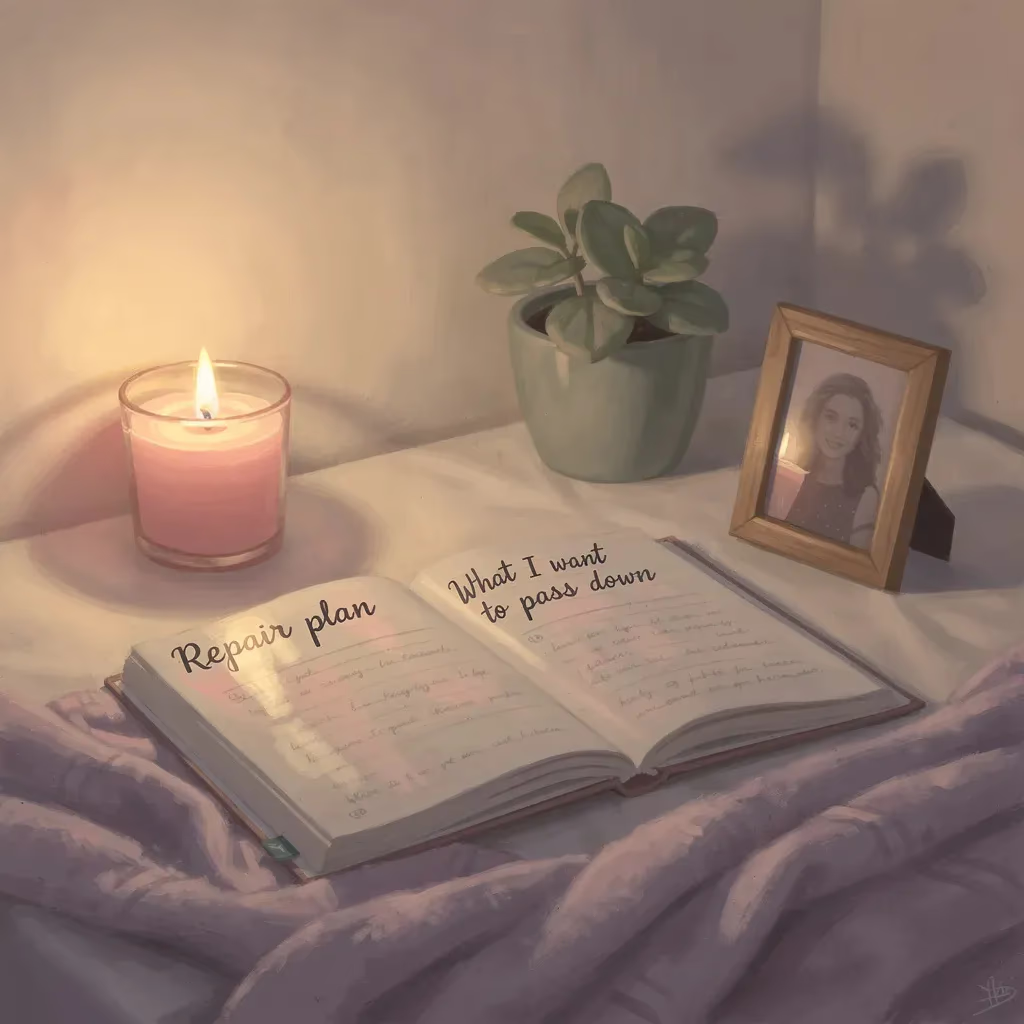
Alchemist moms are the ones who care about the "why" under the behavior. You're not just trying to get through the day. You're trying to build a different emotional legacy.
If you're taking a what kind of mom am I quiz and you keep thinking, "I just don't want to repeat what I grew up with," Alchemist is your language. You're repair-forward. You're intentional.
Alchemists also tend to carry pressure. Because when you care this much, you can start treating motherhood like a moral exam. That's when "am I a good mom" becomes a constant scan.
Alchemist Meaning
Core Understanding
If you recognize yourself in the Alchemist pattern, you create safety through repair and meaning. You're aware of cycles. You can sense when something old is trying to replay itself. You want to interrupt it, gently, and choose something better.
This pattern often develops when you felt something in your childhood needed to be different. Many Alchemists are women who grew up thinking, "I'll do it differently." You might have spent years reflecting, reading, healing, and building self-awareness. That's not overthinking. It's preparation.
Your body remembers old pain as body signals. A child's tantrum might trigger a flash of dread. Your heart might race, your throat might tighten, and you might feel the urge to either over-control or over-soothe. The Alchemist shift is learning: "This is old. I can respond now."
What Alchemist Looks Like
You think in patterns: You notice what repeats. You might catch yourself saying a phrase you hate, then stop mid-sentence. You care about the emotional climate, not just the behavior.
Repair matters to you: After a hard moment, you want to return and reconnect. You can say "I'm sorry" without collapsing. You want your child to learn that love comes back.
You carry meaning: You care about what moments mean. A bedtime fight can feel like a legacy moment. This can be beautiful. It can also be heavy.
You can over-process: When stressed, you might analyze everything. You might replay your tone at 11pm. You might Google what is my parenting style trying to find the "right" one.
You value emotional honesty: You want feelings named, not hidden. You might encourage "It's okay to be mad." You don't want a child to learn they must be convenient to be loved.
You can fear your own anger: If you grew up with scary anger, your own irritation can feel threatening. You might clamp down, then feel ashamed.
You crave healing: You want to break cycles. You might make intentional choices about how you discipline, how you talk, how you apologize, how you rest.
You're sensitive to shame: The "am I a good mom" question can feel like a cliff edge. If you mess up, your mind might jump to, "I'm repeating it. I'm failing." That's not truth. That's fear.
You want partnership: You often care deeply about co-parent dynamics, emotional safety, division of labor, and repair after conflict. You don't want to do it alone.
You carry hope: Even on hard days, you believe change is possible. You're willing to learn and grow.
How Alchemist Shows Up in Different Areas of Life
In romantic relationships: You value depth, honesty, and repair. You may get anxious when conflict feels unresolved. You might need clear "we're okay" signals.
In friendships: You're often the one who goes deep. You can hold space. You may struggle with shallow connections.
At work: You may be reflective and values-driven. Under stress, you may overthink and self-criticize.
Under stress: You might spiral into meaning-making. You might ask, "What does this say about me?" Your reset is grounding: one small repair, one next step, then rest.
What Activates This Pattern
- When you snap, and you fear what it "means."
- When you see a cycle repeating, and you feel panic.
- When someone shames your parenting, even subtly.
- When you feel alone, like you're carrying the emotional work.
- When a child is dysregulated, and it triggers old memories.
- When you're exhausted, and your patience is thin.
The Path Toward More Peaceful Healing
- You don't have to heal perfectly to be a good mom: Repair is enough.
- Keep meaning gentle: Not every moment is destiny. Some moments are just Tuesday.
- Women who understand their Alchemist type often feel huge relief when they replace perfection with consistent repair and self-honoring.
- Let your needs exist: You can break cycles and still be a whole person.
Alchemist Celebrities
- Anne Hathaway - Actress
- Ariana Grande - Singer
- Margot Robbie - Actress, Producer
- Lady Gaga - Singer, Actress
- Emma Watson - Actress
- Brie Larson - Actress
- Joseph Gordon-Levitt - Actor
- Winona Judd - Singer
- Sigourney Weaver - Actress
Alchemist Compatibility
| Other type | Match | Why it feels this way |
|---|---|---|
| Nurturer | 🙂 Works well | Shared tenderness and repair, as long as boundaries keep you from over-giving. |
| Harmonizer | 🙂 Works well | Both value emotional safety, but you may need to tolerate more conflict than they like. |
| Coach | 🙂 Works well | Healing plus growth can be powerful, if coaching doesn't become pressure. |
| Anchor | 😐 Mixed | Structure can support your healing, but perfectionism can spike if you both tighten. |
| Trailguide | 🙂 Works well | Their reset energy helps you stop over-processing and return to the present. |
| Protector | 😐 Mixed | Both are sensitive to danger. The goal is safety without living in fear. |
| Realist | 😐 Mixed | Their practicality grounds you, but you may need more emotional language than they naturally use. |
If you're stuck in the loop of what is my parenting style because every option feels wrong, it's usually because those quizzes don't include your real stress self. This what kind of mom am I quiz isn't about perfect answers. It's about what you do when you're tired, and what helps you come back. If you've been quietly asking am I a good mom, your result is a kinder, clearer starting point.
- 🌸 Discover what kind of mom am I quiz results that feel like recognition, not a stereotype.
- 🧭 Understand what is my parenting style when love meets stress, not only when you're calm.
- 🧩 Recognize what type of mom am I and why that type makes sense for your nervous system.
- 🛠️ Learn what kind of parent am I quiz language you can actually use with a partner or co-parent.
- 💛 Reframe am I a good mom into "what helps me stay steady?"
- 🗝️ Answer what kind of mother are you with warmth, not judgment.
| Where you are now | What becomes possible |
|---|---|
| You keep Googling "what type of mom am I" and somehow feel more anxious afterward. | You get a clear type that explains your default style and your tired-day pattern, so you feel less lost. |
| "Am I a good mom" shows up as a 3am ceiling-staring thought loop. | You learn what calms that loop: repair, boundaries, ease, and support that fits you. |
| You're trying to figure out what is my parenting style, but every label feels like a trap. | You get language that honors your mix: warmth, structure, autonomy, and self-honoring. |
| You worry you'll lose yourself in motherhood. | You build a sustainable plan that includes you, meaning, community, and healing, not just logistics. |
Join over 156,261 women who've taken this under 5 minutes to answer "what kind of mom am I quiz" honestly. Your answers stay private, and your results are just for you.
FAQ
What is a "mom personality" (and how is it different from a parenting style)?
A "mom personality" is the emotional energy and instinct you naturally bring into motherhood. It shapes how you comfort, guide, protect, teach, and reset after hard moments. A parenting style is more like your chosen approach (gentle parenting, authoritative, etc.). Your mom personality is the part of you that shows up even when you're tired, overstimulated, or unsure.
This is a question so many women carry quietly, especially if you've ever taken a "what is my parenting style quiz" and thought, "Okay... but what about who I am when things get messy?" Of course you'd want clarity. Motherhood can feel like a giant personality test you didn't study for, and a lot of us worry we'll get it "wrong."
Here's what's so important to understand: your mom personality isn't a grade. It's a pattern.
- Personality is your default wiring: how you react under pressure, what you notice first, how you offer love.
- Parenting style is your strategy: what you practice on purpose (routines, consequences, communication tools).
- Your season matters: the same woman can look like a different mom at 6 weeks postpartum versus after a good night's sleep and support.
A quick example:
- Two moms can both believe in gentle parenting. One naturally soothes with warmth and closeness. Another naturally soothes by grounding the room and making a plan. Same values. Different "mom personality."
This difference matters because it changes what will actually help you.
- If your nervous system runs sensitive, you'll need tools for overstimulation and repair, not just "be calmer."
- If you're naturally structured, you'll need permission to soften without feeling like you're failing.
- If you're deeply intuitive, you'll need reality-check anchors so you don't spiral into self-doubt.
A good "mom personality quiz" doesn't tell you what kind of mom you "should" be. It helps you name what you're already doing, why it makes sense, and where you might want more support.
How do I find out what kind of mom I would be?
You find out what kind of mom you would be by looking at your patterns under stress and love: how you comfort, how you set limits, what triggers you, and what helps you reset. The clearest clues usually show up in everyday moments, not in your "best self" moments.
If you've been searching for a "what kind of mom would I be quiz," it makes perfect sense. Wondering about motherhood can bring up this tender mix of excitement and fear. Especially if you're the type who replays conversations, worries about messing up, or feels responsible for everyone's feelings. You're not being dramatic. You're being conscientious.
Here are a few surprisingly revealing questions you can ask yourself right now:
When someone I love is upset, my first instinct is to...
- soothe and cuddle
- fix and solve
- teach and coach
- hold the line to create safety
- lighten the mood to reduce tension
When I'm overwhelmed, I tend to...
- get snappy, then feel guilty
- shut down and go quiet
- over-explain to keep everyone okay with me
- try to control the environment (clean, plan, organize)
- dissociate into scrolling or zoning out
What scares me most about parenting is...
- being too much or not enough
- repeating what I grew up with
- raising a child who feels misunderstood
- losing myself completely
- being the "mean mom" if I set boundaries
When conflict happens, I usually...
- smooth it over fast
- apologize quickly
- get defensive
- need space to think
- try to make it a learning moment
These patterns point toward different mom personalities. And none of them are "bad." Each has a gift and a stress-shadow.
The reason quizzes help is they gather these patterns into a clearer picture. It's hard to see yourself accurately when you're anxious. Your brain will cherry-pick your worst moments as "proof" you're not cut out for this. A good "what kind of mother are you" quiz gives you a steadier mirror.
If you're curious, this is exactly what our Mom Personality: What Kind of Mom Would You Be? quiz is for: clarity without judgment.
How accurate is a mom personality quiz (and can it actually tell me my mom type)?
A mom personality quiz can be surprisingly accurate at identifying your patterns, especially when it focuses on real-life scenarios and emotional triggers. What it can't do is predict every detail of the mother you'll become, because your support system, season of life, and healing all shape how your traits show up.
You're not alone if you've taken a "what mom type am I" quiz and thought, "This feels close... but also not quite." Of course. You're a whole person. A single label won't capture your softness, your strength, your history, and your hopes.
Accuracy usually comes down to three things:
Scenario-based questions
- The best quizzes don't ask "Are you calm?" They ask what you do when your kid is melting down in public and your nervous system is on fire.
Balanced answers (not moralized answers)
- A lot of quizzes accidentally reward "perfect gentle mom" responses. Real accuracy comes from letting you choose the honest answer, even if it's messy.
Results that describe patterns, not destiny
- Your "mom personality" should feel like recognition: "Oh. That's why I do that." Not a sentence.
Something else that matters: your attachment style and anxiety levels can skew self-reporting. If you already worry you're failing, you'll interpret neutral behaviors as "bad." That doesn't mean the quiz is wrong. It means your inner critic is loud.
A helpful way to use any "mom personality quiz" is to read your result and ask:
- "Does this explain my stress reactions?"
- "Does this describe how I show love?"
- "Does this give me language for what I need?"
If yes, it's useful. If no, it's still data. Sometimes you resonate with parts of two types, or you move between them depending on sleep, support, and how safe you feel.
Our Mom Personality: What Kind of Mom Would You Be? quiz is designed to feel like a mirror, not a verdict. It helps you name your strongest instincts and your most common pressure points, so you can parent with more self-trust.
Am I too sensitive to be a mom?
No. Being sensitive does not disqualify you from motherhood. It means you'll feel things deeply, notice subtle shifts, and care intensely. The real challenge is not your sensitivity. It's what happens when you don't have enough support, rest, or tools to regulate when the intensity stacks up.
If you have ever typed "am I too sensitive to be a mom" into a search bar at 2 a.m., you're in very real company. So many of us were praised for being "easy" and "good" growing up, which often meant being hyper-aware of everyone else's moods. Then we become adults and think, "If I feel this much, how would I handle a child who needs me constantly?"
Here's what's actually true: sensitivity is a parenting strength, with a cost.
What sensitivity gives you as a mom:
- You notice when something is off before anyone else does.
- You're emotionally attuned, which helps kids feel seen.
- You tend to repair quickly because you care about connection.
- You can create a home where feelings are allowed.
What sensitivity asks from you:
- You will need boundaries with sensory input (noise, touch, mess).
- You will need scripts for overstimulation, because willpower won't be enough.
- You will need permission to take breaks without guilt.
Sensitivity can turn into suffering when it merges with perfectionism. This is the pattern: you want to be a calm, present mom. You get overloaded. You snap. Then you spiral into shame and promise you'll never do it again. That cycle isn't a character flaw. It's nervous system overload.
There are gentle supports that make a huge difference, like:
- having a predictable reset routine for you (not just the child)
- learning repair language that doesn't turn into over-apologizing
- building a "less stimulation" environment where possible
- practicing self-compassion so your kid doesn't inherit your inner critic
If you also wonder "what kind of mom will I be if I have anxiety," the answer is: you can be a deeply loving one. Anxiety doesn't mean you'll damage your child. It means you deserve tools and support so you don't have to white-knuckle motherhood.
Our Mom Personality: What Kind of Mom Would You Be? quiz can help you see what kind of sensitive you are, what overwhelms you most, and what restores you fastest.
What causes different mom personality types? Is it genetic or learned?
Different mom personality types come from a mix of temperament (the parts you were born with), learned coping patterns (what you had to do to feel safe), and life context (support, stress, culture). It's not purely genetic and it's not "all in your childhood" either. It's both, plus the season you're in.
This question tends to show up when you're trying to make sense of yourself without blaming yourself. That is such a loving instinct. If you've ever thought, "Why do I react like this?" you're already doing the kind of self-awareness that changes family patterns.
Here are the biggest influences:
Temperament
- Some people are naturally more sensitive to noise, emotion, or chaos.
- Some are more steady, structured, or novelty-seeking.
- Temperament is not a problem to fix. It's information.
Your own upbringing
- If love felt conditional, you might become a mom who over-gives and over-worries.
- If emotions were unsafe, you might become a mom who needs control to feel okay.
- If you had to be the "responsible one," you might struggle to rest or play.
Attachment and nervous system learning
- Your body learned what connection feels like: safe, unpredictable, distant, or overwhelming.
- Parenting activates that learning, especially when your child is upset.
Stress load and support
- A supported mom often looks more patient and flexible.
- An unsupported mom often looks more reactive. Not because she is worse, but because she's carrying too much.
Values and culture
- Some of us were taught that a "good mom" is self-sacrificing.
- Others were taught that a "good mom" is strict and high-achieving.
- Those beliefs shape your default choices.
The tender truth is this: two women can have the same temperament and become very different moms depending on whether they're safe, supported, and allowed to be human.
That is why a mom personality quiz can feel relieving. It puts language to patterns that used to feel like personal failures. It helps you understand what you're protecting, what you're afraid of, and what you need to feel secure enough to show up the way you want.
How do I set boundaries with my child without feeling mean?
You set boundaries with your child by being clear, consistent, and calm enough, not perfectly calm, and by remembering that a boundary is a form of care. Feeling mean usually comes from guilt, people-pleasing conditioning, or fear that conflict equals disconnection.
If you've searched "how do I set boundaries with my child without feeling mean," you are not alone. So many of us equate love with endless flexibility. We learned early that keeping people happy kept us safe. Then motherhood asks us to hold limits anyway. That can feel like betraying your own identity as the "nice" one.
Here's the reframe that changes everything: a boundary is not rejection. It's structure.
Why boundaries feel mean (even when they're healthy):
- You're feeling your child's discomfort and interpreting it as harm.
- Your nervous system hears crying as danger, not communication.
- You had consequences growing up that felt shaming, so any limit feels like that again.
- You fear being the "bad mom," which is really fear of being unloved.
What a healthy boundary looks like:
- Simple language
- Few words
- A calm, predictable follow-through
- Warmth without negotiation
Examples you can borrow:
- "I won't let you hit. You can be mad. I'm keeping bodies safe."
- "You can have water. Candy is not happening right now."
- "I hear you want more TV. The answer is no. We can pick a book or blocks."
If you tend to over-explain, this is your gentle permission slip: you don't have to convince your child to agree. You just have to be steady.
A lot of moms find it helpful to separate two skills:
- Holding the limit
- Connecting through the feeling
You can do both. "No" can live next to "I know this is hard."
Understanding your mom personality helps here because different types struggle with different parts:
- Some moms struggle to say no.
- Some moms can say no, but struggle to stay connected.
- Some moms freeze and then explode because they waited too long.
A "what is my parenting style quiz" might give you a philosophy. A mom personality quiz helps you see your emotional pattern with boundaries, which is the part that determines whether you feel confident or guilty.
How do I repair after snapping at my child?
You repair after snapping at your child by reconnecting, naming what happened in simple language, taking responsibility without dumping shame, and showing what you'll do differently next time. Repair is not a perfect speech. It's a return to safety.
If you Googled "how to repair after snapping at your child," I already know what happened next. The guilt wave. The replay. The fear that you "ruined something." Of course you feel that. You care deeply. But one hard moment doesn't define you, and repair is one of the most protective things you can give a child.
Here's what repair actually needs (and what it doesn't):
Repair needs:
- calm enough energy (even if you're still a little shaky)
- ownership ("That was my mistake")
- reassurance ("You're safe with me")
- a tiny plan ("Next time I'll...")
Repair does not need:
- a long explanation
- you calling yourself a bad mom
- your child comforting you
A simple repair script (you can literally memorize this):
- Name it: "I snapped and raised my voice."
- Own it: "That wasn't okay. I'm sorry."
- Reassure: "You're not in trouble for having feelings."
- Plan: "Next time I'm that overwhelmed, I'll take a minute to cool down."
If your child is little, you can keep it even shorter:
- "Mom yelled. I'm sorry. I love you. Let's try again."
If your child is older, you can add:
- "I was overstimulated and I handled it badly. That's on me."
This is where so many of us get stuck: we confuse guilt with growth. Guilt feels like you're doing something. Growth is making one small change that reduces the chance of a repeat.
One micro-change that helps almost every mom: identify your "yellow light" signs (the moment before snapping). It might be:
- clenching your jaw
- feeling hot
- repeating yourself a third time
- suddenly needing silence
That moment is your cue to intervene earlier, not to power through.
Knowing your mom personality makes repair easier because you can predict your stress pattern. Some mom types tend to snap from sensory overload. Others snap from feeling disrespected. Others snap after over-giving all day.
Our Mom Personality: What Kind of Mom Would You Be? quiz helps you name your overload triggers and your repair strengths, so you can stop treating normal human moments like proof you're failing.
How can I be a calm mom when I'm overstimulated (or have anxiety)?
You can be a calmer mom when you're overstimulated by reducing inputs, building predictable reset moments, and using short, repeatable scripts instead of relying on willpower. If you have anxiety, calmness becomes less about "staying relaxed" and more about helping your nervous system feel safe enough to respond.
If you've ever searched "how to be a calm mom when overstimulated," you probably weren't looking for fluffy advice. You wanted something that works when the house is loud, you're touched out, and you can feel the edge in your voice. That edge isn't you being a monster. It's your system hitting capacity.
Overstimulation is usually a mix of:
- noise + mess + interruptions
- decision fatigue
- constant physical contact
- feeling responsible for everyone else's mood
Here are a few supports that actually help in real life:
1) Lower the sensory load on purpose
- earplugs or noise-reducing earbuds (not as a punishment, as support)
- a "quiet basket" of low-noise activities
- one room with reduced clutter if possible
2) Use "fewer words" parentingWhen you're overstimulated, talking more often escalates everyone. Short phrases keep you steady:
- "I hear you. Not right now."
- "I can help after I finish this."
- "You're safe. I'm right here."
3) Build micro-resets into the dayNot a spa day. A 60-second reset:
- cold water on wrists
- stepping outside for two minutes
- stretching while your child plays
- a single song that signals "reset time"
4) Plan for your triggers instead of blaming yourself for having themIf transitions wreck you, build transition buffers.If mornings wreck you, prep the night before.If dinner wrecks you, simplify it on purpose.
This is especially important if you wonder "what kind of mom will I be if I have anxiety." Anxiety doesn't mean you can't be calm. It means your calm will be created, not assumed. Calm becomes a practice, not a personality trait.
Understanding your mom personality helps because different mom types get overstimulated for different reasons. Some need more alone time. Some need more structure. Some need more emotional support. When you know which one you are, you stop copying advice that was built for someone else.
What's the Research?
Why "What Kind of Mom Would I Be?" Is a Real Question (Not Just a Cute Quiz)
That late-night spiral where you're thinking, "What kind of mom would I be?" usually isn't about hypothetical baby names. It's about safety. It's your brain trying to predict the emotional weather of a life you care about so deeply it scares you.
What the research tells us is that "mom personality" is less about a fixed identity and more about a pattern: the emotional climate you create through your usual mix of warmth, expectations, and how you handle stress. Across clinical summaries, researchers describe parenting style as the overall pattern of behaviors and attitudes a parent brings to daily life, and it shapes a child's environment in ways that can matter over time (Parenting styles - Wikipedia; Types of Parenting Styles and Effects on Children - StatPearls).
A grounding detail that often helps anxious minds: the classic research framework (from Diana Baumrind, later expanded by Maccoby and Martin) centers two big dimensions, responsiveness (warmth/attunement) and demandingness (structure/expectations) (Verywell Mind overview of Baumrind's styles; Baumrind's Parenting Styles - Iowa State Pressbooks). That means your "mom personality" isn't one trait like sensitive vs. tough. It's how you balance care and limits.
If you worry you're "too sensitive to be a mom," research actually frames sensitivity as part of responsiveness, which is one of the core ingredients of secure relationships. And no, you don't have to be perfectly regulated 24/7 to count as responsive.
Also: you won't be one single style forever. Even mainstream medical guidance notes it's normal to use different approaches in different situations, not commit to a rigid label (Mayo Clinic Press on parenting styles).
The Science Behind "Mom Type": Attachment, Emotion Regulation, and the Nervous System
A lot of what we call "mom personality" is really: how you respond when your child is upset, and how you respond when you are upset.
Attachment research is basically the study of this loop. Attachment theory proposes that babies and kids thrive when they have at least one caregiver who is reliably responsive, especially early on, and that this caregiver becomes a "secure base" for exploring life (Attachment theory - Wikipedia; Simply Psychology: Attachment theory explained). That secure-base idea matters for mom personality because it connects directly to the kinds of moms many of us are trying to be: warm, safe, steady, but still encouraging independence.
At the same time, the research is clear that regulation is learned. Emotion regulation is not something you either have or you don't. It's a set of skills that develop through modeling, practice, and support (Psychology Today: Emotion regulation; McRae & Gross (2020) review on emotion regulation). And parenting includes both self-regulation (your own emotions) and co-regulation (helping your child ride out theirs). Yale's work on emotional intelligence puts it simply: regulation skills are learned, and both kids and adults need instruction and modeling (Yale School of Medicine: Emotion regulation).
So if you already know you get overstimulated, or you have anxiety, that doesn't disqualify you from being a good mom. It just means your mom personality will include figuring out what helps your nervous system come back down.
This is where a "mom personality quiz" can actually be useful (when it isn't shaming): it can help you name whether you tend to soothe first, structure first, fix first, or avoid conflict first. Those tendencies often show up even more under stress.
What Research Suggests Helps Kids Most: Warmth + Structure (And Repair)
If you've ever taken a "what is my parenting style quiz" and felt judged by the results, I want to reframe it with what the research actually emphasizes.
Across summaries of decades of developmental research, the parenting style most consistently associated with positive outcomes is authoritative parenting, which is high warmth/responsiveness plus clear expectations/structure (Verywell Mind: Parenting styles; Baumrind's Parenting Styles - Iowa State Pressbooks). That doesn't mean strict. It means clear and steady. It also doesn't mean perfect. It means the child experiences you as emotionally available while also feeling held by boundaries.
And there's a subtle but important nuance here: parenting style is different from specific parenting practices. Style is the emotional climate. Practices are the tools (time-outs, choices, routines, etc.) (Parenting styles - Wikipedia). That is why two moms can use the same "gentle parenting" technique, and one feels calm and connected while the other feels like she's walking on eggshells. The technique isn't the whole story. The climate matters.
This also connects to one of the most quietly relieving truths for anxious women: outcomes are not only about what you do in the hardest moment. They're also about what happens next. Even Psychology Today emphasizes that parents can shift their style once they understand it, and awareness changes things (Psychology Today: Parenting styles).
Which leads to a question I see constantly: "How to repair after snapping at your child?" While the sources here focus more on the broader science than step-by-step scripts, the logic is clear: kids learn regulation in relationship. When you come back, reconnect, and re-stabilize, you're modeling the exact skill they need for life (co-regulation and repair as part of emotion regulation learning) (Yale School of Medicine: Emotion regulation is learned; Psychology Today: Emotion regulation).
Your "mom type" isn't defined by the moment you lose it. It's defined by your willingness to return, repair, and keep learning.
How This Connects to Your Mom Personality Types (And Why It Can Feel Personal)
If you're reading this because you're thinking, "What kind of mom will I be if I have anxiety?", you are so not alone. Many women are trying to pre-solve parenting because we learned early that love can feel conditional, and being prepared feels like being safe.
Research also keeps reminding us of something that can be both annoying and freeing: parenting happens in context. Culture, stress, and social support shape parenting, and parenting stress can change behavior (like becoming inconsistent or more reactive) (StatPearls: Parenting styles and cultural context; Parenting styles - Wikipedia). So if you're imagining your future mom self while you're currently burned out, of course the picture looks harsher and more fragile than it might in a supported, resourced season of life.
And yes, it matters that kids are different too. Some sources emphasize that child temperament and broader environment complicate simple cause-and-effect claims, which is part of why "mom personality" should never be treated like destiny (Parenting styles - Wikipedia; Grokipedia: Parenting and temperament interplay).
This is also why the eight mom personality types in this quiz (Nurturer, Anchor, Coach, Harmonizer, Trailguide, Protector, Realist, Alchemist) are best understood as patterns you lean toward, not boxes you have to live in. A Protector might be high on vigilance and safety-building. A Harmonizer might be highly attuned to feelings and conflict. An Anchor might bring steadiness and routines. A Coach might focus on skills and growth. None of these are "better." Each one just has a default under stress.
The science tells us what's common across parents. Your personalized report shows which specific patterns are shaping your version of motherhood, including the strengths you already carry and the pressure points that tend to hijack you.
References
Want to go deeper (in a non-overwhelming way)? These are genuinely solid reads:
- Types of Parenting Styles and Effects on Children - StatPearls - NCBI Bookshelf
- The 4 Types Of Parenting Styles: What Style Is Right For You? - Mayo Clinic Press
- Parenting Styles - Psychology Today
- Why Parenting Styles Matter When Raising Children - Verywell Mind
- Baumrind's Parenting Styles - Iowa State Pressbooks
- Parenting styles - Wikipedia
- Attachment theory - Wikipedia
- Attachment Theory In Psychology Explained - Simply Psychology
- What Is Attachment Theory? - Verywell Mind
- Emotion Regulation - Psychology Today
- Emotion regulation (McRae & Gross, 2020) - PubMed
- Emotion regulation is the linchpin for mental health - Yale School of Medicine
- Parenting - Grokipedia
Recommended reading (for when you want more than a quiz)
If you're here because you keep typing "what kind of mother are you" or "what is my parenting style" into a search bar, books can feel like a steady hand. Not to tell you who to be. Just to give you language, perspective, and a few tools that actually work when the day gets loud.
General books (good for any Mom Personality type)
- Good Inside (Amazon, Bookshop.org, AbeBooks) by Becky Kennedy - A parenting approach built on connection, boundaries, and repair that sees both parent and child as good.
- The Whole-Brain Child (Amazon, Bookshop.org, AbeBooks) by Daniel J. Siegel - A clear map of children's developing brains and how to respond to meltdowns with empathy and strategy.
- No-Drama Discipline (Amazon, Bookshop.org, AbeBooks) by Daniel J. Siegel and Tina Payne Bryson - Discipline strategies that teach and connect rather than punish and control.
- The Book You Wish Your Parents Had Read (Amazon, Bookshop.org, AbeBooks) by Philippa Perry - Honest insights into parent-child dynamics with practical tools for breaking cycles and building repair.
- Raising Good Humans (Amazon, Bookshop.org, AbeBooks) by Hunter Clarke-Fields - Mindfulness tools for staying calm as a parent, especially when you are triggered or exhausted.
- How to Talk So Kids Will Listen & Listen So Kids Will Talk (Amazon, Bookshop.org, AbeBooks) by Adele Faber and Elaine Mazlish - Practical tools for connecting with children through validation, problem-solving, and real respect.
- The Gardener and the Carpenter: What the New Science of Child Development Tells Us About the Relationship Between Parents and Children (Amazon, Bookshop.org, AbeBooks) by Alison Gopnik - A science-based case for letting children grow through exploration instead of parental optimization.
- Parenting from the Inside Out: How a Deeper Self-Understanding Can Help You Raise Children Who Thrive (Amazon, Bookshop.org, AbeBooks) by Daniel J. Siegel, MD; Mary Hartzell, MEd - How your own childhood experiences shape your parenting, and how self-awareness creates secure bonds.
For Nurturer types (softness with boundaries)
- Set Boundaries, Find Peace (Amazon, Bookshop.org, AbeBooks) by Nedra Glover Tawwab - Kind limits that protect your energy.
- Fair Play (Amazon, Bookshop.org, AbeBooks) by Eve Rodsky - Division of labor so you don't become the default everything.
For Anchor types (steadiness that includes you)
- Set Boundaries, Find Peace (Amazon, Bookshop.org, AbeBooks) by Nedra Glover Tawwab - Clear boundary language without guilt spirals.
- Fair Play (Amazon, Bookshop.org, AbeBooks) by Eve Rodsky - Systems that stop you from carrying the whole mental load.
For Coach types (growth without pressure)
- Mindset (Amazon, Bookshop.org, AbeBooks) by Carol S. Dweck - Encouragement that builds resilience instead of perfectionism.
- Peaceful Parent, Happy Kids (Amazon, Bookshop.org, AbeBooks) by Laura Markham - Warm leadership when you're tempted to push.
For Harmonizer types (peace without self-erasure)
- Book of Boundaries (Amazon, Bookshop.org, AbeBooks) by Melissa Urban - Scripts for holding the line without over-explaining.
- The Highly Sensitive Person (Amazon, Bookshop.org, AbeBooks) by Elaine N. Aron - Understanding sensitivity as real data, not a flaw.
For Trailguide types (freedom with anchor points)
- How to Keep House While Drowning (Amazon, Bookshop.org, AbeBooks) by KC Davis - Permission and practical systems for real life.
- Raising Your Spirited Child (Amazon, Bookshop.org, AbeBooks) by Mary Sheedy Kurcinka - Guiding big energy without constant battles.
For Protector types (safety without living in fear)
- Adult Children of Emotionally Immature Parents (Amazon, Bookshop.org, AbeBooks) by Lindsay C. Gibson - Naming the old patterns that make you scan so hard.
- Self-Compassion (Amazon, Bookshop.org, AbeBooks) by Kristin Neff - A kinder inner voice after hard moments.
For Realist types (clarity that stays connected)
- Cribsheet (Amazon, Bookshop.org, AbeBooks) by Emily Oster - Decision-making without fear spirals.
- Simplicity Parenting (Amazon, Bookshop.org, AbeBooks) by Kim John Payne; Lisa M. Ross - A calmer home through fewer inputs.
For Alchemist types (healing without perfection)
- The Gifts of Imperfection (Amazon, Bookshop.org, AbeBooks) by Brene Brown - Releasing shame and choosing realness.
- Hold Me Tight (Amazon, Bookshop.org, AbeBooks) by Sue Johnson - Secure connection conversations that support co-parenting too.
P.S.
If you're still Googling "what kind of mom will I be" because "am I a good mom" won't stop looping, this what kind of mom am I quiz is a gentle place to start.