Your Love Pull Starts Before The First Date

Love Pull Quiz: What Kind Of Partner Do You Unconsciously Attract?

Love Pull Quiz: What Kind Of Partner Do You Unconsciously Attract?
If you've ever done the 3am replay after a text, this reveals the Love Pull behind it, and the kind of partner it keeps inviting in.
Love Pull: What Kind of Partner Do You Attract?

That question, "what type of guy do I attract", usually pops up after you've dated the same vibe in a different body. The spark is there... and then comes the confusion. The delayed replies. The almost-commitment. The little stomach-drop when the tone changes and you don't know why.
Of course you're tired. So many women are. You can be smart, kind, self-aware, and still end up in the same relationship pattern because your Love Pull isn't about your "standards on paper." It's about the tiny signals you send when you want closeness, when you get nervous, and when you're trying not to seem like "too much."
This Love Pull Quiz quiz free experience is built to answer the stuff you're actually Googling: "what is my type", "what is my type of guy", "what do I look for in a guy", and "what type of guy do I attract".
Here are the 5 Love Pull types you'll get, based on your patterns:
Magnet
- Definition: You pull people in fast. Spark happens quickly, and so does emotional closeness.
- Key traits: Warm openness, big feelings, quick bonding.
- Benefit: You learn how to keep your softness while filtering out low-effort attention.
Fortress
- Definition: You attract people who want access, but you keep your heart behind a gate until trust is real.
- Key traits: High standards, guarded warmth, "prove it first" energy.
- Benefit: You learn how to let in the right guy without rewarding pushy behavior.
Anchor
- Definition: You attract people who want stability, and you often become the steady one.
- Key traits: Loyal, consistent, calming presence.
- Benefit: You learn how to stop carrying the whole relationship on your back.
Mirror
- Definition: You attract people who love being seen, and you can lose yourself trying to keep the peace.
- Key traits: Deep empathy, high sensitivity to vibes, adapting to avoid conflict.
- Benefit: You learn what do I look for in a guy (for real, not just what you can tolerate).
Catalyst
- Definition: You attract people who want growth, healing, and intensity, sometimes more than they want commitment.
- Key traits: High drive for change, big hopes, "we could be amazing" energy.
- Benefit: You learn how to turn chemistry into something steady, or walk away sooner.
Most quizzes stop at a cute label. This one measures the extra stuff that quietly decides who sticks around:
- Connection seeking: how much closeness you crave, especially when things feel shaky
- Boundary strength: how well you hold your line without guilt spirals
- Emotional regulation: how quickly you come back to yourself after stress
- People pleasing: how often "I'm fine" is code for "I don't want you to leave"
- Availability selectivity: how intentionally you give access, time, and intimacy
If you're searching "what is my type" because you're tired of guessing, this gives you a map that feels like real life. And if you're stuck in "what type of guy do I attract", this helps you see why it's repeating, without blaming your heart for being hopeful.
5 Ways Knowing Your Love Pull Can Transform Your Dating Life (Without Turning You Cold)

- 💗 Discover "what type of guy do I attract", and what your "first-date energy" is silently communicating.
- 🧠 Understand "what is my type", not as a label, but as a pattern you can work with.
- 🧭 Recognize "what do I look for in a guy" versus what you accept when you're anxious.
- 🛡️ Strengthen your filter so "what is my type of guy" stops feeling like a mystery and starts feeling like discernment.
- 🌿 Nurture steadier love by shifting pacing, boundaries, and how you respond to uncertainty.
- 🤝 Belong with women who are also done with crumbs and ready for something real.
Lisa's Story: The Night I Finally Stopped Chasing the Same Kind of Love

At 2:11am, I was scrubbing my kitchen sink so hard the sponge started shredding. Not because it was dirty. Because my brain would not stop replaying the last text I sent.
It was one sentence. Literally one. And somehow I had convinced myself it sounded "too eager," "too available," and also weirdly cold at the same time. Like I managed to be both needy and distant in eight words. Impressive, honestly.
I'm Lisa, I'm 28, and I work as a server. The kind who can tell if a table is about to fight before they even open the menu. I notice everything. The pause before someone answers. The way a smile drops half a second too early. The tiny shift in tone that says, "You're annoying me," even if the words are, "No, it's totally fine."
That skill pays my bills. It also ruins my sleep.
Because when I'm dating someone, I don't just like them. I start tracking them. Their response times, their punctuation, the way their energy changes after I share something real. I become a one-person research study called "Are We Okay?"
And the worst part is, on the outside, I look so chill.
I can play it so cool. I can be the girl who's "down for whatever," the girl who doesn't need much, the girl who laughs off mixed signals like they're jokes. Meanwhile my body is acting like we're in an emergency. Tight chest. Hot face. That sinking feeling like I'm about to be left on the side of the road for having basic human feelings.
I kept attracting the same kind of guy, too. Not always in obvious ways. Sometimes they were sweet and attentive at first. Sometimes they were the life of the party. Sometimes they were so intense I thought, finally, someone who feels the way I feel.
And then, almost like a clock, the shift would happen.
They'd start pulling back a little. Nothing dramatic. Just enough. One shorter reply. One "busy week." One change in their voice when I asked a simple question. And suddenly I was doing that thing again where I start auditioning for my own relationship.
Not by being mean. Not by manipulating. By shrinking.
I would offer solutions before they even asked. I'd say, "No worries!" while my stomach was twisting. I'd pretend I didn't care when I cared so much it felt embarrassing. I'd stay available, always, because somewhere deep in me, availability felt like safety. Like if I was easy enough to love, they'd stay.
That night, with the sink and the shredded sponge, I remember thinking, very plainly: I do this every time.
Not the sink thing specifically, but the whole pattern. The whole "I can feel you slipping and now I'm going to work overtime to stop it" thing. I could see it like a diagram. I just didn't know how to stop being the person inside it.
I found the "Love Pull: What Kind of Partner Do You Attract?" quiz the way I find most things at 2am. TikTok, screen dimmed, volume low, thumb scrolling like I was trying to outrun my own thoughts.
The video was someone talking about how certain relationships feel like gravity. Like you don't even choose them. You just... get pulled. And my whole body reacted. Not in a dramatic way. More like that quiet internal, "Oh. That." Like my nervous system recognized the topic before my brain had words.
I clicked the quiz mostly to distract myself from texting him again. Which is, honestly, a little funny in retrospect. I was trying not to do the thing by doing a different thing.
The questions weren't fluffy. They weren't "pick an aesthetic" or "choose a date idea." They were the kind that made me sit up on my couch, because they were asking what I usually try not to look at. The roles I slip into. The kinds of partners that make me feel instantly hooked. The kind of chaos that feels like chemistry.
When I got my result, I just stared at it for a second.
It basically explained that my love pull is this pattern where I end up drawn to partners who create uncertainty. Not always on purpose. Some are genuinely overwhelmed, avoidant, inconsistent, "not ready," or just... emotionally hard to reach. The quiz didn't call me desperate. It didn't shame me. It just named the dynamic: I get pulled toward people I have to work for.
And then it hit me, in normal-person language: I wasn't attracting my "type." I was attracting my nervous system's favorite puzzle.
Because if love equals earning, then someone steady doesn't feel exciting. Someone steady feels suspicious. Like I'm waiting for the catch.
I remember whispering out loud, "Oh my god." Like I had just been handed the missing page from a book I've been living inside.
The quiz laid out a few different love pulls, and reading through them felt like recognizing different versions of me across different years. The one who attracts intensity and then gets abandoned. The one who attracts emotionally unavailable charm. The one who attracts someone who wants caretaking instead of partnership.
It wasn't that every person I'd dated was some villain. It was that I kept saying yes to the same emotional setup. A setup where I was the one adapting, waiting, interpreting, smoothing, proving.
And here's the thing I didn't expect: I felt sad. Not dramatic-sad. More like... grief.
Like, "Wow, I have been working so hard to be chosen."
I didn't suddenly become a different person after that. I didn't wake up healed and glowing and immune to mixed signals. I still wanted to text him. I still wanted reassurance. I still had that reflex where my fingers move toward my phone before my brain catches up.
But something shifted in the way I understood what was happening.
A few days later, I was at work, running drinks to a table of four. I caught myself doing my usual thing: scanning, reading, trying to predict needs before anyone asked. It's what makes me good at my job. The problem is, I bring that same energy into dating. I try to predict what will keep someone close.
That night, he did the thing again. He replied hours later, breezy, like nothing happened. My old script would have been immediate: respond fast, be fun, be low-maintenance, don't mention it, don't scare him.
Instead, I sat on my couch and did something that felt almost ridiculous.
I waited.
Not in a strategic "make him miss me" way. In a "I am not going to abandon myself for this moment" way. I set my phone down and stared at the wall for a while, like an idiot, and let the discomfort rise and crest without fixing it. I could feel my brain trying to bargain. Send something light. Ask a question. Make a joke. Rehook him. Secure the line.
I didn't.
I grabbed my journal, the one I keep and pretend I don't keep. There are entries in there I have literally folded closed like if I can't see them, they're not real. I wrote, messy and honest: "I feel panicky because I don't know where I stand."
Seeing it in my handwriting was weirdly sobering. Because it was so simple. It wasn't "I'm crazy." It wasn't "I'm unlovable." It was: I don't feel secure.
And then, the next day, I tried something even scarier.
I asked him, plainly, if he was still interested in seeing me. No jokes. No apology. No cushion of "lol it's fine if not."
My hands were shaking when I sent it. Which is embarrassing, but also true. I felt like I was breaking some unspoken rule: don't ask for clarity, don't ask for reassurance, don't risk being seen needing something.
He responded a while later with a paragraph that was... kind, but slippery. Lots of "I've been busy" and "I've had a lot going on" and "I like you, I'm just not sure what I want right now."
And I could feel the familiar trap door opening beneath me. The part where I would usually go, "Okay! Totally! Take your time!" and then quietly make it my job to become the version of me that would make him sure.
But the quiz had named this exact moment. The moment when uncertainty tries to hook me. The moment when I confuse emotional ambiguity for potential.
So I wrote back something I didn't know I was capable of: "I get it. I like you too. But I need someone who's actually available to build something. I don't want to keep guessing."
I stared at that text for ten minutes before sending it. I kept wanting to soften it. To explain more. To reassure him that I wasn't mad. To make sure he didn't think I was "too much."
Then I sent it anyway.
He didn't respond for a full day. And I won't pretend I was peaceful. I checked my phone. I did the sink thing again. I tried to distract myself with laundry. I went to work and smiled at customers and felt like my insides were buzzing.
But underneath the anxiety, there was something else.
A quiet pride. Not loud. Not Instagrammable. Just the feeling of, "I didn't beg. I didn't perform. I didn't disappear myself."
Eventually he replied with something polite, something like, "I understand. You're great. I'm just not there."
It stung. It did.
And it also felt clean.
No months-long fog. No situationship purgatory. No me twisting myself into a shape that could hold someone who didn't want to be held.
A few weeks later, Betty, my friend, asked if I wanted to come to this little birthday thing for her coworker. I almost said no because I was tired and also because I wasn't ready to be perceived again. But I went.
That's where I met Ryan. Not in a rom-com way. More like we ended up in the kitchen at the same time, both trying to be helpful, both refilling ice trays like it mattered.
We talked. It was easy. Not fireworks, but ease. And my brain didn't know what to do with that at first. I kept waiting for the drop. The moment he'd get bored. The moment I'd have to prove something.
It didn't come.
When he texted the next day, it was normal. When I replied, I didn't rewrite my message seven times. When he suggested plans, he followed through. The steadiness was... almost disorienting. Like my body kept reaching for the old alarm bells and finding nothing to grab.
I still catch myself wanting to manufacture closeness. I still have that reflex to over-explain. I still sometimes feel the urge to test, to see if someone's really there.
But now when those urges show up, they feel like signals, not instructions.
Taking the "Love Pull: What Kind of Partner Do You Attract?" quiz didn't turn me into a different person. It gave me a map of what I keep mistaking for love. It put words to the exact magnet inside me that gets activated by certain people.
I don't have it all figured out. I still get that spike of anxiety when a text takes too long. I still have nights where I want to clean my apartment into a new personality.
But now I can tell the difference between chemistry and uncertainty. And that alone has made my life feel a little less like I'm always reaching for someone who's already halfway gone.
- Lisa J.,
All About Each Love Pull Type
| Love Pull Type | Common names and phrases |
|---|---|
| Magnet | "I attract intensity", "spark happens fast", "they pursue then wobble" |
| Fortress | "high standards", "hard to get close to", "I don't trust easily" |
| Anchor | "the steady one", "the fixer", "I carry the relationship" |
| Mirror | "I adapt to them", "I'm sensitive to vibes", "I lose myself" |
| Catalyst | "growth or nothing", "we could be amazing", "I attract projects" |
Am I a Magnet?

You know that moment when the chemistry is so good it feels like a movie? Like your body relaxes for half a second because you think, "Finally. Someone gets me." And then the inconsistency creeps in and you're back to checking your phone like it's a heartbeat monitor.
If you're Googling "what is my type" because you keep attracting intensity that turns into uncertainty, Magnet might land hard. No, it doesn't mean you're "clingy." It usually means you're emotionally open, warm, and responsive. Those are strengths. They just create a specific kind of Love Pull.
A lot of Magnet women can answer "what type of guy do I attract" in one sentence: "Guys who love the chase." The relief is that when you see your pattern clearly, you can stop confusing attention with real availability.
Magnet Meaning
Core understanding (2-3 paragraphs)
Magnet means your presence is inviting. You create closeness quickly, sometimes without meaning to. If you recognize yourself in this pattern, you bond through vibe, laughter, deep talks, and that feeling of "we're the same kind of person." Research on dating patterns shows warmth can attract both steady partners and inconsistent partners.
This pattern often develops when being emotionally tuned-in helped you keep connection. Many women with Magnet energy learned early that being loving, flexible, and "easy to be around" kept relationships safe. So in dating, you naturally offer a lot. You don't do it to earn love. You do it because care is your default.
Your body's wisdom shows up fast. Your chest can feel light and floaty in the beginning. Then it can feel heavy when signals change. That "holding my breath waiting for their reply" thing isn't random. It's your system trying to find steady ground.
What Magnet Looks Like
- Fast emotional bonding: You can go from "this is fun" to "this means something" quickly. On the outside, you look open and affectionate. On the inside, you can feel attached before you've even had the exclusivity talk.
- Chemistry-first decisions: Your body says yes before your brain finishes the sentence. Others see you as romantic and all-in. You notice later that you ignored compatibility signs because the spark was loud.
- Over-explaining to keep closeness: When something feels off, you try to communicate it perfectly. You might send the long text that starts with "I don't want to be annoying..." because you're trying to be careful. It can leave you feeling exposed afterward.
- Giving access early: You share your time, attention, and softness quickly. People feel special around you. The wrong partner can start acting entitled to that access.
- Big hope, big crash: When it's good, it's electric. When it shifts, it feels like you got dropped from a height. Your stomach does that hollow thing, and your mind runs scenarios.
- Reassurance loops: You ask questions that are really about safety, not control. "Are we okay?" "Did I do something?" It sounds casual, but inside you're trying to stop the spiral.
- Spotlighting their potential: You see the best version of them so clearly. Friends might say, "He doesn't deserve you," and you're like, "But he could be amazing if..." That is Magnet vision, and it needs boundaries.
- Tolerating ambiguity too long: Situationships can last longer than you want because intermittent attention keeps you hoping. You tell yourself you're being patient. Your body keeps feeling on edge.
- Hyper-aware of tone changes: You notice tiny shifts in texting speed, punctuation, or warmth. Others might miss it. You feel it in your shoulders and jaw first.
- Making yourself smaller after conflict: If you speak up and it goes badly, you can backtrack. You might apologize for having needs. Later, you feel resentful at yourself, not just them.
- High emotional openness: You share real feelings, not just surface chatter. The right partner feels closer to you quickly. The wrong partner uses that openness like entertainment.
- Chasing closure: If something ends or fades, you want an explanation that makes sense. You replay conversations at 3am. It can feel impossible to let go without a clean ending.
- Being "the safe place": People tell you their secrets fast. It's flattering. It can also be a trap, because you end up holding someone who isn't holding you back.
- People-pleasing to prevent distance: You might laugh off something that hurt. You might agree to plans that don't work for you. It looks chill, but your body feels tight afterward.
- Over-availability in early dating: You answer quickly, you rearrange things, you make it easy. A steady partner appreciates it. A flaky partner can start expecting it.
How Magnet Shows Up in Different Areas of Life
In romantic relationships: You create intimacy quickly. You often attract partners who like being wanted. When someone is consistent, your whole body relaxes. When someone is inconsistent, you can feel pulled into chasing the version of them you met first.
In friendships: You're the friend who answers, checks in, remembers details. The downside is you can over-give, then quietly hurt when it's not returned.
At work: You're collaborative and emotionally smart. You might take on extra because you notice what needs doing and you want harmony. That can blur boundaries with coworkers who rely on you.
Under stress: Your brain tries to solve uncertainty. You might text, re-read, draft messages, delete them, then text again. Your body feels keyed up, like you're waiting for a verdict.
What Activates This Pattern
- When replies get delayed and you don't know why.
- Mixed signals, affection in private and distance in public.
- Hot-and-cold attention that makes you chase the "good version."
- Vague commitment, "not ready for labels" but acting couple-ish.
- You feel like you're auditioning for basic care.
- They go quiet after you share feelings, even small ones.
The Path Toward More Steady Love
- You don't have to change who you are: Your warmth is a gift. The upgrade is protecting it with pacing and selectivity.
- Small shifts, not a personality transplant: Let consistency earn access. Your attention is valuable.
- Say the clean sentence: "I like you. I also like consistency." Clarity attracts grown-up energy.
- What becomes possible: When Magnet women see their pattern, "what is my type" stops being a panic question. It becomes a filter.
Magnet Celebrities
- Zendaya (Actress)
- Dua Lipa (Musician)
- Florence Pugh (Actress)
- Hailey Bieber (Model)
- Emma Stone (Actress)
- Jennifer Lawrence (Actress)
- Selena Gomez (Singer/Actress)
- Ariana Grande (Singer)
- Anne Hathaway (Actress)
- Reese Witherspoon (Actress)
- Kate Winslet (Actress)
- Winona Ryder (Actress)
- Drew Barrymore (Actress)
Magnet Compatibility
| Other type | Compatibility | Why it feels that way |
|---|---|---|
| Fortress | 😐 Mixed | Magnet warmth can feel fast to Fortress guardrails unless both pace closeness intentionally. |
| Anchor | 🙂 Works well | Anchor steadiness helps Magnet relax, as long as Magnet doesn't test for reassurance constantly. |
| Mirror | 😕 Challenging | Two sensitive systems can spiral together, especially if neither names needs clearly. |
| Catalyst | 😐 Mixed | The spark is real, but intensity can outrun consistency unless boundaries and pacing lead. |
Am I a Fortress?

Fortress is that energy where you look unbothered, but inside you're doing a full safety scan. Not because you're cold. Because you learned what it costs to let the wrong person in.
If you're asking "what is my type of guy" and you keep ending up with partners who push, rush, or get offended by your boundaries, Fortress is a strong possibility. You don't want games. You want proof. You can smell inconsistency like smoke.
A lot of Fortress women also ask "what do I look for in a guy" because they don't trust their own yes anymore. That makes sense. When you have been disappointed, your standards become your shelter.
Fortress Meaning
Core understanding (2-3 paragraphs)
Fortress means you lead with selectivity. You may be warm and funny, but your heart doesn't open just because someone is cute or charming. If you recognize yourself here, you attract partners who love the challenge of "winning you over." Sometimes that is healthy pursuit. Sometimes it's someone treating your boundaries like a puzzle.
This pattern often develops when trust was mishandled. Many women with Fortress energy learned early that being too open got them hurt, embarrassed, or left holding the emotional mess alone. So you protect your softness by keeping your cards close. Underneath the calm is a quiet promise to yourself: "I won't abandon me again."
Your body remembers. You feel it as a tight jaw, crossed arms without meaning to, or that slightly numb feeling when someone is overly intense too soon. It's not you being "too picky." It's your body signals saying: verify first.
What Fortress Looks Like
- High standards, low tolerance for nonsense: You spot red flags fast. People see you as confident. Inside, you might worry you're "too guarded" and miss out.
- Testing before trusting: You watch behavior over words. You wait for follow-through. It looks like calm patience, but inside you're collecting evidence.
- Attracting pursuers: People who like the chase are drawn to you. It can feel flattering at first. Later you realize they loved the challenge more than the relationship.
- Slow emotional openness: You keep feelings private until someone earns them. Friends might say "open up," and your chest tightens. Opening up without safety has history.
- Clear boundaries with a soft voice: You can say "I'm not comfortable with that" calmly. The wrong partner calls you cold. The right partner respects you more.
- Overthinking after vulnerability: If you share something personal, you replay it later. You might pull back to regain control. That pullback is self-protection, not drama.
- Discomfort with love-bomb energy: Big compliments early can make you suspicious. Your brain wants to enjoy it, but your body stays braced.
- Protecting your time fiercely: You don't rearrange your life for someone you barely know. People label you "hard to get." You're actually just careful.
- Struggling to receive: Help can feel like debt. Care can feel like a trap. So you say no, even when you want to say yes.
- Directness once you're sure: When you decide something, you're clear. Before you're sure, you can go quiet so you don't get persuaded.
- Quiet loneliness: You can have friends and still feel unseen. Your deeper self stays inside the fortress.
- Attraction to self-contained partners: You might choose partners who "don't need anyone." It feels low-risk. It can also create emotional distance.
- Handling hard things alone: You don't want to "burden" anyone. People see you as strong. You feel tired.
- Softness hidden under competence: When you do let someone in, you're deeply caring. It surprises people who assumed you were detached.
- Allergic to disrespect: A rude joke, a boundary push, a dismissive comment. Your whole body goes cold, and you are done.
How Fortress Shows Up in Different Areas of Life
In romantic relationships: You need consistent actions to relax. Once you trust, you're loyal and deeply committed. The friction happens when a partner wants instant closeness and gets resentful about your pace.
In friendships: You're dependable. You show up. You may keep your own problems private, then feel like nobody truly knows you.
At work: You're competent and clear. You can be the boundary-setter in group projects. Sometimes you get called "intimidating" when you're simply not over-accommodating.
Under stress: You withdraw and try to handle it alone. Your body goes into control mode because uncertainty feels unsafe.
What Activates This Pattern
- Pressure to move fast, early exclusivity demands or rushed intimacy.
- Boundary pushing, jokes about you being "uptight."
- Inconsistent follow-through, last-minute changes and vague excuses.
- Defensiveness when you ask a normal question.
- Being guilted for having standards.
- Wanting access without accountability.
The Path Toward Softening Without Losing Power
- You don't have to become "easy" to attract love: Your standards are protecting something precious.
- Let actions earn the key: Your openness can be gradual. You get to pace intimacy.
- Try one clean ask: "I like steady communication. Are you up for that?"
- What becomes possible: Fortress women stop spiraling on "what is my type of guy." They can tell the difference between respectful pursuit and boundary games.
Fortress Celebrities
- Jenna Ortega (Actress)
- Margot Robbie (Actress)
- Emma Watson (Actress)
- Brie Larson (Actress)
- Keira Knightley (Actress)
- Mila Kunis (Actress)
- Natalie Dormer (Actress)
- Kristen Bell (Actress)
- Michelle Williams (Actress)
- Courteney Cox (Actress)
- Jennifer Aniston (Actress)
- Sandra Bullock (Actress)
Fortress Compatibility
| Other type | Compatibility | Why it feels that way |
|---|---|---|
| Magnet | 😐 Mixed | Magnet moves with warmth; Fortress moves with proof. Great if both respect pace, messy if not. |
| Anchor | 😍 Dream team | Anchor steadiness plus Fortress standards can create a calm, grounded bond. |
| Mirror | 🙂 Works well | Mirror brings softness; Fortress brings structure, as long as Mirror doesn't self-silence. |
| Catalyst | 😕 Challenging | Catalyst intensity can feel intrusive to Fortress unless both agree on pace and clarity. |
Am I an Anchor?
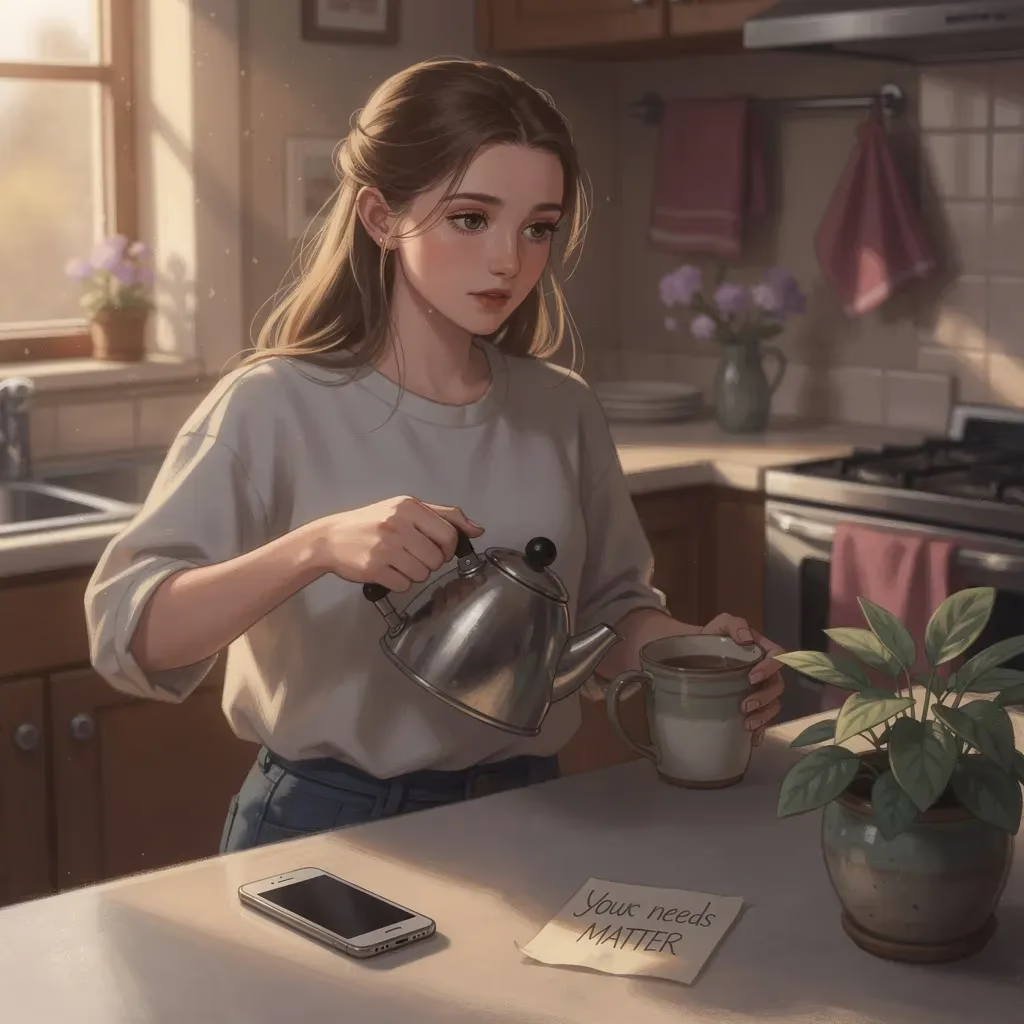
Anchor is the type that people lean on. It can feel flattering until you realize you're always the one holding the emotional weight, making the plans, smoothing the awkward moments, and being "understanding."
If you're asking "what do I look for in a guy", Anchor usually answers: "Someone stable." But here's the twist. You can accidentally attract partners who want stability without offering it back. If you're asking "what is my type", Anchor can be why you keep becoming the adult in the relationship.
Anchor energy is warm, consistent, and grounding. It also has a shadow: staying too long because you can endure a lot.
Anchor Meaning
Core understanding (2-3 paragraphs)
Anchor means you signal safety. Your energy says: "I'm loyal. I'm steady. I'm here." If you recognize yourself in this pattern, you often attract partners who crave being held by that steadiness. Sometimes they're healthy and they meet you there. Sometimes they show up because they want your structure, not because they want to build with you.
This pattern often develops when you learned to be the one who doesn't fall apart. Many women with Anchor energy were praised for being mature, helpful, and "low maintenance." You learned your value was reliability. So in dating, you can slip into caretaker mode without noticing. You call it love. Your body calls it burnout.
Your body signals are quiet but loud. Heaviness in your shoulders. That tired exhale when you see their name pop up. The numb feeling when you are having the same repair talk again. It's not that you don't love them. It's that your system is tired of being the foundation alone.
What Anchor Looks Like
- Being the steady one: You stay calm in chaos. People admire it. Inside, you might feel like you're always bracing for their next mood.
- Fixing without being asked: You solve problems quickly because you can. It looks like competence. It becomes unpaid emotional labor in relationships.
- Attracting "unfinished" partners: Messy or inconsistent partners can feel drawn to your stability. At first it feels like you're helping. Later it feels like you're parenting.
- Overfunctioning in the relationship: You plan dates, you initiate talks, you keep things moving. It looks like effort. It feels one-sided inside.
- Quiet resentment: You rarely explode. You just slowly get tired. You smile and say "it's fine" while your body feels tight and heavy.
- High tolerance for discomfort: You can endure a lot and still show up. It makes you loyal. It can also keep you in hurt longer than you need.
- Feeling guilty for wanting more: When you need care, you can feel selfish. You soften your needs so they don't feel pressured.
- Choosing "peace" that is actually distance: You avoid chaotic chemistry, which is healthy. But sometimes you settle for emotionally distant because it's not dramatic.
- Consistency as love language: You show love through showing up. When a partner doesn't match it, it hits deep.
- Struggling to ask for support: You might not even know what to ask for. You're used to handling it.
- Being the peacemaker: You smooth tension fast. It protects connection. It can also stop you from naming real issues.
- Staying through "almost": You rationalize crumbs because you're practical. You tell yourself, "He means well."
- Taking responsibility for their feelings: If they are upset, you try to fix it. It looks caring. It can become exhausting.
- Over-giving time and access: You answer, you show up, you accommodate. A healthy partner appreciates it. An unhealthy partner starts expecting it.
- Loyalty past the expiration date: You stay because you meant what you said. Your body begs for relief.
How Anchor Shows Up in Different Areas of Life
In romantic relationships: You create stability quickly. You may attract partners who feel calmer with you, but they don't always learn to be calm themselves. The healthiest match is someone who meets your steadiness with steadiness.
In friendships: You're the organizer and the listener. You might forget you're allowed to be held too, not just helpful.
At work: You're the one who catches details and saves projects. People rely on you. You can get overbooked because you don't want to let anyone down.
Under stress: You go into task mode. You make lists. You handle it. Then you crash emotionally when you're finally alone.
What Activates This Pattern
- A partner in constant crisis who expects you to stabilize everything.
- Last-minute chaos that you end up cleaning up.
- Being taken for granted, no thanks and no reciprocity.
- Doing the "relationship work" alone, talks, plans, repairs.
- They avoid responsibility and call you "too serious" for asking basics.
- You can't relax, because things fall apart if you don't manage them.
The Path Toward Feeling Held Too
- You don't have to earn love through effort: Your devotion is beautiful. It deserves reciprocity.
- Make room for mutual care: Let someone step up, or not, so you can see the truth early.
- Hold one standard out loud: "I need shared effort." You can say it calmly and still mean it.
- What becomes possible: Anchor women stop asking "what do I look for in a guy" from depletion. They start choosing from clarity.
Anchor Celebrities
- Emilia Clarke (Actress)
- Lupita Nyong'o (Actress)
- Jessica Chastain (Actress)
- Rachel McAdams (Actress)
- Amy Adams (Actress)
- Julia Roberts (Actress)
- Toni Collette (Actress)
- Kate Hudson (Actress)
- Brooke Shields (Actress/Model)
- Diane Lane (Actress)
- Diane Keaton (Actress)
- Michelle Pfeiffer (Actress)
Anchor Compatibility
| Other type | Compatibility | Why it feels that way |
|---|---|---|
| Magnet | 🙂 Works well | Anchor calms Magnet, and Magnet brings warmth, if both keep boundaries and reciprocity. |
| Fortress | 😍 Dream team | Fortress filters early while Anchor sustains long-term, a strong mix when both stay emotionally open. |
| Mirror | 😐 Mixed | Anchor can carry too much if Mirror self-silences instead of sharing needs directly. |
| Catalyst | 😕 Challenging | Catalyst wants growth and intensity; Anchor wants steadiness, and mismatched pacing can drain Anchor. |
Am I a Mirror?

Mirror is that pattern where you can read someone like a book, but you forget to read yourself. You pick up micro-shifts. You feel the vibe change before the words change. Then you adjust your whole self to keep the connection smooth.
If you're stuck on "what type of guy do I attract", Mirror often attracts partners who love being understood. The problem is they don't always return the favor. If you're asking "what is my type", Mirror can feel like: "I'm always the emotional translator."
You are not too sensitive. Your sensitivity is data, not damage. It just needs a partner who respects it.
Mirror Meaning
Core understanding (2-3 paragraphs)
Mirror means you make people feel seen. If you recognize yourself here, you bond through emotional attunement. You notice tone, timing, and energy shifts instantly. That can create deep connection. It can also create self-erasure if you keep prioritizing their comfort over your truth.
This pattern often develops when keeping the peace kept you connected. Many women with Mirror energy learned early that being tuned-in was how you stayed safe. So in dating, that turns into hinting instead of asking, waiting instead of clarifying, shrinking instead of risking conflict.
Your body remembers it as a tight throat when you want to say something real. Or that fluttery dread before you hit send on a message that might rock the boat. It's not you being dramatic. It's your body signals remembering what honesty used to cost.
What Mirror Looks Like
- Reading the room constantly: You notice micro-shifts in tone and timing. People call you intuitive, and you are. Inside, it can feel like you're always scanning for danger.
- Adapting your needs: You want one thing, then talk yourself out of it because you sense their discomfort. It looks flexible. Your body feels tense because you abandoned yourself.
- Apologizing automatically: You say sorry even when you did nothing wrong. It looks polite. Internally, it's fear of disconnection.
- Attracting emotionally self-focused partners: People who love being cared for can latch onto you. They feel good around you. You feel drained after.
- Hinting instead of asking: You drop clues and hope they'll notice. You don't want to be needy. Ambiguity grows, and ambiguity attracts non-committal energy.
- Overthinking every message: You draft texts like legal documents. You re-read punctuation. Your chest tightens while you wait.
- Mood-matching: If they are distant, you get quieter. If they are excited, you get brighter. It looks like chemistry, but sometimes it's a survival habit.
- Fear of being too much: You monitor your enthusiasm, your questions, your affection. Others see chill. Inside, you're working hard to be acceptable.
- Giving the benefit of the doubt: You can explain someone's behavior in ten compassionate ways. It looks kind. It can keep you stuck with someone who isn't showing up.
- Freezing in the moment: You know later what you wanted to say. In the moment, you soften or go quiet. You leave feeling disappointed in yourself.
- Feeling responsible for the vibe: If a date is awkward, you assume it's your fault. You become the entertainer. You go home exhausted.
- Emotional intimacy without commitment: You have deep talks with someone who won't define the relationship. It feels close. It doesn't feel safe.
- Craving reassurance but feeling ashamed: You want a simple "I like you." You tell yourself you shouldn't need it. Your body keeps asking anyway.
- People-pleasing as a reflex: You say yes quickly. You agree to keep things smooth. Later you feel resentment simmer.
- Slow self-trust: You wait for more proof, even when your gut already knows. You fear being unfair. You end up staying too long.
How Mirror Shows Up in Different Areas of Life
In romantic relationships: You tune into your partner constantly. You can become the one who makes things smooth even when you're unhappy. When a partner is inconsistent, Mirror energy gets pulled into self-doubt.
In friendships: You're the listener. People vent to you. You might struggle to ask for support without feeling guilty.
At work: You're great at teamwork because you anticipate needs. The risk is over-accommodating, then feeling unseen for the emotional effort.
Under stress: You fawn and fix the vibe. Then you crash privately, feeling empty and annoyed at yourself.
What Activates This Pattern
- Someone's tone shifts and you don't know why.
- Silence after vulnerability, you share and they go quiet.
- Ambiguous commitment that keeps you guessing.
- Being called too sensitive, even gently.
- Conflict that feels unsafe, coldness, withdrawal, sharp tone.
- Feeling like you're competing with their phone or attention elsewhere.
The Path Toward Clearer Love
- You don't have to lose softness to get respect: You can be gentle and direct at the same time.
- Say the simple sentence: "I like you, and I want consistency." It filters faster than hints.
- Let discomfort be information: If you keep feeling anxious, it matters. Your body is trying to tell you something.
- What becomes possible: Mirror women stop asking "what type of guy do I attract" in frustration. They start choosing partners who can meet them, not just receive them.
Mirror Celebrities
- Olivia Rodrigo (Singer)
- Billie Eilish (Singer)
- Saoirse Ronan (Actress)
- Alicia Vikander (Actress)
- Rooney Mara (Actress)
- Carey Mulligan (Actress)
- Emma Mackey (Actress)
- Zooey Deschanel (Actress)
- Mandy Moore (Singer/Actress)
- Alicia Silverstone (Actress)
- Molly Ringwald (Actress)
- Claire Danes (Actress)
Mirror Compatibility
| Other type | Compatibility | Why it feels that way |
|---|---|---|
| Magnet | 😕 Challenging | Both can run hot emotionally, and without directness it becomes reassurance loops and guessing. |
| Fortress | 🙂 Works well | Fortress provides structure; Mirror provides warmth, if Mirror doesn't self-silence around standards. |
| Anchor | 😐 Mixed | Anchor can hold steady, but Mirror must speak up so Anchor doesn't carry the whole emotional load. |
| Catalyst | 😐 Mixed | The growth energy is exciting, but Mirror needs consistent reassurance, not just intensity. |
Am I a Catalyst?

Catalyst energy is "I want real growth, real depth, real evolution." You don't want a relationship that stays on the surface. You want to build something. And you can attract partners who love your fire, but treat you like a season instead of a home.
If you're asking "what is my type", Catalyst shows up when you keep dating high potential people who aren't showing up consistently. Or you attract someone who loves the intensity, then gets overwhelmed when it becomes real.
The Catalyst struggle is never that you love too deeply. It's that your hope can outrun the evidence.
Catalyst Meaning
Core understanding (2-3 paragraphs)
Catalyst means your presence sparks change. You bring honesty, momentum, and a strong desire for a relationship that grows. If you recognize yourself in this pattern, you attract partners who feel inspired around you. They want your energy. Some even want your healing. But inspiration isn't the same thing as commitment.
This pattern often develops when you learned that love equals effort and improvement. Many women with Catalyst energy were rewarded for being resilient and strong. So in relationships, you can fall into a quiet belief: "If we try harder, it will work." It's loyal. It can also keep you negotiating with crumbs.
Your body remembers it as adrenaline that feels like chemistry. Your heart races. You feel alive. Then when they pull back, your whole system wants to chase connection back into place.
What Catalyst Looks Like
- High growth focus: You want progress, not stagnation. People see you as inspiring. Inside, inconsistency makes you restless and edgy.
- Attracting project partners: People mid-transition or emotionally messy can be drawn to you. You see potential. You end up doing emotional coaching.
- Direct communication: You can say the hard thing. It looks confident. It can scare off partners who prefer ambiguity.
- Intensity as connection: You bond through deep talks, big feelings, big plans. It's exciting. It can skip the slow process of verifying character.
- Trying to fix the dynamic: When things wobble, you want a talk, a plan, clarity. It can feel like leading the relationship while they coast.
- Hope overriding warning signs: You convince yourself to stay because you believe in growth. Your body feels tense, but your mind sells you the dream.
- Attracting avoidant energy: People who like being pursued can enjoy your intensity. They give enough to keep you engaged, not enough to keep you secure.
- All-or-nothing investment: When you're in, you're in. If it ends, it feels like losing a future you already built in your head.
- Struggling with slow pacing: Calm dating can feel boring at first. Your system is used to intensity. This is where the Love Pull shift happens.
- Strong standards, shaky follow-through: You know your boundaries. In the moment, you bend them because you want to believe.
- Wanting a partner with drive: You keep asking "what is my type of guy" because you want someone who matches your momentum. A mismatch resents your ambition.
- Deep loyalty: You don't quit easily. It's beautiful. It can also keep you stuck in almost for too long.
- Big-picture thinking: You see how things could be. Your body needs the present-day reality too.
- Over-explaining under pressure: When you feel distance, you go into let me clarify mode. You might talk more, not because you're needy, but because you want resolution.
- Chasing evidence after the fact: You review the timeline, the texts, the memories. You're trying to prove it's real. It's your brain trying to calm your heart.
How Catalyst Shows Up in Different Areas of Life
In romantic relationships: You want clarity and growth. You might bring up "what are we?" sooner because ambiguity feels like wasted time. When a partner can't match consistency, you can feel like you're dragging them forward.
In friendships: You're the friend who motivates. People come to you for advice. You might forget to ask for support back.
At work: You're proactive. You lead naturally. The risk is doing too much because you can, then feeling resentful when others coast.
Under stress: You problem-solve. You want to talk and decide. If a partner shuts down, it can trigger chasing and over-explaining.
What Activates This Pattern
- Inconsistency paired with promises of future change.
- Intensity without commitment, big talks then distance.
- I'm not ready while still taking your energy.
- Feeling like you're teaching them how to love you.
- Withdrawal after depth, they disappear after a real conversation.
- Potential feels louder than present-day behavior.
The Path Toward Calm Power
- You don't have to shrink ambition: The goal is a partner who matches your depth, not one you have to develop.
- Let reality lead: Consistency is the love language that keeps you safe.
- Use directness as a filter: The right guy respects clarity. The wrong guy calls it pressure.
- What becomes possible: Catalyst women often feel relief around "what is my type" and "what do I look for in a guy" because they stop chasing potential and start choosing evidence.
Catalyst Celebrities
- Anya Taylor-Joy (Actress)
- Sydney Sweeney (Actress)
- Phoebe Bridgers (Musician)
- Lady Gaga (Singer/Actress)
- Adele (Singer)
- Miley Cyrus (Singer)
- Demi Lovato (Singer/Actress)
- Blake Lively (Actress)
- Jessica Alba (Actress)
- Eva Mendes (Actress)
- Cameron Diaz (Actress)
- Meg Ryan (Actress)
Catalyst Compatibility
| Other type | Compatibility | Why it feels that way |
|---|---|---|
| Magnet | 😐 Mixed | The spark is huge, but pacing and reassurance need to be intentional so it doesn't become a chase loop. |
| Fortress | 😕 Challenging | Catalyst pushes for growth; Fortress pushes for proof. Without alignment, both feel misunderstood. |
| Anchor | 😕 Challenging | Anchor wants steady rhythm, Catalyst wants momentum, and mismatched speed can create friction. |
| Mirror | 😐 Mixed | Mirror brings depth, Catalyst brings clarity, but both must avoid over-functioning. |
If you've been stuck in the loop of "what type of guy do I attract" and "what do I look for in a guy", the issue usually isn't your standards. It's your signals. This quiz makes the signals visible. Then "what is my type" stops being a mystery and becomes a choice.
- 🔎 Discover "what is my type" by mapping your real-life dating reactions, not your ideal answers.
- 💬 Understand "what is my type of guy" by seeing how you communicate needs when you're nervous.
- 🧩 Recognize "what do I look for in a guy" versus what you accept when you want closeness fast.
- 🧯 Calm spiral moments by building emotional regulation into your dating choices.
- 🛑 Strengthen boundaries so "almost" doesn't get access to your whole heart.
- 💞 Clarify "what type of guy do I attract" so you can filter earlier, not later.
The "why now" part (without pressure)
You don't have to do anything dramatic to change your Love Pull. Clarity is enough to start shifting who approaches you and who stays. Women just like you are learning that "what type of guy do I attract" is not a curse. It's a pattern you can read.
And when you can finally answer "what is my type of guy" with confidence, you stop trying to earn the calm. Calm becomes the baseline.
Join over 236,195 women who've taken this in under 5 minutes. Your answers stay private, and your results are private results too.
FAQ
What does "Love Pull" mean (and what does it reveal about the kind of partner you attract)?
"Love Pull" is the pattern of signals you give off in dating and relationships, often without realizing it, that influences what kind of partner you attract and what kind of dynamic forms once you connect. It is not "your fault." It is your nervous system doing what it learned to do to keep you safe and loved.
If you've ever caught yourself thinking, "Why do my relationships follow the same pattern?" this is exactly what Love Pull explains. So many of us feel like we're picking different people... but somehow ending up in the same emotional movie.
Here's what Love Pull is made of:
- What you tolerate early on. Not because you're weak, but because you're hoping it will get better once they "really see you."
- What you lead with. Caretaking, humor, achievement, being chill, being endlessly understanding, being the low-maintenance girl.
- What you chase. Consistency? Intensity? Chemistry? A feeling of being chosen? A feeling of finally being safe?
- What you interpret as love. Some of us learned that love feels like effort, anxiety, earning, proving, or waiting.
Love Pull isn't just about who approaches you. It's also about who sticks around, who you feel sparks with, and who feels familiar. Familiar doesn't always mean healthy. Familiar often means "my body recognizes this."
A simple way to think about it: your Love Pull is the intersection of your needs, your boundaries, and your emotional availability. When those are out of balance, you can accidentally become the perfect match for emotionally unavailable partners, commitment-ambivalent partners, or partners who love being cared for but struggle to care back. That is why searches like "Why do I always attract emotionally unavailable people" hit so hard.
The hopeful part is this: once you can name your Love Pull, you can start choosing in a way that feels less like anxiety and more like clarity. Not overnight. Just step by step, with your dignity intact.
Why do I keep attracting the same type of partner (even when I try to choose differently)?
You keep attracting the same type of partner because "attraction" isn't only preference. It's also pattern. Your brain and body are constantly scanning for what feels recognizable, and recognizable often wins over "good for me." That is why "How to break bad dating patterns" becomes such a personal question, not a trendy one.
This happens for a few very human reasons:
1) Familiar feels like chemistry.
When you've spent years earning closeness, over-explaining, or feeling slightly unsafe in love, your body can read calm consistency as "boring" at first. Meanwhile, mixed signals can feel magnetic.
2) Your strengths can become a beacon.
If you're empathetic, thoughtful, emotionally aware, and loyal, that is beautiful. It can also pull in people who want to be understood more than they want to understand you. This is one reason some women feel like, "Am I a magnet for toxic relationships?" (You are not toxic. You're often just very giving.)
3) Early dynamics set the contract.
If you tend to over-function early (initiating plans, smoothing conflict, accepting crumbs because you don't want to seem needy), you may accidentally teach someone that they don't have to show up fully to keep you.
4) Unavailable people feel safer on a deeper level.
This part can be hard to admit, but it is common: someone who can't fully choose you can also protect you from the full vulnerability of being truly seen. If they leave, your nervous system gets to say, "See? I was right to worry." That is not because you're broken. That is because your system likes predictability.
5) You are selecting from your "comfort menu."
Even if you consciously want something new, your unconscious might still be choosing what it knows how to survive. That is why it can feel like you have a "type of guy I attract" even when your checklist changes.
A gentle micro-shift that helps right away: pay attention to the early moment when you start performing for connection. That moment is usually your Love Pull turning on.
Understanding your Love Pull makes this pattern feel less mysterious and more workable. It turns "Why does this always happen to me?" into "Oh. This is the point where I start abandoning myself."
What are signs I'm attracting emotionally unavailable people?
If you feel like you're always dating someone who is "kind of" there but never fully there, you're probably not imagining it. The signs are usually consistent, and they often show up early. This is one of the biggest reasons women search "Why do I always attract emotionally unavailable people" because it starts to feel like a curse.
Here are common signs you are attracting emotionally unavailable partners (or getting pulled into that dynamic):
- Strong start, weak follow-through. They come in hot, then get vague when consistency is required.
- You feel anxious more than loved. You spend more time decoding than enjoying.
- They avoid defining things. They say they like you, but resist labels, plans, or real commitment.
- Connection only happens on their terms. You feel chosen when it's convenient for them.
- They share just enough to keep you hooked. Deep conversations at 1 a.m., but no emotional responsibility at 1 p.m.
- You are the emotional manager. You bring up the hard stuff, you repair, you soothe, you lower your needs.
- Your needs feel like "too much." Not because you are too much, but because they are under-equipped.
- They have a "reason" they can't show up. Work stress, an ex, mental health, "I'm not ready," family stuff. Real reasons can exist. The pattern is when the reason becomes permanent.
Here's the tricky part: emotionally unavailable people are often not monsters. They can be charming, wounded, funny, even caring in bursts. That is why you can feel so confused. Your heart keeps pointing to their good moments, and your nervous system keeps bracing for the drop.
A quick reality check that helps: availability looks like consistency, not intensity. Consistency is boring to an anxious nervous system at first. Then it becomes peaceful.
If you're wondering "what type of guy do I attract," your Love Pull can explain why these partners find you, why you stay longer than you want to, and what would change the pattern without turning you into a colder person.
How do I figure out what kind of partner I attract (without overthinking every date)?
You figure out what kind of partner you attract by tracking repeated dynamics, not by psychoanalyzing every text. The clearest answer comes from patterns over time: who pursues you, what they want from you, and what role you keep getting assigned in relationships.
If you have ever typed "What kind of partner do I attract quiz" into Google at 2 a.m., it's usually because your intuition is already picking up on a pattern your mind keeps trying to rationalize.
Here are a few calm, concrete ways to figure it out:
1) Look at who feels instantly familiar.
Not who is "best on paper." Who triggers that immediate spark. Familiarity can point to old attachment wiring and old roles.
2) Track the role you slip into by week two.
Ask yourself:
- Do I become the therapist?
- The cool girl who never asks for more?
- The fixer?
- The over-giver?
- The one waiting for clarity?
Your role is a huge clue to your Love Pull.
3) Notice what you excuse early.
Do you find yourself making explanations for them?
- "He's just busy."
- "He's had a hard past."
- "He doesn't like texting."
Sometimes those things are true. The question is: does the relationship still feel emotionally safe?
4) Watch how your body feels after contact.
This is big for anxious attachment. After you hang out, do you feel grounded, or do you feel shaky and hyper-focused on whether they like you? Your body is honest.
5) Identify your "hook."
Most patterns have a hook:
- The potential.
- The intensity.
- The chase.
- The fantasy of being chosen.
- The feeling of earning love.
This is also how you get clearer on "what do I look for in a guy" versus what your nervous system is craving.
If you want a shortcut without spiraling, a quiz can be helpful because it organizes your answers into a clear picture, instead of letting your brain turn it into a thousand tiny questions.
How accurate is a "what type of partner do I attract" quiz?
A "what type of partner do I attract" quiz can be surprisingly accurate at spotting patterns, as long as it measures behaviors and relationship dynamics (not just ideal preferences). It cannot predict your future or diagnose you. It can absolutely reflect the emotional gravity you tend to create and the partners who typically respond to it.
If you're asking "How to attract better partners quiz" style questions, that usually means you've already tried willpower. The missing piece is pattern-awareness.
Accuracy mostly depends on three things:
1) The questions are about real-life behavior, not who you want to be.
The best quizzes ask about what happens when you're stressed, when you feel uncertain, when you like someone, when conflict shows up. Those moments reveal your Love Pull.
2) It focuses on dynamics, not stereotypes.
"Bad boys" and "nice guys" are too vague. What matters is: do you attract avoidant partners, dependent partners, controlling partners, emotionally immature partners, or steady partners who can handle real intimacy?
3) You answer from your lived experience (not the version of you who is trying to be chill).
So many of us answer based on who we want to be. The most accurate results come when you answer based on what you've actually done in your last few relationships.
A quiz is best used like a mirror, not a verdict. The point is to give you language for what you've felt but couldn't explain. When you can name it, you can change it. That is how you stop thinking "Why do my relationships follow the same pattern?" and start seeing the exact turning point where the pattern begins.
One more thing that matters: you might get a result that surprises you because it shows what you attract, not what you consciously want. That can feel tender. It can also be deeply freeing.
Can I change what kind of partner I attract (or am I stuck in this pattern)?
Yes, you can change what kind of partner you attract. You're not stuck. Patterns are learned, and learned patterns can be updated. The shift usually happens when your boundaries, standards, and emotional availability become clearer and steadier than your fear of being alone.
If you're searching "How to break bad dating patterns," you're already in the doorway of change. Curiosity is the start of freedom.
Here is what actually changes your Love Pull over time:
1) You stop auditioning for love.
This one is huge for anxious hearts. When you stop over-performing (being endlessly flexible, endlessly understanding, endlessly available), you naturally become less appealing to people who want convenience more than connection.
2) You raise your baseline for consistency.
Not "perfect," not "constant texting," not obsession. Just basic steadiness:
- They follow through.
- They communicate clearly.
- They repair when there's tension.
- You do not feel like you're guessing all the time.
3) You learn to tolerate the discomfort of healthy love.
Healthy can feel quiet at first. Your nervous system might say, "Where's the chase?" You are allowed to learn a new normal.
4) You practice early honesty (without over-explaining).
When you can say what you want early, you filter faster. Not in a harsh way. In a self-respecting way.
5) You grieve your old pattern.
This is the part nobody glamorizes. Sometimes we miss the intensity, even when it hurt. Grief is not regression. It's your heart letting go of what it used to mistake for love.
A tiny micro-step that matters: the next time you notice yourself trying to earn someone's attention, pause and ask, "If I did nothing extra right now, would they still choose me?" That question is clarifying in a way anxiety hates and your future self will thank you for.
Understanding your Love Pull gives you a map. You cannot change a pattern you cannot see.
Why do I feel drawn to partners who feel a little "out of reach"?
You're drawn to out-of-reach partners because your nervous system associates distance with desire and pursuit with love. That pull can feel intoxicating. It can also be exhausting. This is one of the most common roots underneath "what is my type of guy" and "what type of guy do I attract" questions.
A few deep, real reasons this happens:
1) Your brain confuses uncertainty with importance.
Intermittent reinforcement (inconsistent attention) is one of the strongest bonding mechanisms humans have. When someone is warm one day and distant the next, your mind works overtime trying to "solve" them. That effort can masquerade as love.
2) Being chosen feels like proof.
If you grew up having to work for approval (even subtly), then finally getting attention from someone unavailable can feel like winning. Not because you're shallow. Because your heart wants relief.
3) Closeness triggers fear too.
Many anxious-preoccupied women crave intimacy, but deep down fear it, because closeness means you can be fully seen and fully left. Out-of-reach partners let you stay in longing rather than risk real mutuality.
4) You have a gift for seeing the best in people.
You can sense someone's potential. You can see their softness under the armor. That is a strength. The trap is when you fall in love with who they could be, then slowly abandon who you are.
A grounded reframe: a partner being "hard to get" is not the same as a partner being valuable. Value is shown through care, consistency, and the ability to meet you emotionally.
If you want to shift this pull, the first step is not forcing yourself to like "nice boring guys." It's understanding your Love Pull so you can separate chemistry from chaos. That is when your attraction starts feeling safer.
How does knowing my Love Pull help me choose better partners in real life?
Knowing your Love Pull helps you choose better partners because it gives you a clear pattern to watch, especially in the first few weeks when your emotions are loud and your logic is tired. It turns dating from a confusing swirl into something you can actually navigate with self-respect.
This is why "How to attract better partners quiz" is not just a fun internet thing. It can be a real tool for women who are done repeating the same dynamic.
Here is how it plays out in real life:
1) You stop mistaking anxiety for intuition.
Your anxious thoughts can feel like intuition, but they usually sound urgent and catastrophic. Real intuition is quieter. When you know your Love Pull, you can tell the difference faster.
2) You recognize red flags sooner (without gaslighting yourself).
Instead of thinking "Maybe I'm being dramatic," you can name what's happening:
- inconsistency
- avoidance
- hot-and-cold behavior
- lack of repair
- emotional immaturity
3) You choose from your values, not your wounds.
This is the heart of it. When you are selecting from a wound, you chase proof. When you are selecting from values, you look for alignment.
4) You communicate more cleanly.
Not more. Cleaner. You stop over-explaining. You stop negotiating your needs into something smaller. That alone changes what kind of partner is attracted to you.
5) You feel less addicted to potential.
Potential is not partnership. Love Pull clarity helps you evaluate what is real, now, consistently, not what could be if you just tried harder.
A small practical way to use it on a date: notice what you feel compelled to do next. Do you want to chase? Prove? Perform? Or do you feel safe enough to be yourself? Your impulse is revealing.
If you're wondering "what is my type" in dating, your Love Pull is often the missing explanation. It connects your past relationships into one understandable story, so you can write a different next chapter.
What's the Research?
Why "Love Pull" Feels So Real (Even When You Hate the Pattern)
That "why do I always attract emotionally unavailable people" spiral isn't you being dramatic. It's your nervous system noticing a repeat. Across adult attachment research, scientists describe how our earliest experiences with caregivers shape "internal working models", basically the expectations your brain carries about whether closeness is safe, whether your needs will be met, and what you have to do to keep someone near you (Simply Psychology; Verywell Mind; Fraley, University of Illinois; Wikipedia: Attachment theory).
In adult dating, those expectations show up as your "love pull": who you feel chemistry with, who feels familiar, and who tends to stick around. It's not mystical. It's pattern recognition, plus emotional learning.
If you grew up having to work for attention, your body can mistake inconsistency for attraction. That isn't a character flaw. It's your attachment system doing its job a little too hard.
Attachment theory is also really clear about something that matters for your hope: attachment patterns can change across the lifespan, especially through new relationships and experiences (Simply Psychology). So your results are not a permanent label. They're a snapshot of what your system has been trained to expect.
The Science Behind "Who You Attract": Familiarity, Similarity, and Reciprocity
Attraction isn't only about looks or "having a type." Social psychology breaks interpersonal attraction into patterns we can actually track: familiarity (how often you see someone), similarity (shared values and attitudes), and reciprocity (how much they seem to like you back) (Wikipedia: Interpersonal attraction).
This explains a quiet truth: sometimes you don't attract "a type of guy." You attract whoever you're repeatedly around. Proximity and repeated exposure tend to increase liking in a lot of situations, simply because your brain processes them as safer and more predictable over time (Wikipedia: Interpersonal attraction). That matters if you keep meeting partners in the same social scenes (certain bars, friend groups, work settings, niche apps). Your environment can accidentally become your matchmaking algorithm.
Similarity matters too. In one study, participants reported more attraction to partners who were more similar, and also to partners who "aligned" their attitudes during conversation (The Journal of Social Psychology study on similarity and attitude alignment). So if you're someone who naturally adapts, smooths things over, and meets people where they are, you can unintentionally create a fast sense of "we get each other"... even when the deeper compatibility isn't there yet.
If you tend to over-attune, you can accidentally manufacture chemistry with people who haven't earned access to you yet. That doesn't mean you're fake. It means you're relationally skilled, and that skill needs protection.
How Caretaking, "Codependency," and Anxious Attachment Get Entangled
A lot of women who take a "what kind of partner do I attract quiz" are really asking: "Why do I keep ending up as the caretaker?"
The research world is careful with the word codependency, because it's not an official diagnosis and definitions vary (Psychology Today: Codependency; Wikipedia: Codependency). But even critics agree the pattern is recognizable: one person becomes the over-functioner (the fixer, the emotional manager), and the other gets used to being carried.
Community and clinical resources describe codependency as learned behavior that often shows up as self-sacrifice, fear of rejection, and losing track of where you end and someone else begins (Mental Health America: Co-Dependency; Psych Central: Signs of Codependency; HelpGuide: Codependency). And attachment research gives a parallel explanation: if your system learned that closeness is unpredictable, it makes sense you'd try to secure it by being "useful," "easy," or "the calm one" (Verywell Mind; Fraley, University of Illinois).
There is also a hard statistic that normalizes you instantly: one source focused on attachment education reports that over 32% of US adults struggle with an "attachment disturbance" pattern (The Attachment Project). You are not rare. You're not broken. You're part of a very large group of women quietly trying to love without losing themselves.
That guilt you feel for having needs is usually learned, not innate. And once you see it as a learned strategy, it becomes something you can gently unlearn.
What This Means for Your "Love Pull" Result Types (Magnet, Fortress, Anchor, Mirror, Catalyst)
So here's the bridge between research and your personal Love Pull result: science explains the big forces that shape attraction, like attachment expectations and similarity/familiarity effects (Simply Psychology; Wikipedia: Interpersonal attraction). But your result type tells you how those forces show up through you, in your energy, your boundaries, and your emotional reflexes.
In this quiz, the result types (Magnet, Fortress, Anchor, Mirror, Catalyst) are different "pull patterns," meaning the kinds of partners who tend to feel drawn to you and what dynamic you tend to co-create:
- Magnet types often pull intense, fast-bonding partners (sometimes beautiful, sometimes chaotic).
- Fortress types often attract people who want closeness but resist being truly known.
- Anchor types often draw people who want steadiness, sometimes because they feel unsteady themselves.
- Mirror types tend to attract partners who "recognize themselves" in you, which can feel like fate, but can also blur identity.
- Catalyst types often attract partners during transition points, growth spurts, breakups, reinventions.
And here's the part I want you to hold onto: attachment science was never meant to be a life sentence. It was meant to explain why your reactions make sense, and how new experiences can reshape what feels familiar and safe (Simply Psychology; Verywell Mind). You are allowed to stop choosing "familiar" and start choosing "safe."
The science tells us what's common; your report reveals what's true for you specifically, including which Love Pull type you are and the exact pattern that keeps repeating.
References
Want to go a little deeper (in a non-overwhelming way)? These are genuinely useful reads:
- Attachment theory - Wikipedia
- Attachment Theory In Psychology Explained - Simply Psychology
- What Is Attachment Theory? - Verywell Mind
- A Brief Overview of Adult Attachment Theory and Research - R. Chris Fraley
- Contributions of Attachment Theory and Research (PMC)
- Interpersonal attraction - Wikipedia
- The Power of Change: Interpersonal Attraction as a Function of Attitude Similarity and Attitude Alignment
- The Attachment Project (overview + statistics)
- Co-Dependency - Mental Health America
- Signs of Codependency - Psych Central
- Codependency: Signs of a Codependent Relationship - HelpGuide
- Codependency - Psychology Today
Books That Actually Help
If you keep circling back to the same relationship patterns and wondering why, these books give real clarity on the forces behind your Love Pull. Each one was chosen because it names the experience without shaming you for it, and because understanding your pull is the first step toward choosing love that actually holds you.
General books (good for any Love Pull Quiz)
- Attached (Amazon, Bookshop.org, AbeBooks) by Amir Levine, Rachel Heller - gives language for why certain partners feel magnetic and why others feel "boring" even when they are kind, so you can stop confusing anxiety with chemistry
- Hold Me Tight (Amazon, Bookshop.org, AbeBooks) by Sue Johnson - translates attachment science into real conversations that create safety and repair, so relationships stop feeling like tests you can fail
- Wired for Love (Amazon, Bookshop.org, AbeBooks) by Stan Tatkin - a practical bridge between "why am I drawn to this type?" and "how do we actually do love day to day?" that helps you spot what your nervous system does under stress
- Insecure in Love (Amazon, Bookshop.org, AbeBooks) by Leslie Becker-Phelps - speaks directly to the scanning, the overthinking, and the fear that love can disappear overnight, and normalizes these feelings without shaming you
- Boundaries (Amazon, Bookshop.org, AbeBooks) by Henry Cloud, John Sims Townsend - a classic for understanding how boundaries protect love rather than ruin it, so you stop attracting partners who benefit from your over-giving
- Set Boundaries, Find Peace (Amazon, Bookshop.org, AbeBooks) by Nedra Glover Tawwab - helps you name what you feel, say what you mean, and stop negotiating your needs down to keep someone close
- Getting the Love You Want (Amazon, Bookshop.org, AbeBooks) by Harville Hendrix - explains the unconscious pattern of being drawn to what feels familiar from early attachment, and why that insight is the backbone of understanding your Love Pull
- Codependent No More (Amazon, Bookshop.org, AbeBooks) by Melody Beattie - helps you see the difference between love and over-functioning, especially when you have learned that being needed equals being loved
- The New Codependency (Amazon, Bookshop.org, AbeBooks) by Melody Beattie - updates the codependency conversation for modern life, helping you spot when you are bonding through anxiety and intermittent reinforcement instead of mutual care
- The Seven Principles for Making Marriage Work (Amazon, Bookshop.org, AbeBooks) by John Gottman, Nan Silver - one of the most research-backed guides to what predicts relationship success, helping you separate intense attraction from long-term safety
- Come as You Are (Amazon, Bookshop.org, AbeBooks) by Emily Nagoski - helps all Love Pull types understand how arousal, stress, and self-acceptance connect, so desire can feel like connection, not a test you might fail
- Nonviolent Communication: A Language of Life (Amazon, Bookshop.org, AbeBooks) by Marshall B. Rosenberg - a foundational guide to expressing needs without blame and hearing others without abandoning yourself, supporting every result type in making connection feel possible
- How to Be an Adult in Relationships (Amazon, Bookshop.org, AbeBooks) by David Richo - a calming guide to what mature love looks like, helping you separate longing from compatibility and teaching the difference between being loving and abandoning yourself
- Facing Love Addiction (Amazon, Bookshop.org, AbeBooks) by Pia Mellody, Andrea Wells Miller, J. Keith Miller - helps you name when "intensity" is actually an attachment injury being activated, and separates love from compulsion
- Women Who Love Too Much (Amazon, Bookshop.org, AbeBooks) by Robin Norwood - captures the pattern of falling in love with potential and confusing intensity with intimacy, then gently redirects you back to yourself without calling you broken
For Anchor types (staying whole while loving deeply)
- Codependent No More (Amazon, Bookshop.org, AbeBooks) by Melody Beattie - helps you notice when care turns into self-erasure, and why that pattern can quietly shape who you attract, without saying you are wrong for loving deeply
- The Human Magnet Syndrome (Amazon, Bookshop.org, AbeBooks) by Ross A. Rosenberg - names the chemistry of familiar roles without making you feel stupid for it, and helps you shift from "I can heal them" to "I can choose me, too"
- Women Who Love Too Much (Amazon, Bookshop.org, AbeBooks) by Robin Norwood - helps you see that you can be compassionate without staying in a relationship that costs you your peace
- Stop Caretaking the Borderline or Narcissist (Amazon, Bookshop.org, AbeBooks) by Margalis Fjelstad - helps you recognize when a partner's volatility is turning you into a full-time emotional manager, so you can choose relationships where your steadiness is appreciated, not exploited
- The Disease to Please (Amazon, Bookshop.org, AbeBooks) by Harriet Braiker - shows you the cost of minimizing your needs to keep love "stable," and why that strategy can attract partners who take comfort but do not offer care back
- Not Nice (Amazon, Bookshop.org, AbeBooks) by Aziz Gazipura - helps loosen the grip of "I will be good, and then I will be chosen," focusing on the guilt and fear that come up when you speak honestly
- Self-Compassion (Amazon, Bookshop.org, AbeBooks) by Kristin Neff - helps you build an internal home where you feel held, so your Love Pull shifts toward partners who also know how to hold you
For Catalyst types (protecting your spark without dimming it)
- Set Boundaries, Find Peace (Amazon, Bookshop.org, AbeBooks) by Nedra Glover Tawwab - gives scripts and examples to protect your nervous system without turning you into a colder version of yourself, ideal if you fear that limits will make you "unlovable"
- Stop Caretaking the Borderline or Narcissist (Amazon, Bookshop.org, AbeBooks) by Margalis Fjelstad - helps you recognize when you are being recruited into a caretaker role where your empathy becomes a trap, with a way to step out while staying compassionate toward yourself
- Psychopath Free (Amazon, Bookshop.org, AbeBooks) by Jackson MacKenzie - supports you in trusting your instincts again after a cycle of idealization, manipulation, and self-doubt, without shaming you for caring
- Women Who Love Too Much (Amazon, Bookshop.org, AbeBooks) by Robin Norwood - helps you grieve the fantasy relationship and come back to the real you, the one who deserves consistent love now
- Running on Empty (Amazon, Bookshop.org, AbeBooks) by Jonice Webb - helps you understand the emptiness underneath over-giving, and how to build a Love Pull toward mutual emotional presence
- Adult Children of Emotionally Immature Parents (Amazon, Bookshop.org, AbeBooks) by Lindsay C. Gibson - offers a deeply relieving reframe for why you might be drawn to partners who are charming-but-avoidant, with the insight that your longing makes sense and you can choose steadier love
- Facing Codependence (Amazon, Bookshop.org, AbeBooks) by Pia Mellody, Andrea Wells Miller, J. Keith Miller - helps you see how shame and enmeshment shape who you attract, supporting you in building a self that can stay present in love without disappearing
- Self-Compassion (Amazon, Bookshop.org, AbeBooks) by Kristin Neff - interrupts the reflex to blame yourself for someone else's inconsistency, and builds the inner permission to have needs and expect care back
For Fortress types (softening the armor without losing yourself)
- The Disease to Please (Amazon, Bookshop.org, AbeBooks) by Harriet Braiker - speaks directly to the reflex to earn safety through compliance, and helps you notice how people-pleasing can accidentally attract partners who take more than they give
- Codependent No More (Amazon, Bookshop.org, AbeBooks) by Melody Beattie - addresses why you might be drawn to emotionally unavailable partners, and why you might work overtime to make it okay once you are there
- Women Who Love Too Much (Amazon, Bookshop.org, AbeBooks) by Robin Norwood - helps Fortress readers stop confusing intensity with love and start choosing steadiness
- Disarming the Narcissist (Amazon, Bookshop.org, AbeBooks) by Wendy T. Behary - teaches how to stay grounded and self-protecting without turning cold or cruel, supporting you in keeping your softness while no longer being an easy target
- No Bad Parts (Amazon, Bookshop.org, AbeBooks) by Richard Schwartz - helps you meet the inner protector that learned closeness can cost you with compassion instead of force, healing the split between "I want love" and "I must stay safe"
- Running on Empty (Amazon, Bookshop.org, AbeBooks) by Jonice Webb - helps you name what was missing emotionally so you stop recreating it in adult relationships, because you are worthy of care, not just earning it
- Not Nice (Amazon, Bookshop.org, AbeBooks) by Aziz Gazipura - helps you speak up without collapsing into guilt, shifting your Love Pull toward partners who respect clarity instead of benefiting from your silence
For Magnet types (choosing love that chooses you back)
- Women Who Love Too Much (Amazon, Bookshop.org, AbeBooks) by Robin Norwood - gently names the pattern of chasing closeness with unavailable partners, and helps you notice when devotion turns into self-erasure
- The Human Magnet Syndrome (Amazon, Bookshop.org, AbeBooks) by Ross A. Rosenberg - speaks directly to the magnetism between high-empathy people and more narcissistic traits, and helps you break the spell without shaming your big heart
- Facing Codependence (Amazon, Bookshop.org, AbeBooks) by Pia Mellody - connects your survival strategies to adult relationship choices in a way that makes your behavior make sense, and supports you in reclaiming a self that does not have to earn love
- The Anxiety and Phobia Workbook (Amazon, Bookshop.org, AbeBooks) by Edmund J. Bourne - offers practical tools to calm the nervous system so attraction is not being driven by panic, and so you can soothe yourself without needing a partner to do it for you
- Self-Compassion (Amazon, Bookshop.org, AbeBooks) by Kristin Neff - helps you replace self-criticism with a steady inner warmth so you stop confusing abandonment fear with a verdict about your worth
- Not Nice (Amazon, Bookshop.org, AbeBooks) by Aziz Gazipura - targets the guilt and fear that keep you over-agreeable, directly shifting what kind of partners you attract and tolerate
- Running on Empty (Amazon, Bookshop.org, AbeBooks) by Jonice Webb - helps you name the quiet emptiness that can lead to over-functioning or choosing partners who cannot meet you emotionally, and builds the inner permission to have needs and expect care
For Mirror types (being seen, not just needed)
- The Disease to Please (Amazon, Bookshop.org, AbeBooks) by Harriet Braiker - gently names the hidden cost of editing your needs out before you even speak, and helps you loosen the love pull toward people who take your devotion for granted
- Not Nice (Amazon, Bookshop.org, AbeBooks) by Aziz Gazipura - supports the Mirror growth edge of letting your real preferences be seen early, before attachment bonds you to someone who only likes the convenient version of you
- Codependent No More (Amazon, Bookshop.org, AbeBooks) by Melody Beattie - helps you notice when your care turns into over-responsibility with emotionally inconsistent partners, and offers a path back to yourself that still honors how deeply you love
- The Assertiveness Workbook (Amazon, Bookshop.org, AbeBooks) by Randy J. Paterson - gives you scripts and exercises for real moments like defining a relationship and asking for consistency, shifting your love pull toward partners who respond well to honest requests
- Boundary Boss (Amazon, Bookshop.org, AbeBooks) by Terri Cole - made for the pattern of attuning so well you train partners to rely on you while giving you very little in return, helping you practice being seen as a whole person
- Self-Compassion (Amazon, Bookshop.org, AbeBooks) by Kristin Neff - builds an inner place to land so your love pull is not driven by fear and self-blame, and makes you less magnetized to partners who keep you chasing reassurance
- Running on Empty (Amazon, Bookshop.org, AbeBooks) by Jonice Webb - helps you stop earning love through usefulness and start expecting love that includes your feelings, too
- Safe People (Amazon, Bookshop.org, AbeBooks) by Henry Cloud, John Townsend - helps you recognize the difference between someone who feels familiar and someone who is truly safe, which is the core shift a Mirror needs for changing her love pull
P.S.
If you've been searching "what is my type of guy" because you're tired of repeating the same ending, this is a gentle way to finally answer "what type of guy do I attract".