A gentle check-in, not a push

Motherhood Check: Do You Actually Want Children Or Just Think You Should?

Motherhood Check: Do You Actually Want Children Or Just Think You Should?
When the question "kids?" makes your chest tighten, this is a safe place to sort out what's yours... desire, dread, pressure, and your real voice underneath it all.
Do I want kids?
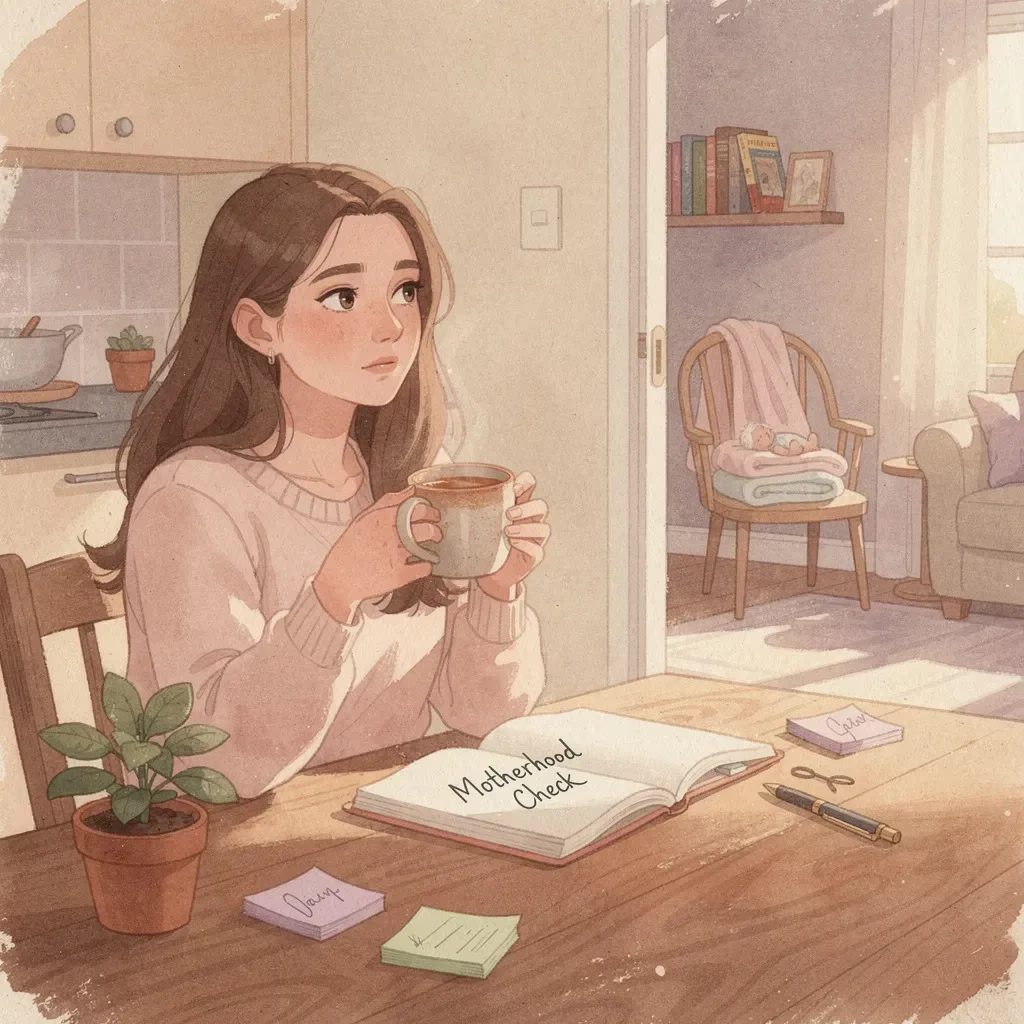
That question, "do I want kids", almost never lands like a simple yes or no. It lands like a group chat notification you don't want to open, plus the memory of every auntie, mom, coworker, and partner comment you've ever swallowed.
If you're here because you're quietly Googling "how do I know if I want kids", you're already doing something brave. You're refusing to build a whole life off a vibe, a timeline panic, or other people's expectations of what a "good woman" does next.
Motherhood Check is a gentle way to separate three things that get tangled fast:
- What you actually want
- What you're afraid of (regret, being alone, being judged)
- What you're carrying for other people (their dreams, their pressure, their disappointment)
This quiz doesn't try to talk you into motherhood. It also doesn't try to hand you a child-free identity you have to perform. It gives you language for the truth you already feel in your body.
Maternal Certainty
You have a real, steady yes inside. Even if you're nervous, your core answer stays the same.
Key traits:- You feel warmth when you picture daily parenting, not just the cute moments
- You can imagine sacrifice without feeling erased
- You want the role, not only the baby
Benefit: You stop second-guessing yourself every time someone shares a scary parenting story.
Pressured Uncertainty
Your "maybe" is loud because other people's opinions are louder than your own voice right now.
Key traits:- You feel guilt the second you lean toward "no"
- You over-explain your timeline to keep the peace
- You scan reactions, then adjust your truth
Benefit: You learn what is pressure and what is desire, so you can stop performing an answer.
Freedom Certainty
You feel clear that kids are not your path, and the hard part is the social fallout.
Key traits:- Your body softens when you picture a child-free future
- You value autonomy and quiet more than the parenting lifestyle
- You don't want to be convinced
Benefit: You get permission to stop defending your life like it's on trial.
Conflicted Explorer
You're not faking it. You're genuinely split, and you're trying to be honest.
Key traits:- Your mind can argue both sides convincingly
- You swing between longing and resistance
- You're scared of choosing wrong
Benefit: You get a map for the conflict, so "how do I know if I want kids" stops being a daily spiral.
Ready But Terrified
You want kids, but fear makes it feel like standing at the edge of a cliff.
Key traits:- You can picture the love, and you can also picture the overwhelm
- You worry you'll mess it up or lose yourself
- You crave reassurance that you're not "too sensitive" to parent
Benefit: You learn why your fear makes sense, and how to turn it into preparation (not paralysis).
Conditional Maybe
You could want kids, but only if certain conditions feel safe enough.
Key traits:- Your answer depends on partner support, money, mental load, or timing
- You fear becoming the default parent
- You're trying to negotiate a future you can survive
Benefit: You get clarity on which "conditions" are real needs vs fear-based bargaining.
A quick note, because it matters: this is one of the only quizzes that doesn't stop at "do I want kids" and call it done. It also looks at things like partner alignment, partner pressure, family pressure, judgment sensitivity, conflict avoidance, boundary strength, resource readiness, emotional capacity, and freedom values. Because that's where the truth usually hides.
6 ways your Motherhood Check result makes your decision feel lighter (and more honest)
- Discover what your "yes" or "no" feels like when nobody is watching (so "do I want kids" stops being a performance).
- Understand why "how do I know if I want kids" can feel impossible when your brain is also trying to keep everyone happy.
- Recognize the difference between real desire and that itchy pressure feeling that shows up after family dinners.
- Name the fears underneath the debate (regret, losing your identity, not being good enough) so they stop running the whole show.
- Clarify what you actually need to feel safe, supported, and resourced if you do choose motherhood.
- Feel less alone, because this is the quiet conversation happening everywhere, even if nobody says it out loud.
Karen's Story: The Question I Kept Answering For Everyone Else

The first time I said, "I don't know if I want kids," out loud, it came out like a confession. Like I was admitting I didn't know the password to a life I was supposed to be entering.
It was a Tuesday night in my kitchen, still wearing my work clothes, staring at a group chat where someone had posted an ultrasound photo with thirteen heart emojis underneath. I typed "congrats!!!" with the same reflex I use when a client tells me something heavy. My stomach did that little drop, not jealousy exactly, more like... an internal calendar page turning without asking me.
I'm 31, and I work as a nonprofit coordinator. It sounds more put together than it feels. My days are color-coded spreadsheets and donor emails and trying to make impossible goals happen with the kind of budget that makes you laugh if you don't want to cry. I'm good at being calm, good at being the steady one. I also have this habit of replaying conversations in my head like I'm editing a documentary, trying to find the moment I should have said something different.
And lately, the conversation I'm replaying most is the one I haven't even fully had yet. The one where I tell someone, anyone, the truth.
Because here's my pattern: whenever kids come up, I become whatever I think is safest in the room.
If I'm with friends who are glowing about motherhood, I nod like it's inevitable for me too. If I'm with friends who are loudly child-free, I laugh like I never even considered it. If I'm with my mom, I become vague and cheerful and change the subject before she can ask anything that makes my throat tighten.
The weird part is that I can't tell where my real feelings are in all of that.
Some nights I catch myself looking at toddlers in the grocery store, sticky hands and all, and my chest does this soft little ache. Not pain. More like a pull. A curiosity. A sweetness that scares me because I don't know what it means.
Other nights I imagine waking up for the tenth time to crying, feeling like my body isn't mine anymore, and I want to crawl out of my own skin. Not because I hate kids. Because I know what it's like to be the person who holds everything together. I'm terrified I'd disappear into it.
Then the guilt shows up, right on time. The part of me that hisses, "If you don't want it wholeheartedly, doesn't that make you selfish?" Or worse, "If you want it and then regret it, you'll ruin everything."
I started doing this thing where I'd Google the same questions over and over, but phrased slightly differently, like the internet might finally hand me a definitive answer:
"How do you know you want children?"
"What if I have a baby and hate being a mom?"
"How to decide kids or no kids."
Every article seemed to assume I was choosing between two clean, confident identities. Either you desperately want to be a mother, or you dramatically want freedom, and you post about it with a well-lit iced coffee and perfect boundaries.
My reality was messier. My reality was holding my breath in conversations, waiting to see what kind of answer would keep everyone close to me.
One night, after dinner with my partner, I stood in the bathroom brushing my teeth and watched myself in the mirror like I was checking for evidence. We had just left a friend's house where everyone kept making jokes about who would have babies next. On the drive home, my partner had said, casually, "We should talk about our timeline soon."
I smiled and said, "Yeah, totally," and my mouth went numb.
In the mirror, I could see it in my own face: the panic I swallow so quickly I barely notice I'm doing it.
I finally admitted, at least to myself, that I wasn't indecisive about children in general. I was indecisive about whether it was safe to want what I want.
That was the sentence that scared me, because it sounded like something I couldn't un-know once I said it.
A few days later, I was texting my friend Barbara, who's 35 and has always had this blunt kindness I secretly envy. I sent her a screenshot of another engagement announcement with the caption: "Why does every life update feel like a ticking clock?"
She replied almost immediately: "I took this quiz a while back when I was spiraling about the same thing. Not kidding, it helped me separate what I wanted from what I was absorbing. Want the link?"
It wasn't a dramatic recommendation. It was casual, like sending a playlist. That made it easier to click. Less like I was entering a whole identity crisis, more like I was borrowing someone else's flashlight for a second.
The quiz was called "Motherhood Check: Do You Really Want Children?" and I remember rolling my eyes a little because I thought it would be obvious, or cheesy, or pushy in one direction.
Instead, it asked questions that felt... oddly specific. Not just "Do you like kids?" but things about how I pictured my life, what I imagined losing, what I imagined gaining, what parts of motherhood I was drawn to versus what parts I feared.
Halfway through, I had to put my phone down because my heart started beating faster. Not in a fun way. In a "why does this feel like someone is reading my browser history and my diary at the same time?" way.
When I got my result, it wasn't a verdict. It was a mirror.
I landed in something that felt like Conditional Maybe, with a lot of overlap into Ready But Terrified. Which, in normal words, meant: there is a part of me that wants this, but I'm also carrying conditions and fears that aren't random.
The quiz basically pointed out something I'd never been able to say cleanly: I wasn't afraid of children. I was afraid of motherhood as a role that could swallow me, especially if I kept living the way I already live. Over-functioning. Over-apologizing. Trying to earn emotional safety by being agreeable.
It also named the pressure part. How much of my "maybe" was actually "I don't want to disappoint anyone."
I reread that line like ten times. Not because it was revolutionary. Because it was simple. And it was true.
What shifted, quietly, was that the question stopped being "Do I want kids, yes or no?" and became something more honest: "What would need to be true for this to feel like my choice?"
I didn't immediately go announce anything. I didn't dramatically reinvent my life. I just started paying attention in a different way.
Like, when my mom would send me a photo of my cousin's baby and say, "Look at those cheeks. When are you giving me one of these?" I'd usually laugh and do the classic, "Someday!"
This time I typed, "Cute. Also I'm not sure yet. I want to think about it without pressure."
My thumb hovered over send for a full minute. My chest felt tight like it does when I'm about to step into conflict. Then I sent it anyway and immediately regretted being alive.
My mom responded with: "Okay. I love you."
That was it. No lecture. No guilt trip. Just... okay.
It was such a small exchange, but it did something to my nervous system. It made me realize how often I pre-punish myself for conversations that haven't even happened.
With my partner, I approached it badly at first. I tried to bring it up in the in-between moments: while loading the dishwasher, while folding laundry, like slipping it into the air would make it less terrifying.
One night he asked, "Are you okay? You've been kind of far away."
And I did the thing I always do. I started to say, "I'm fine." I felt it rising automatically, like a button my body presses to keep peace.
But instead I said, "I'm scared to talk about kids because I don't want to say the wrong thing and ruin us."
It came out in one breath. My voice sounded small. I hated that. I hate sounding small.
He didn't fix it for me. He didn't reassure me in that over-confident way that makes me feel like my fears are silly. He just nodded and said, "Okay. Thank you for telling me that."
We sat on the couch for a while, and I could feel my own brain trying to sprint ahead: What if he leaves? What if he's secretly judging me? What if I wasted his time?
And then he said, "When you imagine having kids, what's the part that feels good? And what's the part that makes you feel trapped?"
I stared at him like he had just asked me my favorite color in a language I didn't know I spoke.
No one had asked me that like it mattered. Like my answer wasn't supposed to match a script.
So I tried. I said, "The good part is... I think I'd like building a little family with you. I like the idea of traditions. I like the idea of loving someone that much. The trapped part is... I'm scared I'll become the default parent and resent you and then hate myself for resenting you."
Even saying it out loud made me feel both awful and relieved. Awful because it sounded harsh. Relieved because it was true.
He didn't get defensive. He said, "That's a real fear. We should talk about how we'd handle that. Like practically."
That word, practically, grounded me. Not because practical fixes everything. Because it made the whole topic less mystical and more real. Like this wasn't fate. This was a life we could design.
Over the next few weeks, I started doing this slightly awkward thing where I'd write down what was actually triggering me when kids came up.
Not journaling in a pretty way. More like a messy notes app list:
- "Saw pregnancy announcement, felt behind."
- "Friend complained about daycare costs, felt terrified."
- "Held my nephew, felt warm."
- "He mentioned timeline, felt cornered."
It was data. Not a sentence. Not a final answer. Just evidence.
And the more evidence I collected, the more I could see patterns.
When I felt warm, it wasn't about cute baby outfits. It was about connection. It was about building something with someone I loved.
When I felt terrified, it wasn't about diapers. It was about losing myself. It was about being alone inside a partnership. It was about being needed in a way that never ends.
So I did something that felt almost embarrassing. I asked two moms I trust, separately, if they could tell me the truth about what surprised them most.
Not Instagram truth. Real truth.
One told me, "I love my kid more than anything. I also grieved my old life harder than I expected."
The other told me, "The hardest part wasn't the baby. It was feeling like my relationship became a logistics meeting."
I didn't feel scared hearing that. I felt calmer. Because it matched the exact fears I already had. It made me feel less dramatic, less alone.
Then, in a moment that surprised me, I noticed my answer starting to take shape. Not as a declaration, but as a direction.
I wasn't moving toward "yes" because everyone else was doing it. I was moving toward "yes, but only if we build it differently than what I've watched."
Or maybe I was moving toward "not yet, and I deserve time."
Both of those started to feel more honest than my old "sure, someday" smile.
The biggest shift was that I stopped treating my uncertainty like a character flaw. I started treating it like information.
I still have nights where I spiral. I'll see a stroller on the sidewalk and my brain will start running numbers and timelines and worst-case scenarios. Sometimes I still feel that familiar urge to shape-shift into whatever answer keeps everyone comfortable.
But now, when the panic rises, I can usually name it. "This is pressure." Or, "This is grief." Or, "This is me being scared that wanting something will cost me love."
I don't have a final answer. Not a perfect one, not a social-media-ready one.
I just have something I didn't have before: the sense that whatever I choose, it can actually belong to me.
- Karen S.,
All About Each Motherhood Check type
| Motherhood Check Type | Common names and phrases you might recognize |
|---|---|
| Maternal Certainty | "I know I want kids", "waiting for the right time", "steady yes", "I can picture the life" |
| Pressured Uncertainty | "I feel guilty either way", "I don't want to disappoint anyone", "I keep changing my mind", "I think I'm supposed to" |
| Freedom Certainty | "I want my life to be mine", "I feel relief thinking no kids", "I'm tired of defending myself", "child-free feels right" |
| Conflicted Explorer | "I can see both lives", "I keep Googling it", "split down the middle", "I want clarity, not a script" |
| Ready But Terrified | "Yes, but I'm scared", "what if I'm not cut out for this", "I want it and I'm panicking", "fearful yes" |
| Conditional Maybe | "Maybe, if...", "I need more support", "I don't want to be the default parent", "timing matters" |
Do I have Maternal Certainty?

Some people talk about wanting kids like it's a cute Pinterest board. That isn't this. Maternal Certainty is quieter than that. It's more like your body settles when you picture the real day-to-day of parenting, not just the announcement photo.
If you've been asking "do I want kids" and the answer keeps returning to yes, even after a bad night of sleep or after you watch a friend melt down in Target with a toddler, that's a specific kind of clarity. It doesn't mean you're not scared. It means the fear doesn't change the direction of your compass.
A lot of women with Maternal Certainty still Google "how do I know if I want kids" because they don't trust that it's allowed to be simple. Especially if you've spent years being the responsible one, the one who thinks through consequences, the one who doesn't want to romanticize anything.
Maternal Certainty Meaning
Core understanding
Maternal Certainty means your desire isn't coming from pressure, aesthetics, or a relationship milestone. It's coming from a real inner pull toward raising a child, building a family life, and being responsible for someone else's world for a long time. If you recognize yourself in this pattern, you don't need more proof that kids are hard. You need support for trusting that your yes is real.
This pattern often develops in women who had early experiences of caring, nurturing, or imagining family as a meaningful way to love. Sometimes you grew up in a home where caretaking was expected, and you had to sort out whether your desire is yours or a role you learned. Maternal Certainty is what remains after that sorting.
Your body remembers the difference between "I should" and "I want." For Maternal Certainty, when you picture motherhood, your shoulders tend to drop instead of rising. Your breath feels fuller. The future feels like movement forward, not like a cage closing.
What Maternal Certainty looks like
- A steady yes beneath the noise: Even when someone tells you a horror story about sleep deprivation, you don't feel talked out of it. You might feel nervous, but you don't feel turned off. It's like your mind says "that sounds hard" while your body still says "that sounds like my life."
- You picture the boring parts too: Not only first steps. Also packing lunches, pediatric appointments, messy car seats. Your friends might notice you asking practical questions, while inside you're checking, "Does this still feel like me?" and it does.
- You don't need it to be perfect: You can imagine being a beginner at this and still wanting it. You might still have perfectionist moments, but you don't require total certainty to know the direction. The internal feeling is more "I'm willing" than "I'm guaranteed."
- Emotional warmth around kids in real life: When you're around children, something in you softens. Not every minute is magical, but you feel an ease that surprises you. Other people might notice you naturally crouching down to talk to them like a person, not like a prop.
- You feel protective, not trapped: The responsibility feels heavy, but in a meaningful way. It's the difference between "this is too much for me" and "this matters, so I'll rise to it." Your chest might tighten from seriousness, not from dread.
- You can tolerate other people's opinions: When someone judges your timeline, it still annoys you, but it doesn't hijack your truth. You might still want validation, but you don't need permission. You can hear "you'll change your mind" and think "no, actually."
- You want the role, not the praise: You aren't doing this to be seen as mature or to fit in with your friend group. If anything, you sometimes worry you'll disappear socially. Your inner yes isn't fueled by applause.
- You care about your partner's capacity: Instead of fantasizing, you evaluate. You watch how your partner handles stress and mental load. Outsiders might call you "overthinking," but you're actually protecting the future.
- You feel grief when you imagine not having kids: Even if you could have a full life without children, a child-free path feels like a loss to you. Not shame, not emptiness. Real grief, like closing a door you wanted open.
- You notice your nurturing energy wants a home: You already hold space for friends, pets, siblings, coworkers. You can feel a part of you wanting that care to be directed somewhere that is truly yours. It can feel like you have love with nowhere to land.
- You don't confuse fear with a no: You can feel the fear of birth, the fear of losing freedom, the fear of not being enough, and still not interpret those fears as "therefore, I shouldn't." Your mind can hold both.
- You feel timing pressure, but it isn't the reason: Yes, you notice time. You might still spiral sometimes. But if time pressure disappeared, you would still want kids. That's the difference between desire and panic.
- You want a family culture: You think about what kind of home you want to build, what kind of emotional tone you want in your family. You notice generational patterns and you want to do it differently. That motivation feels deep, not trendy.
How Maternal Certainty shows up in different areas of life
In romantic relationships, you tend to take this seriously early. You might feel anxious bringing it up because you don't want to scare someone away, but you also don't want to lose years hoping the mismatch will magically fix itself. If your partner is aligned, you feel more secure in the relationship quickly.
In friendships, you can feel the shift when your friends are still living spontaneous lives and you're quietly thinking about future stability. You might worry you'll be left behind socially, even while you want motherhood. That mix is normal.
At work, you tend to think ahead: benefits, flexibility, career moves that create breathing room. This isn't you being boring. It's you building a life that can hold what you want.
Under stress, you might over-function. When anxiety hits, you try to plan your way to safety. The growth edge is letting support in, not carrying the entire future alone.
What activates this pattern
- When someone mocks your desire: Being told you're "basic" for wanting kids can sting more than you admit.
- When your partner gets vague: "Someday" can make your stomach drop, because you feel the stakes.
- When you see unequal parenting: Watching moms do everything can trigger fear of becoming the default parent.
- When family gets intense: Even a yes can feel polluted when other people act entitled to your body.
- When you imagine losing yourself: That flash of panic, "Will I still be me?"
- When you hear regret stories: Not as a deterrent, but as a reminder to go in with eyes open.
The path toward grounded confidence
- You don't have to rush to prove anything: Certainty isn't a deadline. It's a direction. You can move at a pace that keeps you emotionally steady.
- Turn fear into preparation, not avoidance: If you feel scared, that's information. Use it to talk about labor division, support, finances, and rest.
- Practice asking for support now: Motherhood doesn't create the people-pleasing. It amplifies it. Building help-muscles now protects you later.
- What becomes possible: Women who understand their Maternal Certainty often feel calmer in dating or partnership decisions, because they stop negotiating their future away.
Maternal Certainty Celebrities
| Name | Field |
|---|---|
| Jennifer Garner | Actress |
| Kristin Bell | Actress |
| Reese Witherspoon | Actress |
| Serena Williams | Athlete |
| Blake Lively | Actress |
| Anne Hathaway | Actress |
| Jessica Alba | Actress |
| Kate Winslet | Actress |
| Julia Roberts | Actress |
| Drew Barrymore | Host |
| Shakira | Singer |
| Victoria Beckham | Designer |
Maternal Certainty Compatibility
| Other type | Match | Why it tends to feel this way |
|---|---|---|
| Pressured Uncertainty | 😐 Mixed | Your clarity can calm her, but she may resent feeling pushed if she isn't sure yet. |
| Freedom Certainty | 😬 Difficult | This is a real life-direction mismatch that love alone usually can't erase. |
| Conflicted Explorer | 🙂 Works well | Your steadiness can help her relax, as long as you don't treat her uncertainty like a problem to fix. |
| Ready But Terrified | 😍 Dream team | You both want kids, and you can model calm while she learns to hold fear without panicking. |
| Conditional Maybe | 🙂 Works well | Your certainty helps, and her conditions can protect you both from unrealistic expectations. |
Do I have Pressured Uncertainty?

Pressured Uncertainty is that specific hell where you're not sure what you want, but you're very sure what everyone else wants. So your brain keeps trying to solve the question like it's a relationship test.
If you're stuck in "do I want kids" loops, and every time you almost land on an answer you immediately picture someone's disappointed face, this is probably your pattern. You aren't indecisive. You're trying to stay loved.
A lot of women with this result are also the ones who type "how do I know if I want kids" into Google at 1am, because daylight is full of opinions and nighttime is the only place your real feelings even get a chance to speak.
Pressured Uncertainty Meaning
Core understanding
Pressured Uncertainty means your internal voice is real, but it's not the loudest voice in the room. Your decision gets shaped by a thousand tiny moments: the joke someone made about "baby fever," your partner's casual comments, your mom's sigh, the way friends treat motherhood like the only adult storyline that counts.
This pattern often develops when you learned early that being agreeable keeps things safe. Many women with this type grew up reading moods like weather. You got good at being easy to be around. That skill makes you lovable. It also makes big life decisions feel like you're choosing between yourself and belonging.
Your body remembers the cost of disappointing people. So when the topic of kids comes up, you might feel your stomach drop, your throat tighten, your smile appear automatically. That's not you being dramatic. That's your nervous system trying to prevent a reaction.
What Pressured Uncertainty looks like
- Holding your breath for their response: You say something like "maybe someday" and then wait for micro-reactions. Your body goes still, like it's bracing for impact. People think you're "considering," but you're actually scanning for safety.
- You rehearse conversations in your head: Not because you love drama, but because you fear being misunderstood. You play out the scene where you say "I don't want kids" and someone says "you'll regret it." The rehearsal is you trying to avoid emotional ambush.
- You over-explain your timeline: You feel like you need a PowerPoint to justify your feelings. "Not now because money, career, mental health, housing..." Underneath it is the belief that a simple preference isn't allowed.
- You feel guilt before you even decide: The moment you lean "no," guilt hits. The moment you lean "yes," dread hits. That whiplash is a sign you're carrying other people's expectations in your body.
- You say what sounds acceptable: In groups, you may mirror the vibe. If everyone's excited about babies, you nod along. If everyone's complaining, you act doubtful. It's a survival skill that makes your truth hard to hear.
- You mistake pressure for desire: Sometimes you feel a rush and think it's excitement, but it's anxiety. You might feel your heart race when friends announce pregnancies, and your brain interprets it as "I want that." Later you feel flat and confused.
- You dread being the "bad guy": You worry that choosing child-free means you're selfish, or choosing kids means you're "trapping" your partner in responsibility. You're trying to keep everyone emotionally safe, including hypothetical future people.
- You feel responsible for family happiness: The grandkids conversation lands like a job assignment. You can feel the invisible contract: "You owe us this." Even if nobody says it out loud, your body acts like they did.
- You worry about abandonment: If a partner wants kids and you don't, you might feel panicked. Not because you don't know your answer, but because you know the consequences. The fear makes your clarity wobble.
- You avoid the topic until it explodes: You tell yourself you'll decide later. Then a birthday passes, or a friend announces a pregnancy, and you spiral. Avoidance isn't laziness. It's conflict avoidance protecting you from the weight of reaction.
- You feel relieved when someone else decides for you: A friend says "you'd be such a good mom" and you feel oddly soothed. That's a sign you're craving external permission. It doesn't mean it's true.
- You feel angry at yourself for not knowing: You call yourself flaky or immature. But uncertainty in this context often means you're deeply considerate. You're trying to build a life you won't resent.
- Your yes/no changes depending on who asked: With your mom it's "maybe." With your partner it's "I don't know." With close friends it's "honestly I'm leaning no." That isn't lying. It's safety calibration.
How Pressured Uncertainty shows up in different areas of life
In romantic relationships, you might try to be the "cool girl" about it. You keep things vague so you don't scare him off. Then you resent the vagueness because you're the one carrying the mental load. If you have anxious attachment tendencies, this can feel like abandonment in slow motion.
In friendships, you might feel split between friend groups: the ones deep in baby content and the ones loudly child-free. You don't want to be rejected by either side, so you stay quiet and feel lonely in both rooms.
At work or school, you may overcompensate. You chase achievement to prove you're still valuable if you don't choose motherhood. Or you fear motherhood will make you "fall behind" and you can't tell which fear is real.
Under stress, your thoughts loop. You might notice 3am ceiling-staring, replaying conversations, searching for the "right" choice that keeps everyone close.
What activates this pattern
- When someone asks casually, loudly: "So when are you having kids?" in public settings.
- When your partner says "someday": Vague timelines that hide real expectations.
- When you feel judged as selfish: Even a small comment can sting for days.
- When friends start having babies: Group dynamics shift and you feel left behind.
- When family uses guilt: "We just want grandchildren before we're too old."
- When you imagine disappointing someone: Your chest tightens before you even speak.
The path toward inner permission
- Your peace matters: Clarity doesn't come from pleasing. It comes from being safe enough to hear yourself.
- Practice small truth-telling: Not dramatic declarations. Tiny honest sentences like "I'm still figuring it out, and I don't want advice right now."
- Boundaries are kindness: The right people don't require you to disappear to stay connected.
- What becomes possible: Women who understand Pressured Uncertainty often stop asking "how do I know if I want kids" like it's a test and start treating it like a choice they get to make.
Pressured Uncertainty Celebrities
| Name | Field |
|---|---|
| Florence Pugh | Actress |
| Hailee Steinfeld | Actress |
| Emma Chamberlain | Creator |
| Lana Del Rey | Singer |
| Kendall Jenner | Model |
| Ariana Grande | Singer |
| Zoey Deutch | Actress |
| Mila Kunis | Actress |
| Megan Fox | Actress |
| Jennifer Lopez | Singer |
| Winona Ryder | Actress |
| Demi Moore | Actress |
Pressured Uncertainty Compatibility
| Other type | Match | Why it tends to feel this way |
|---|---|---|
| Maternal Certainty | 😐 Mixed | Her certainty can feel soothing or pressuring, depending on how safe you feel to be unsure. |
| Freedom Certainty | 🙂 Works well | She can normalize opting out, but only if she doesn't make your uncertainty feel "behind." |
| Conflicted Explorer | 😍 Dream team | You both value honesty and reflection, and you can feel less alone in the in-between. |
| Ready But Terrified | 😐 Mixed | Her fear can amplify your spirals, but shared vulnerability can also create closeness. |
| Conditional Maybe | 🙂 Works well | Her "conditions" give you language for needs and support, not just vague anxiety. |
Do I have Freedom Certainty?

Freedom Certainty is when the answer to "do I want kids" is a real no, and you're not confused about that part. The confusion is the social noise: the assumptions, the pity, the "you'll change your mind," the way people act like your life is a placeholder.
If you're here because "how do I know if I want kids" keeps popping up in your search history, Freedom Certainty can still be you. A lot of women with a clear no still doubt themselves because they've been trained to treat motherhood as the default setting.
This type isn't cold. It's not selfish. It's often deeply thoughtful. You just don't want the parenting life, and your body knows it.
Freedom Certainty Meaning
Core understanding
Freedom Certainty means you feel your most like yourself when you picture a life with autonomy, flexibility, and less constant caretaking. It's not that you hate kids. It's that you don't want to be a mother. If you recognize yourself in this, it's usually not a phase. It's your values speaking.
This pattern often develops when you had to grow up fast, or when you watched the women around you disappear into caretaking. Some women with Freedom Certainty were the second mom in the house. Others were the emotional support friend from age 15. So when the world says "and now become a mother," your body quietly says, "I can't do another lifetime of that."
Your body remembers what "too much" feels like. So when you imagine motherhood, you might feel your chest tighten, your shoulders creep up, your energy drain. When you imagine a child-free life, your breath expands. That's data, not damage.
What Freedom Certainty looks like
- Relief when you picture no kids: It's not a loud party feeling. It's a deep exhale. Your face relaxes. You feel space inside your day.
- You love kids in small doses, then you need quiet: You can be the fun aunt, the mentor, the friend who shows up. Then you need your life back. Others might label you inconsistent, but you're just honest about capacity.
- You fear being trapped more than missing out: When friends talk about parenthood, you notice your mind going to loss of time, sleep, identity. Not because you're dramatic. Because those losses matter to you.
- You don't want to negotiate your body: Pregnancy, birth, the bodily demands, the constant need. Even if adoption exists, the parenting role itself still doesn't fit. Your boundaries around your body feel non-negotiable.
- You get tired of defending yourself: You have a list of reasons ready because you've been asked so many times. Sometimes you wish you could just say "I don't want kids" and have it be enough.
- You build meaning elsewhere: You pour yourself into friendships, creative work, travel, caregiving roles that are chosen, not permanent. You don't feel empty. You feel alive.
- You feel protective of your partnerships: If you're with someone, you often want a relationship that has time, intimacy, and spontaneity. You might fear a baby would turn love into logistics.
- You don't romanticize motherhood: You see the emotional labor. You see the unequal division. You see the identity cost. You're not anti-mom. You're pro-truth.
- You sometimes grieve the "normal" path: Even with certainty, you might feel a pang watching friends do baby showers. Not because you want the baby. Because you want the belonging.
- You notice judgment sensitivity spikes: The comment "who will take care of you?" can hit like a slap. Your body reacts not because you're wrong, but because you're being evaluated.
- You want to be chosen for you: A partner who wants kids can feel like a threat to your security. Not because you're unstable. Because the mismatch is real.
- You hate being reduced to a timeline: People treat you like you're late to your own life. Freedom Certainty is often a refusal to live on someone else's schedule.
- You want a life with open edges: Weekends that are yours. Evenings that can be quiet. The ability to move, change, pivot. That flexibility isn't immaturity. It's your definition of a good life.
How Freedom Certainty shows up in different areas of life
In romantic relationships, you need honesty early. Not on the first date, but before it becomes serious. When you avoid the conversation, you may feel a steady undercurrent of dread, like you're building on a fault line.
In friendships, you might feel the loneliness of being "off-script." You may lose closeness when friends become moms, not because you stop loving them, but because their lives get absorbed. You need new community that doesn't require motherhood to belong.
At work, you may be ambitious or simply stable. People sometimes assume your life is "easier" because you're not parenting, and that can lead to extra expectations. Boundaries matter here too.
Under stress, the fear isn't "what if I regret not having kids." It's more often "what if I let other people decide my life through guilt."
What activates this pattern
- When someone treats your choice as selfish: That small shaming tone can light you up inside.
- When you get the pity look: Like you're missing out on "real womanhood."
- When a partner is undecided: "Maybe someday" can feel like a trapdoor.
- When family demands grandchildren: Especially when it's framed as "owed."
- When friends disappear into mom-only worlds: It triggers grief and isolation.
- When you see moms burning out: It confirms what your body already knew.
The path toward steadiness and belonging
- You're allowed to want your life: Freedom values are not a flaw you have to outgrow.
- Build a child-free vision, not only a refusal: It's easier to stay steady when your "no" comes with a rich "yes" to something else.
- Practice short boundaries: "I don't discuss my reproductive plans." No apology. No essay.
- What becomes possible: Women who embrace Freedom Certainty often stop asking "do I want kids" in fear and start building a life they actually look forward to living.
Freedom Certainty Celebrities
| Name | Field |
|---|---|
| Tracee Ellis Ross | Actress |
| Allison Janney | Actress |
| Jennifer Aniston | Actress |
| Sarah Silverman | Comedian |
| Stevie Nicks | Singer |
| Betty White | Actress |
| Helen Mirren | Actress |
| Winona Judd | Singer |
| Kim Cattrall | Actress |
| Dita Von Teese | Performer |
Freedom Certainty Compatibility
| Other type | Match | Why it tends to feel this way |
|---|---|---|
| Maternal Certainty | 😬 Difficult | This is a core values mismatch that usually becomes painful over time. |
| Pressured Uncertainty | 🙂 Works well | You can offer permission, but she needs space to find her own answer, not adopt yours. |
| Conflicted Explorer | 😐 Mixed | You may feel impatient with looping, while she may feel judged for not being clear yet. |
| Ready But Terrified | 😕 Challenging | She is moving toward motherhood, and you may feel like her fear is still a yes you don't share. |
| Conditional Maybe | 😐 Mixed | It can work if her conditions lean toward no, but if she leans yes, the mismatch returns. |
Am I a Conflicted Explorer about motherhood?

Conflicted Explorer is the type that makes you feel like you're "bad at decisions," when really you're just trying to make a life choice without lying to yourself. You can imagine the love. You can also imagine the cost. And you can't unsee either.
This is the type that Googles "how do I know if I want kids" the most, because your mind can build a convincing argument for every future. You can watch a baby giggle and feel a tug, then watch a mom look dead-eyed in a parking lot and feel your stomach flip.
If you're stuck in "do I want kids" loops, and it changes depending on the day, you're not flaky. You're exploring honestly. The goal isn't to force certainty. It's to understand the forces pulling you.
Conflicted Explorer Meaning
Core understanding
Conflicted Explorer means you are genuinely split between two valid lives. Part of you can feel the sweetness of family, belonging, legacy, tenderness. Another part of you can feel the value of freedom, quiet, selfhood, and not being responsible for someone 24/7. If you recognize yourself here, you're not missing something everyone else has. You're seeing clearly.
This pattern often develops in women who are deeply empathetic and future-minded. You've spent years thinking about the emotional cost of choices. Maybe you watched a parent struggle. Maybe you were parentified. Maybe you had a childhood where you learned to monitor other people's moods, and now you're asking, "Do I want to sign up for more caretaking?"
Your body remembers both longing and resistance. So you get mixed body signals: a softening in your chest when you picture holding your child, and a tight throat when you picture losing your evenings and your identity. The mixed signals are not a flaw. They are information.
What Conflicted Explorer looks like
- You can see both futures vividly: When someone asks, you don't get blank. You get too much. Your mind can picture school drop-offs and family dinners, and also picture travel, art, quiet mornings. It's like you're living two lives in your head.
- You swing based on what you just witnessed: A cute baby video can pull you toward yes. A friend venting about burnout can pull you toward no. Your nervous system is reacting to real data, but it can feel like emotional whiplash.
- You fear choosing wrong more than you fear choosing: You don't hate decisions. You hate irreversible regret. So the question "do I want kids" turns into "what if I'm the kind of person who regrets either choice?"
- You feel shame about uncertainty: Everyone acts like this should be obvious. You wonder what's wrong with you. Nothing is wrong. You're just not letting culture decide for you.
- You keep asking for "a sign": A dream, a moment, a partner comment. You want the universe to decide so you can't be blamed. That's not weakness. It's fear of self-betrayal.
- You try to solve it intellectually: Pros/cons lists, podcasts, Reddit threads. Then you realize it still doesn't answer the felt question. Because this decision isn't only logical. It's identity.
- You worry about identity loss: Not in an abstract way. In a sensory way. You picture no quiet. No spontaneous rest. You feel your shoulders tense.
- You also fear missing out on a deep kind of love: You worry that if you don't become a mom, you'll miss a level of connection. That fear can be genuine longing, or it can be cultural messaging. The quiz helps separate it.
- You feel pulled by belonging: You watch friends become moms and feel the social shift. Sometimes you want the baby. Sometimes you just want to stay in the circle.
- You have tenderness for mothers and also anger at the system: You can admire motherhood and also resent how unsupported moms are. That tension makes it hard to picture what motherhood would feel like for you.
- You feel protective of your future self: You don't want to sacrifice your life for a role you might resent. This isn't selfish. It's responsibility.
- You might be waiting for "more readiness": Not only money. Emotional readiness. Partner stability. Mental load fairness. Your maybe is often a request for safety.
- You fear being judged for either answer: If you choose motherhood, you fear losing your freedom identity. If you choose child-free, you fear being labeled cold or selfish. You can't win the room, so you freeze.
How Conflicted Explorer shows up in different areas of life
In romantic relationships, you may avoid committing to a partner who is very certain either way, because it forces your hand. Or you attach harder to someone uncertain because it keeps the future open. That can feel safer in the moment, and exhausting long-term.
In friendships, you might feel like you're living in between worlds. You can relate to moms emotionally, and you can relate to child-free friends values-wise. But you may feel like neither group fully sees you.
At work, you may feel the pressure of planning. You might notice yourself thinking, "If I have kids, will I have to choose between my career and my rest?" This isn't ambition. It's survival planning.
Under stress, your mind loops. You might feel 3am ceiling-staring, heart racing, because the decision feels like it will define whether you are loved, accepted, and safe.
What activates this pattern
- When someone demands certainty: "Yes or no?" as if you're ordering off a menu.
- When you see burnout up close: A friend crying in the kitchen can trigger dread.
- When you see sweetness up close: A quiet family moment can trigger longing.
- When you feel time pressure: The "deadline" vibe makes your body panic.
- When you think about repeating your childhood: "What if I become my mom?"
- When a partner is unclear: You feel like you're building on fog.
The path toward clarity (without forcing it)
- Clarity comes from separation: Desire, pressure, and fear feel similar in the body at first. Naming them is the unlock.
- Stop trying to answer forever: A next-step decision is different from a lifetime verdict. You can choose exploration without choosing motherhood yet.
- Protect your nervous system: Less debate with loud people. More honesty with yourself.
- What becomes possible: Women who understand Conflicted Explorer energy often stop asking "how do I know if I want kids" like it's a mystery and start treating it like a series of honest experiments.
Conflicted Explorer Celebrities
| Name | Field |
|---|---|
| Zendaya | Actress |
| Saoirse Ronan | Actress |
| Dakota Johnson | Actress |
| Emma Stone | Actress |
| Margot Robbie | Actress |
| Miley Cyrus | Singer |
| Kylie Jenner | Creator |
| Taylor Hill | Model |
| Natalie Portman | Actress |
| Rachel McAdams | Actress |
| Cameron Diaz | Actress |
Conflicted Explorer Compatibility
| Other type | Match | Why it tends to feel this way |
|---|---|---|
| Maternal Certainty | 🙂 Works well | Her steadiness can soothe you, as long as she respects your pace and doesn't push a decision. |
| Pressured Uncertainty | 😍 Dream team | You both need validation and space, and you can name pressure patterns together without shame. |
| Freedom Certainty | 😐 Mixed | Her clarity can feel inspiring or invalidating, depending on how tender your ambivalence is. |
| Ready But Terrified | 🙂 Works well | You share fear, and her underlying yes can help you sense whether your longing is real too. |
| Conditional Maybe | 😍 Dream team | You both think in conditions and support systems, which makes the decision feel more reality-based. |
Am I Ready But Terrified?
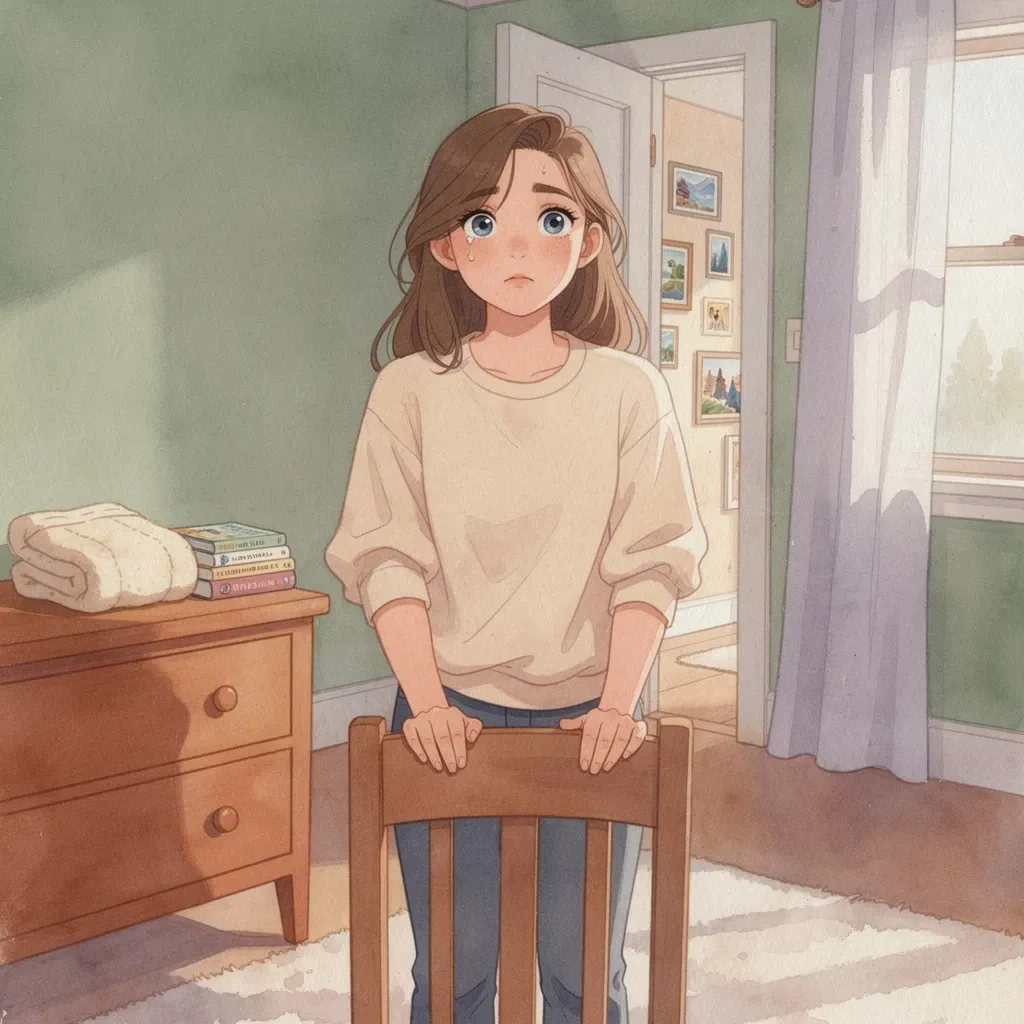
Ready But Terrified is the kind of yes that doesn't feel cute. It feels like wanting something so much it scares you. Like your heart is leaning forward and your nervous system is gripping the doorframe.
If "do I want kids" is mostly a yes for you, but your mind keeps flashing worst-case reels (burnout, messing your kid up, losing yourself, your partner changing), this is the pattern. You're not "too anxious to be a mom." You're just taking it seriously.
A lot of women in this type still search "how do I know if I want kids" because fear makes you doubt your own desire. Fear can be loud enough to mimic a no. The quiz helps you tell which is which.
Ready But Terrified Meaning
Core understanding
Ready But Terrified means you have an authentic pull toward motherhood, but your fears are also very active. You might be picturing the love and the meaning, and at the same time picturing sleep deprivation, postpartum changes, relationship strain, and the mental load of being the default parent.
This pattern often develops in women who are responsible, sensitive, and used to being the one who holds everything together. If you grew up in chaos, you may fear repeating it. If you grew up being judged, you may fear being a "bad mom" in the eyes of everyone. The terror isn't random. It's protective.
Your body remembers what it feels like to be overwhelmed. So when you imagine motherhood, you might feel your chest tighten, your jaw clench, your thoughts speed up. The key is: the fear is about cost and safety, not about lacking love.
What Ready But Terrified looks like
- Your yes shows up as intensity: You don't feel casual about it. The thought of motherhood can make you emotional fast. People might see you as "dramatic," but it's because you can feel the stakes in your body.
- You fear not being good enough: Not in a vague way. In a "what if I snap, what if I fail, what if I become resentful" way. You might picture your kid's face and feel immediate pressure to be perfect.
- You dread the identity shift: You can feel your current self, your routines, your quiet, your friendships. The idea of losing them can make your stomach drop, even while you want the child.
- You over-research: You read everything. Pregnancy, birth, parenting styles, attachment, mental load. It's your attempt to control uncertainty. Sometimes it calms you, sometimes it makes the fear bigger.
- You get triggered by motherhood content: Cute baby videos can make you cry. Burnout videos can make you feel nauseous. Your system is reacting to both longing and threat.
- You worry about your relationship: You might fear a baby will take your partner away from you emotionally. If you have anxious attachment tendencies, the idea of being less chosen can feel like abandonment.
- You fear being trapped in unequal labor: You might have watched moms do everything. The fear isn't the baby. It's becoming the default parent while everyone praises you for "handling it."
- You imagine regret in both directions: You fear regretting not having kids, and you fear regretting having them. That double fear can freeze you.
- You ask for reassurance indirectly: You might test the waters with comments like "kids seem hard" and watch how your partner reacts. You're checking: will you be safe with your truth?
- You feel guilt about fear: You think "if I wanted it, I wouldn't be scared." Not true. Wanting something big often comes with fear. Fear is not a no.
- You fear your body being out of your control: Pregnancy and birth can feel like losing agency. Even if you want a child, you may feel protective of your body.
- You have moments of calm certainty: Then you get triggered and doubt everything. Those calm moments matter. They show where your truth lives when you feel safe.
How Ready But Terrified shows up in different areas of life
In romantic relationships, you might cling harder when you feel uncertain, because closeness feels like safety. But the topic of kids can also create distance if you don't feel safe to share fear. You need a partner who can hold emotion without making it about them.
In friendships, you may compare yourself to friends who seem "so ready." You might feel behind, even if you're in your early 20s. You aren't behind. You're thoughtful.
At work, you might feel pressure to get stable quickly, to be "ready." Or you might avoid taking risks because you fear you need to prepare for motherhood. Both are signs your fear is trying to plan the future.
Under stress, your thoughts loop into worst-case scenes. You might notice your body buzzing, your shoulders tight, your sleep light. Your system is trying to keep you safe.
What activates this pattern
- When someone minimizes your fear: "You'll be fine" can feel like being unseen.
- When you see moms overwhelmed: It confirms your dread.
- When you imagine losing yourself: That identity fear hits hard.
- When your partner avoids real planning: Vague promises feel unsafe.
- When you feel judged: You fear being evaluated as a mother before you even start.
- When you think about your childhood: Old pain can surface fast.
The path toward calm preparedness
- Fear can become a plan: Instead of fighting fear, translate it. "I'm scared I'll be alone in it" becomes "I need a clear labor division and support."
- You deserve support, not toughness: Motherhood isn't a prize for the strongest. It's a role that requires a village.
- Practice staying you: Keep your identity now. Protect rest, hobbies, friendships. That becomes your motherhood foundation too.
- What becomes possible: Women who understand Ready But Terrified often stop asking "do I want kids" in panic and start preparing in ways that make the yes feel livable.
Ready But Terrified Celebrities
| Name | Field |
|---|---|
| Adele | Singer |
| Jennifer Lawrence | Actress |
| Olivia Rodrigo | Singer |
| Billie Eilish | Singer |
| Emma Roberts | Actress |
| Emma Watson | Actress |
| Lily Collins | Actress |
| Hailey Bieber | Model |
| Dua Lipa | Singer |
| Leighton Meester | Actress |
| Kirsten Dunst | Actress |
| Meg Ryan | Actress |
Ready But Terrified Compatibility
| Other type | Match | Why it tends to feel this way |
|---|---|---|
| Maternal Certainty | 😍 Dream team | Her steadiness can help your fear settle, and you share the same direction. |
| Pressured Uncertainty | 😐 Mixed | You can amplify each other's anxiety if neither of you feels safe from pressure. |
| Freedom Certainty | 😕 Challenging | You want different lives, and your fear may make you second-guess yourself around her clarity. |
| Conflicted Explorer | 🙂 Works well | She understands ambivalence, and you can help her see how fear can hide desire. |
| Conditional Maybe | 🙂 Works well | Her focus on support and conditions can make your yes feel safer and more realistic. |
Do I have a Conditional Maybe about kids?
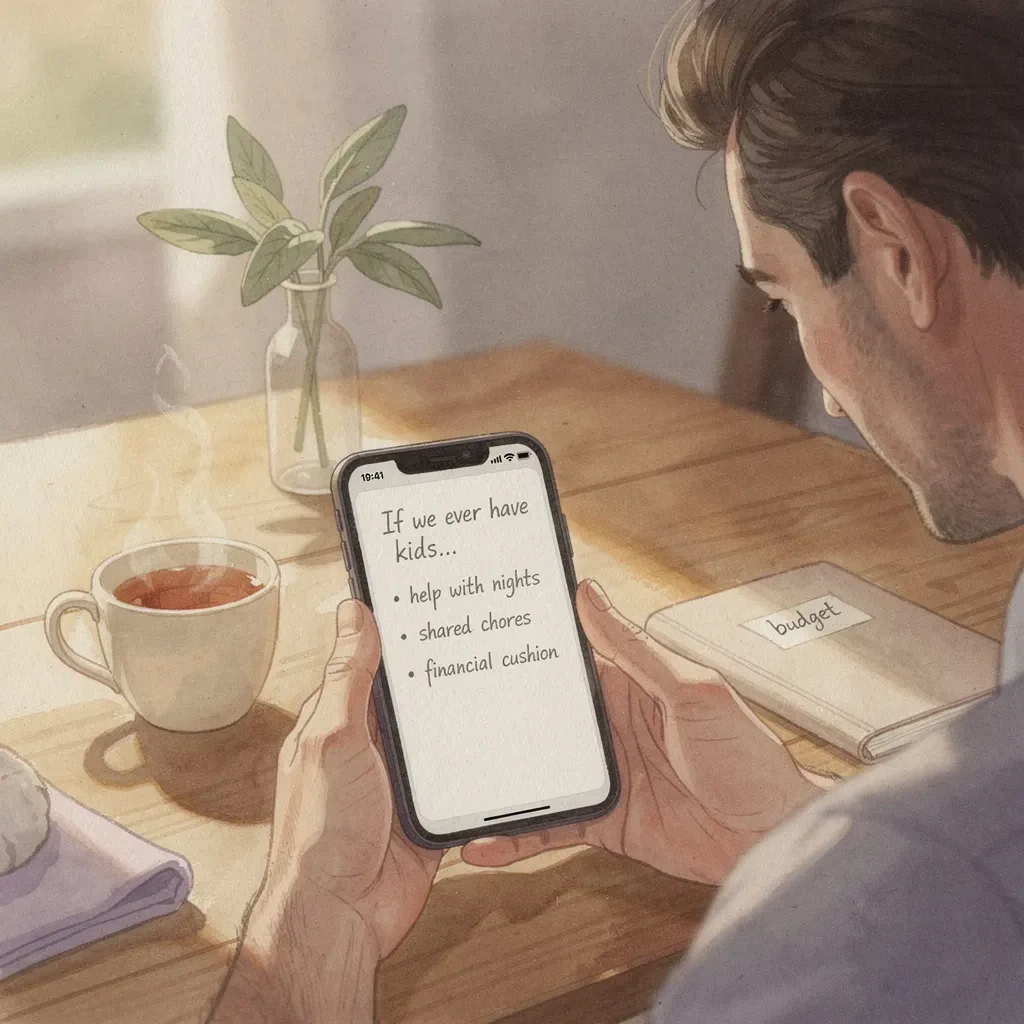
Conditional Maybe is the most relatable type for a lot of us, honestly. Because it isn't "yes" or "no." It's "I could want kids, but not like that." Not with zero support. Not with constant stress. Not with you doing everything while everyone claps for the dad.
If you're asking "do I want kids" and the real answer is "maybe, if I feel safe," this is your lane. And if you're always Googling "how do I know if I want kids," it's often because nobody taught you that conditions are allowed. Needs are allowed.
This type is not indecision. It's standards. It's self-protection. It's you refusing to sign up for a life that would break you.
Conditional Maybe Meaning
Core understanding
Conditional Maybe means your desire is present, but it isn't unconditional. You might feel some warmth around the idea of a child, but you also feel a sharp awareness of what motherhood can cost when support is low: sleep, money, identity, relationship stability, your mental and emotional energy.
This pattern often develops when you watched unequal labor up close. Maybe your mom did everything. Maybe your friends are doing everything. Maybe you've already been the emotional caretaker in relationships. So the thought of motherhood triggers a boundary: "I won't do that to myself."
Your body remembers the difference between safe workload and drowning. So when you imagine parenting with a supportive partner and fair division, your body might soften. When you imagine being the default parent, your throat tightens and your energy drops. Those are body signals, not overthinking.
What Conditional Maybe looks like
- "Maybe" that is actually a checklist: You don't want to be talked into it. You want to see the conditions. People might call you controlling. You're actually being realistic.
- You fear the mental load: Not only diapers. The planning, the remembering, the emotional labor. You can feel resentment rising in your chest just imagining being the one who notices everything.
- Partner alignment matters a lot: If your partner is supportive, you lean more open. If he's vague or entitled, you lean no. Your desire is relational and practical, not fantasy-based.
- You need practical stability: Money, housing, time, childcare. Not because you need perfection, but because you know what chronic stress does to you.
- Your emotional capacity is a real factor: Some seasons of life you feel full. Some seasons you feel on empty. Conditional Maybe women often refuse to build a child on top of burnout.
- You worry about identity loss: You want to remain you. Not only "mom." You might imagine losing hobbies, friendships, rest. That fear isn't vanity. It's self-preservation.
- You want fairness: Not "help." Real shared responsibility. You might feel anger when someone frames parenting as something you should naturally do.
- You ask "what would daily life be?": You want to see Tuesdays, not only Christmas morning. Others might find it unromantic. It's actually the best question.
- You fear regret, but you fear resentment more: Regret feels like sadness. Resentment feels like poison. You want to avoid building a life you'll secretly hate.
- You don't want to be pressured into a timeline: You want to choose from readiness, not from panic. Pressure makes you more resistant.
- You tend to bargain with yourself: "Maybe if I was older, richer, more stable." Sometimes those are real needs. Sometimes it's fear moving the goalposts. The quiz helps you tell which.
- You crave a village: You might be open to motherhood if support is real: family that helps, friends nearby, childcare options. Isolation is a dealbreaker for you.
- You can feel both grief and relief: If you decide no, you might grieve. If you decide yes, you might grieve some freedom. Conditional Maybe is often bittersweet, not simple.
How Conditional Maybe shows up in different areas of life
In romantic relationships, you might struggle to say your conditions out loud because you fear being seen as demanding. But silence is expensive. Conditional Maybe needs honest conversations about labor, money, support, and expectations.
In friendships, you might feel frustrated watching friends accept unfair dynamics, because you can see your future in theirs. You might also feel guilty for judging. It's not judgment. It's fear and boundary awareness.
At work, you may aim for stability or flexibility. You might stay in a job you don't love because it feels safer for "maybe kids someday." Or you might avoid commitment because you fear losing options.
Under stress, you can spiral into planning. Lists, budgets, scenarios. The planning is a way to feel control. The growth is learning which conditions are true needs and which are fear disguises.
What activates this pattern
- When you see unequal parenting: It triggers instant resistance.
- When a partner says "you'll handle it": That assumption can make your body go cold.
- When family pressures you: Especially when they offer opinions but not actual support.
- When you feel judged for being "picky": You might collapse into guilt.
- When money feels uncertain: Practical instability can shut down your openness.
- When you're already tired: Low emotional capacity makes motherhood feel impossible.
The path toward clean clarity
- You're allowed to have conditions: This isn't a romance novel. It's a life.
- Turn conditions into conversations: "I need shared nights" is more useful than "I'm scared."
- Stop apologizing for wanting support: The right partner hears needs as teamwork, not criticism.
- What becomes possible: Women who understand Conditional Maybe often stop asking "how do I know if I want kids" in circles and start negotiating a future that actually fits.
Conditional Maybe Celebrities
| Name | Field |
|---|---|
| Taylor Swift | Singer |
| Selena Gomez | Singer |
| Gigi Hadid | Model |
| Emma Chamberlain | Creator |
| Phoebe Dynevor | Actress |
| Maddie Ziegler | Dancer |
| Alicia Vikander | Actress |
| Emma Stone | Actress |
| Anne Hathaway | Actress |
| Gwyneth Paltrow | Actor |
| Jennifer Connelly | Actress |
| Sandra Bullock | Actress |
Conditional Maybe Compatibility
| Other type | Match | Why it tends to feel this way |
|---|---|---|
| Maternal Certainty | 🙂 Works well | Her certainty gives direction, and your conditions create healthy planning instead of fantasy. |
| Pressured Uncertainty | 🙂 Works well | You can help her separate needs from people-pleasing, as long as you don't become her decider. |
| Freedom Certainty | 😐 Mixed | You share autonomy values, but your openness can feel threatening to her clarity. |
| Conflicted Explorer | 😍 Dream team | You both think deeply and need safety to find truth without pressure. |
| Ready But Terrified | 🙂 Works well | Your practical focus can soothe her fear, making the yes feel supported and survivable. |
The real reason this feels so hard (and how Motherhood Check helps)
If you've been stuck asking "do I want kids" and "how do I know if I want kids," the problem usually isn't lack of maturity. It's too much noise around a decision that needs quiet. This quiz gives you language for what you're already feeling, so you can choose from truth instead of pressure.
What you get from your Motherhood Check result (under 5 minutes)
- 👶 Discover where your real desire lives, so "do I want kids" stops being a daily interrogation.
- 🧭 Understand how pressure shows up (partner, family, society) so you stop performing an answer.
- 🫶 Recognize fear patterns like regret fear and identity loss fear, without turning them into a verdict.
- 🧱 Honor your boundaries, especially if guilt makes you over-explain.
- 💬 Connect to words and scripts that help you talk about kids without spiraling.
- 🌿 Create a next step that fits your actual life, not an Instagram timeline.
Where you are now vs what becomes possible
| Where you are now | What becomes possible |
|---|---|
| You keep replaying "do I want kids" like a loop you can't exit. | You can name your answer for today without panicking about forever. |
| You feel pressure from family, friends, or a partner, and you can't tell what's yours. | You can separate desire from expectation, and stop carrying other people's dreams. |
| You over-explain because you fear judgment. | You can set calmer boundaries without the guilt hangover. |
| You feel scared of regretting either choice. | You can make a values-based decision and tolerate uncertainty without 3am spirals. |
| You wonder "how do I know if I want kids" and keep searching for the perfect sign. | You get a clearer compass: desire, pressure, fear, and identity, so your next step feels grounded. |
Join over 244,635 women who've taken this under 5 minutes quiz for private results. Your answers stay private, and the point is clarity, not pressure.
FAQ
How do I know if I really want children or just think I should?
You can tell by separating "desire" from "duty." When you really want children, the pull tends to feel like a grounded yes (even if it comes with fear). When you mainly think you should, it usually feels like pressure, guilt, or a constant mental debate that never lands.
If you've been googling "Do I want children or just think I should," you're not alone. So many women are quietly carrying this exact question, especially when everyone around them has opinions about what a "normal" life looks like.
Here's a helpful way to sort it out, gently:
Check your body, not just your mind.
Wanting kids often comes with warmth, curiosity, a sense of meaning, or even a soft ache. "Should" energy often feels tight: dread in your chest, a sinking feeling, irritability, or numbness.Notice what you imagine, and what you avoid imagining.
Desire usually includes some details: a child on your hip, bedtime routines, watching a tiny person become themselves. "Should" is often vague and image-free, like a concept: "a family," "the next step," "not being alone when I'm older."Ask who you're trying to keep safe.
A lot of the time, "I should have kids" is code for "I don't want to disappoint my partner/parents/society" or "I want to prove I'm lovable and grown-up." That makes perfect sense if you've spent years being the peacekeeper or the good girl.Look at your resentment levels.
Resentment is information. If the thought of kids makes you feel like your life will be taken from you, that's not a moral failure. It's your system protecting you.
A tiny truth many women discover: you can love kids and still not want to be a parent. And you can want to be a parent without feeling "ready" in a perfect, Instagram way.
If you want a structured way to explore this without spiraling, a "Motherhood decision quiz" can help you see whether you're in a season of true desire, pressure, fear, or a conditional yes.
Is it normal to not want children (or to feel unsure)?
Yes. It's completely normal to not want children, and it's also completely normal to feel unsure. Both are common, and neither makes you cold, broken, or "behind."
If you've ever typed "Is it normal to not want children" at 2 a.m. and felt that little punch of anxiety while waiting for the internet to answer... I get it. So many of us were raised with the idea that motherhood is inevitable, not optional. So when your heart doesn't follow the script, the brain tries to explain it as a problem.
A few reasons this is so normal:
For the first time in history, more women can choose.
Previous generations often didn't have real options: financially, socially, legally. Uncertainty shows up when choice becomes real.Motherhood is emotionally loaded.
It's not just a lifestyle decision. It's identity, responsibility, sacrifice, love, fear, and money. When something carries that much weight, feeling unsure is a human response.You might be responding to your actual lived experience.
If you had to parent siblings, manage adults' emotions, or be "the responsible one" early, your nervous system may associate caregiving with exhaustion. You're not selfish. You're remembering.You can be unsure for practical reasons, not personal defects.
Housing costs, childcare costs, career instability, health stuff, relationship uncertainty... it adds up. "Am I ready to have kids" isn't just an emotional question. It's a real-world one.
One more permission that matters: being child-free by choice is a legitimate life path. It's not a consolation prize. It's a real answer.
If you want support sorting your uncertainty into something clearer (without someone trying to push you toward motherhood or away from it), this quiz can help you name what you're actually feeling.
What are the signs you might want to be a mother someday?
Signs you might want to be a mother someday usually look less like constant baby fever and more like a steady, values-based pull toward nurturing, building family, and choosing responsibility with love.
This question matters because a lot of women expect wanting kids to feel like a movie scene. In real life, it can be quieter. It can even show up alongside fear, especially if you're the kind of person who takes big commitments seriously.
A few common signs that "Do I want to be a mother" might be leaning yes:
You feel meaning when you imagine the long game.
Not just pregnancy or cute moments, but raising a whole person. The thought feels heavy, but in a purposeful way.Your caretaking energy feels like a choice, not a trap.
You don't just take care of people because you can't say no. You genuinely like tending to someone, teaching, guiding, being steady.You can picture a child as a real human, not an accessory.
You're not chasing a fantasy of "a cute family." You're imagining the full range: tantrums, teen years, messy feelings, the work of showing up.You feel drawn to family rituals.
Holidays, traditions, creating a home base. Not because you're supposed to, but because it genuinely lights something up in you.You feel protective in a way that surprises you.
Sometimes a maternal instinct isn't about loving every kid you see. It's that fierce "I could be someone's safe place" feeling.You can tolerate trade-offs without disappearing.
This one is big. Wanting kids doesn't mean you want to erase yourself. It can look like, "I want this, and I want support, and I want to still be me."
Also: wanting motherhood doesn't mean you're always calm about it. "Ready but terrified" is a real place to be. It often shows up in women who would actually be thoughtful parents.
If you're craving a clearer mirror, a "Maternal desire test" style quiz can help you explore whether your pull is genuine desire, social pressure, or a conditional maybe.
Why am I unsure about having children even if I like kids?
You're unsure because liking kids and wanting the job of parenting are two different things. You can adore children and still not want the 24/7 responsibility, identity shift, and emotional labor that comes with motherhood.
If you're asking "Why am I unsure about having children," there's usually a good reason. Not a shameful reason. A real one.
Here are the most common ones I see (and they make a lot of sense):
You don't fear kids. You fear being unsupported.
Many women don't just picture a baby. They picture doing everything alone while still being expected to smile. If you've watched mothers burn out, your hesitation is wisdom, not selfishness.You're carrying invisible history.
If you were the emotional caretaker in your family, motherhood can feel like signing up to lose yourself again. Your nervous system may be saying, "Not that. Not again."You fear regret either way.
"What if I regret not having children" can haunt you. So can "What if I regret having children." When both doors feel irreversible, the brain loops.The world feels unstable.
Money, climate anxiety, political stuff, safety. Even if you want children, it can feel scary to bring a child into uncertainty.You want kids, but not the default version of motherhood.
Maybe you want parenting with real partnership, flexible work, a village, boundaries with extended family, or a later timeline. That's not being picky. That's knowing what you need to stay well.
A practical way to get clarity is to write two lists:
- "What I love about kids is..."
- "What scares me about motherhood is..."
Often, the second list isn't about kids at all. It's about support, identity, freedom, and whether you'll be allowed to be human.
If you'd like help untangling your exact mix (desire vs fear vs pressure), this "Do I really want children quiz" can organize what your mind has been carrying.
My partner wants children but I don't (or I'm not sure). What do I do?
If your partner wants children but you don't (or you're unsure), the next step is clarity before compromise. A baby isn't a middle-ground decision. It's one of those choices where both people deserve an honest yes, because the consequences are lifelong.
This is such a tender spot. Of course it is. If you're anxiously attached, this can hit the deepest fear: "If I don't want what they want, will they leave?" So many women start people-pleasing around this topic without even realizing they're doing it.
A few truths that can steady you:
Your uncertainty is valid data.
It's not a delay tactic or a character flaw. It's information about your readiness, desires, and needs.Love doesn't erase incompatibility.
Two good people can want different futures. That doesn't make either of you wrong. It makes the decision real.Pressure isn't the same as persuasion.
If you're feeling "When are you having kids pressure" from your partner or family, it can blur your own voice. Pressure often creates a false yes that turns into resentment later.
What tends to help in real conversations:
- Talk about timelines (Is this a now wish, a someday wish, or a non-negotiable wish?)
- Talk about division of labor (Who does nights, mental load, childcare planning, career trade-offs?)
- Talk about support systems (family help, finances, work flexibility)
- Talk about non-parenthood grief (If you choose child-free, what will you build instead that still feels meaningful?)
If you're not sure what you want yet, a structured tool can help you speak from clarity instead of panic. A "Should I have children test" isn't about letting the internet decide for you. It's about hearing yourself more clearly before you negotiate your future with someone else.
Am I being selfish for not wanting kids?
No. Not wanting kids is not selfish. Having kids to avoid guilt or to meet expectations is usually what creates resentment, burnout, and emotional distance later.
If you've typed "Am I too selfish to have kids" or "Am I wrong for not wanting children," you're in very familiar company. A lot of women were taught that goodness equals sacrifice. So if you don't want motherhood, your brain tries to translate that into "Something is wrong with me."
Here's a kinder, truer framework:
Selfish is taking without considering impact.
Choosing not to have children is often deeply considerate. You're thinking about your capacity, your mental health, your future, and the child's experience.Not wanting kids can be an act of integrity.
Parenting asks for consistency, patience, and emotional availability. If you don't want that life, saying no is honest.You can be nurturing without being a mother.
You can pour love into nieces, community work, teaching, mentoring, friendships, animals, art, activism, or caregiving roles that fit your nervous system. Your care isn't only valid if it becomes motherhood.Sometimes "selfish" is a mislabeled boundary.
If you've spent your life making yourself convenient, choosing a child-free life can feel "selfish" simply because it's the first time you're not handing your life over to someone else's expectations.
A practical gut-check that helps:
- If nobody had opinions... what would you choose?
- If you knew you'd be supported either way... what would you choose?
Those questions often reveal the difference between your desire and your fear of judgment.
If you want support exploring this without being shamed or pushed, a "child-free by choice quiz" style reflection can help you name what you actually want, and why.
What if I regret not having children? And what if I regret having them?
Both fears are real, and you're not dramatic for thinking about them. "What if I regret not having children" and "What if I regret having children" are two sides of the same thing: you understand this decision is irreversible in different ways, and you want to protect your future self.
A lot of people only talk about regret in one direction, usually to scare women into motherhood. That pressure doesn't create clarity. It creates panic.
A more honest way to think about regret:
Regret is often grief + lack of choice.
People feel the most regret when they didn't feel free to choose. So the goal is not "choose the option with zero regret." The goal is "choose from a place of agency."You can grieve a path and still choose correctly.
If you choose motherhood, you may grieve freedom, spontaneity, a certain kind of identity. If you choose child-free, you may grieve the experience of raising a child, certain traditions, or the feeling of being part of a cultural norm. Grief is not proof you chose wrong.Future-proofing comes from building a full life, not predicting feelings.
Whether you have kids or not, you reduce regret by building community, financial stability, meaningful work, supportive relationships, and a sense of self that doesn't disappear.
A practical exercise that helps many women:
- Write a letter from "You at 40" who chose motherhood. What did she gain? What did she lose? What does she need from you now?
- Write a letter from "You at 40" who chose child-free. What did she gain? What did she lose? What does she need from you now?
Often, one letter feels more like relief. The other feels more like performance.
If you're also feeling biological clock anxiety, this fear can get louder fast. A structured "How to know if you want kids" process can help you step out of panic and into clarity.
How accurate are "Do I want children" quizzes and motherhood decision tests?
A "Do I really want children quiz" can be accurate in a specific way: it won't predict your future, but it can reveal your current patterns, motivations, and emotional blocks with surprising clarity. Think of it less like a fortune-teller and more like a mirror.
It makes sense to ask this. If you've ever taken a random internet test and thought, "That was... not me at all," your skepticism is healthy.
Accuracy depends on a few things:
The questions have to separate pressure from desire.
Many quizzes accidentally measure how anxious you are, how much you like kids, or how traditional you are. A better "Motherhood decision quiz" asks about values, nervous system capacity, support systems, and what you imagine day-to-day.Good quizzes give you language, not a verdict.
The most helpful outcome is, "Oh. This is why I'm stuck," not "You must have kids" or "You must not."Your honesty matters more than your mood.
If you're taking the quiz right after a fight with your partner or a baby shower that made you spiral, your answers may skew. That doesn't make the results useless. It just means your feelings are loud right now.A quiz should point you toward next steps, not trap you in a label.
The best tools help you reflect: What support would you need to feel safe as a parent? What would a meaningful child-free life look like for you? What fears are actually about money, partnership, or identity?
One more reassurance: uncertainty doesn't mean you're immature. It often means you're thoughtful. A lot of women who rush into a decision are the ones who never gave themselves permission to ask the hard questions.
If you're looking for a grounded, non-shaming way to explore "Am I ready to have kids" and your real reasons underneath, this quiz is built to help you sort it out gently.
What's the Research?
Why this decision feels so emotionally loud (and why that makes sense)
That moment when someone casually asks "So... when are you having kids?" and your whole chest tightens like you just got put on the spot in front of a class. A lot of women are living inside that exact tension: wanting to feel sure, but also terrified of choosing wrong.
Across research on reproductive decision-making, one consistent theme is that this choice is rarely just "Do I want a baby?" It is also: identity, partnership, finances, health, family expectations, and the future you cannot fully predict. A qualitative study of mothers making later reproductive decisions under uncertainty found their thinking clustered around themes like future uncertainty, perceptions of risk, expectations of family life, and the impact on existing children, not just desire alone (PMC qualitative study). Research on reproductive decision-making in women with medical comorbidities also highlights how many forces can weigh in, social, familial, medical, yet people still strongly value the right to decide for themselves (BMC Pregnancy and Childbirth).
If you feel "behind" because you are not sure yet, the research basically confirms this is one of the most layered life decisions humans make. And your anxiety is not proof you are failing it. It is proof you understand the stakes.
One more thing that matters, especially if you tend to over-attune to everyone else: family systems research describes families as emotionally interconnected systems, where expectations and anxiety move through people like electricity (Bowen Center overview). So when your mom, partner, friends, or culture has feelings about motherhood, it can genuinely be hard to hear your own.
The pressure is real: pronatalism, social norms, and the "default life script"
So many of us were raised with an invisible checklist: graduate, partner, marriage, baby. Even if no one says it out loud, it shows up in little comments, algorithms, baby shower invites, and that weird guilt spike when you imagine a child-free life.
There is a name for the cultural push that treats having children as inherently "right" or socially necessary: pronatalism (also called natalism) (Cambridge Dictionary definition; Wikipedia overview). It can be personal ("I believe motherhood is the purpose") or political ("We need higher birth rates"), and it can show up as policies and messaging that subtly shrink your feeling of choice.
Recent reporting and policy analysis has raised concerns that pronatalist movements can drift into reproductive coercion or reduced autonomy, especially when governments or institutions push births without building real support for women (NWLC issue brief; Journal of Law, Medicine & Ethics abstract). That matters because it explains a super common internal conflict: "Do I want children or just think I should?"
In research on young women's reproductive decision-making, social norms can strongly shape early attitudes about pregnancy and motherhood, and agency often grows over time as women get older and more intentional about timing and whether they want children at all (PMC study on norms and agency).
If your desire feels blurry, it might not be because you are "indecisive." It might be because you have been absorbing everyone else's expectations like they are your own.
Autonomy and safety matter more than people admit (especially with partners)
This part can be hard to say plainly, but it is important: your motherhood decision is not just about wanting a child. It is also about whether you feel safe and supported in the relationship and environment you would be parenting in.
The reproductive rights framework, as summarized by the World Health Organization and discussed in overviews of reproductive rights, emphasizes the right to decide freely and responsibly, without coercion (Reproductive rights overview). That includes freedom from pressure, discrimination, and violence. In real life, coercion can be subtle, like guilt trips, "If you loved me you would," or sabotage of contraception. Overviews of reproductive coercion describe patterns like contraceptive interference and pregnancy pressure as forms of undermining autonomy, often tied to power and control dynamics (Grokipedia: Reproductive coercion).
On a softer-but-still-real level, family systems theory also explains how triangles and emotional fusion can form when tension rises, and how partners or parents can pull you into roles that are not actually yours (Psychology Today on Bowen concepts; Bowen Center overview). That is a fancy way of describing something you might already live: you can feel like you are making a decision for three people, not one.
Wanting a baby is one thing. Feeling emotionally safe enough to become a mother, with the right support, is another.
What research suggests actually helps you decide (and how your results fit)
Across reproductive decision-making research, the pattern is not "the right answer appears." The pattern is: people move from vague pressure and uncertainty into clearer agency by naming the specific forces shaping their choice. That includes health realities, financial stability, family expectations, partner alignment, and your own internal desire (or lack of it) (BMC Pregnancy and Childbirth; PMC qualitative study).
One useful lens from decision-making research is agency: who feels they get to decide, and in what areas (when, whether, and how) (ScienceDirect on reproductive decision-making agency measures). Another lens is uncertainty: researchers describe how fertility intentions and behaviors often do not perfectly match, especially when life is unstable or emotionally complicated (dissertation overview on uncertainty and reproductive health decision-making).
That is why a "Do I really want children quiz" can be helpful when it is designed well: not to tell you what to do, but to separate true desire from pressure, fear, and relationship dynamics. And it is also why "Am I ready to have kids" is not a single question. It is a cluster of questions.
This is where the six patterns in your motherhood check become useful language, not labels:
- Maternal Certainty: your desire is internally steady, even if logistics are still real.
- Pressured Uncertainty: the noise outside you is louder than the truth inside you.
- Freedom Certainty: you feel clear about being child-free, and want to own it without guilt.
- Conflicted Explorer: you can see both lives, and you are not ready to shut either door yet.
- Ready But Terrified: you want it, and fear is still taking up a lot of space.
- Conditional Maybe: your desire depends on specific conditions (partner, finances, support, timing).
The science tells us what is common across women making this choice. Your report shows which of these patterns is driving your feelings, and what your specific mix of desire, fear, and pressure looks like.
References
Want to go a little deeper? Here are the sources I leaned on (all worth a skim if you like receipts with your reassurance):
- Reproductive decision making: interviews with mothers of children with undiagnosed developmental delay (PMC)
- Reproductive decision making in women with medical comorbidities: a qualitative study (BMC Pregnancy and Childbirth)
- Developing and testing measures of reproductive decision-making agency in Nepal (ScienceDirect)
- Reproductive decision-making under uncertainty: exploring the relationship of economic preferences and reproductive health (eScholarship)
- Exploring young women's reproductive decision-making, agency and social norms in South African informal settlements (PMC)
- Reproductive rights (Wikipedia)
- Pronatalism / Natalism overview (Wikipedia)
- Pronatalism definition (Cambridge Dictionary)
- The Rise and Fall and Rise of Pronatalism (PubMed)
- Baby Bonuses and Motherhood Medals: Why We Shouldn't Trust the Pronatalist Movement (National Women's Law Center)
- Introduction to the Eight Concepts (Bowen Center for the Study of the Family)
- Understanding Bowen Family Systems Theory (Psychology Today)
- Reproductive coercion (Grokipedia)
Recommended reading (when you want deeper clarity, not louder opinions)
If Motherhood Check made you feel seen, these books are the next gentle step. They don't shove you toward yes or no. They help you hear yourself, especially if "how do I know if I want kids" has become your most visited thought.
General books (good for any Motherhood Check type)
- The Baby Decision (Amazon, Bookshop.org, AbeBooks) by Merle Bombardieri - Practical frameworks for navigating the decision to have children with less panic and more clarity.
- Regretting Motherhood (Amazon, Bookshop.org, AbeBooks) by Orna Donath - Expands the conversation beyond the socially acceptable version of motherhood, so you can choose with eyes open.
- All Joy and No Fun (Amazon, Bookshop.org, AbeBooks) by Jennifer Senior - A realistic, unsentimental look at what modern parenting actually feels like day to day.
- Selfish, Shallow, and Self-Absorbed (Amazon, Bookshop.org, AbeBooks) by Meghan Daum - Thoughtful essays that validate child-free lives and reduce shame around not following the default script.
- Childfree by Choice (Amazon, Bookshop.org, AbeBooks) by Amy Blackstone - A research-backed exploration of child-free lives, meaning, and community beyond the stereotypes.
- Of Woman Born by Adrienne Rich - Separates motherhood as a personal experience from motherhood as a social institution (huge for sorting desire vs pressure). (AbeBooks: https://www.abebooks.com/servlet/SearchResults?kn=Of%20Woman%20Born+Adrienne%20Rich)
- Motherhood (Amazon, Bookshop.org, AbeBooks) by Sheila Heti - A deeply internal, literary meditation on the experience of deciding whether to become a mother.
- Like a Mother (Amazon, Bookshop.org, AbeBooks) by Angela Garbes - Brings bodily honesty and real science to pregnancy and early motherhood without the sanitized story.
- Bringing Up Bebe: One American Mother Discovers the Wisdom of French Parenting (Amazon, Bookshop.org, AbeBooks) by Pamela Druckerman - This widely read cultural comparison challenges the idea that "good mothers" must be exhausted martyrs.
For Pressured Uncertainty types (so you stop performing an answer)
- Set Boundaries, Find Peace (Amazon, Bookshop.org, AbeBooks) by Nedra Glover Tawwab - Scripts and structure for saying no without spiraling afterward.
- The Disease to Please (Amazon, Bookshop.org, AbeBooks) by Harriet B. Braiker - Helps untangle approval-seeking so motherhood isn't a peace-keeping strategy.
- Codependent No More (Amazon, Bookshop.org, AbeBooks) by Melody Beattie - For the "I manage everyone's feelings" pattern that makes big choices feel impossible.
- Self-Compassion (Amazon, Bookshop.org, AbeBooks) by Kristin Neff - Softens the inner courtroom voice so uncertainty doesn't turn into self-hate.
- Nonviolent Communication (Amazon, Bookshop.org, AbeBooks) by Marshall B. Rosenberg - Helps you speak honestly without turning it into a war or a guilt spiral.
For Conflicted Explorer types (for "how do I know if I want kids" spirals)
- The Disease to Please (Amazon, Bookshop.org, AbeBooks) by Harriet B. Braiker - If your uncertainty is partly about being the easiest to love.
- Set Boundaries, Find Peace (Amazon, Bookshop.org, AbeBooks) by Nedra Glover Tawwab - Builds the skill of disappointing people safely, which is required for any honest choice.
- When the Body Says No (Amazon, Bookshop.org, AbeBooks) by Gabor Mate - If your conflict shows up as tight chest, stomach drops, insomnia, and chronic self-abandonment.
- Essentialism (Amazon, Bookshop.org, AbeBooks) by Greg McKeown - Helps you practice clean tradeoffs when choosing one life feels like betraying the other.
For Freedom Certainty types (so you can stay steady when others disagree)
- Set Boundaries, Find Peace (Amazon, Bookshop.org, AbeBooks) by Nedra Glover Tawwab - Keeps your "no" from being negotiated away by guilt.
- Too Good to Leave, Too Bad to Stay (Amazon, Bookshop.org, AbeBooks) by Mira Kirshenbaum - If a partner mismatch is the real pressure point.
- Design Your Life (Amazon, Bookshop.org, AbeBooks) by Bill Burnett and Dave Evans - Turns freedom into a plan you can trust, not a void you have to defend.
- Women Without Kids (Amazon, Bookshop.org, AbeBooks) by Ruby Warrington - For belonging and language when you're off-script.
For Ready But Terrified types (so fear becomes preparation)
- The Gifts of Imperfection (Amazon, Bookshop.org, AbeBooks) by Brene Brown - Softens perfectionism so fear doesn't run your motherhood story.
- Fair Play (Amazon, Bookshop.org, AbeBooks) by Eve Rodsky - A concrete system to test whether partnership labor will actually be fair.
- How Not to Hate Your Husband After Kids (Amazon, Bookshop.org, AbeBooks) by Jancee Dunn - Turns vague dread into specific protective conversations.
For Conditional Maybe types (to clarify your non-negotiables)
- Fair Play (Amazon, Bookshop.org, AbeBooks) by Eve Rodsky - Helps you name "I don't want to be the default parent" in a concrete, testable way.
- Burnout (Amazon, Bookshop.org, AbeBooks) by Emily Nagoski and Amelia Nagoski - If your maybe is connected to exhaustion and low bandwidth, this gives language and tools.
- Attached (Amazon, Bookshop.org, AbeBooks) by Amir Levine - Useful if your decision gets tangled with fear of losing a partner.
P.S.
If you're still stuck on "how do I know if I want kids," you deserve a clearer answer than anxiety, pressure, and one more late-night scroll.