Your Feminine Aura Is Already Speaking
Feminine Aura: Why You Keep Shape-Shifting For Love (And What You Actually Radiate)

Feminine Aura: Why You Keep Shape-Shifting For Love (And What You Actually Radiate)
If you've ever felt your chest tighten while waiting for a reply, this helps you name your feminine aura... and stop shrinking to be chosen.
What feminine energy do I radiate?
That feeling you bring into a room? The one you can't fully explain, but you can feel it in how others lean in, relax, or get a little intimidated? That's your feminine aura.
And if you're here because you're quietly Googling what is feminine energy at 1am, it usually isn't because you're bored. It's because you're tired of feeling like you have to be "easy to love" to be kept.
This Feminine Energy Archetype quiz free page is here to name what you already know in your bones: you radiate something real. You just might be leaking it when you start shape-shifting for approval.
This quiz sorts your Feminine Aura into one of five archetypes:
Nurturer
- Definition: Your feminine aura feels like safety and soft landing.
- Key traits: caring instinct, emotional warmth, loyalty.
- Benefit: You learn to give love without disappearing inside it.
Mystic
- Definition: Your feminine aura feels like depth, intuition, and "she sees things."
- Key traits: inner knowing, symbolism, emotional insight.
- Benefit: You learn to trust yourself, so you stop outsourcing certainty.
Creator
- Definition: Your feminine aura feels like sparkle, beauty, and inspiration.
- Key traits: imagination, play, self-expression.
- Benefit: You learn to create from desire, not validation.
Warrior
- Definition: Your feminine aura feels like truth, backbone, and clean boundaries.
- Key traits: directness, protection, self-respect.
- Benefit: You learn to stay soft without being available for disrespect.
Lover
- Definition: Your feminine aura feels like presence, intimacy, and magnetic warmth.
- Key traits: sensual aliveness, devotion, emotional openness.
- Benefit: You learn to be close without clinging or performing.
If you're wondering what is divine feminine energy, here's the grounded version: it isn't a costume. It's the part of you that knows how to feel, receive, create, protect, and connect without betraying yourself.
Also, this quiz is built to be more than "pick a vibe." It's one of the only quizzes that also maps the quiet stuff that changes your aura day-to-day:
- Authenticity (are you being you, or being "likable"?)
- Boundaries (do you protect your energy or overgive?)
- Assertiveness (can you say what you mean without apologizing?)
- External validation (do you need permission to feel okay?)
- Sensuality (are you in your body, or stuck in your head?)
- Emotional regulation (can you come back to center after a trigger?)
- Self-worth (do you feel deserving, or always proving?)
- Emotional openness (can you be seen without panic?)
- Sensitivity (do you pick up everything in the room?)
- Self-compassion (is your inner voice kind, or brutal?)
If you came here looking for how to tap into feminine energy, you're in the right place. Your results will show you the easiest doorway back to yourself.
6 ways knowing your Feminine Aura changes everything (without you becoming a different person)
- Discover why your care turns into overgiving, and how to keep your feminine aura bright (not depleted).
- Understand what is feminine energy in your real life, not on social media, so you stop copying someone else's "soft girl" script.
- Recognize how to tap into feminine energy when you're triggered, especially in the dread before a text back.
- Embrace how to embrace feminine energy without losing your voice, even when you want closeness more than anything.
- Learn how to radiate feminine energy in a way that feels grounded, so you stop feeling "too much" and start feeling steady.
- Name what is divine feminine energy for you, specifically, so you can build relationships that fit your actual heart.
Jennifer's Story: The Night I Stopped Performing "Fine"

My thumb hovered over "send" for so long my screen dimmed. Again. A three-line text that said nothing wrong, nothing dramatic, nothing that should require a committee meeting in my brain... and yet I was rewriting it like it was going to be entered into evidence.
It was one of those nights where the apartment is quiet, but my body isn't. Christopher had been "busy today" and I couldn't tell if that meant actually busy or emotionally gone. I hated that I couldn't tell. I hated more that I cared this much.
I'm Jennifer, 33, and I work as a mental health technician. Which is hilarious, in a bleak kind of way, because I can sit with someone else's panic like it's a weather pattern. "Okay. It's here. It's loud. It'll pass." Then I go home and get haunted by a punctuation mark.
I have this habit where I reread text messages too many times before I send them. Not for typos. For vibes. For "does this sound like I'm asking for too much?" For "does this sound like I'm annoying?" For "does this sound like I'm about to get left?"
The weird thing is, if you met me, you probably wouldn't clock any of this. I'm the calm one. The steady one. The one who remembers birthdays and notices when someone's voice sounds a little thinner than usual. The one who checks in. The one who can make a room feel softer.
But that softness has a cost when it's built on scanning.
Because the truth is, I've spent years trying to be the kind of feminine that feels safe for other people. Not the kind that feels true for me.
I learned how to carry warmth like a tray: balanced, careful, never spilled. I learned how to ask questions so I didn't have to take up too much space with answers. I learned how to be comforting, agreeable, low-maintenance. I learned how to be "easy to love," which, in my experience, mostly meant "easy to forget about."
And in dating, it always looked the same from the outside. I would meet someone and feel that spark. Not even fireworks, just that quiet click like, oh, there you are. Then I'd start doing what I do best: managing the connection.
If he took longer to respond, I'd act cooler. If he seemed stressed, I'd become soothing. If he was distant, I'd get smaller so I wouldn't make it worse. And I'd tell myself I was being mature. Understanding. Flexible.
Meanwhile, I'd be lying in bed doing mental math like an unpaid accountant for intimacy.
How many texts did I send today? Did I double-text? Was my last message too affectionate? Did I ask a question that requires effort? Did I use too many exclamation points and now I look like a golden retriever in human form? Should I wait until tomorrow? Would tomorrow be too late? What if he's already annoyed?
I could feel myself shape-shifting in real time and still couldn't stop.
It wasn't even that Christopher was cruel. That's what made it harder. He was nice. Funny. Twenty-two and very good at being charming in the moment and vague in between moments. Which meant my nervous system had a full-time job.
One night, after I'd rewritten a simple "Hope your day went okay" about seventeen times, I finally admitted something to myself that I usually avoid because it sounds embarrassing.
I wasn't asking for too much. I was asking for it from someone who couldn't hold it.
The next morning at work, between rounds, I ended up reading this self-help article someone had posted in a group chat. It was one of those pieces that starts innocently and then, ten lines in, you're sitting there like: oh. That's my exact personal brand of suffering.
It talked about how some of us confuse feminine energy with being endlessly accommodating. How we think radiance is something we earn by being pleasant, pretty, helpful, calm. How we forget that real feminine aura isn't performance. It's presence.
There was a link in the middle: "Feminine Aura: What Feminine Energy Radiate Within You".
I almost didn't click. Not because I thought it was dumb, but because I was tired. Tired of trying to fix myself with another article. Tired of being told to "love myself" in ways that felt like homework. Tired of thinking I was one breakthrough away from finally becoming a person who doesn't care so much.
But I clicked anyway, sitting in my car on my lunch break, AC blasting, my badge still on, my phone smudged with fingerprints.
The questions were... annoyingly accurate. Not in a spooky way. More like someone was naming the things I do that I pretend are normal.
How I react when I'm not getting reassurance.How I handle attention.Whether I feel safer giving or receiving.Whether I soften myself to keep closeness.Whether I mistake intensity for intimacy.Whether I glow more when I'm expressing or when I'm protecting.
I finished it fast, like ripping off a bandage. Then my results came up and I actually laughed out loud. Not because it was funny. Because it was like getting caught, gently.
I got "Nurturer" as my feminine aura.
And at first, I felt that immediate flinch of shame. Like, of course. Of course I'm the one whose whole vibe is taking care of everyone. Of course my aura is basically "free emotional labor with a side of lip gloss."
But then I kept reading.
It wasn't calling me naive. It wasn't saying I was weak. It was describing this specific kind of feminine energy that radiates safety and warmth, and how it can become a trap when it's used to secure love instead of share it.
It basically put words to something I'd never said out loud: I don't just care. I manage. I over-function. I soothe preemptively. I anticipate needs so I don't have to risk asking for mine.
And the part that hit hardest was this line about how Nurturer energy can start to dim when you're pouring from a place of fear. Like you're trying to keep people close by being indispensable.
That landed in my chest in a way I didn't love.
Because I could see it. I could see myself acting like a candle, trying to burn brighter so nobody leaves the room. I could see how my "feminine aura" wasn't something I was embodying. It was something I was performing as insurance.
That night, I didn't do a dramatic life overhaul. I didn't block Christopher. I didn't have a perfectly articulated conversation. I didn't start meditating at dawn with a silk robe floating behind me in the breeze.
I did something way less impressive.
I stopped editing myself for ten minutes.
Christopher texted, "Hey sorry, crazy day. You good?"
Usually I'd respond with something like, "Totally! No worries :) hope you're okay!" which is code for: I am not good, but I would rather eat glass than risk you thinking I'm difficult.
Instead I stared at the message, felt the heat in my face, and typed: "I missed you today. I'm glad you're okay."
Then I sat there like an idiot, phone in my hand, heart thumping, waiting for the punishment.
He replied a minute later: "Aw. I missed you too. Can I call you in a bit?"
I did not float into the heavens. I did not become a healed goddess. I did, however, feel something unfamiliar: my body relaxed without me earning it.
And here's where it got interesting. The next few weeks, I started watching my own energy the way I watch my patients: not judging it, just tracking it.
I noticed how my Nurturer aura came alive when I was choosing it. Like when I made soup for Stephanie, my friend, after she got dumped. That felt good. Full. Clean.
I also noticed how it went sour when I was using it to keep someone. Like when I offered to rearrange my schedule to see Christopher even though I was exhausted. Like when I apologized for asking a normal question. Like when I kept my needs vague so I wouldn't look "too much."
So I tried this messy little experiment.
When I felt that urge to over-give, I would wait. Not forever. Not as a punishment. Just long enough to see what was underneath it. Usually it was fear.
Fear that if I wasn't useful, I'd be optional.Fear that if I asked for something clear, I'd get a clear no.Fear that my softness would be treated like a nuisance instead of a gift.
One Friday, Christopher suggested hanging out. I was coming off a long shift and my whole body felt like it was buzzing. Old me would have said yes and then secretly resented him for not magically reading that I needed rest.
This time I texted, "I want to see you, but I'm wiped. Can we do tomorrow morning instead?"
I stared at the message afterward like it was a live grenade.
He took a while to respond. My brain did what it does: sprinted. I paced. I opened the fridge and stared like there was going to be an answer next to the ketchup. I drafted a follow-up that started with "Sorry, ignore that, I can make tonight work" because apparently my reflex is to erase myself the second there's silence.
But I didn't send it.
He replied: "Yeah tomorrow works. Wanna do coffee?"
And I swear to God, my first thought was, Oh. So I can be a person. And the world doesn't end.
Coffee the next day was normal. We talked. He teased me about my order. I teased him about his. At one point, he reached across the table and squeezed my hand like it was the easiest thing in the world.
The shift wasn't that he suddenly became a different partner. The shift was that I was showing up less like a service and more like a human.
I kept rereading my quiz results, too. Not obsessively, but like a reminder. My feminine aura, my feminine energy, isn't a job. It's a signal.
When I'm radiant, I feel warm without being drained. I feel open without being exposed. I feel generous without keeping score. I feel soft and still solid.
When I'm dim, I start bargaining for closeness. I start over-explaining. I start giving what I hope will be returned instead of stating what I need.
There's one moment I think about a lot.
I was at work, sitting with a patient who was spiraling. They kept apologizing. Over and over. For crying. For taking up time. For being "a lot." It was like watching my own inner monologue walk around outside my body.
I said, "You don't have to apologize for needing care."
And then I went to the bathroom after and just stood there, staring at myself in the mirror, because I realized how rarely I say that to me.
I don't have this fully figured out. I still get that tight feeling when someone takes too long to text back. I still want to smooth things over before there's even a problem. I still sometimes confuse being needed with being safe.
But now, when I think about my feminine aura, I don't picture a performance. I picture a steadier glow. Something that's mine. Something I can feel in my own body before anyone else confirms it.
And that changes the way I move through everything, even on the days I slide backward.
- Jennifer M.,
All About Each Feminine Aura Type
| Feminine Aura Type | Common names and phrases you might relate to |
|---|---|
| Nurturer | "The safe one", "the mom friend", "the healer vibe", "I always take care of it" |
| Mystic | "I just know", "the intuitive one", "deep feeler", "private but intense" |
| Creator | "The muse friend", "ideas at 2am", "aesthetic brain", "I need beauty to breathe" |
| Warrior | "Don't play with me", "soft but firm", "truth teller", "my no is sacred" |
| Lover | "Magnetic", "all-in heart", "presence you can feel", "I crave real intimacy" |
What this Feminine Aura quiz reveals about you
You know when you're trying to explain yourself to someone and suddenly you're talking too fast, over-clarifying, adding ten little disclaimers so they don't misunderstand you? That isn't "you being crazy." It's your feminine aura trying to stay safe.
This quiz gives you language for the five big currents that shape what you radiate, plus the subtle "flavor notes" that make your aura feel uniquely you.
Here are the dimensions it reads, in human language:
- Emotional depth (how intensely you feel): This is how big your feelings run, and how much you let them exist without minimizing them. It's the difference between "I'm fine" and "I can tell I'm hurting and I don't have to pretend." Real-life sign: the 3am ceiling-staring when one text shifts your whole mood.
- Intuition (how much you trust your inner knowing): This is whether you trust your gut, or you need three friends and a TikTok tarot reading to make a decision. Real-life sign: your stomach drops when something feels off, but you talk yourself out of it anyway.
- Nurturing (how you care for others): This is your instinct to create emotional safety. Real-life sign: you automatically manage everyone else's comfort at dinner, then leave feeling empty.
- Creative flow (how naturally you make beauty and meaning): This is how you turn life into art, softness, fun, or vision. Real-life sign: you feel more like yourself after making something, even if it's tiny.
- Relational harmony (how much you orient toward connection): This is your pull toward closeness and peace. Real-life sign: you smooth things over before you even ask what you need.
And then the "personalization layer" that makes this a real Feminine Aura map:
- Authenticity: Do you show up as you, or do you become who you think will be chosen?
- Boundaries: Can you say no without guilt body-sweats?
- Assertiveness: Can you name needs without apologizing 12 times?
- External validation: Does approval feel like oxygen?
- Sensuality: Can you feel your body, or do you float above it when you're stressed?
- Emotional regulation: How fast can you come back to yourself after a wobble?
- Self-worth: Do you feel worthy now, or only after you "earn it"?
- Emotional openness: Can you be seen without panicking and over-performing?
- Sensitivity: Do you pick up micro-shifts like a human lie detector?
- Self-compassion: Is your inner voice a friend, or a judge?
If you're searching what is feminine energy, this is the answer in practice: it's the emotional tone you bring, the boundaries you hold, and the way you receive love without bargaining for it.
Where you'll see this play out
In romantic relationships: This is where your feminine aura gets loud. It's in the waiting. The tiny pauses. The way your chest tightens when a reply is "k" instead of a sentence. It's also in how you try to be "low maintenance" while quietly craving reassurance. If you've been looking up how to embrace feminine energy, this is the real version: being able to ask for closeness without collapsing into fear if you don't get it instantly.
In friendships: You know that pattern where you're everyone's therapist, everyone's calendar, everyone's emotional support, but you have a hard time asking someone to show up for you? That's nurturing and harmony without enough boundaries. It's not your fault. So many of us learned that being "easy" is safer than being honest. Learning how to tap into feminine energy here often looks like letting yourself receive, not only give.
At work or school: Feminine energy isn't just candles and dresses. It's also your presence in meetings, your relationship to feedback, and whether you keep volunteering to "help" because you're afraid of being disliked. If you want to know how to radiate feminine energy professionally, it often starts with self-worth: you don't have to earn respect by over-functioning.
In daily decisions: What you eat, what you wear, who you text back, whether you rest. If you keep Googling what is divine feminine energy, your nervous system might be begging for the simplest answer: your body wants honesty. You're allowed to choose what feels like a yes, even when it's inconvenient for someone else.
What most people get wrong
Myth: "Feminine energy means being soft all the time." Reality: Softness without boundaries turns into self-erasure. Real feminine aura includes protection.
Myth: "If I'm anxious, my aura is bad." Reality: Anxiety is often your sensitivity doing its job, scanning for safety. Your sensitivity is data, not damage.
Myth: "What is feminine energy is just aesthetics." Reality: Your aura is more about your inner steadiness than your outfit. People feel your self-trust.
Myth: "What is divine feminine energy means never being 'needy'." Reality: Having needs is not a character flaw. The right people welcome your needs.
Myth: "If I learn how to embrace feminine energy, I'll never be triggered." Reality: Triggers still happen. The win is coming back to yourself faster, with less self-blame.
Myth: "How to radiate feminine energy means being desirable." Reality: Radiance isn't performance. It's presence. It's being here, in your body, not auditioning.
How we built this quiz (and why it feels so accurate)
This quiz isn't trying to diagnose you or put you in a box. It's a mirror for patterns you already live with.
- It uses real scenarios, like waiting for a text, sensing a tone shift, being the peacekeeper, or feeling your spark dim when you overgive.
- It separates your core aura (Nurturer, Mystic, Creator, Warrior, Lover) from your current coping style (like people-pleasing, over-explaining, or going numb).
- It checks for the difference between "you when you're safe" and "you when you're bracing."
So when you ask how to tap into feminine energy, the answer isn't "be more feminine." It's: stop abandoning yourself in small ways. Your aura comes back online.
What changes after you get your results
Women who take this quiz usually say some version of: "I finally have words for it." Not because the quiz gave them an identity. Because it gave them permission.
You get to understand what is feminine energy for you. You get to see what is divine feminine energy without the pressure to be perfect. And you get a clearer path for how to embrace feminine energy in a way that doesn't cost you your peace.
Am I a Nurturer?
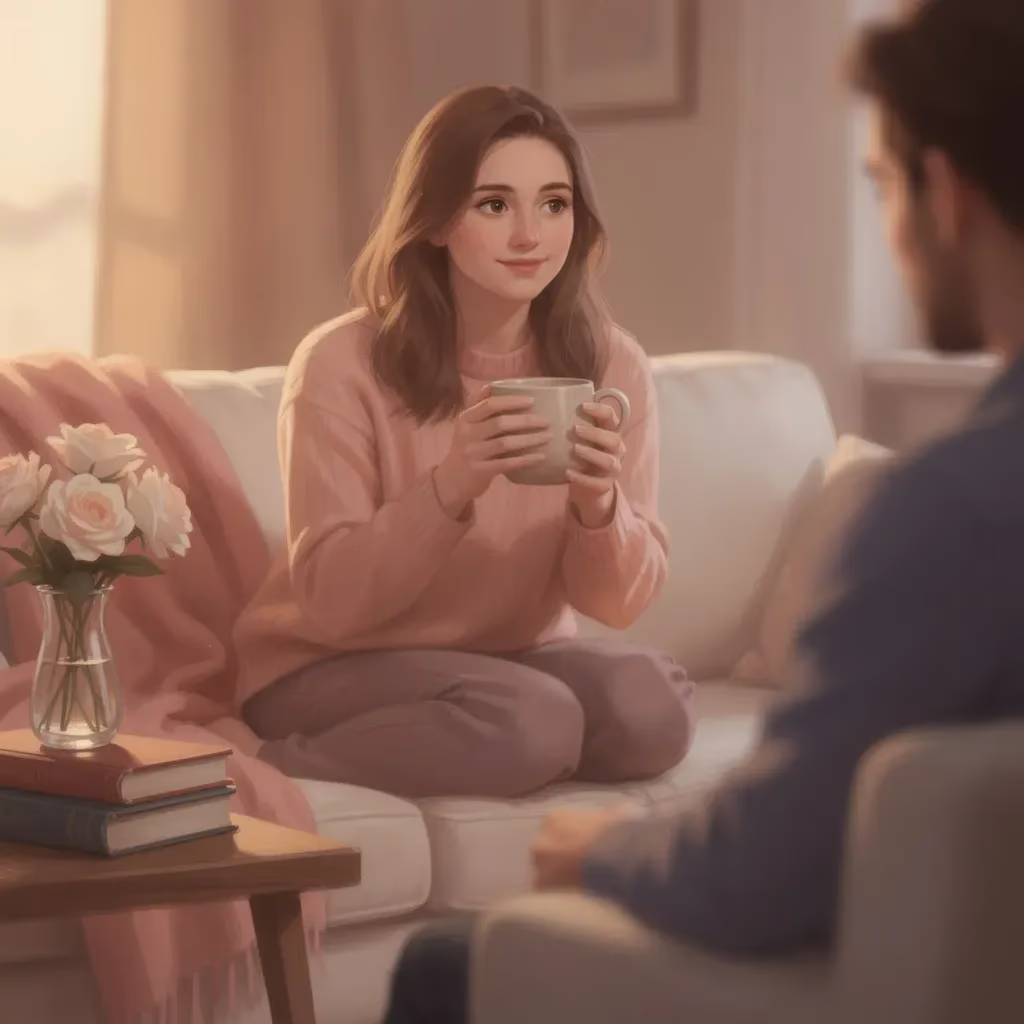
If you've ever been told "you're so easy to talk to" and it landed like a compliment and a burden at the same time, welcome. Your feminine aura might be Nurturer.
This is the type that makes people exhale. It's the energy that says, "I can hold you." The tricky part is you can end up holding everybody, and then wonder why your own chest feels tight at night.
If you're trying to understand what is feminine energy, Nurturer energy is one of the clearest answers: warmth that feels like home. If you want to learn how to embrace feminine energy without burning out, you'll want to see what the Nurturer looks like when she's safe vs. when she's chasing love.
Nurturer Meaning
Core understanding
Nurturer doesn't mean you exist to take care of everyone. It means your presence naturally organizes a room around safety. If you recognize yourself in this pattern, you probably do emotional labor without realizing it, like you're scanning faces, tracking vibes, and quietly adjusting yourself to keep closeness.
This pattern often develops when being "helpful" was the fastest way to earn love or avoid conflict. Many women with Nurturer energy learned early that being needed felt safer than being known. So you became steady, capable, the one who remembers birthdays and notices when someone goes quiet.
Your body remembers this too. That familiar feeling of your shoulders creeping up when tension rises. The way your stomach flips when someone is disappointed, even if you did nothing wrong. Your feminine aura stays bright when your care is a choice, not a reflex.
What Nurturer Looks Like
- Being everyone's safe place: You can feel when someone is off before they say a word. Others see kindness. Inside, you feel pressure to make it better, fast, because discomfort feels like danger.
- Overgiving before being asked: You offer help immediately, even when you're tired. People think you're generous. You might feel a quiet resentment later and then hate yourself for it.
- Apologizing for existing: "Sorry, quick question" is your default. You appear polite and considerate. Inside, you're bracing for rejection like your needs are a problem.
- The peacekeeper reflex: When conflict shows up, you smooth it over with humor or caretaking. Others see maturity. You feel a buzzing urgency to restore closeness at any cost.
- Love as a job you do well: You keep track of what makes people comfortable. You look thoughtful and attentive. Internally, you might be thinking, "If I do this right, they'll stay."
- Feeling responsible for moods: If someone is distant, you assume you caused it. You might double-text or over-explain. Your chest tightens because silence feels loud.
- Quietly craving reassurance: You give reassurance easily but struggle to ask for it. You act "fine." At night you replay conversations, looking for what you missed.
- Protective loyalty: Once you're in, you're all in. People experience you as devoted. You might tolerate too much because leaving feels like failing.
- Softness with a hidden edge: Your warmth can flip into snapping when you're depleted. Others are surprised. You feel guilty, like your needs are an inconvenience.
- Caretaking as closeness: Doing things for others makes you feel connected. People feel cared for. You can feel invisible if no one notices your effort.
- Self-neglect dressed as kindness: You skip meals, rest, or fun because someone needs you. You look reliable. Your body feels heavy, like you're walking through water.
- High sensitivity to tone: A slightly colder message can ruin your day. You might act casual. Inside you're spiraling: "Did I do something wrong?"
- Difficulty receiving: When someone offers help, you say "I'm good" automatically. You seem independent. You might feel unworthy of being cared for.
- Relief when someone is happy: Their happiness regulates you. You feel calm when the room is calm. Your feminine aura shines brightest when your nervous system isn't bracing.
How Nurturer Shows Up in Different Areas of Life
In romantic relationships: You love through care. You remember details, you anticipate needs, you try to make love feel safe. Distance can trigger the dread before, and you might lean into fixing or over-functioning to pull closeness back.
In friendships: You're the one friends call first. You hold space, plan things, check in. If you don't feel reciprocated, you might go quiet instead of asking, then feel hurt that nobody noticed.
At work: You become the glue. You cover for people. You pick up slack. You're seen as dependable, but your boundaries can blur, especially if you fear being disliked.
Under stress: You get more helpful, not less. You might become overly available, reply instantly, over-explain, and then crash. Your feminine aura can start to feel "thin" because you're pouring outward.
What Activates This Pattern
- When someone's tone shifts and you can't read why
- When a message goes unanswered for hours
- When you sense disappointment in the room
- When you feel left out of plans
- When you're asked for "one more favor"
- When you think you'll be seen as selfish
- When closeness feels uncertain
The Path Toward Inner Peace
- You don't have to change who you are: Your care is a gift. Growth is letting your care include you.
- Small shifts, not dramatic transformation: Start by noticing the moment you say yes while your body says no. No fixing needed yet. Just honesty.
- Let receiving be part of love: When you practice receiving, you learn you don't have to earn affection by being useful.
- Boundaries protect your softness: A clean no keeps your yes sacred. That's how to radiate feminine energy without burnout.
- What becomes possible: When you understand this type, you stop confusing overgiving with love. Your feminine aura becomes warm and steady, not anxious.
Nurturer Celebrities
- Drew Barrymore - Actress
- Julia Roberts - Actress
- Jennifer Garner - Actress
- Reese Witherspoon - Actress
- Rachel McAdams - Actress
- Anne Hathaway - Actress
- Amy Adams - Actress
- Kristen Bell - Actress
- Florence Pugh - Actress
- America Ferrera - Actress
- Mandy Moore - Actress
- Zooey Deschanel - Actress
Nurturer Compatibility
| Other type | Match | Why it feels this way |
|---|---|---|
| Mystic | 🙂 Works well | Your warmth helps her feel safe, and her depth helps you feel understood, as long as you don't become her emotional manager. |
| Creator | 🙂 Works well | You stabilize her spark, and she brings play back into your life, if you let her care for you too. |
| Warrior | 😐 Mixed | She helps you hold boundaries, but her directness can feel scary until you realize it's safety, not rejection. |
| Lover | 😐 Mixed | Big feelings meet big devotion, which can be beautiful, but it needs steadiness so it doesn't turn into anxiety spirals. |
Do I have a Mystic Feminine Aura?

You know that thing where you can feel something is off before anyone says it out loud? Like your body gets the memo first? That's Mystic energy.
Mystic feminine aura isn't about being "mysterious" for attention. It's about depth. It's about being tuned in. If you're searching what is divine feminine energy, Mystic is often the archetype people mean, but nobody explains it in a way that helps you live your actual life.
If you're also trying to figure out how to tap into feminine energy without getting pulled into everybody else's moods, your Mystic result will feel like a relief.
Mystic Meaning
Core understanding
Mystic means your feminine aura is guided by inner knowing. If you recognize yourself in this pattern, you probably pick up on subtle cues, contradictions, and unspoken feelings. You can read the room, but you also read between the lines.
This pattern often develops when you had to become perceptive to feel safe. Many women with Mystic energy learned early to notice micro-signals because direct communication wasn't reliable. So you became intuitive. It wasn't magic. It was survival plus sensitivity.
Your body remembers it through signals: a sudden tight throat when someone isn't being honest, a sinking feeling in your stomach when you're about to say yes to the wrong thing, that buzzing in your skin when you're overstimulated. Learning how to embrace feminine energy as a Mystic often means honoring those signals instead of explaining them away.
What Mystic Looks Like
- Knowing without proof: You feel a strong yes or no before you can "justify" it. Others may call you dramatic. Inside, you're trying to translate sensation into words.
- Deep emotional absorption: You can leave a conversation feeling like you carried someone else's sadness. People see empathy. You feel heavy and foggy afterward.
- Private inner world: You share carefully. Others see you as calm. You might feel afraid that if you reveal too much, you'll be judged or left.
- Pattern recognition: You notice repeating cycles in relationships. Others might miss it. You feel frustrated when nobody believes you until it blows up.
- Strong dream and symbol life: Your mind speaks in images. You might wake up with a feeling you can't shake. It guides your choices more than logic does.
- Seeing through performance: You can sense when someone is acting. People feel seen by you. You might feel lonely because you want someone to see you back.
- Overthinking as protection: When you're unsure, your mind runs scenarios. You look composed. Internally, you're checking every angle to avoid regret.
- Needing solitude to reset: Crowds can drain you fast. People assume you're antisocial. Your body is simply overloaded.
- Craving realness: Surface-level talk can feel painful. Others might think you're intense. You just want honesty.
- Sensitivity to energy shifts: A room can feel "sharp" or "heavy" to you. You might become quiet. Your nervous system is reading threat or safety.
- Attraction to meaning: You want connection to feel purposeful. Others might call it high standards. You call it self-respect.
- Second-guessing yourself anyway: Even with strong intuition, you can still outsource decisions. You ask friends, reread texts, look for signs, because abandonment fear makes certainty feel risky.
- Soft magnetism: People are drawn to you without knowing why. You might feel exposed by that attention, like you can't hide.
- Healing through truth: You calm down when things are named. You might cry with relief when someone finally says the honest thing out loud.
How Mystic Shows Up in Different Areas of Life
In romantic relationships: You bond through depth. You want the real story, the real feelings, the real repair. If someone is inconsistent, your body screams before your brain catches up, and you can get stuck in thought loops trying to decode them.
In friendships: You're the friend who "gets it." You can sit with hard feelings. You might struggle when friends only come to you for wisdom but don't offer softness back.
At work: You read dynamics fast. You can sense tension in meetings and unspoken power plays. You may hesitate to speak up if you fear being dismissed, even when your read is accurate.
Under stress: You can become hyper-aware. Sleep gets lighter. You might scroll, search, or obsess because you want certainty. If you're asking what is feminine energy in stress, it's often: can I stay with what I know without panicking?
What Activates This Pattern
- When someone says "I'm fine" but isn't
- When you sense dishonesty and get told you're overthinking
- When a close connection becomes inconsistent
- When a crowd drains you and you feel guilty
- When you get pushed to decide quickly
- When your intuition gets mocked
- When you're asked to ignore your gut
The Path Toward Inner Trust
- Your intuition is not a liability: It's a gift. Growth is learning when to act on it and when to gather a little more data.
- Boundaries are a spiritual practice: Protecting your energy is how to radiate feminine energy as a Mystic, instead of dissolving into the room.
- Regulation before interpretation: When you're overwhelmed, your reads can get noisy. Calm first, then decide.
- Ask for clarity out loud: You don't have to hint. Clean questions create clean answers.
- What becomes possible: When you trust yourself, you stop chasing reassurance. Your feminine aura becomes steady, luminous, and hard to manipulate.
Mystic Celebrities
- Winona Ryder - Actress
- Natalie Portman - Actress
- Keira Knightley - Actress
- Kate Winslet - Actress
- Marion Cotillard - Actress
- Rachel Weisz - Actress
- Eva Green - Actress
- Rooney Mara - Actress
- Saoirse Ronan - Actress
- Anya Taylor-Joy - Actress
- Zendaya - Actress
- Maggie Gyllenhaal - Actress
Mystic Compatibility
| Other type | Match | Why it feels this way |
|---|---|---|
| Nurturer | 🙂 Works well | Her warmth settles your nervous system, and your insight helps her stop doubting herself, as long as neither of you becomes the "fixer." |
| Creator | 😐 Mixed | You inspire each other, but you can both drift into intensity and overthinking if there's not enough grounding. |
| Warrior | 🙂 Works well | Her directness cuts through confusion, and your intuition helps her stay emotionally wise, if she doesn't bulldoze your sensitivity. |
| Lover | 😐 Mixed | Chemistry can be strong, but if reassurance becomes a loop, it can feel consuming instead of nourishing. |
Am I a Creator type?
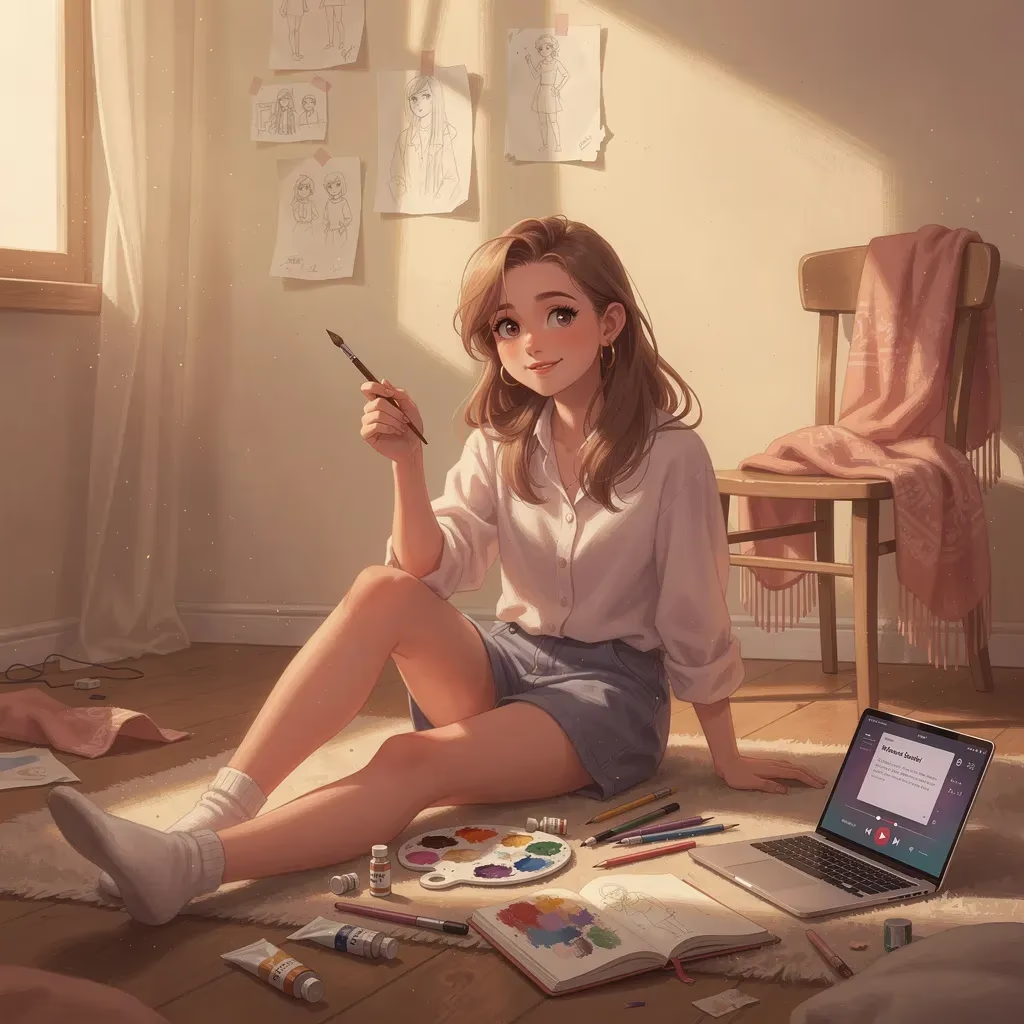
Creator feminine aura is the one you feel before you can name it. It's the spark. It's the vibe. It's the way you make a room feel a little more alive just by being there.
If you keep searching how to radiate feminine energy, Creator energy is a real path, because radiance is literally what you do. The shadow is when your spark starts performing, like your creativity has to earn you love.
Also, if you've been stuck on what is feminine energy because everything online sounds like a personality cosplay, Creator will feel grounded. It's not about being "pretty." It's about being expressive.
Creator Meaning
Core understanding
Creator means your feminine aura runs on inspiration, beauty, and meaning. If you recognize yourself in this pattern, your body often settles when you can make something, style something, remix something, write something. It's like your aliveness needs a channel.
This pattern often develops in women who learned to find safety in imagination. When real life felt intense, creating became a sanctuary. Many Creator types became observant and artistic because it was the one place you could be fully you.
Your body shows you this too: you feel brighter when you're inspired, and you feel heavy when you're boxed in. You might feel restless, skin-crawly, or numb when life gets too rigid. Learning how to tap into feminine energy as a Creator often means letting play be valid, not something you have to justify.
What Creator Looks Like
- Ideas that won't leave you alone: You get flashes of inspiration in the shower or on the train. Others see you as imaginative. You feel crowded by your own thoughts in the best and worst way.
- Aesthetic sensitivity: You notice lighting, tone, color, vibe. People might tease you for caring. You feel safer when your environment feels beautiful and calm.
- Emotional expression through art: You say what you can't say by making something. Others see talent. You feel relief, like your chest can finally unclench.
- Fear of being seen: You want to share, then panic. People think you're confident. Inside, you're afraid rejection means you are the rejection.
- Comparison spirals: Scrolling can light you up and crush you in the same minute. Others see you as ambitious. You feel like you have to catch up to be worthy.
- Playfulness as medicine: You come alive when you laugh and create. People love being around you. You can feel drained if you keep being "productive" without joy.
- Mood tied to inspiration: When you're inspired, you're magnetic. When you're blocked, you might feel flat. It's not laziness. It's your spirit craving movement.
- Shape-shifting style: You experiment with looks, aesthetics, identities. Others call it fun. Sometimes you use it to be liked, and then you feel lost.
- Romanticizing life: You can find beauty in small moments. People feel soothed by you. You might avoid hard truths by turning them into a story too quickly.
- Sensitivity to feedback: One comment can sting for days. You might smile it off. Inside, you replay it and wonder if you should disappear.
- Burst energy then crash: You create intensely, then need recovery. People see hustle. You feel like a wave, not a machine.
- High intuition + high taste: You know what feels right, aesthetically and emotionally. Others might not get it. You feel frustrated when you settle.
- Craving emotional permission: You might wait for someone to say "it's good" before you believe it. That external validation can quietly steer your choices.
- Radiance when you're safe: When you're not bracing, you glow. People can feel it. It's how to embrace feminine energy without forcing it.
How Creator Shows Up in Different Areas of Life
In romantic relationships: You want connection to feel inspiring, like you're building a world together. You might over-give creativity, planning, vibe-making. When someone withdraws, you can start performing, posting, or polishing yourself to get reassurance.
In friendships: You're the one who makes things fun and meaningful. You plan cute moments, take photos, make playlists. If friends don't reciprocate effort, you can feel unappreciated, then withdraw quietly.
At work: You bring vision and taste. You can also struggle with rigid structures, or with leaders who only value output, not creativity. You might people-please to keep approval, which dulls your spark.
Under stress: You can get stuck. Procrastination shows up. Perfectionism shows up. If you're Googling what is divine feminine energy in this state, it's because your creativity is asking for safety, not pressure.
What Activates This Pattern
- When your work is criticized publicly
- When you compare yourself online
- When you have to be "practical" nonstop
- When someone doesn't respond to your excitement
- When you feel like you're too much
- When you feel unseen for your effort
- When you lose your play
The Path Toward Steady Radiance
- Your creativity is not a performance: It's your life force. Protect it like you protect your heart.
- Build tiny creative rituals: Small daily creating teaches your body it is safe to be you. That is how to tap into feminine energy consistently.
- Let authenticity lead style: Wear, make, and share from truth, not from fear.
- Get close to your body: When you're in your body, your spark stops chasing approval. This is how to radiate feminine energy without burnout.
- What becomes possible: You start creating from devotion, not desperation. Your feminine aura becomes magnetic and calm at the same time.
Creator Celebrities
- Alicia Keys - Singer
- Ariana Grande - Singer
- Lana Del Rey - Singer
- Emma Stone - Actress
- Dakota Johnson - Actress
- Margot Robbie - Actress
- Billie Eilish - Singer
- Olivia Rodrigo - Singer
- Jenna Ortega - Actress
- Kendall Jenner - Model
- Addison Rae - Entertainer
- Camila Cabello - Singer
Creator Compatibility
| Other type | Match | Why it feels this way |
|---|---|---|
| Nurturer | 🙂 Works well | She gives you safety to create, and you bring joy back to her, if you don't make her responsible for your moods. |
| Mystic | 😐 Mixed | You connect through depth and meaning, but you both need grounding so intensity doesn't become spiraling. |
| Warrior | 😐 Mixed | She helps you hold standards and boundaries, but her bluntness can sting unless it's delivered with care. |
| Lover | 🙂 Works well | Chemistry + beauty + devotion can be powerful, as long as closeness doesn't turn into performance for reassurance. |
Do I have a Warrior Feminine Aura?

Warrior feminine aura is for the woman who is done bargaining for basic respect. Not because she's cold. Because she's tired.
If you've ever felt your throat close up before saying what you actually want, then watched yourself smile anyway, Warrior energy is the part of you that wants to come back online.
And yes, Warrior is feminine. If you're stuck on what is feminine energy, this is your reminder: feminine energy includes boundaries. It includes "no." It includes protecting softness so it doesn't get drained.
Warrior Meaning
Core understanding
Warrior means your feminine aura is truth-forward and self-protective. If you recognize yourself in this pattern, you likely have a strong internal compass. You can feel when something isn't aligned, and you want to address it, not pretend.
This pattern often develops when you learned that nobody was coming to rescue you. Many women with Warrior energy became competent, direct, and self-led because it was the safest way to live. You learned to stand up for yourself, even if you were shaking inside.
Your body remembers it as bracing. Jaw tension. Shoulders locked. That sharp inhale when someone crosses a line. Learning how to embrace feminine energy as a Warrior often looks like letting your body soften after you set the boundary, not staying armored.
What Warrior Looks Like
- Clear yes and no: You know what you want quickly. Others see confidence. Inside, you may still fear being abandoned for having needs.
- Low tolerance for mixed signals: Inconsistency irritates you. People see standards. Your body feels agitated because chaos reads as unsafe.
- Protecting your time: You value your energy. Others might call it intense. You feel calmer when your schedule isn't being invaded.
- Direct communication: You prefer saying it plainly. People experience you as honest. You may feel guilt afterward if you've been trained to be "nice."
- Softness under the armor: You can look unbothered. Inside, you feel deeply and want closeness. You just don't want to beg for it.
- Anger as information: You feel anger early. Others might avoid it. You use it as a signal that something needs addressing.
- High self-respect: You won't stay where you're disrespected. People might label you "hard to please." You're actually easy to love when love is clean.
- Difficulty receiving help: You default to doing it yourself. Others admire it. Your body can feel lonely carrying everything.
- A protective presence: Friends feel safer with you around. You feel responsible for safety sometimes, like you're on watch.
- Conflict doesn't break you: You can stay present in disagreement. Others may freeze. You can still feel shaky later in private.
- Boundary guilt: After you say no, your stomach might drop. You might over-explain to soften it. That is old conditioning.
- Quick cutoffs: If you sense disrespect, you can detach fast. Others are shocked. It's your nervous system choosing self-protection.
- Strong leadership vibe: You take initiative. People follow. You might secretly worry you're "too much" for softer connections.
- Longing for tenderness: You want to be held too. You just need it to be safe.
How Warrior Shows Up in Different Areas of Life
In romantic relationships: You want loyalty and consistency. You can struggle with partners who want you to shrink to be "easy." If someone withdraws, you may go cold or cut it off to protect yourself, even if you still care.
In friendships: You're the one who says what everyone is thinking. You protect friends from being mistreated. Sometimes you crave friends who also protect you, so you can rest.
At work: You hold standards. You can advocate for yourself. You might get labeled intimidating by people who benefit from you being quiet.
Under stress: You tighten. You control. You push through. If you're searching how to radiate feminine energy in this state, the answer is often: soften after the moment. Let yourself come back to your body.
What Activates This Pattern
- When someone crosses a boundary "by accident"
- When you feel taken for granted
- When someone tries to guilt you into yes
- When you get inconsistent communication
- When you're expected to be "easygoing"
- When you sense manipulation
- When you have to repeat yourself
The Path Toward Soft Power
- You don't have to become gentler to be lovable: You can be direct and still be warm.
- Let boundaries be simple: The less you explain, the stronger your aura feels. This is how to radiate feminine energy as a Warrior.
- Practice receiving: Allowing help is not weakness. It's intimacy with life.
- Regulate after the boundary: After you speak up, give your body care. That's how to tap into feminine energy without staying armored.
- What becomes possible: Your presence becomes both strong and soothing. People feel safe around you, and you feel safe inside you.
Warrior Celebrities
- Sandra Bullock - Actress
- Michelle Pfeiffer - Actress
- Jodie Foster - Actress
- Charlize Theron - Actress
- Halle Berry - Actress
- Emily Blunt - Actress
- Gal Gadot - Actress
- Viola Davis - Actress
- Gina Rodriguez - Actress
- Brie Larson - Actress
- Ana de Armas - Actress
- Sydney Sweeney - Actress
Warrior Compatibility
| Other type | Match | Why it feels this way |
|---|---|---|
| Nurturer | 😐 Mixed | You help her hold boundaries, but she may feel judged unless you soften your delivery and let her set the pace. |
| Mystic | 🙂 Works well | Her intuition helps you stay emotionally wise, and your clarity helps her stop doubting what she knows. |
| Creator | 😐 Mixed | You can ground her, but if you dismiss her feelings or playfulness, she will dim. Respect her spark. |
| Lover | 😕 Challenging | The intensity can be hot, but if reassurance needs collide with your need for autonomy, you may both feel unsafe unless you communicate clearly. |
Am I a Lover type?

Lover feminine aura is misunderstood online. It gets flattened into "sexy" or "desired." But real Lover energy is about presence. It's about intimacy. It's about aliveness in your body.
If you're looking up how to embrace feminine energy, Lover energy might be the one you're trying to get back to. Years of stress can make you forget what "alive" feels like. Trying to be "chill" can do it too.
If you're also asking what is divine feminine energy, the Lover is often the archetype that reminds you: pleasure and tenderness are allowed.
The shadow is when closeness becomes a panic project. When you start gripping. When you start performing affection to keep someone near.
Lover Meaning
Core understanding
Lover means your feminine aura naturally radiates warmth, devotion, and deep connection. If you recognize yourself in this pattern, you don't do half-hearted. You want real intimacy. You want to be felt, and you want to feel back.
This pattern often develops in women who learned closeness is safety. Many Lover types are deeply relational, and you can sense disconnection like a physical ache. When closeness feels uncertain, you might chase, over-text, or over-give affection to pull the bond back together.
Your body remembers it as longing. That hollow feeling in your chest when someone is distant. The tight stomach when you see them online but not replying. Learning how to tap into feminine energy as a Lover is learning to soothe yourself without abandoning your desire for connection.
What Lover Looks Like
- Presence you can feel: You listen with your whole body. Others feel important around you. Inside, you crave that same level of attention back.
- Deep emotional openness: You're comfortable saying you miss someone. People experience you as brave. You might fear being "too much" afterward.
- Strong chemistry sensitivity: You can feel attraction fast. Others see confidence. Your body can confuse intensity with safety if you're not grounded.
- Romantic devotion: You remember anniversaries, small details, favorite snacks. People feel adored. You can feel crushed if it's not reciprocated.
- Reassurance hunger: You want to know where you stand. Others might call it needy. Your nervous system is asking for safety.
- Performing to be chosen: If you sense distance, you might become extra sweet, extra polished, extra agreeable. People see charm. You feel exhausted and a little unseen.
- Attachment through closeness: Physical affection can calm you. Without it, you might spiral. It's not weakness, it's your wiring.
- Big feelings with big loyalty: You're fierce about love. People feel protected. You may tolerate red flags because your hope is strong.
- Sensitivity to rejection: A canceled plan can feel like abandonment. You might pretend it's fine. Your chest tightens and your mind runs stories.
- High empathy in romance: You sense what they need. They feel held. You might forget to ask what you need.
- Magnetism without trying: When you're in your body, you glow. People notice. You can get self-conscious and start editing yourself.
- Jealousy as fear: Jealousy isn't "bad." It's often your fear of being replaced. It needs compassion, not shame.
- Receiving is hard: You can give affection easily. Receiving it can feel vulnerable, like it could be taken away.
- Desire for repair: You want to talk it out. People might avoid it. You feel anxious until the bond feels restored.
How Lover Shows Up in Different Areas of Life
In romantic relationships: You bond deeply. You crave consistency and emotional presence. If the connection is unstable, you can become hyper-focused on signs, timing, and tone. The dread before a date or a reply can be intense.
In friendships: You're warm, affectionate, and loyal. You value closeness. If friends are flaky, you might feel quietly rejected and start pulling away or people-pleasing.
At work: You build relationships easily. People like you. You can struggle with boundaries if you feel responsible for everyone's comfort.
Under stress: Your body wants closeness as comfort. If it's not available, you may scroll, text, overthink, and then crash. Learning how to radiate feminine energy here is learning to stay in your body even when reassurance isn't immediate.
What Activates This Pattern
- When someone takes hours to reply
- When plans change last minute
- When you feel like you're not a priority
- When affection drops suddenly
- When you sense secrecy or vagueness
- When you get told you're "too intense"
- When you're left in uncertainty
The Path Toward Secure Intimacy
- You don't have to shrink your desire: Wanting closeness is human. Your needs are not an inconvenience to the right people.
- Choose steadiness over intensity: Chemistry is real. Consistency is safety.
- Practice self-soothing in the moment: Small rituals help your body calm down. That is how to tap into feminine energy without gripping.
- Ask clean questions: You don't need to hint. Directness builds trust.
- What becomes possible: Your feminine aura stays magnetic and warm, but it stops feeling frantic. Love becomes a place you rest, not a place you prove yourself.
Lover Celebrities
- Beyonce - Singer
- Jennifer Lopez - Singer
- Scarlett Johansson - Actress
- Penelope Cruz - Actress
- Shakira - Singer
- Rihanna - Singer
- Blake Lively - Actress
- Dua Lipa - Singer
- Sabrina Carpenter - Singer
- Madelyn Cline - Actress
- Jessica Alba - Actress
- Eva Mendes - Actress
Lover Compatibility
| Other type | Match | Why it feels this way |
|---|---|---|
| Nurturer | 😐 Mixed | It can feel like home, but if both of you overgive, the relationship can become caretaking instead of mutual receiving. |
| Mystic | 😐 Mixed | Depth meets devotion, but you need clarity so intuition doesn't become suspicion and intensity doesn't become spiraling. |
| Creator | 🙂 Works well | You bring warmth to her spark, and she brings play to your heart, if you both keep self-worth inside the bond. |
| Warrior | 😕 Challenging | You may crave reassurance while she craves autonomy. It can work if both of you communicate cleanly and respect pace. |
The real problem (and the simple solution)
If you keep asking what is feminine energy and every answer feels vague, that's the problem. You don't need another aesthetic. You need a mirror that shows what you're already radiating, and why it shifts when you're trying to be chosen. This quiz gives you language for what is divine feminine energy in your real life, plus a path for how to radiate feminine energy without self-abandonment.
Quick wins you get from your results
- ✨ Discover what is feminine energy for you (not the internet)
- 🔮 Understand what is divine feminine energy without the pressure to perform it
- 🌿 Learn how to tap into feminine energy when you're triggered or spiraling
- 🌸 Practice how to embrace feminine energy while keeping boundaries
- 🔥 Strengthen how to radiate feminine energy in love and life
- 🤍 Join 169,315 other women doing this too
Where you are now vs. what becomes possible
| Where you are now | What becomes possible |
|---|---|
| You feel your energy change around certain people | You recognize the pattern early and stay anchored |
| You over-explain because you're afraid of being misunderstood | You communicate simply and still feel safe |
| You crave closeness, but you fear asking for it | You ask cleanly, without shame |
| You try to "be more feminine" to be chosen | You learn how to embrace feminine energy as self-trust |
| You want to know how to tap into feminine energy but you keep abandoning your needs | You protect your softness with boundaries, so your aura stays bright |
| You wonder how to radiate feminine energy without being a performance | You radiate presence, not effort |
Join over 169,315 women who've taken this in under 5 minutes for private results. Your answers stay private and this is just for you.
FAQ
What is feminine energy, and what does it mean to have a "feminine aura"?
Feminine energy is the part of you that moves through life with receptivity, intuition, emotion, softness, creativity, magnetism, and presence. A "feminine aura" is the vibe people feel when they are near you, the specific feminine energy you radiate without even trying.
This question matters because so many of us have been taught to treat our natural softness like it's unsafe. Like being warm, open, playful, or deeply feeling will automatically get us hurt. Of course you'd want clarity on what feminine energy actually is. When you're the kind of woman who notices shifts in tone and reads between the lines, you want a map. You want something to make sense.
Here's what's actually happening beneath the buzzwords: feminine energy is not a personality type, and it's not a performance. It's a set of inner qualities and nervous system patterns that show up in how you:
- Receive love, help, compliments, and attention
- Relate to your emotions (do you trust them, hide them, intellectualize them, ride them?)
- Create connection (do you nurture, seduce, protect, inspire, or transform?)
- Move through the world (do you soften, lead, adapt, or challenge?)
When someone searches "what is feminine energy" they usually mean one of two things:
- "How do I feel more like myself again?" (especially after burnout, heartbreak, or people-pleasing)
- "What do I naturally radiate?" (because they feel different in different rooms, around different people)
A helpful way to think about divine feminine energy is that it includes both softness and strength. The feminine isn't only gentle. It can be:
- Tender and nurturing
- Sensual and magnetic
- Wild and creative
- Mysterious and intuitive
- Fierce and protective
So if you've ever felt like, "I can be sweet, but I can also be intense," nothing about that is wrong. It's often a sign your feminine aura has layers, not contradictions.
If you want something practical: feminine energy tends to feel like presence. Not perfection. Presence. People feel you when you're grounded in your own inner world instead of trying to earn your place in theirs.
If you're curious about the specific flavor you radiate (and how it shapes your relationships, confidence, and boundaries), a feminine energy archetype test can help you name what you already sense.
How do I know what feminine energy I radiate?
You can usually tell what feminine energy you radiate by noticing what people consistently come to you for, what they assume about you quickly, and what you feel yourself becoming in close relationships. In other words, your feminine aura leaves a pattern.
If you've ever had that moment where you think, "Why do people always treat me like the therapist?" or "Why do I become the strong one?" or "Why do I feel invisible unless I'm impressive?" you're already tracking your aura. Of course you want to know. When you're sensitive, you can feel the impact you have, even when nobody names it.
Here are a few grounded signs that point to what you naturally radiate. You might recognize more than one:
- People relax around you fast: They open up, overshare, ask for comfort. This often points to a nurturing or stabilizing feminine presence.
- People get curious about you: They ask questions, lean in, feel intrigued. This often points to a mysterious, intuitive, or "hard to read" aura.
- People are inspired around you: They want to create, change, take action, or dream bigger after talking to you. This can point to creative, visionary feminine energy.
- People test you or challenge you: They push boundaries, act bold, or try to dominate the space. This often happens when you radiate power, independence, or leadership.
- People flirt without you trying: You notice lingering eye contact, compliments, playful energy. This can point to sensual, magnetic feminine energy.
Now the more tender part: if you have anxious attachment patterns, your radiance can sometimes get tangled with "earning safety." You might soften to keep people close. Or over-give so nobody leaves. That doesn't mean your feminine energy is fake. It means your nervous system learned that connection requires effort.
A gentle way to self-check is to ask:
- When I feel secure, what version of me shows up?
- When I feel unsure, what version of me performs?
- What do I feel most proud of in how I love people?
- What do I secretly wish people would give me back?
Those answers usually reveal the core feminine energy you radiate, and where it's been stretched thin.
If you're thinking "what feminine energy do I radiate" and you want a clear, specific mirror, a quiz can help you name your pattern without overthinking it.
How accurate is a feminine energy archetype test or divine feminine quiz?
A feminine energy archetype test can be surprisingly accurate when it measures patterns (how you relate, respond, and restore) instead of stereotypes (how "girly" you are). The best quizzes feel like someone finally put words to what you've always sensed.
It makes perfect sense to ask this. So many women have taken personality tests that felt cute but not true. Or worse, they felt like a box that erased the complicated parts. If you're someone who already questions yourself, the last thing you want is a quiz telling you a shallow story about who you are.
Here's what accuracy actually means for a quiz like this:
- It won't "diagnose" you. This is self-discovery, not a clinical label.
- It can reflect your dominant feminine energy, the one you default to under stress, and the one you access when you feel safe.
- It can help you spot mismatches, like when you're living in survival mode but craving softness.
A high-quality divine feminine quiz tends to be accurate because it asks about:
- Your emotional instincts (do you soothe, withdraw, confront, romanticize, create?)
- Your relationship patterns (do you bond through care, mystery, passion, or protection?)
- Your energy boundaries (do you absorb others, lead others, inspire others?)
- Your restoration style (what actually refuels you when you're depleted?)
One of the most useful parts of a quiz isn't the label. It's the language. When you can name your feminine aura, you can stop making it a problem.
A quick reality check, too: your result might shift slightly depending on your season of life. After a breakup, you might be more guarded. During a creative high, you might feel more expressive. That doesn't mean the quiz failed. It means you're a human being, not a fixed identity.
The real test of accuracy is this:
- Do you feel seen?
- Do the patterns explain your past relationships?
- Do the growth suggestions feel kind, not shaming?
- Do you recognize yourself even in the parts you're still healing?
If you're curious, treat a feminine energy archetype test like a mirror, not a verdict. You get to keep what resonates and release what doesn't.
What causes your feminine aura to feel "blocked" or dimmed?
Your feminine aura often feels blocked when your nervous system is stuck in protection mode. Stress, heartbreak, chronic people-pleasing, feeling unseen, or living in constant performance can make your natural radiance go quiet.
If you've felt like, "I used to feel magnetic and alive, and now I just feel flat," you're not alone. This is the quiet conversation happening everywhere. So many women are functioning on the outside while feeling emotionally wrung out on the inside. Of course your aura would dim. You've been trying to be safe.
Here are common reasons feminine energy gets "blocked," in a real-life, not mystical-only way:
- Hypervigilance: When you're scanning for rejection, you can't fully drop into receptivity. Your body is busy monitoring.
- Overgiving: When you're always anticipating needs, your energy flows outward. Feminine energy also needs receiving.
- Shame around desire: If you were taught that wanting attention, intimacy, softness, or pleasure is "too much," you might suppress your sensual and loving energies.
- Burnout: Creativity, play, and glow require resources. When you're depleted, your aura doesn't disappear. It's just tired.
- Unprocessed grief: Loss (even small losses) can make you feel less open. Many of us keep moving and never metabolize what happened.
- Unsafe dynamics: Being with someone inconsistent can pull you into anxious spirals. Your aura becomes about securing love, not expressing it.
A grounded way to think about "how to tap into feminine energy" is: what helps you feel safe enough to be present? That might look like:
- Time alone without performing
- Clothes that feel like you (not what you think others want)
- Music that reconnects you to your body
- Saying one honest sentence you usually swallow
- Choosing environments where you're met, not managed
You're allowed to have seasons where your radiance is quieter. You're not behind. You're recovering.
If you want clarity on what feminine energy is most natural for you, you can stop forcing the "right" kind of feminine and start nourishing the real one.
Can your feminine energy archetype change over time?
Yes, your feminine energy can evolve over time. Your core feminine aura tends to stay recognizable, but the way it expresses itself changes as you heal, gain confidence, and move through different life seasons.
If that brings up anxiety, you're in good company. When you're someone who attaches deeply, change can feel like, "If I shift, will people still love me?" Of course you'd wonder if you're allowed to grow without losing belonging.
Here's the truth: growth doesn't erase you. It reveals you.
A few ways feminine energy shifts:
- Healing changes your "default": When you're no longer in survival mode, you stop using your energy to manage outcomes. You start using it to express your truth.
- Safety expands your range: In a secure relationship, a woman who felt guarded might become softer. A woman who overgave might become more boundaried without losing her warmth.
- Life roles awaken different facets: New jobs, friendships, creative projects, and love can call forward different energies.
- Confidence changes how you carry the same aura: The same archetype can look completely different when it's grounded instead of seeking approval.
One useful distinction: sometimes what changes isn't your archetype, it's your coping strategy.
Example:
- You might have a naturally romantic, magnetic aura, but after being hurt, you present more guarded and detached.
- You might be naturally nurturing, but after burnout, you feel resentful and numb.
That doesn't mean you became a different person. It means your energy is asking for repair.
This is also why women love a well-built "goddess archetype quiz." It gives language for both who you are and what season you're in. It helps you stop moralizing your shifts. You're not "regressing." You're adapting.
If you're wondering what is my feminine energy right now (not just who you were two years ago), the quiz can reflect your current pattern with a lot more clarity than spiraling alone.
How does the feminine energy you radiate affect your relationships and dating?
The feminine energy you radiate affects who approaches you, how partners treat you early on, what dynamics get reinforced over time, and what you tolerate when you're afraid of losing someone. Your aura is not just "vibes." It's relational information.
This matters because if you have an anxious edge in love, you might blame yourself for every shift. You might assume, "If I were prettier, calmer, cooler, more feminine, they'd stay." Of course you'd want to understand your feminine aura in relationships. You want something solid to hold onto.
Here are a few common patterns:
- Nurturing feminine energy often attracts people who want comfort and care. In healthy relationships, this becomes devotion and emotional safety. In unhealthy ones, it can turn into you becoming the only emotional provider.
- Mysterious or intuitive feminine energy can attract intense pursuit. People want to "figure you out." In healthy love, this becomes deep bonding. In unhealthy love, it can attract hot-and-cold dynamics because intensity gets mistaken for intimacy.
- Creative feminine energy often draws people who feel inspired by you. In healthy love, your partner becomes a collaborator. In unhealthy love, you can get minimized or copied because your shine triggers insecurity.
- Fierce, protective feminine energy tends to attract strong personalities. In healthy love, it's power-couple energy. In unhealthy love, it can become control battles or you being cast as "too much."
- Sensual, magnetic feminine energy attracts attention easily. In healthy love, it's playful and connected. In unhealthy love, you can get reduced to a fantasy instead of being fully known.
A key point: your aura doesn't "cause" someone to treat you poorly. It can shape the early script, but character and emotional maturity decide the rest.
A micro-shift that helps right away is separating:
- Chemistry (nervous system activation, pursuit, intensity)from
- Safety (consistency, repair, emotional steadiness)
When you learn how to embrace feminine energy in a grounded way, your dating life gets clearer. You're still radiant. You just stop confusing anxiety with love.
If you want a mirror for the specific energy you lead with, and how it tends to play out in relationships, the quiz can help you understand your patterns without blaming yourself.
How do I tap into feminine energy and radiate feminine energy in daily life (without feeling fake)?
You tap into feminine energy by returning to your body, your emotions, and your truth. Radiating feminine energy isn't about acting "softer." It's about becoming less performative and more present, so your natural feminine aura can come through.
If you've ever tried advice online and felt like you were playing a role, that reaction is wisdom. A lot of "feminine energy" content accidentally teaches women to self-abandon in prettier packaging. Of course you don't want that. Especially if you've already spent years over-adapting to keep people close.
Here's a real, sustainable approach to "how to tap into feminine energy":
Receptivity (receiving without apologizing)
Practice accepting small offers: a compliment, a coffee, someone holding the door, someone listening. Many of us reflexively say, "Oh no, it's fine." Receptivity is a muscle.Emotional honesty (feeling without collapsing)
Feminine energy includes emotion, but not emotional self-erasure. It can sound like: "That hurt my feelings," without a 10-minute explanation.Sensory presence (coming back to the moment)
What you wear, eat, touch, smell, and hear can reconnect you to yourself. Soft fabrics, warm showers, music, stretching. This isn't shallow. It's nervous system care.Creative expression (letting energy move)
Journaling, makeup, cooking, dancing in your room, writing, decorating, photography. Feminine energy often radiates when it's in motion.Boundaries (the container that keeps you safe)
Boundaries are not masculine. They protect your softness. If you keep giving past your limit, your aura doesn't glow. It strains.
A simple way to check if you're "being fake" is to ask:
- Does this make me feel more like me, or less like me?
- Am I doing this to be chosen, or because it feels true?
You're allowed to radiate feminine energy in a way that fits your real life. Not everyone has time for hour-long rituals. Sometimes it's as small as choosing a playlist that brings you back to yourself before you reply to texts you feel anxious about.
If you want to know which feminine energy you naturally radiate, it gets easier to embody it without copying someone else's aesthetic.
What is my feminine energy if I feel like I have multiple sides (soft, intense, independent, romantic)?
If you feel like you have multiple sides, your feminine energy is probably layered, not confused. Most women are not one-note. You can be soft and intense. You can be independent and deeply romantic. That doesn't mean you are inconsistent. It means you're whole.
And honestly, if you've spent years trying to be "easy to love," having multiple sides can feel scary. You might worry people will only accept the convenient parts. Of course that would make you question what feminine energy you "really" are. When love has felt conditional, self-definition can feel risky.
Here's a helpful framework: think of your feminine aura as having:
- A core (your natural baseline energy when you're safe)
- A protector (the side that shows up when you're unsure)
- A longing (the side that comes out when you feel deeply seen)
Example:
- Your core might be sensual and loving.
- Your protector might look like a warrior, independent, sharp boundaries.
- Your longing might be nurturing, wanting to build a soft home with someone.
That is not a contradiction. It's a nervous system and a heart trying to get all its needs met.
Also, different environments pull different facets:
- At work, you might lead with competence and independence.
- With friends, you might be playful and creative.
- In dating, you might be tender but also hyper-aware of rejection cues.
So when you ask "what is my feminine energy," the most accurate answer isn't a single adjective. It's a pattern: what you return to, what you use to cope, and what you crave.
This is why a goddess archetype quiz can feel like relief. It helps you name the archetype you most naturally embody, and the one you're borrowing when you're stressed or trying to be chosen.
If you're tired of guessing which side of you is "the real one," you're allowed to stop forcing a single identity. You can explore what you radiate most strongly, and what you need to feel safe enough to stay in your core.
What's the Research?
Feminine aura is felt first: the science behind "energy" you can actually measure
That moment when you walk into a room and instantly sense who feels safe, who feels tense, and who might need you... that isn't you being "too much." It's your nervous system doing what it learned to do.
When people talk about a "feminine aura," they're usually describing a mix of things other humans can pick up on quickly: facial expression, tone of voice, posture, pacing, warmth, and emotional steadiness. Research on emotional intelligence backs this up. Emotional intelligence is commonly defined as the ability to perceive, understand, and manage emotions in yourself and others (Wikipedia: Emotional intelligence). So yes, that "vibe" is partly your emotional skills showing up in your body language and presence.
The interesting part: some emotional intelligence models focus specifically on emotion perception and regulation as real abilities (not just personality). The Mayer-Salovey framework, for example, measures skills like perceiving emotions and managing emotions in everyday situations (Grokipedia: Mayer-Salovey-Caruso Emotional Intelligence Test). In plain English: the more practiced you are at reading emotion and staying grounded, the more your "aura" reads as calming, magnetic, or powerful to other people.
If you have an anxious attachment style, your feminine aura can get shaped by hyper-awareness. You learned to read the room fast because it once helped you feel safe. That isn't a flaw. It's data.
The hidden link: boundaries shape your aura more than aesthetics ever will
A lot of women think "radiating feminine energy" means looking softer or being more agreeable. But the research around boundaries points to something deeper: your sense of where you end and other people begin.
Across counseling and psychology summaries, personal boundaries are described as the limits that protect your emotional, physical, and mental space, and they're built by changing your own responses rather than trying to control others (Wikipedia: Personal boundaries). When boundaries are weak, you absorb more than you mean to. When boundaries are rigid, you can feel shut down or unreachable. When they're flexible, you feel warm and steady at the same time.
Health and well-being sources echo the same core idea: you cannot control what others think, feel, or do, and stress spikes when you take responsibility for other people's emotions (Mayo Clinic Health System: Setting boundaries for well-being). This matters for feminine aura because the "energy" people feel from you often comes from how centered you are in your own lane.
And if you're someone who people-pleases, boundaries can feel terrifying because it means risking disapproval. That fear is real. Psych Central describes how many of us were taught early to bend ourselves to make others comfortable, which makes boundary-setting feel emotionally loaded later (Psych Central: Personal Boundaries). Stanford Student Affairs also frames boundaries as a way to create trust, safety, and respect in relationships, and highlights the role of self-awareness plus clear communication (Stanford Student Affairs: Importance of Boundaries).
Your feminine aura gets brighter when you stop leaking energy into places it was never meant to go. Not because you become colder, but because you become clearer.
Why we "feel" different feminine archetypes (Nurturer, Mystic, Creator, Warrior, Lover)
If you're here because you're asking, "What feminine energy do I radiate?" it helps to know that archetypes are basically pattern language. They're not diagnoses. They're mirrors.
From a relationship science perspective, humans form connections through repeated emotional and social interaction, and relationships vary in intimacy, reciprocity, and power (Wikipedia: Interpersonal relationship). So the "type" people experience you as is often the pattern you bring into closeness:
- The Nurturer vibe often shows up as warmth, attunement, and emotional caretaking. It can be beautiful, but can also slide into over-responsibility if boundaries are porous (Wikipedia: Personal boundaries).
- The Mystic vibe often reads as depth, intuition, and emotional sensitivity. That can overlap with being highly perceptive of emotions, which fits with emotional intelligence concepts like perceiving emotions (Grokipedia: Mayer-Salovey-Caruso Emotional Intelligence Test).
- The Creator vibe often feels playful, expressive, inspiring. Emotion can be used to facilitate thinking and creativity in ability-based emotional intelligence models (Grokipedia: Mayer-Salovey-Caruso Emotional Intelligence Test).
- The Warrior vibe often comes through as firmness, protection, and decisiveness. In boundary language, this can look like clear limits and consistent follow-through, which reduces stress and confusion in relationships (Mayo Clinic Health System: Setting boundaries for well-being).
- The Lover vibe often radiates openness, connection, affection, and emotional presence. Interpersonal relationship research emphasizes openness and mutual sharing as key to deep bonds (Verywell Mind: How to Maintain Interpersonal Relationships).
What matters is that your "aura" isn't just a personality label. It's the emotional experience other people have in your presence, shaped by your emotional skills, attachment patterns, and boundaries.
You don't have to pick one archetype and perform it perfectly. Your feminine energy shifts depending on whether you feel safe, seen, and respected.
Why this matters (especially if you grew up becoming "easy to be around")
So many of us learned that being lovable meant being low-maintenance. Being agreeable. Being useful. And then we wonder why our feminine aura feels inconsistent, like it disappears the second we're stressed.
The research points to a simple truth: relationships are built through reciprocal interaction, and they thrive on trust, openness, and respect (Verywell Mind: How to Maintain Interpersonal Relationships). Boundaries help determine what is and isn't okay, which protects your well-being and builds trust (Stanford Student Affairs: Importance of Boundaries). When you repeatedly override your limits to keep the peace, your body reads that as danger. Your nervous system goes into monitoring mode. And that changes your presence.
One of the most grounding boundary reframes is that a boundary is not a demand or ultimatum. It's a course of action you take to care for your needs, even if someone dislikes it (Salt and Roe: Why are Boundaries Important?). That shifts feminine aura from "please like me" energy into "I know myself" energy.
This is also where emotional intelligence becomes practical instead of just a buzzword. Being able to recognize your feelings and understand what they mean is part of emotional intelligence, and it supports healthier interactions and self-regulation (Mental Health America: Emotional Intelligence). The more you can name what's happening inside you, the less your aura gets hijacked by anxiety.
You deserve a feminine aura that feels like home to you, not like a performance for other people. While research reveals patterns many women share, your personalized report shows which feminine energy archetype is most dominant for you (Nurturer, Mystic, Creator, Warrior, or Lover) and how your specific strengths and stress patterns shape the vibe you radiate.
References
Want to go deeper? Here are the sources I leaned on (and a few that are genuinely worth a scroll):
- Emotional intelligence (Wikipedia)
- Personal boundaries (Wikipedia)
- Interpersonal relationship (Wikipedia)
- Setting boundaries for well-being (Mayo Clinic Health System)
- Personal Boundaries: Types and How to Set Them (Psych Central)
- Trust, Safety, and Respect: The Importance of Boundaries (Stanford Student Affairs)
- Why are Boundaries Important in Your Personal Life? (Salt and Roe)
- What is emotional intelligence and how does it apply to the workplace? (Mental Health America)
- How to Maintain Interpersonal Relationships (Verywell Mind)
- Personal boundaries (Grokipedia)
- Mayer-Salovey-Caruso Emotional Intelligence Test (Grokipedia)
- Interpersonal Processes research overview (Penn State Psychology)
Recommended reading (for when you want to go deeper)
If you keep circling back to what is feminine energy, these books help you build a Feminine Aura that feels real, steady, and self-owned. They aren't about becoming "more feminine." They're about coming home to yourself, so how to radiate feminine energy becomes natural.
A quick note: the source list for this page didn't include ISBN numbers, so these are shared as titles + authors for easy searching.
General books (good for any Feminine Aura type)
- Women Who Run With the Wolves (Amazon, Bookshop.org, AbeBooks) by Clarissa Pinkola Estes - A mythic exploration of feminine instinct and wildness through folklore and archetypal storytelling.
- The Gifts of Imperfection (Amazon, Bookshop.org, AbeBooks) by Brene Brown - A guide to letting go of who you think you should be and embracing authenticity, vulnerability, and self-worth.
- Set Boundaries, Find Peace (Amazon, Bookshop.org, AbeBooks) by Nedra Glover Tawwab - Clear scripts and real-life examples for setting limits in relationships, work, and family without guilt.
- The Body Is Not an Apology (Amazon, Bookshop.org, AbeBooks) by Sonya Renee Taylor - A radical framework for making peace with your body by dismantling the shame you were taught.
- Self-Compassion (Amazon, Bookshop.org, AbeBooks) by Kristin Neff - Research-backed practices for replacing self-criticism with kindness, common humanity, and mindfulness.
- Come as You Are (Amazon, Bookshop.org, AbeBooks) by Emily Nagoski - A science-based guide to female desire and arousal that replaces shame with curiosity and understanding.
- Untamed (Amazon, Bookshop.org, AbeBooks) by Glennon Doyle - Feminine energy often gets buried under the habit of being palatable.
- Burnout: The Secret to Unlocking the Stress Cycle (Amazon, Bookshop.org, AbeBooks) by Emily Nagoski - Aura is nervous system communication.
For Nurturer types (stop overgiving, keep your warmth)
- Codependent No More (Amazon, Bookshop.org, AbeBooks) by Melody Beattie - The foundational guide to recognizing and recovering from codependent patterns in relationships.
- The Disease to Please (Amazon, Bookshop.org, AbeBooks) by Harriet Braiker - Identifies the hidden cost of chronic people-pleasing and offers a structured recovery plan.
- Nonviolent Communication (Amazon, Bookshop.org, AbeBooks) by Marshall B. Rosenberg - A practical framework for expressing needs and resolving conflicts through empathy-based communication.
- The Highly Sensitive Person (Amazon, Bookshop.org, AbeBooks) by Elaine N. Aron, Ph.D. - Validates deep processing and helps sensitive people build a life that honors their wiring.
- Radical Acceptance (Amazon, Bookshop.org, AbeBooks) by Tara Brach - Combining Buddhist psychology with personal stories to help you break free of the trance of unworthiness.
- Running on Empty (Amazon, Bookshop.org, AbeBooks) by Jonice Webb - Reconnects you to your own emotional needs when a lifetime of neglect taught you to ignore them.
For Mystic types (protect your energy, trust your knowing)
- The Empath's Survival Guide (Amazon, Bookshop.org, AbeBooks) by Judith Orloff - Practical strategies for sensitive people to protect their energy without shutting down.
- Eastern Body, Western Mind (Amazon, Bookshop.org, AbeBooks) by Anodea Judith - Maps the psychology of the seven chakras, connecting body awareness with emotional healing.
- Psychic Self-Defense by Dion Fortune
- The Highly Sensitive Person (Amazon, Bookshop.org, AbeBooks) by Elaine N. Aron, Ph.D. - Validates deep processing and helps sensitive people build a life that honors their wiring.
- The Artist's Way (Amazon, Bookshop.org, AbeBooks) by Julia Cameron - A twelve-week program for recovering your creative self through morning pages and artist dates.
- Waking the Tiger (Amazon, Bookshop.org, AbeBooks) by Peter A. Levine, Ph.D. - How the body holds unresolved trauma and how to release it through body-based awareness.
- When Things Fall Apart (Amazon, Bookshop.org, AbeBooks) by Pema Chödrön - Buddhist wisdom for sitting with uncertainty, loss, and the groundlessness of change.
- Existential Kink (Amazon, Bookshop.org, AbeBooks) by Carolyn Elliott - A provocative guide to embracing shadow desires as a path to freedom and self-knowledge.
For Creator types (create from devotion, not approval)
- The Artist's Way (Amazon, Bookshop.org, AbeBooks) by Julia Cameron - A twelve-week program for recovering your creative self through morning pages and artist dates.
- Big Magic (Amazon, Bookshop.org, AbeBooks) by Elizabeth Gilbert - A warm, permission-giving guide to living a creative life without perfectionism or fear.
- Steal Like an Artist (Amazon, Bookshop.org, AbeBooks) by Austin Kleon - Ten principles for sharing your creative work and finding your audience in the digital age.
- Show Your Work! (Amazon, Bookshop.org, AbeBooks) by Austin Kleon - A guide to building a sustainable creative practice by showing your process and connecting with others.
- The War of Art (Amazon, Bookshop.org, AbeBooks) by Steven Pressfield - Identifies the internal resistance that blocks creative work and offers a warrior mindset to overcome it.
- Mindset (Amazon, Bookshop.org, AbeBooks) by Carol S. Dweck - How a growth mindset transforms the way you learn, parent, and handle setbacks.
- Quiet (Amazon, Bookshop.org, AbeBooks) by Susan Cain - How introverts can harness their quiet strengths in a world that rewards extroversion.
For Warrior types (strong boundaries without hardening)
- When the Body Says No (Amazon, Bookshop.org, AbeBooks) by Gabor Mate - How chronic stress and emotional repression manifest as physical illness, with case studies and science.
- The Dance of Anger (Amazon, Bookshop.org, AbeBooks) by Harriet Lerner - How to use anger as a tool for clarity and change in close relationships without losing connection.
- The Nice Girl Syndrome (Amazon, Bookshop.org, AbeBooks) by Beverly Engel - Identifies the patterns that keep women from asserting themselves and offers a path to authentic power.
- The Assertiveness Workbook (Amazon, Bookshop.org, AbeBooks) by Nedra Glover Tawwab - Guided exercises and prompts for practicing boundaries in everyday relationships.
- Radical Acceptance (Amazon, Bookshop.org, AbeBooks) by Tara Brach - Combining Buddhist psychology with personal stories to help you break free of the trance of unworthiness.
- The Power of a Positive No (Amazon, Bookshop.org, AbeBooks) by Kristin Neff - How to say no clearly and stand your ground while preserving the relationship.
For Lover types (magnetic closeness without panic)
- Anxiously Attached (Amazon, Bookshop.org, AbeBooks) by Jessica Baum, LMHC - Tools for calming anxious attachment patterns and building security from within.
- Women Who Love Too Much (Amazon, Bookshop.org, AbeBooks) by Robin Norwood - A mirror for patterns of over-giving, intensity, and confusing longing with love.
- Codependent No More (Amazon, Bookshop.org, AbeBooks) by Melody Beattie - The foundational guide to recognizing and recovering from codependent patterns in relationships.
- The New Codependency (Amazon, Bookshop.org, AbeBooks) by Melody Beattie - Updated tools for codependency recovery that account for modern relationship dynamics.
- The Assertiveness Workbook (Amazon, Bookshop.org, AbeBooks) by Nedra Glover Tawwab - Guided exercises and prompts for practicing boundaries in everyday relationships.
P.S.
If you're still wondering how to embrace feminine energy, take the quiz. Knowing what you radiate is the fastest way to stop shape-shifting and start feeling safe in your own aura.