A Gentle Map of Your Triggers

Anxiety Triggers: Why Does Your Nervous System Keep Going Off?

Anxiety Triggers: Why Does Your Nervous System Keep Going Off?
When your chest tightens over "nothing": this is how you finally figure out what sets you off, without shaming yourself for it
Anxiety Triggers: What Sets Off Your Nervous System?

That "random" anxiety isn't random. It's patterned. The reason it feels like it comes out of nowhere is because your nervous system is reacting to tiny cues before your brain even finishes the sentence.
If you keep Googling why do I have anxiety or why do I get anxious for no reason, you're not being dramatic. You're trying to make your life make sense. This Anxiety Triggers quiz free is built to help you name the exact moments that flip your system into alarm so you can stop taking it personally.
This quiz sorts your trigger style into one of five gentle, human types:
💗 Sensitive Heart
- What it is: Connection-based triggers. Your nervous system reacts fast to tone shifts, silence, and "where do I stand?" energy.
- You might notice: You read the room instantly, your stomach drops after a short reply, you replay conversations.
- The upside: You get language for what triggers social anxiety in your world, and how to ask for steadiness without apologizing.
🧠 Perfectionist Mind
- What it is: Evaluation-based triggers. Being seen, judged, graded, compared, or "not good enough" lights you up.
- You might notice: You over-prepare, rewrite, procrastinate, or feel sick before anything important.
- The upside: You learn what trigger anxiety at work or school, and how to stop turning your life into a constant performance review.
🗺️ Cautious Planner
- What it is: Uncertainty-based triggers. Not knowing, not having a plan, last-minute changes, and vague communication set you off.
- You might notice: You need details, timelines, and clarity to feel safe. Waiting is the worst.
- The upside: You finally see what can trigger anxiety for you (and why your brain treats "maybe" like danger).
🎧 Overloaded Sensor
- What it is: Overstimulation-based triggers. Noise, crowds, too many plans, too much screen time, and constant access to you pushes your system over the edge.
- You might notice: Your shoulders live by your ears, you get irritable, you want to disappear after social time.
- The upside: You get a realistic map of what can trigger anxiety in your body (not just your thoughts).
🌊 Intense Processor
- What it is: Big-feelings triggers. When something hits, it hits. Your activation spikes high and lingers, especially after conflict or emotional uncertainty.
- You might notice: You cry easily, you feel "too much," you can't just "let it go."
- The upside: You learn how to ride intensity without drowning in it, and you stop judging yourself for having a deep emotional range.
What makes this quiz different (and honestly, why it tends to feel freakishly accurate): it doesn't only ask what trigger anxiety. It also tracks the patterns that keep triggers sticky, like worst-case spirals, thought loops, how grounded you feel in the moment, how much you personalize, how you talk to yourself, how easily you say what you need, your urge to seek safety fast, and whether you're in a growth season or a "please let me just survive this week" season.
If you've been stuck on why do I have anxiety... you're about to get a much more useful answer than "try to relax."
5 Ways Knowing Your Anxiety Trigger Type Can Make Life Feel 2% Lighter, Fast

- Discover your specific anxiety triggers so you stop wondering why do I get anxious for no reason at 3am.
- Understand what trigger anxiety for you (connection, pressure, uncertainty, overstimulation, intensity) so you can catch it earlier.
- Name what can trigger anxiety in your day-to-day with real-life examples, not vague advice.
- Translate what triggers social anxiety for you into simple words you can actually say out loud (without over-explaining).
- Build self-trust by separating "my nervous system is alarmed" from "I'm doing something wrong."
Rebecca's Story: The Minute My Body Hit "Panic" Without Asking Me

My chest did that thing it does, the sharp little clamp, because someone typed "K" and nothing else. Not "k lol" or "k sounds good" or any other sentence that would have made my nervous system stand down. Just a single letter. Like a tiny door closing.
And I'm standing in the hotel lobby, smiling at a guest, while my body is already sprinting ahead into catastrophe.
I'm 34, and I work the front desk at a busy hotel, which means I am professionally pleasant in the face of other people's emergencies. I've checked in a bridal party missing half their luggage. I've dealt with a grown adult screaming about the "wrong view." I've reissued key cards so many times I could do it in my sleep. My whole job is staying calm so other people can fall apart.
At home, I keep a journal. Sometimes I write like I'm talking to myself. Sometimes I write like I'm making a case for why I'm not insane. And sometimes I don't read what I wrote the next day because it feels a little too honest, like catching myself in the act of needing things.
The pattern is this: I can handle real problems. Plumbing leaks. Last-minute schedule changes. A guest whose flight got canceled. I am steady.
But I cannot handle the quiet, squishy, undefined stuff that lives in the gaps between words. The pause after I say something and I'm waiting for the reaction. The moment a conversation gets even slightly cooler. A delayed reply. A sigh that could mean literally anything.
My nervous system treats those moments like a smoke alarm. Like, "We are not safe. We have been emotionally exiled. Begin emergency procedures."
So I do what I always do when I'm triggered: I become a detective and a janitor at the same time. I scan for clues and I try to clean up whatever I think I did wrong.
If someone responds short, I reread the last ten messages to find the crime. If I hear a certain tone, I rewrite my whole personality to fit it. If I feel distance, I get quieter, sweeter, more "easy." Like I can earn my way back into connection by being low-maintenance enough.
And it's exhausting in this specific way that people don't really see. It's not dramatic. It's not a breakdown. It's the constant internal calculating. The holding my breath while pretending I'm fine.
I had gotten especially good at this in my relationship. Andrew (24, yes, I know) and I had been together long enough that we looked stable from the outside. He showed up. He was physically there. He wasn't cruel.
But I was doing most of the emotional labor, and I could feel it. I was always adjusting the thermostat of the relationship, trying to keep it "warm enough" so nobody left. If he was tired, I didn't bring things up. If he was distant, I did extra. If he was normal, I still watched him, waiting for the temperature to drop.
I didn't call it fear. I called it "being attentive." I called it "being thoughtful." I called it "I just pick up on things."
Then there was this one afternoon at work, lunch break, sitting at a wobbly table in the employee room with Emily (27), who always has lip balm and spare hair ties like she's a walking emergency kit.
I was complaining in the way you complain when you don't want anyone to worry about you. Joking about how my brain thinks a one-word text is basically a legal notice of abandonment.
Emily didn't laugh. She just looked at me and said, really casually, "That sounds like anxiety triggers. Like nervous system stuff. I took this quiz that helped me figure out what actually sets mine off."
I remember rolling my eyes because that's my coping mechanism. Dry humor. If I'm funny about it, maybe it's not humiliating.
But later that night, I was in bed with my phone at 2% (classic), Andrew asleep beside me, and I was replaying a conversation from earlier where he had said, "I'm fine," with that flat tone that isn't fine. My body was buzzing like I had caffeine in my bloodstream, even though the room was quiet.
I found the quiz Emily mentioned. "Anxiety triggers: what sets off your nervous system?"
I clicked it like I click most things at midnight: half skeptical, half desperate, pretending I'm just "curious."
The questions were annoyingly accurate. Not in a horoscope way. In a "how did you get access to my private panic logic" way.
It asked about uncertainty, about how I react to mixed signals, about whether certain social dynamics make me feel like I'm bracing for impact. It asked about perfectionism, sensory overload, the pressure to be "on" all the time. It didn't make me feel dramatic. It made me feel ... trackable. Like there were patterns, not random defects.
When my results came up, I had this weird moment where I wanted to argue with the screen, then immediately started crying because I couldn't.
I landed most strongly in "Sensitive Heart," with a lot of "Perfectionist Mind" sprinkled in like a garnish I did not order.
In normal words, it was saying: my nervous system doesn't freak out because I'm weak. It freaks out because ambiguity and emotional distance read like danger to me. Not intellectually. Physically. My body reacts first. Then my brain scrambles to find a reason.
And the Perfectionist piece was like, "Also, you try to fix the feeling by being flawless." Which... yes. Obviously. If I'm perfect, no one leaves. That's the math my body keeps trying to run.
The part that hit the hardest was this description of triggers that aren't loud. They're quiet.
- A shift in tone.
- A vague "we'll see."
- Being left on read.
- Someone being distracted while I'm talking.
- A plan that isn't fully confirmed.
Those are the exact moments I pretend don't bother me. Those are the moments I call myself ridiculous for. Those are the moments that send me into a spiral where I start drafting apology texts I don't even understand.
I sat there on my side of the bed thinking: oh. So it's not that I'm "crazy." It's that my nervous system has a hair-trigger for disconnection.
I didn't wake Andrew up. I didn't have a big, cinematic conversation about it. I just stared at the ceiling and felt this tiny shift, like some internal part of me unclenched.
Because if I can name the trigger, I can stop treating it like a prophecy.
The next week was messy in the way real change is messy. It wasn't like I took the quiz and then became a serene, unbothered adult who drinks green juice and never checks her phone.
I still got triggered. Constantly.
But the difference was: I started catching the exact second it happened.
Like at work, when a guest snapped, "Is it that hard to answer a question?" and my whole body tensed like I was about to be punished, even though I was literally doing my job. I noticed that my reaction wasn't about this guest. It was about my body hearing "disapproval" and translating it into "unsafe."
Or when Andrew said, "Can we talk later?" and my brain immediately filled in: "He hates you. You're too much. It's over." I could feel my stomach drop before I even formed a thought.
I started doing this thing that felt almost stupidly simple: I would wait ten minutes before I responded to the urge.
Not the urge to communicate. The urge to fix.
Ten minutes where I didn't send the extra text. Didn't over-explain. Didn't try to sound cooler than I felt. Didn't do that thing where I pre-apologize for having a feeling.
I'd set my phone down, walk to the kitchen, and make tea like a Victorian ghost. I'd stare at the microwave clock. I'd do the world's least satisfying form of self-control.
And half the time, by minute seven, my body would come down a notch on its own.
Not because the situation changed. Because my nervous system got the message that I wasn't going to abandon myself to keep someone else comfortable.
The first time I tried it with Andrew, it was almost embarrassing how hard it was.
He had been quiet all evening, not mean, just ... elsewhere. I felt that familiar itch under my skin. The "say something, fix it, make it okay" feeling.
Instead of poking at him with questions like I usually did ("Are you mad? Did I do something? Are we okay?"), I said one sentence that felt like walking into traffic.
"I feel weird when it's quiet like this. Can you tell me where your head's at?"
He looked surprised, like he hadn't realized the silence was loud to me.
"I'm just stressed about money," he said. "It's not you."
And the most wild part was my body didn't fully believe him at first. I could feel it still braced, still scanning for the twist. Like, "Sure. That's what someone would say right before they leave."
But then he reached over and squeezed my hand. Not dramatically. Just a small, normal gesture.
I realized something kind of sad and kind of freeing: I had been treating reassurance like a secret test. If he said the exact right phrase, I'd relax. If he didn't, I'd panic. But I never actually told him what the test was.
The quiz didn't magically solve my relationship, but it did give me a language for my triggers that wasn't shameful.
It also helped me see how many of my triggers were about being caught off guard.
Not just in relationships. In life.
Like how a sudden schedule change at the hotel can make me feel like I'm failing, even if I'm actually handling it. Or how fluorescent lights and constant noise on a busy weekend can leave me jittery and short-tempered, and then I blame myself for "being moody" when I'm literally overstimulated.
I started packing little things that made my nervous system feel less trapped. A snack in my bag so I wasn't running on fumes. A sweater so I didn't sit in freezing AC all day. Headphones for my break so I could have ten minutes without other people's voices in my ears.
Again, nothing glamorous. Just small signals to my body that I wasn't going to power through discomfort like it's a personality trait.
One night, a month or so after I took the quiz, Andrew sent me a text that just said, "Busy. Talk later."
Three words. Potentially terrifying, historically.
I felt the trigger hit. That immediate flash of heat in my chest. The story beginning to spool.
And then I did my ridiculous ten-minute thing. I made tea. I didn't text my friends for reassurance. I didn't draft and delete five "no worries!" messages trying to be the chillest human alive.
When the ten minutes passed, I realized the panic had dropped from an eight to maybe a five. Still there. But not in control of me.
So I texted back, "Okay. Hope your day chills out."
Normal. Not performative. Not a plea.
He called later. He was fine. We were fine. The world didn't end because there was a gap.
I wish I could say I became untriggerable after that, like my nervous system got the memo and retired.
It didn't.
I still get set off by tone. I still have days where I feel like I'm waiting for people to leave, even when they're sitting right next to me. I still sometimes read into pauses like they're verdicts.
But now, when my body hits "panic" over something small, I at least know what's happening. It's a trigger, not a truth. It's my nervous system trying to keep me connected the only way it learned how.
And most days, that's enough to make the spiral shorter. Not gone. Shorter.
- Rebecca M.,
All About Each Anxiety Trigger Type
| Anxiety Trigger Type | Common names and phrases you might relate to |
|---|---|
| Sensitive Heart | "I overthink texts", "tone shift panic", "need reassurance", "conflict feels like danger" |
| Perfectionist Mind | "high-achiever anxiety", "fear of mistakes", "imposter spiral", "I can't relax until it's perfect" |
| Cautious Planner | "uncertainty makes me spiral", "I need details", "plan changes stress me out", "waiting is torture" |
| Overloaded Sensor | "too much noise", "social hangover", "I get overwhelmed fast", "I need alone time to reset" |
| Intense Processor | "big feelings", "I feel everything", "I can't let go", "I recover slowly" |
Am I a Sensitive Heart?

You know that moment when you send a text, set your phone down, and then pick it up again 11 seconds later like it's going to magically have an answer? That's not you being "needy." That's your nervous system trying to locate safety.
If you've ever typed what triggers social anxiety into a search bar, and what you meant was "Why does silence feel so loud?", you're in the right place. Sensitive Heart anxiety triggers usually live in connection: tone, timing, conflict, and unclear closeness.
This type doesn't mean you're fragile. It means you're relationally tuned in. Your sensitivity is data, not damage.
Sensitive Heart Meaning
Core Understanding
If you recognize yourself in this pattern, your nervous system treats relationship uncertainty like a smoke alarm. Not because you're "too much." Because somewhere along the way, closeness started to feel earned, conditional, or easily taken away.
Many women with Sensitive Heart triggers learned early that harmony equals safety. So you became the one who smooths things over, keeps the vibe light, checks in, and carries the emotional weather for the whole room. That skill can look like kindness. It can also cost you your peace.
Your body's wisdom shows up fast: a stomach drop when you see "read," jaw tension when someone's tone changes, that tight feeling behind your ribs when you're not sure where you stand. This is often why you end up asking, again and again, why do I have anxiety when nothing "big" happened.
What Sensitive Heart Looks Like
- Waiting for the reply (and holding your breath): You tell yourself you're fine, but your shoulders creep up and your mind starts scanning for meaning. On the outside you're "chill." Inside, you're doing math on time stamps.
- Tone shift hyper-focus: Someone replies with "k" or a period at the end of a sentence and your whole body gets alert. You might laugh it off, but you feel that prickly heat in your chest like something just changed.
- The urge to fix it immediately: If there's tension, you want repair now. You send a "hey are we okay?" text even when you promised yourself you wouldn't. Not because you love drama, but because uncertainty feels like danger.
- Over-explaining as self-protection: You add context, disclaimers, and little apologies to make sure no one misunderstands you. It looks like being considerate. It feels like being terrified of being misread.
- Replaying conversations: You go back through what you said, how you said it, what their face did. Your mind is trying to answer what trigger anxiety in that moment so it doesn't happen again.
- Being everyone's emotional translator: You notice when someone's mood dips and you quietly start adjusting. You ask questions, soften your tone, offer solutions. Later, you feel oddly drained and don't know why.
- Feeling responsible for disconnection: If someone is distant, you assume it's about you. Your thoughts spiral to "I did something wrong." You don't even need proof for your body to react.
- Craving reassurance but feeling guilty about it: You want to hear "I'm not mad" or "I'm here." Then the guilt hits: "Why can't I be normal?" That shame can become its own trigger.
- Conflict feels bigger than it is: Even calm disagreement can make your heart race. You might get teary or go quiet. It's not weakness. It's your system remembering that conflict used to mean loss.
- People-pleasing in soft clothing: You don't always say yes loudly. Sometimes you say yes by not correcting people, not asking for what you need, and not taking up space. Your body keeps the score anyway.
- Over-attuning to micro-signals: You notice pauses, eye contact, changes in texting patterns, and you can't unsee them. This is often the hidden engine behind "what triggers social anxiety" for you.
- A deep need to feel chosen: Not just liked. Chosen. Clear. Secure. When it's unclear, your nervous system starts searching for proof.
- Care that turns into self-abandonment: Your empathy is real. The cost is that you sometimes leave yourself behind to keep connection safe.
How Sensitive Heart Shows Up in Different Areas of Life
In romantic relationships: You feel closeness like oxygen. When it's steady, you glow. When it's inconsistent, you spiral. The hardest part is not even "being left." It's the in-between, the not knowing, which is why you might keep asking why do I get anxious for no reason when your partner "didn't do anything."
In friendships: You're the check-in friend. The birthday-rememberer. The one who notices who got quiet at dinner. You might also be the one who feels embarrassed to ask for support back.
At work: You can be hyper-aware of how you're perceived. A manager's short message can make your stomach drop. You end up trying to be extra helpful so no one thinks you're difficult.
Under stress: Your safety-seeking goes up. You want reassurance. You might text more, apologize more, or overthink more. Your body wants closeness like a lifeline.
What Activates This Pattern
- When someone's tone shifts and you don't know why
- Being left on read or getting short replies
- Unclear plans in dating ("maybe" energy)
- Conflict without repair
- Feeling like you're a burden
- Someone pulling back after closeness
- Group dynamics where you don't know your place
The Path Toward More Security
- You don't have to change who you are: Your love is loyal. Growth is letting your own needs be part of the relationship too.
- Small shifts, not dramatic transformation: You can start by naming the moment your body reacts, without forcing yourself to be "fine."
- Clear requests beat mind-reading: A simple "Can you reassure me where we stand?" often calms more than ten subtle hints.
- Repair is a skill, not a personality trait: Women who understand their Sensitive Heart pattern usually learn to choose people who do repair, not punishment.
Sensitive Heart Celebrities
- Hailee Steinfeld - Actress
- Florence Pugh - Actress
- Jenna Ortega - Actress
- Sabrina Carpenter - Singer
- Rachel McAdams - Actress
- Anne Hathaway - Actress
- Emma Stone - Actress
- Zooey Deschanel - Actress
- Mandy Moore - Singer
- Julia Roberts - Actress
- Meg Ryan - Actress
- Brooke Shields - Actress
Sensitive Heart Compatibility
| Other Type | Fit | Why it feels this way |
|---|---|---|
| Perfectionist Mind | 🙂 Works well | Both care deeply, but you'll need reassurance not performance, and they'll need gentleness not pressure. |
| Cautious Planner | 😐 Mixed | Their need for certainty can soothe you, but if they over-control, you may feel managed instead of loved. |
| Overloaded Sensor | 🙂 Works well | You can create a quiet, safe bubble together, as long as you don't take their need for downtime personally. |
| Intense Processor | 😐 Mixed | Big feelings match, but the spiral can amplify unless you both practice repair instead of panic. |
Do I have a Perfectionist Mind?
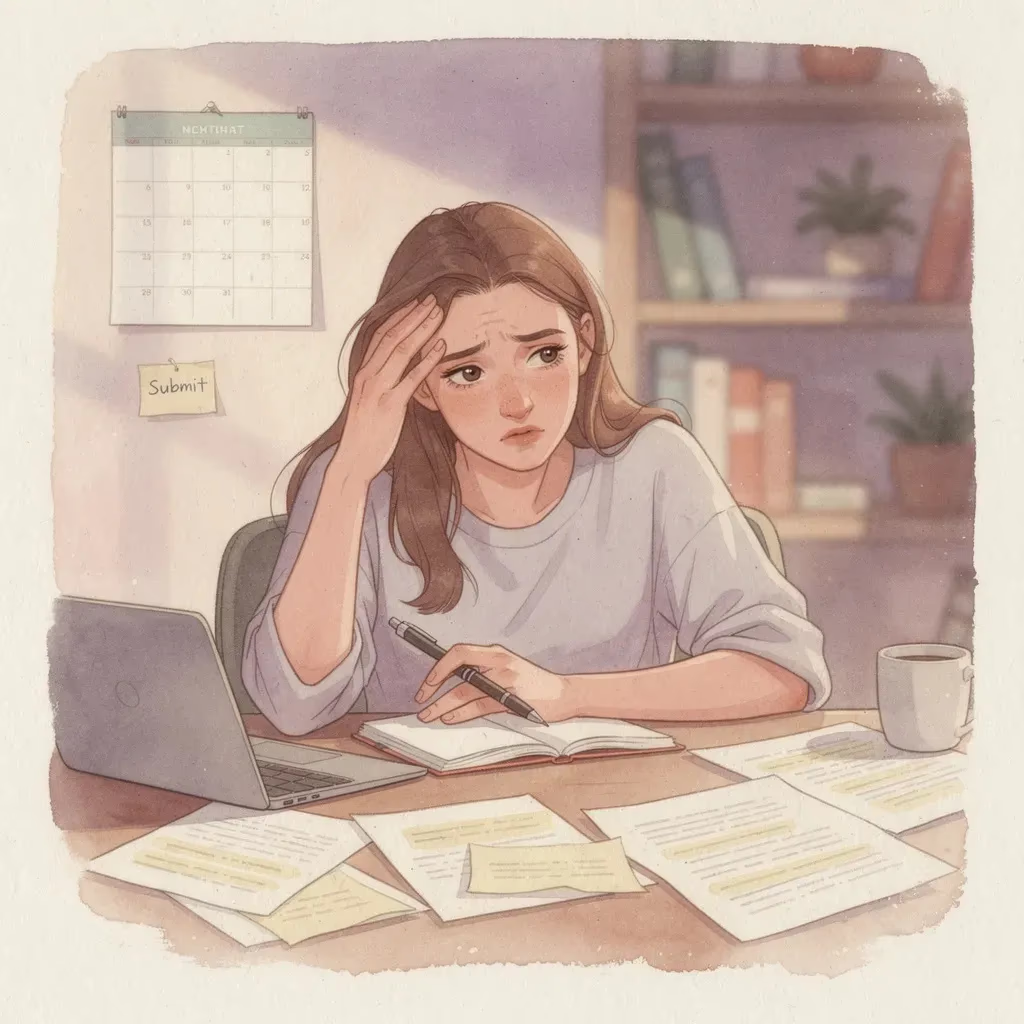
You don't just want to do well. You want to not be embarrassed. You want to not be judged. You want to not give anyone a reason to look at you differently.
Perfectionist Mind triggers often show up as that exact question: why do I get anxious for no reason right before you hit "send." Even when you logically know it's fine, your body acts like it's not.
This is one of the most common answers to what trigger anxiety in high-achieving women. Visibility feels risky. Mistakes feel expensive.
Perfectionist Mind Meaning
Core Understanding
If you recognize yourself in this pattern, your nervous system has learned that being evaluated equals being unsafe. Psychologists often describe this as social-evaluative threat, but in real life it looks like: your stomach flips when someone says "quick question," you sweat before presentations, and you rewrite one email until it doesn't sound like you.
This pattern often develops when approval, praise, or peace felt tied to achievement. Maybe you were the "good" one. Maybe you got rewarded for being easy, smart, high-performing. Many women with this type learned early that mistakes create consequences, even if the consequence was just a change in someone's mood.
Your body's wisdom shows up in the physical channel: tight throat, shaky hands, that wired feeling that keeps you up the night before. This is why you can keep asking why do I have anxiety when you're doing everything "right." Your nervous system doesn't care about right. It cares about safety.
What Perfectionist Mind Looks Like
- Over-preparing to feel safe: You make lists, outlines, backups, and you still don't feel ready. People see dedication. You feel like you're trying to prevent humiliation.
- Procrastinating because the stakes feel huge: It's not laziness. It's your body freezing because "doing it imperfectly" feels like danger. Then the deadline gets closer and the alarm gets louder.
- Rewriting tiny things: Texts, captions, emails, resumes, even casual messages. You're not trying to be fancy. You're trying to be un-attackable.
- Fear of being perceived: Being watched while you work, being called on unexpectedly, having people look at you during a meeting. It's a classic answer to what triggers social anxiety in work settings.
- An inner critic that thinks it's being helpful: "If I push you, you'll be safe." That voice isn't evil. It's protective. It's also exhausting.
- Relief only after it's over: You can't enjoy the thing while it's happening because you're monitoring performance. Afterward, your body collapses.
- Difficulty receiving feedback: Even kind notes can feel like danger because your system hears "you're not enough." You might smile and say thanks while your chest tightens.
- Comparing yourself constantly: You don't even want to. It happens automatically. Your brain scans for where you rank so you can adjust.
- Seeking certainty through perfection: Perfection becomes a safety strategy. It's your version of control, which answers what can trigger anxiety when life is vague.
- "If I relax, I'll fall behind": Rest feels like risk. You might feel guilty watching a show because your body thinks you should be improving.
- High standards in relationships too: You want to say the right thing, be the right amount of available, not be "too much." That pressure can create relationship anxiety triggers as well.
- Spirals after small mistakes: You mispronounce a word or send a typo and your mind goes "they think I'm incompetent." This is catastrophizing, not because you're irrational, but because you're trying to predict threat.
- Difficulty celebrating: You hit a goal and immediately raise the bar. Your nervous system never gets the message that you're safe now.
How Perfectionist Mind Shows Up in Different Areas of Life
In romantic relationships: You can feel like love is something you have to earn through being impressive, desirable, low-maintenance, and always "handling it." If you feel yourself asking why do I get anxious for no reason after you share a need, it's often the fear of being judged.
In friendships: You're dependable and thoughtful. You might also worry about being inconvenient. You may hide your messy feelings so you don't "burden" anyone.
At work: You're the person who catches errors and thinks five steps ahead. Your nervous system is also living under constant evaluation pressure. This is where "what trigger anxiety" becomes painfully obvious.
Under stress: You clamp down. You control details, check things repeatedly, and you might isolate so no one sees you struggle.
What Activates This Pattern
- Being watched, judged, graded, or compared
- Making mistakes in public (even tiny ones)
- Presentations, interviews, reviews, auditions
- Ambiguous feedback ("we'll see")
- High-stakes deadlines
- Social situations where you feel "on"
- Any moment you can't control perception
The Path Toward Performance Confidence
- You're allowed to be a work in progress: Your worth is not a deliverable.
- Practice "good enough" in low-stakes places: Tiny experiments teach your body that imperfection is survivable.
- Replace rehearsing with clarifying: Instead of re-writing a text ten times, ask one clear question.
- Women who understand this type often find they become calmer and more magnetic when they stop trying to be flawless and start being real.
Perfectionist Mind Celebrities
- Anya Taylor-Joy - Actress
- Zendaya - Actress
- Sydney Sweeney - Actress
- Jessica Chastain - Actress
- Natalie Portman - Actress
- Keira Knightley - Actress
- Michelle Pfeiffer - Actress
- Sigourney Weaver - Actress
- Karlie Kloss - Model
- Serena Williams - Athlete
Perfectionist Mind Compatibility
| Other Type | Fit | Why it feels this way |
|---|---|---|
| Sensitive Heart | 🙂 Works well | You can offer steadiness, they offer warmth, but reassurance needs can clash with your self-pressure. |
| Cautious Planner | 😐 Mixed | You both seek certainty, which can help, but can also turn into over-managing and burnout. |
| Overloaded Sensor | 🙂 Works well | Their sensory boundaries can teach you rest, while you can help them structure without overwhelm. |
| Intense Processor | 😕 Challenging | Your control reflex can feel invalidating to their feelings, and their intensity can spike your performance alarm. |
Am I a Cautious Planner?
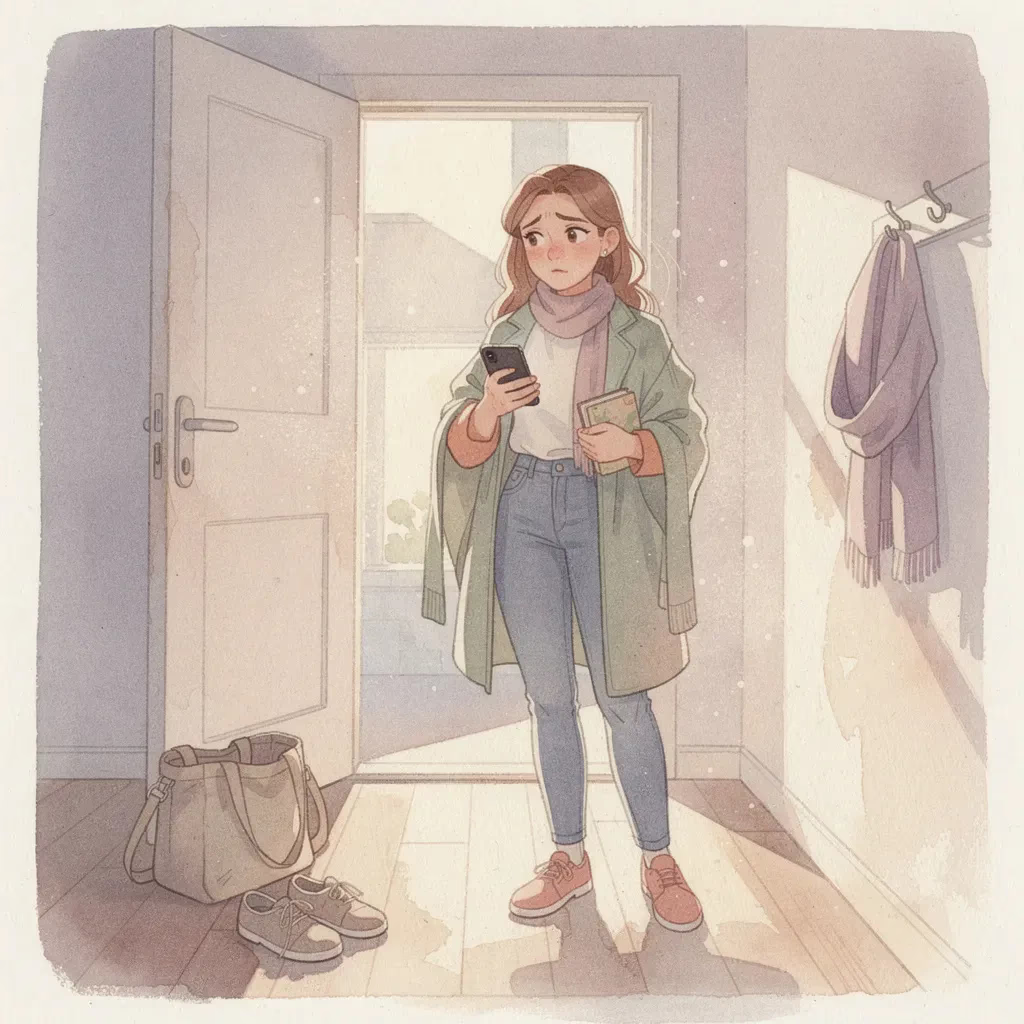
Plan changes shouldn't feel like a personal attack. And yet... when someone says, "Actually, can we do tomorrow?" your whole body tightens like it's bracing for impact.
If you're constantly searching what can trigger anxiety, the Cautious Planner answer is often: uncertainty. Not knowing. Vague timelines. Missing information. The dread before.
This is one of those types where why do I get anxious for no reason is basically code for "I don't have enough data to feel safe."
Cautious Planner Meaning
Core Understanding
If you recognize yourself in this pattern, your nervous system tries to create safety through clarity. It's not controlling for fun. It's controlling because ambiguity feels like standing on a floor that might drop out.
This pattern often emerges when life felt unpredictable. Or when you learned you had to be the responsible one. Many women with this type became planners because planning reduced consequences. When your system learns "preparing prevents pain," it will keep preparing.
Your body's wisdom shows up as tension when you can't plan: shallow breathing, a tight jaw, that "I can't settle" feeling. You might find yourself asking why do I have anxiety when your life looks organized on paper. The missing piece is that your nervous system still doesn't trust the unknown.
What Cautious Planner Looks Like
- Needing details to relax: You feel calm when you know the time, the place, the plan, the exit route. People might call you "organized." You're actually creating safety.
- Decision fatigue: Too many options short-circuit you. Picking a restaurant becomes a mini crisis because your brain wants to prevent regret.
- Waiting is the worst: Waiting for replies, waiting for results, waiting for someone to decide. Your body stays on alert because it can't close the loop.
- Over-researching: You read reviews, compare, ask around, and still feel uncertain. It's your mind trying to answer what trigger anxiety before it happens.
- A strong "what if" engine: You can imagine every possible outcome in seconds. This is catastrophizing with good intentions.
- Feeling edgy when plans are loose: "Let's play it by ear" sounds like danger. You might smile while your stomach drops.
- Safety-seeking behaviors: Checking weather apps, tracking packages, re-reading messages, confirming details. These behaviors give quick relief, then teach your system to need them.
- You crave clarity but fear what clarity might reveal: You want answers. You also dread answers. That tension can keep you stuck.
- Being the friend who coordinates everything: Group chats stress you out because no one answers clearly. You end up doing the work because you can't tolerate the uncertainty.
- Feeling responsible for preventing problems: You carry backup plans in your head. Others feel held. You feel tired.
- Hard time being spontaneous: Not because you're boring. Because your nervous system doesn't trust surprise.
- Quiet resentment: You plan around other people's chaos, then feel unseen for how much you do.
- Relief when you can "lock it in": Once a plan is final, your body softens. You can breathe again.
How Cautious Planner Shows Up in Different Areas of Life
In romantic relationships: The trigger isn't love. It's uncertainty in love. Mixed signals, inconsistent effort, vague future talk. You might keep asking why do I get anxious for no reason when the real answer is "I don't know where I stand."
In friendships: You're the organizer. The reliable one. You can also get quietly overwhelmed when friends are flaky because your system reads flakiness as instability.
At work: You shine in structure. Clear expectations calm you. Vague projects or unclear leadership can be a major answer to what can trigger anxiety for you.
Under stress: You tighten your grip. More lists, more checks, more planning. Your system is trying to reduce threat by reducing uncertainty.
What Activates This Pattern
- Last-minute changes
- Unclear timelines
- Waiting for someone else's decision
- "We'll see" conversations
- No response after you reach out
- Ambiguous relationship status
- Situations with no clear exit
The Path Toward Uncertainty Tolerance
- You're not wrong for wanting clarity: Clarity is a valid need.
- Practice "small uncertainty" on purpose: Tiny doses teach your body you can survive not knowing.
- Swap control for options: Instead of one perfect plan, hold two acceptable ones.
- Women who understand this type often find they stop burning energy on imaginary fires and start using that planning power for things they actually want.
Cautious Planner Celebrities
- Lily Collins - Actress
- Margot Robbie - Actress
- Emily Blunt - Actress
- Amy Adams - Actress
- Eva Mendes - Actress
- Cameron Diaz - Actress
- Andie MacDowell - Actress
- Diane Keaton - Actress
- Julianne Moore - Actress
- LeBron James - Athlete
- Tom Hanks - Actor
Cautious Planner Compatibility
| Other Type | Fit | Why it feels this way |
|---|---|---|
| Sensitive Heart | 😐 Mixed | Your structure can soothe them, but their reassurance needs can feel like another unknown to manage. |
| Perfectionist Mind | 😐 Mixed | You both seek certainty, but can accidentally create a pressure-cooker if neither allows "good enough." |
| Overloaded Sensor | 🙂 Works well | You can plan recovery time; they can remind you that rest is part of the plan. |
| Intense Processor | 😕 Challenging | Their emotional waves can feel unpredictable, and your need for clarity can feel like pressure to them. |
Am I an Overloaded Sensor?

Sometimes the trigger isn't a thought. It's a fluorescent light. It's the group chat. It's the third plan in a row when you haven't had one quiet hour to yourself.
If you've been asking what can trigger anxiety, this type is the answer that finally says: overstimulation counts. Your nervous system has a threshold, and modern life loves to bulldoze it.
Overloaded Sensor doesn't mean you're weak. It means your system is sensitive to input. That sensitivity is real.
Overloaded Sensor Meaning
Core Understanding
If you recognize yourself in this pattern, your nervous system gets set off by "too much": noise, social energy, constant notifications, crowded spaces, even intense conversations when you're already depleted. Your body registers overload before your mind labels it.
This pattern often develops when you've been the reliable one, the helper, the absorber. Many women with this type learned to stay available, stay pleasant, and keep going. Your system didn't get enough recovery time, so it started sounding the alarm sooner.
Your body's wisdom is loud: buzzing skin, headaches, irritability, tired eyes, that shaky "I need to get out" feeling. This is a huge reason you can wonder why do I get anxious for no reason when, technically, nothing is wrong. Something is wrong for your body: capacity is maxed out.
What Overloaded Sensor Looks Like
- Social hangovers: You can have fun and still feel wiped after. People might think you're flaky when you cancel later. Your body is protecting itself.
- Noise as a trigger: Loud bars, busy restaurants, roommates, city traffic. Your chest tightens and your brain gets foggy.
- Irritability that surprises you: You're kind. Then you snap. Then you feel guilty. The real problem is overstimulation, not your personality.
- Shutting down after too much input: You get quiet, stop texting, stop responding. It's not punishment. It's your system trying to recover.
- Being extra sensitive to touch when overwhelmed: Even a hug can feel like too much. You might pull away and then worry you hurt someone's feelings.
- Phone-triggered anxiety: Notifications feel like demands. Scrolling makes you wired. This is one of the modern answers to what trigger anxiety.
- Crowds and lines: Standing close to strangers, waiting with nowhere to go, bright lights. Your body starts scanning for exits.
- Hard transitions: Going from work mode to social mode with no buffer makes your system cranky and shaky.
- Absorbing room energy: You walk into a space and feel what everyone feels. Then you can't tell what's yours.
- Compulsive "escape plans": You pick seats near doors, you map bathrooms, you bring headphones. It looks picky. It feels like survival.
- Skin-crawly overstimulation: Tags, fabrics, temperature changes, strong smells. Your body reacts first.
- Needing solitude to reset: Not because you hate people. Because your system needs quiet to return to baseline.
- Feeling guilty for needing less: You compare yourself to friends who can do three events in a weekend. Then you spiral into shame.
How Overloaded Sensor Shows Up in Different Areas of Life
In romantic relationships: You can adore someone and still need space. If your partner takes your downtime personally, you can feel trapped. That trapped feeling is a major answer to what can trigger anxiety.
In friendships: You love deep one-on-one time. Group hangs can be draining. You may be the friend who disappears for a week and then comes back with love, and lots of apologies you don't actually owe.
At work: Open offices, constant pings, meetings stacked back-to-back. Your focus drops and your body gets tense. It's not a motivation problem. It's sensory load.
Under stress: Your threshold gets lower. Things that usually feel fine start feeling unbearable. Your nervous system is already running hot, so small inputs feel huge.
What Activates This Pattern
- Loud environments and crowded spaces
- Back-to-back plans with no recovery time
- Constant notifications and group chats
- Bright lights, strong smells, uncomfortable clothes
- Being "on" socially for too long
- Unexpected touch when you're already overloaded
- Feeling trapped with no exit
The Path Toward Sensory Resilience
- You're allowed to protect your bandwidth: Rest isn't earned. It's required.
- Tiny boundaries change everything: One "I can't tonight" can prevent a three-day crash.
- Name the input, not the flaw: "I'm overstimulated" is more accurate than "I'm being weird."
- Women who understand this type often find they become more present in relationships when they stop forcing themselves past capacity.
Overloaded Sensor Celebrities
- Dakota Johnson - Actress
- Saoirse Ronan - Actress
- Carey Mulligan - Actress
- Alicia Vikander - Actress
- Kirsten Dunst - Actress
- Liv Tyler - Actress
- Molly Ringwald - Actress
- Keri Russell - Actress
- Tom Holland - Actor
- Andrew Garfield - Actor
- Cillian Murphy - Actor
Overloaded Sensor Compatibility
| Other Type | Fit | Why it feels this way |
|---|---|---|
| Sensitive Heart | 🙂 Works well | If you communicate downtime clearly, they can feel secure without chasing, and you can feel free without guilt. |
| Perfectionist Mind | 🙂 Works well | You can teach rest; they can help with structure, as long as they don't turn recovery into another task. |
| Cautious Planner | 🙂 Works well | Their planning can protect your capacity, and your boundaries can help them relax their grip. |
| Intense Processor | 😐 Mixed | Intensity can be beautiful, but too much emotional input without recovery time can overload you quickly. |
Am I an Intense Processor?

Some people feel a feeling and move on. You feel a feeling and it becomes weather. It rolls through your body, lingers in your chest, and shows up later when you're trying to sleep.
If you've ever wondered why do I have anxiety when your life is okay, Intense Processor triggers often answer: the intensity itself. Your nervous system spikes higher and takes longer to settle.
This type doesn't mean you're unstable. It means your system is deeply responsive. You pick up meaning fast, and you feel it fully.
Intense Processor Meaning
Core Understanding
If you recognize yourself in this pattern, your nervous system doesn't do half-measures. When something feels uncertain, disappointing, or emotionally sharp, your body reacts fast and big. Psychologists often talk about emotional reactivity, but what you feel is: "I can't just shake it off."
This pattern often develops when you didn't have enough steady support while you were feeling big things. Many women with this type learned to process alone, to make sense of emotions in silence. So now, when something hits, your system runs the whole movie by itself.
Your body's wisdom is obvious: tears, heat in your face, a tight throat, a racing heart. The spiral is not "for attention." It's a nervous system trying to metabolize intensity. This is why you might ask why do I get anxious for no reason when the trigger was subtle, a tone shift, a memory, a look.
What Intense Processor Looks Like
- Emotions arrive fast: A small comment can land like a heavy stone in your stomach. Others might not notice. You feel it everywhere.
- Long recovery time: You can be "over it" mentally while your body still buzzes. It's the aftershock that keeps you up.
- Tears as a release, not a weapon: You cry when you're overwhelmed, relieved, angry, or touched. Then you feel embarrassed, which adds a second layer of anxiety.
- Deep meaning-making: You search for what it meant, what it says about you, what it says about the relationship. That's how your mind tries to answer what trigger anxiety for next time.
- Rumination as comfort: Replaying feels like control. It feels like solving. It rarely solves.
- High empathy, high absorption: You can feel other people's moods in your own body. Then you wonder what's yours.
- Strong intuition mixed with fear: Sometimes you're right about a vibe. Sometimes anxiety is shouting. Telling the difference can be hard.
- Craving repair and depth: Surface-level reassurance doesn't always land. You want real clarity and emotional presence.
- Avoiding conflict but also exploding: You hold it in to keep peace, then it comes out sideways. Not because you're dramatic, but because you've been full for too long.
- Feeling "too much": You've probably been told you're intense. You start hiding your feelings to stay lovable.
- Big love, big fear: When you care, you care. That's beautiful. It also makes uncertainty feel sharper.
- Sensitivity to rejection cues: A delayed response or vague message can trigger fear quickly. It overlaps with "what triggers social anxiety" when connection feels uncertain.
- Needing time to process before you talk: In the moment, your body is too activated to find the words. Later, you can explain perfectly.
How Intense Processor Shows Up in Different Areas of Life
In romantic relationships: You want emotional consistency. You want repair. You want to feel chosen in ways that land in your body, not just your mind. If your partner shuts down, it can be one of the strongest answers to what can trigger anxiety.
In friendships: You're the friend who remembers the details. You show up deeply. You can also feel crushed when effort isn't matched.
At work: Feedback can hit hard. Conflict in teams can linger in your body for days, even if you keep performing fine on the outside.
Under stress: Your system stacks triggers. One small thing on top of another becomes a wave. You might cry in a bathroom, go quiet, or spiral at night when the day finally stops distracting you.
What Activates This Pattern
- Emotional uncertainty and mixed signals
- Feeling misunderstood
- Conflict that ends without repair
- Sudden criticism or harsh tone
- Big life transitions
- Being alone with your thoughts after an intense day
- Any situation where you feel "too much"
The Path Toward Inner Steadiness
- Your intensity is not the enemy: It's information. It's depth. It's care.
- Give feelings a container: Journaling, voice notes, movement, creative outlets. Your body needs somewhere to put what it's holding.
- Practice asking for the kind of support that lands: Not "fix me." More like "Can you stay with me for a minute?"
- Women who understand this type often find they become calmer faster, not because they feel less, but because they stop fighting the feeling.
Intense Processor Celebrities
- Selena Gomez - Singer
- Millie Bobby Brown - Actress
- Billie Eilish - Singer
- Ariana Grande - Singer
- Jennifer Lawrence - Actress
- Emma Thompson - Actress
- Kate Winslet - Actress
- Winona Ryder - Actress
- Sarah Jessica Parker - Actress
- Robert Pattinson - Actor
- Bruno Mars - Singer
Intense Processor Compatibility
| Other Type | Fit | Why it feels this way |
|---|---|---|
| Sensitive Heart | 😐 Mixed | You both crave repair, but if neither feels grounded, reassurance-seeking can snowball quickly. |
| Perfectionist Mind | 😕 Challenging | They may try to "logic" your feelings, and you may experience that as dismissal. |
| Cautious Planner | 😕 Challenging | Your emotional waves can feel unpredictable to them, and their need for clarity can feel like pressure to you. |
| Overloaded Sensor | 😐 Mixed | They need quiet; you need connection. It works when you both honor recovery time and communicate it clearly. |
The Nervous System Compass: what this Anxiety Triggers quiz actually reveals about you
You didn't come here because you love reading about feelings for fun. You came here because something keeps happening and you're tired of being blindsided.
You keep asking questions like why do I have anxiety and why do I get anxious for no reason, and you're hoping someone will finally give you an answer that fits your real life. Not a generic "reduce stress" lecture. Not a vibe. A pattern.
This is the pattern: anxiety triggers usually live in one (or a mix) of five directions. Connection. Competence. Control. Comfort. Capacity. Different women have different "loudest" directions. That's why two people can have the same day, and only one ends up in a spiral.
What this Anxiety Triggers quiz reveals about you
This quiz maps the main channels where your nervous system gets set off, plus the "aftershocks" that keep it going.
- Connection triggers (Sensitive Heart): This is about relationship cues, closeness, distance, tone shifts, and that "where do I stand?" feeling. It's often the hidden answer to what triggers social anxiety, because social safety is really about belonging, not popularity.
- Competence triggers (Perfectionist Mind): This is the part of you that feels activated by evaluation, mistakes, being watched, being graded, or feeling behind. It's a common reason you can ask why do I get anxious for no reason before something important.
- Control triggers (Cautious Planner): This is your system reacting to ambiguity, missing information, unclear outcomes, and plan changes. If your chest tightens in the waiting phase, this is likely where what trigger anxiety is coming from.
- Comfort triggers (Overloaded Sensor): This is your body reacting to too much sensory input, too much social input, too much digital input, or physical discomfort. It answers what can trigger anxiety when the trigger is literally the environment.
- Capacity (Intense Processor): This is how big your activation gets and how long it lingers. Some women spike fast and recover fast. Some spike and carry it for days.
Then we add the layers that decide whether a trigger becomes a moment or a spiral:
- Catastrophizing (worst-case jumps): That moment when a short text turns into "they hate me" in 12 seconds. It's your brain trying to prevent pain by predicting it.
- Rumination (thought loops): 3am ceiling-staring, replaying the conversation like it's a courtroom case. It feels like solving. It's usually feeding the alarm.
- Present-moment awareness (staying here): When you're triggered, can you stay anchored, or do you time-travel into past/future instantly?
- Perspective-taking (not making it about you): Can you hold "maybe they're stressed" alongside "maybe they're mad at me"? This one matters a lot for what triggers social anxiety.
- Self-compassion (how you talk to yourself): When you're anxious, do you comfort yourself or attack yourself? Self-attack makes triggers louder and longer.
- Emotional expression (saying what's true): Do you name what you feel, or swallow it until it comes out sideways?
- Safety-seeking (the urge to make it stop): Reassurance, checking, controlling, avoiding. These work short-term and can keep anxiety sticky long-term.
- Growth orientation (willingness to try something new): Not "be perfect." More like "I can learn my pattern without hating myself."
If you've been stuck on why do I have anxiety, this is the answer you've been looking for: your nervous system learned what to watch for. Now you're learning its language.
Where you'll see this play out
In relationships: This is the most obvious place anxiety triggers show up, especially if connection is your loudest direction. You'll see it in the gap between messages, the change in tone, the "we should talk" text, the silence after you share something vulnerable. Your body reacts first, then your mind tries to explain it.
In friendships: Group chats, delayed replies, feeling like you're the one who always reaches out. That's where what triggers social anxiety can show up without you ever feeling "socially anxious" in the stereotypical way. You can be confident and still feel activated by belonging cues.
In work or school: Feedback, presentations, performance reviews, being called on, being seen making mistakes. This is where a lot of women ask why do I get anxious for no reason because the threat isn't real danger. It's the fear of being judged and losing respect.
In daily life decisions: Choosing a plan, committing to something, making the "wrong" choice, getting stuck in comparison, feeling overwhelmed by options. This is where what can trigger anxiety often looks like "small things," but the body experience is not small.
What most people get wrong (and what's actually true)
- Myth: "If it's not logical, it's not real." Reality: Your body signals can be real even when the situation is safe on paper.
- Myth: "I should be able to handle this." Reality: Capacity changes. Sleep, stress, and overstimulation change what trigger anxiety day-to-day.
- Myth: "Needing reassurance is pathetic." Reality: Reassurance is a normal human need. The goal is learning how to ask for it clearly, and also how to soothe yourself.
- Myth: "If I avoid triggers, I'll be fine." Reality: Avoidance can shrink your life. Understanding your triggers lets you respond with care instead of fear.
- Myth: "My anxiety means something is wrong with me." Reality: Anxiety usually means your nervous system is trying to protect you.
- Myth: "Everyone else is calmer than me." Reality: So many women are carrying the same trigger loops. They're just hiding it better.
- Myth: "I'll feel better once I have certainty." Reality: Certainty helps, but learning to tolerate the unknown is what creates lasting steadiness.
When anxiety feels random, you end up living on edge
If you keep Googling why do I have anxiety and why do I get anxious for no reason, it's usually because you don't have a trigger map yet. Once you can name what trigger anxiety and what can trigger anxiety in your actual life, your nervous system stops feeling like an unpredictable enemy and starts feeling like information you can work with.
- 🔎 Discover why do I have anxiety patterns (without blaming yourself)
- 🧩 Understand why do I get anxious for no reason moments (and what they're actually about)
- ⚡ Recognize what trigger anxiety in your body first (before the thought spiral)
- 🗺️ Name what can trigger anxiety in relationships, work, and daily life
- 💬 Clarify what triggers social anxiety for you, especially around belonging cues
- 🤍 Honor your needs with less guilt
Where you are now vs. what becomes possible
| Where you are now | What becomes possible |
|---|---|
| You feel blindsided and ask "why do I get anxious for no reason" | You see the early cue and the spiral starts later (or not at all) |
| You assume your anxiety means you're "too much" | You treat it as a body signal, not a character flaw |
| You keep guessing what trigger anxiety | You can name it: connection, pressure, uncertainty, overstimulation, intensity |
| You over-explain to keep people close | You ask clearly for what helps and stop apologizing for having needs |
| You push past capacity until you crash | You build tiny protections that keep you steady |
Join over 159,329 women who've taken this under 5 minutes Anxiety Triggers quiz free for private results. Your answers stay private, and the clarity is yours to keep.
FAQ
What are anxiety triggers, and why do they feel so random?
Anxiety triggers are specific internal or external cues that your nervous system interprets as danger, even when your logical mind knows you're "fine." They can feel random because your body reacts faster than your conscious thoughts. So you end up thinking, "Why do I get anxious for no reason?" when the reason is just hidden under the surface.
If you've ever had that whiplash moment, laughing with friends, then suddenly your chest tightens and you can't explain why, you're in very familiar company. So many of us are walking around with a nervous system that learned to be on-call.
Here's what's actually happening:
- Your brain is a pattern detector. If something in the present reminds your body of a past threat (rejection, conflict, humiliation, losing control), your system reacts.
- Triggers aren't always obvious events. They can be tiny: a tone shift, a delayed text, a door closing a little too loudly.
- Your body stores associations. A certain smell, song, time of day, or lighting can quietly link back to a stressful memory.
- Anxiety can be delayed. You might handle something stressful in the moment, then your body processes it later when you're finally "safe."
Common anxiety triggers (the kind many women don't realize count) include:
- Uncertainty: waiting for an answer, unclear plans, situations with no "script"
- Interpersonal cues: being left on read, a partner seeming distant, a friend being short
- Performance pressure: presentations, interviews, being watched while you work
- Overstimulation: too many notifications, loud environments, busy stores
- Body-based triggers: caffeine, low blood sugar, lack of sleep, hormonal shifts
- Emotional echoes: anniversaries of hard events, conflict that resembles past conflict
A helpful reframe: your sensitivity is data, not damage. If you keep asking "What can trigger anxiety?" the answer is often "anything that your nervous system has learned equals risk."
If you want a gentle way to identify anxiety triggers without over-pathologizing yourself, a quiz can help you spot the patterns your body already knows.
Why do I feel anxious all the time, even when nothing is wrong?
You can feel anxious all the time because your nervous system may be stuck in a chronic state of activation, like it's bracing for impact. It doesn't mean you're broken. It means your body learned that being prepared was safer than being surprised. This is one of the most common reasons people search "why do I feel anxious all the time" or "why does everything make me anxious."
If you're the kind of person who can sense a mood shift across a room, or you notice a one-word change in a text message, of course your system gets tired. You've been running a background scan for danger.
There are a few big reasons anxiety can feel constant:
Your baseline is stressed, not calm
- When stress is steady (school, work, money, family stuff, relationship tension), your body can forget what "off" feels like.
- Your anxiety might not spike. It just hums.
You are carrying unresolved fear
- Not dramatic, not obvious. More like: "If I mess up, I lose love." "If I'm not useful, I'm disposable." "If I'm honest, I get rejected."
- Those beliefs create internal triggers all day long.
Avoidance keeps anxiety alive
- When you avoid what scares you, your nervous system never gets the update that you could survive it.
- So anxiety stays on, trying to keep you away from "risk."
Your body is sounding the alarm for physical reasons
- Caffeine, poor sleep, dehydration, hormone shifts, low iron, thyroid issues, and blood sugar dips can all mimic anxiety symptoms.
- This isn't "all in your head." It's your body talking.
Relationship uncertainty is a huge trigger
- For many women with an anxious attachment pattern, inconsistency (hot and cold behavior, unclear labels, delayed reassurance) keeps the nervous system activated.
A practical way to start sorting this out is to separate anxiety into two buckets:
- Situational anxiety: linked to specific stressors (a deadline, a conversation, a crowd)
- Baseline anxiety: present even in calm moments (often tied to chronic stress, hypervigilance, or physical factors)
If you're consistently thinking "am I too sensitive or is this anxiety," the honest answer is often: it's both. You're sensitive, and your nervous system is working overtime.
The quiz can help you name what kind of trigger profile you have (for example, relationship cues vs. perfection pressure vs. sensory overload), so you stop treating every anxious moment like a mystery.
What can trigger anxiety in relationships (especially texting, tone changes, and distance)?
In relationships, anxiety is often triggered by perceived disconnection: anything your nervous system reads as "I might be losing them." That includes texting changes, tone shifts, less affection, slower replies, or a partner needing space. This is a big reason people search "what triggers social anxiety" and relationship anxiety questions, because the body reacts socially, not logically.
If you know the exact feeling of staring at your phone, trying to act chill, while your mind runs 40 worst-case scenarios, you are not alone. A lot of women learned love through inconsistency, so consistency now feels like the only oxygen.
Common relationship-based anxiety triggers include:
Delayed replies or "dry" texts
- Not because you're needy.
- Because unpredictability is a nervous system trigger.
A change in routine
- Good morning texts stop.
- Plans are less certain.
- Affection feels different.
Tone changes
- A shorter response.
- A sigh.
- A "k" instead of "okay."
- Your system flags it as danger and tries to decode it.
Conflict or emotional distance
- Even mild conflict can feel like abandonment if your system equates disagreement with loss.
- Some of us learned: "If they're upset, I'm about to be left."
Ambiguous commitment
- "We're just seeing where it goes."
- Unclear labels.
- Mixed signals.
- These create a constant uncertainty loop.
Power imbalances
- You feel like you're always the one reaching out, repairing, explaining, softening.
- That drains your safety.
A gentle truth: relationship triggers are often about survival, not drama. Your nervous system is trying to protect your connection. It just uses anxious strategies because they worked before (monitoring, people-pleasing, over-explaining, chasing reassurance).
Micro-skill that helps (without forcing you to "just calm down"):
- Ask: "Is this a present-moment fact, or a familiar fear?"
- Fact: "He replied 5 hours later."
- Fear story: "He doesn't care. He's pulling away. I'm about to be replaced."
You don't have to ignore your instincts. You just get to separate instinct from old fear.
If you're trying to identify anxiety triggers in dating or relationships, the quiz can help you see whether your nervous system is most reactive to abandonment cues, conflict cues, inconsistency, or feeling "not chosen."
Why do I get anxious for no reason, then later realize I was overwhelmed?
You can get anxious "for no reason" because overwhelm often builds quietly, then your nervous system hits a threshold and sounds the alarm. The trigger wasn't one dramatic thing. It was the pile-up. This is especially common if you've been high-functioning, responsible, and emotionally "fine" until you're suddenly not.
If you've ever been the person who keeps it together all day, then breaks down the second you get in the car, that makes perfect sense. Your body waited until it had privacy and enough safety to finally feel what it couldn't feel earlier.
This pattern usually comes from a few places:
You normalize stress
- When you've been stressed for years, you stop labeling it as stress.
- You think you're okay because you can still perform, but your nervous system is keeping score.
You dissociate from early signals
- Early signs like jaw tension, shallow breathing, irritability, or brain fog get ignored.
- Then anxiety shows up as the "louder" symptom.
You are overstimulated
- Noise, social demands, constant texting, lights, commuting, crowds.
- If you're sensitive, your system gets flooded faster. This is why so many people ask, "why does everything make me anxious?"
Your anxiety is protective
- Sometimes anxiety is your body trying to create control when life feels too big.
- The "reason" might be: you have no margin.
A simple way to track overwhelm-related triggers is to look for the pattern of "too much, too fast, too long":
- Too much input (people, tasks, noise)
- Too fast (no breaks between demands)
- Too long (no real recovery time)
Common hidden overwhelm triggers:
- Back-to-back plans with no alone time
- Socializing that requires constant masking or people-pleasing
- Living on caffeine and adrenaline
- Feeling responsible for everyone's emotions
- Big life transitions (new job, breakup, moving)
If you're stuck in "how to identify anxiety triggers" mode and you want something clearer than "reduce stress," you might love seeing your specific trigger profile laid out. It helps you stop blaming your personality and start understanding your nervous system.
Is anxiety triggered by hormones, caffeine, or lack of sleep? (Or is that just me?)
Yes. Hormones, caffeine, and sleep can absolutely trigger anxiety because they directly affect arousal in the nervous system. This isn't you being "dramatic." It's biology. For a lot of women, this is the missing puzzle piece behind "why do I have anxiety" and "why do I feel anxious all the time."
If you have days where your mind is calm but your body is buzzing, pay attention to the body inputs. They matter.
Here are the biggest physical anxiety triggers people underestimate:
Caffeine
- It increases heart rate and adrenaline-like sensations.
- If you're already stressed, caffeine can push you into panic symptoms (shaky, sweaty, racing thoughts).
- Your brain can interpret those sensations as danger.
Lack of sleep
- Sleep loss reduces emotional regulation and increases threat sensitivity.
- You may feel more reactive, more teary, more "everything is too much."
- Even one bad night can raise baseline anxiety.
Blood sugar dips
- Skipping meals, eating very little protein, or long gaps between meals can create jitteriness and irritability that feels like anxiety.
- Your body reads "low fuel" as "something is wrong."
Hormonal changes
- PMS and PMDD symptoms can include anxiety, rumination, panic, and sensitivity to rejection.
- Ovulation can also shift mood for some women.
- Postpartum and perimenopause are big transition periods too.
Dehydration
- Mild dehydration can increase heart palpitations and fatigue, which can spiral into anxious interpretation.
Two things can be true at once:
- Your anxiety has emotional roots (stress, attachment wounds, pressure).
- Your body can amplify it through physical triggers.
Practical value without forcing you into a rigid routine:
- If you track anxiety spikes for two weeks, note: caffeine timing, sleep hours, meals, and cycle day.
- Patterns usually show up fast. That information is power, not homework.
And if you're wondering "am I too sensitive or is this anxiety," physical triggers often hit sensitive nervous systems harder. It doesn't mean you're fragile. It means your system is responsive.
Our quiz helps you see whether your triggers lean more physical and sensory, more relational, or more perfection-driven, so you can stop treating all anxiety like it's the same thing.
How do I identify my anxiety triggers without spiraling or overanalyzing?
You identify anxiety triggers by looking for repeatable patterns: what happened right before the shift in your body or thoughts. The key is doing it gently, because if you're prone to overthinking, "tracking triggers" can become its own trigger. This is the heart of how to identify anxiety triggers without turning your life into a detective board.
If you tend to be a "make sense of everything" girl, of course you'll want an answer fast. Your mind is trying to protect you by creating certainty. That makes perfect sense.
A nervous-system-friendly way to identify triggers is to track categories, not every detail.
Try these five trigger buckets:
- People triggers
- conflict, criticism, distance, being misunderstood, feeling excluded
- Pressure triggers
- deadlines, perfectionism, being evaluated, fear of disappointing someone
- Uncertainty triggers
- waiting, ambiguous plans, unclear relationships, "I don't know yet" situations
- Sensory triggers
- noise, crowds, bright lights, messy spaces, too many notifications
- Body triggers
- caffeine, hunger, sleep loss, cycle changes
Then use a simple three-line check-in (quick enough that it doesn't feed the spiral):
- What was I doing right before anxiety?
- What did my body feel first? (tight chest, nausea, racing heart, heat, tears)
- What story did my mind immediately tell? ("I'm in trouble," "I'm not enough," "They're mad," "I'm going to mess this up.")
This matters because triggers often attach to:
- A body sensation (heart racing)
- A meaning (danger, rejection, failure)
- A coping move (over-explaining, people-pleasing, avoidance, checking)
When you can name that chain, the anxiety becomes less mysterious. And when anxiety is less mysterious, it's less powerful.
If you've been googling "why do I get anxious for no reason," this process is how you find the "reason" without blaming yourself.
A quiz can shortcut this gently. Instead of you having to hold all the data in your head, it organizes your trigger patterns into something you can actually use.
How accurate is a free "what triggers anxiety" quiz? What can it actually tell me?
A free "what triggers anxiety quiz" can be accurate in the way that matters most: it can reflect your patterns back to you clearly, so you stop feeling like your anxiety is random. It won't diagnose a disorder, and it can't replace therapy or medical care. What it can do is help you name the specific kinds of triggers that set off your nervous system.
If you're asking this, you probably want something you can trust. That makes sense. When you've been living with anxiety, you get tired of vague advice like "reduce stress" or "just relax." You're looking for a map.
A well-designed anxiety trigger quiz can help you:
Identify your dominant trigger theme
- Some people get set off by relationships and rejection cues.
- Some by performance pressure and perfectionism.
- Some by sensory overload or physical stressors.
- Most of us are a blend, but there is usually a strongest pull.
Separate anxiety from personality
- You might be sensitive and intuitive, and also anxious.
- Knowing the difference helps you stop shaming yourself.
Find language for what you feel
- When you can name your triggers, you can communicate them.
- This is huge in relationships, work, and friendships.
Spot your coping pattern
- Do you overthink? People-please? Avoid? Get controlling? Shut down?
- Triggers and coping moves often come as a pair.
What affects quiz accuracy:
- Your honesty with yourself
- Not "perfect honesty." Just real honesty.
- Your current stress level
- When you're burned out, everything feels like a trigger.
- Whether questions are specific
- Specific scenarios get more reliable answers than vague statements.
If you keep thinking "why do I have anxiety" or "why does everything make me anxious," a quiz can give you a starting framework. Then you can test it against your real life and refine it.
And honestly? The best outcome isn't a label. It's relief. That feeling of, "Oh. Of course I react like this. There's a reason."
Can anxiety triggers change over time, and can I actually retrain my nervous system?
Yes. Anxiety triggers can change over time, and you can retrain your nervous system. Triggers are learned associations, which means they can be unlearned or softened through repeated experiences of safety, support, and regulation. If you've been stuck thinking "why do I feel anxious all the time," this is the hopeful part: your baseline is not permanent.
It makes perfect sense if you feel skeptical. When your body has been on high alert for years, "retraining" can sound like a fantasy. But the truth is simpler: your nervous system updates through repetition.
Triggers change for a few reasons:
- Your life circumstances change
- A stable relationship, a safer job, leaving a toxic environment, or getting financial breathing room can reduce activation.
- You build new coping skills
- The trigger might still show up, but your recovery gets faster.
- You process old experiences
- Therapy, journaling, somatic work, support groups, honest conversations.
- When the meaning of a memory shifts, the trigger often loses power.
- Your body changes
- Sleep, hormones, medication changes, nutrition, movement, chronic illness management.
Retraining your nervous system usually looks like:
- Awareness without self-attack
- "This is a trigger response." Not "I'm ridiculous."
- Reducing avoidable triggers
- Not forever. Just enough to create safety and margin.
- Practicing tolerance for the trigger in small doses
- Gentle exposures to uncertainty, conflict, or sensations, so your body learns, "I can handle this."
- Building co-regulation
- Safe people matter. Calm nervous systems are contagious.
- Consistency
- Your body trusts patterns, not promises.
One of the biggest shifts women report is not "I never get triggered." It's: "I get triggered and I don't abandon myself anymore."
If you're wondering "what triggers social anxiety" or "what can trigger anxiety," you might also be wondering which triggers are actually yours to work with first. That's where a trigger profile helps. It gives you a starting point that matches your real life.
What's the Research?
Your nervous system isn't "dramatic". It's doing its job.
That moment when your chest tightens because someone read your message but didn't reply? Or when you walk into a room and instantly start scanning faces, tone, micro-expressions, the vibe... like your body is trying to solve a puzzle before anything "bad" happens?
Of course you feel like you get anxious for no reason. A lot of the time, the trigger isn't logical. It's pattern-based.
Across clinical overviews, anxiety is basically your brain anticipating threat (even if the threat is social, emotional, or hypothetical), and it tends to show up as very real body symptoms: racing heart, rapid breathing, sweating, stomach upset, muscle tension, trouble concentrating, trouble sleeping (Mayo Clinic). Research summaries also point out how common anxiety disorders are: about one in three people will experience an anxiety disorder at some point in life (NIMH; UC Davis Health). And women are diagnosed about twice as often as men, which tracks with what so many of us quietly live with (Cleveland Clinic).
Underneath the emotion is a body system. The autonomic nervous system (your body's "autopilot") regulates heart rate, breathing, digestion, sweating, and more (Cleveland Clinic; StatPearls). When your brain flags "danger," it tends to shift you toward sympathetic activation (fight-or-flight), and away from parasympathetic calming (rest-and-digest) (Harvard Health; Mayo Clinic).
If you feel like your body reacts before your mind even catches up, that's not you being "too much." That's your nervous system firing on old data.
What actually triggers anxiety (hint: it's not always the obvious stuff)
When people search "what can trigger anxiety," they usually imagine big, dramatic events. But research on stress physiology makes something clear: anything that disrupts your sense of safety or stability can count as a stressor, including psychological stressors that aren't life-threatening (Harvard Health; StatPearls).
Here are the most common trigger categories, translated into real life:
Uncertainty and lack of control. Your brain treats unpredictability like risk. Deadlines, waiting to hear back, "we need to talk," unclear expectations at work, mixed signals in dating. These are classic anxiety fuel because your system can't "close the loop." Chronic stress articles describe how everyday pressures can keep the stress response switched on over time (Mayo Clinic; Harvard Health).
Social evaluation and rejection cues. Anxiety isn't only fear of danger. It's also fear of being judged, excluded, or abandoned. Social anxiety is specifically tied to fear of negative evaluation (Wikipedia: Anxiety). For someone with anxious attachment patterns, "small" social cues can feel huge because they used to mean something.
Body sensations that feel like danger. Sometimes the trigger is internal: a racing heart, dizziness, shortness of breath, nausea. Anxiety can be set off by noticing sensations and then worrying about what they mean (Mayo Clinic; Wikipedia: Anxiety). This is one reason panic can feel like it comes out of nowhere, even when it doesn't.
Chronic stress buildup (the slow burn). A single stressor can be manageable. But repeated activation of the stress response, especially when you never fully come down, creates wear and tear that increases anxiety vulnerability (Harvard Health; Mayo Clinic). Your body starts living "on alert" as a baseline.
Sensory overload and environmental pressure. Bright lights, noise, crowded places, constant notifications. This isn't "being dramatic." When your system is already stressed, extra sensory input can push you over the edge because your body reads it as "too much to process safely." (This will matter a lot if you resonate with the Overloaded Sensor or Intense Processor patterns.)
Substances and physiology that mimic anxiety. Caffeine can increase sympathetic activation for many people, and can amplify jittery sensations that your brain then interprets as anxiety. Anxiety-like symptoms can also overlap with medical conditions, which is why reputable sources emphasize considering health factors when symptoms feel sudden or intense (Wikipedia: Anxiety).
The "trigger" is often less about what's happening and more about what your nervous system predicts is about to happen.
The mechanism: why your body hits the alarm button so fast
This part is weirdly comforting once you understand it.
The stress response exists to keep you alive. When the brain perceives threat, the body releases stress hormones like adrenaline and cortisol, shifting your heart rate, breathing, muscles, and attention into "ready" mode (Mayo Clinic; Harvard Health). This is mediated through systems like the sympathetic-adreno-medullar axis and the hypothalamic-pituitary-adrenal axis (StatPearls).
In a true emergency, that's brilliant. In modern life, your brain can label non-lethal things as threats: criticism, conflict, being ignored, disappointing someone, making a mistake, feeling "too needy." So your body launches the same survival response it would use for a real danger, because it cannot always tell the difference between physical danger and emotional risk.
And once the response is activated a lot, it starts getting easier to activate. Chronic stress can literally contribute to changes that are linked with anxiety and depression over time (Harvard Health). So if you feel like "everything makes me anxious," it may not be because everything is objectively threatening. It may be because your system has been running too hot for too long.
Your anxiety isn't random. It's your body trying to prevent pain using the best pattern it has.
Why this matters (and what your quiz results are really pointing to)
If you've ever taken a "what triggers anxiety quiz free" and felt both seen and exposed, that makes sense. Naming triggers can feel like ripping off a coping strategy you worked hard to build.
But understanding triggers doesn't make you fragile. It makes you effective.
When you can identify what sets off your nervous system, you stop fighting yourself and start working with your biology. You might realize:
- you're not "clingy," you're reacting to inconsistent connection (Sensitive Heart)
- you're not "high maintenance," you're living under pressure to be perfect (Perfectionist Mind)
- you're not "boring," you're trying to prevent uncertainty from swallowing you (Cautious Planner)
- you're not "overreacting," you're overstimulated and maxed out (Overloaded Sensor)
- you're not "too intense," you're processing deeply and fast (Intense Processor)
This is also why the question "why do I have anxiety" often has multiple answers at once. Anxiety triggers are usually layered: stress + uncertainty + social cues + body sensations + exhaustion. None of this is a moral failure.
You don't have to earn calm by proving you're low-maintenance. Your nervous system deserves safety too.
While research reveals these patterns across women navigating similar pressures, your report shows which specific patterns are shaping your experience, and where your unique strengths already live.
References
Want to go a little deeper? These are the sources I pulled from (and they're genuinely helpful):
- Anxiety disorders - Symptoms and causes (Mayo Clinic)
- Anxiety Disorders (National Institute of Mental Health)
- Anxiety Disorders: Causes, Symptoms, Treatment & Types (Cleveland Clinic)
- Understanding the stress response (Harvard Health)
- Chronic stress puts your health at risk (Mayo Clinic)
- Physiology, Stress Reaction (StatPearls - NCBI Bookshelf)
- Autonomic Nervous System: What It Is, Function & Disorders (Cleveland Clinic)
- Anatomy, Autonomic Nervous System (StatPearls - NCBI Bookshelf)
- Stress: What It Is, Symptoms, Management & Prevention (Cleveland Clinic)
- Symptoms of anxiety and how to know when you need help (UC Davis Health)
- Anxiety (Wikipedia)
- Autonomic nervous system (Wikipedia)
Recommended Reading (for when you want to go deeper)
Sometimes the most healing thing is realizing: there's a reason your body reacts the way it does. If you want extra support understanding what can trigger anxiety, what trigger anxiety, and why you keep asking why do I have anxiety, these books are solid, readable companions.
General books (good for any Anxiety Trigger type)
- The Body Keeps the Score (Amazon, Bookshop.org, AbeBooks) by Bessel van der Kolk, M.D. - Helps you understand why your body reacts before your brain has words.
- Why Zebras Don't Get Ulcers (Amazon, Bookshop.org, AbeBooks) by Robert M. Sapolsky - A big-picture guide to stress physiology that makes "random anxiety" make sense.
- The Upside of Stress (Amazon, Bookshop.org, AbeBooks) by Kelly McGonigal - Shows how your interpretation of stress can soften the spiral.
- Unwinding Anxiety (Amazon, Bookshop.org, AbeBooks) by Judson Brewer - A practical way to spot your cue-loop and interrupt it gently.
- Rewire Your Anxious Brain (Amazon, Bookshop.org, AbeBooks) by Catherine M. Pittman, Elizabeth M. Karle - Explains why logic doesn't always calm the body, and what to do instead.
- The Anxiety and Phobia Workbook (Amazon, Bookshop.org, AbeBooks) by Edmund J. Bourne - A structured, step-by-step resource for mapping triggers and building a plan.
- Burnout (Amazon, Bookshop.org, AbeBooks) by Emily Nagoski, Amelia Nagoski - Helps you understand why triggers linger, especially for women.
- Attached (Amazon, Bookshop.org, AbeBooks) by Amir Levine, Rachel Heller - Offers language for why relationship uncertainty can feel like danger.
For Sensitive Heart types (connection that feels steady)
- Hold Me Tight (Amazon, Bookshop.org, AbeBooks) by Sue Johnson - Helps turn conflict and distance triggers into repair and closeness.
- Set Boundaries, Find Peace (Amazon, Bookshop.org, AbeBooks) by Nedra Glover Tawwab - Practical boundary scripts that reduce relationship-based anxiety triggers.
- Self-Compassion (Amazon, Bookshop.org, AbeBooks) by Kristin Neff - Builds a kinder inner voice for when you feel "too much."
- The Highly Sensitive Person (Amazon, Bookshop.org, AbeBooks) by Elaine N. Aron, Ph.D. - Validates sensitivity and helps you plan around overstimulation and emotional cues.
- Not Nice (Amazon, Bookshop.org, AbeBooks) by Aziz Gazipura - Helps you stop using people-pleasing as a safety strategy.
- Codependent No More (Amazon, Bookshop.org, AbeBooks) by Melody Beattie - Helps you step out of over-responsibility loops that keep your nervous system on alert.
For Perfectionist Mind types (calm without lowering your standards)
- The Gifts of Imperfection (Amazon, Bookshop.org, AbeBooks) by Brene Brown, Ph.D. - Connects perfectionism to belonging so you can soften shame-based triggers.
- The Perfectionism Workbook (Amazon, Bookshop.org, AbeBooks) by Taylor Newendorp MA, LCPC - Exercises that teach your nervous system "imperfect doesn't equal unsafe."
- Self-Compassion (Amazon, Bookshop.org, AbeBooks) by Kristin Neff - Softens the inner critic that re-triggers you after mistakes.
- How to Be an Imperfectionist (Amazon, Bookshop.org, AbeBooks) by Stephen Guise - A practical antidote to all-or-nothing pressure.
- Chatter (Amazon, Bookshop.org, AbeBooks) by Ethan Kross - Tools for quieting the inner voice that keeps you in performance mode.
- Radical Acceptance (Amazon, Bookshop.org, AbeBooks) by Tara Brach - Helps you stop treating your humanity like a problem.
For Cautious Planner types (less dread in the unknown)
- The Worry Trick (Amazon, Bookshop.org, AbeBooks) by David A. Carbonell - Names how worry pretends to be problem-solving and keeps your alarm system running.
- Anti-Anxiety Program, Second Edition (Amazon, Bookshop.org, AbeBooks) by Peter J. Norton, Martin M. Antony - Structured steps for building tolerance for not knowing yet.
- The Worry Workbook (Amazon, Bookshop.org, AbeBooks) by Melisa Robichaud, Kristin Buhr - Helps you separate real problems from hypothetical ones.
- Present Perfect (Amazon, Bookshop.org, AbeBooks) by Pavel G Somov - Loosens control reflexes without making you feel unsafe.
- The Assertiveness Workbook (Amazon, Bookshop.org, AbeBooks) by Randy J. Paterson - Builds scripts for hard conversations so you don't plan forever.
- Radical Acceptance (Amazon, Bookshop.org, AbeBooks) by Tara Brach - Soothes the deeper fear under planning: self-blame.
For Overloaded Sensor types (protecting your bandwidth)
- The Highly Sensitive Person (Amazon, Bookshop.org, AbeBooks) by Elaine N. Aron, Ph.D. - Names overstimulation triggers and offers gentle self-protection.
- The Highly Sensitive Person's Workbook (Amazon, Bookshop.org, AbeBooks) by Elaine N. Aron, Ph.D. - Exercises for building a realistic sensory plan.
- Set Boundaries, Find Peace (Amazon, Bookshop.org, AbeBooks) by Nedra Glover Tawwab - Helps reduce the trigger of constant access to you.
- The Empath's Survival Guide (Amazon, Bookshop.org, AbeBooks) by Judith Orloff - Helpful if you absorb other people's emotions quickly.
- Digital Minimalism (Amazon, Bookshop.org, AbeBooks) by Cal Newport - Lowers digital overstimulation that can trigger anxiety daily.
- The Power of A Positive No (Amazon, Bookshop.org, AbeBooks) by William Ury - Boundary tools that protect connection while protecting you.
For Intense Processor types (big feelings with more steadiness)
- Hold Me Tight (Amazon, Bookshop.org, AbeBooks) by Sue Johnson - Especially helpful for conflict and distance triggers in relationships.
- The Highly Sensitive Person (Amazon, Bookshop.org, AbeBooks) by Elaine N. Aron, Ph.D. - Helps you identify what overstimulates you before it flips into anxiety.
- Set Boundaries, Find Peace (Amazon, Bookshop.org, AbeBooks) by Nedra Glover Tawwab - Reduces resentment triggers and over-explaining.
- Self-Compassion (Amazon, Bookshop.org, AbeBooks) by Kristin Neff - Helps you recover faster after emotional waves.
- Unwinding Anxiety (Amazon, Bookshop.org, AbeBooks) by Judson Brewer - Breaks the habit loop that turns feelings into spirals.
- Running on Empty: Overcome Your Childhood Emotional Neglect (Amazon, Bookshop.org, AbeBooks) by Jonice Webb - Helps connect adult triggers to feeling under-supported.
P.S.
If you're still stuck on why do I get anxious for no reason, this quiz gives you a trigger map you can actually use, especially in relationships where the cues feel subtle but hit hard.