A Gentle Emotional Check-In

Emotional Check-In: Are You Running On Empty?

Emotional Check-In: Are You Running On Empty?
When "I'm fine" is the only sentence you have left, this check-in helps you tell if you need more support, without the guilt or the over-explaining.
How do I know if I need to talk to someone?

You know that moment when you type, "how do I know if I need to talk to someone" and your stomach flips a little? Then you backspace. Then you tell yourself you're being dramatic. Then you search again at 1:13am anyway.
That is the moment this page is for.
Because the real question usually isn't "Am I okay?" It's: "Am I allowed to need support?" And I want you to hear this like it's coming from a steady older sister: yes. You are.
If you've been asking yourself "do I need help", this Emotional Check-In is a gentle way to stop guessing. If the thought "do I need counseling or therapy" keeps floating up right when you finally get quiet, you're not broken. You're listening.
This Emotional Check-In quiz free check-in sorts your current season into one of four support levels:
- Flourishing: You're mostly okay, and you want clarity instead of waiting for a crash.
- Key signs: your feelings make sense more often than not, your usual routines still help, you bounce back.
- Benefit: you learn what to protect so you stay steady.
- Stretched: You're functioning, but you can feel yourself tightening around life.
- Key signs: quicker tears, quicker snapping, sleep that feels lighter, mind that won't stop at night.
- Benefit: you get language for what needs care before you burn out.
- Depleted: You're running on fumes, even after you "rest."
- Key signs: heavy body, foggy brain, numb scrolling, withdrawing, feeling alone in a crowded room.
- Benefit: you get a clear "support would help" without shame.
- In Distress: It feels urgent, intense, or hard to hold by yourself right now.
- Key signs: panic-y body signals, scary thought loops, daily life feeling hard to manage.
- Benefit: you get immediate next steps and safer support options.
What makes this quiz feel different is that it doesn't only ask "how bad is it?" It also notices how you process:
- Expressive Echo vs Silent Shadow (do your feelings come out, or do they stay inside)
- Sensitive Spark vs Resilient Root (how fast emotions hit you, and how fast you recover)
- Aware Aura vs Distant Drift (do you have clarity, or fog)
- Steady Stream vs Volatile Vortex (steady mood vs emotional whiplash)
- Deep Dive vs Surface Skim (layered feelings vs simpler waves)
- Empathic Embrace vs Detached Distance (absorbing everyone vs holding healthier space)
So yes, the quiz helps you answer "do I need help" and "do I need counseling or therapy". It also helps you understand why reaching out might feel scary even when you know you want to.
5 ways this emotional check-in can make your week feel lighter (without forcing you to "be positive")

- 💡 Spot the line between "I'm stressed" and "do I need help" so you stop arguing with yourself at 3am.
- 🧭 Clarify whether "do I need counseling or therapy" is the right next step, or if you mainly need safer support and better boundaries.
- 🫶 Release some of the guilt around having needs (because needs do not make you needy).
- 🧠 Name your pattern (overthinking, people-pleasing, shutting down, emotional whiplash) so you can treat it with care instead of shame.
- 📩 Get words you can actually use when you reach out, without the 12-text apology spiral.
- 🌱 Protect what already works so Flourishing doesn't quietly slide into Stretched.
Margaret's Story: The Night I Finally Admitted I Wasn't "Fine"

My chest did that thing again, the tight, buzzy squeeze that shows up when someone texts "Can we talk?" and doesn't add a single emoji after it. I stared at my screen long enough for it to dim, then tapped it awake again like the answer might change if I looked at it one more time.
I was at my kitchen table, still wearing my work lanyard, shoes kicked off, hair doing that end-of-day frizz. The apartment was quiet except for my fridge humming and my neighbor's bass barely thumping through the wall. The kind of quiet that should feel peaceful, but somehow felt like being left alone with a problem I couldn't solve.
I'm Margaret. I'm 34, and I work as a nonprofit coordinator. It's the kind of job where you're always translating chaos into spreadsheets and making other people feel taken care of. I remember birthdays, I remember who likes oat milk, I remember which donor hates long emails. I miss things about myself all the time. And if I'm being honest, I replay conversations the way other people rewatch comfort shows, looking for the exact moment I should have said something different.
The pattern was never loud. It was subtle. It looked like competence.
It looked like me answering "All good!" when I wasn't. It looked like me being the first to say sorry when there wasn't anything to apologize for. It looked like me checking my phone in the bathroom at work because someone said "I'll call you later" and later had started to feel like a threat.
With my dating life, it was the same energy in a different outfit. I'd end up in these almost-relationships where everything happened through texts, voice notes, late-night "miss you" messages, and then weird silence when I tried to make anything real. The kind of dynamic where you're constantly trying to interpret what you're allowed to ask for.
If I asked for clarity, I felt like I was being annoying. If I didn't ask, I felt like I was disappearing.
So I'd do this thing where I became very easy to keep. I could be low-maintenance to the point of not existing. I'd laugh off stuff that hurt me. I'd tell myself, "It's fine, he's busy," even when my stomach was doing flips and my brain was building a whole courtroom case out of one unanswered message.
And honestly, the worst part wasn't even the anxiety.
It was the shame that came after.
Because I'd catch myself drafting a text, deleting it, rewriting it, deleting it again. I'd stalk the "active" dot, hate myself for caring, swear I'd stop, then do it again twenty minutes later. I'd tell my friends I was chill, and then lie awake at 3 a.m. replaying every single thing I'd said like it was evidence of my unlovability.
I didn't call it loneliness, because that felt dramatic. I called it "overthinking." Like it was a silly little personality quirk.
But somewhere in the middle of that week, I started noticing something: my body was acting like it was always waiting for bad news, even on perfectly normal days. A small delay, a weird tone, a slightly shorter reply. My entire nervous system would light up like a smoke alarm.
I kept telling myself I was just sensitive.
Which is a polite way of saying I thought something was wrong with me.
The moment I admitted it to myself wasn't pretty or poetic. It was me washing a mug and realizing my hands were shaking a little. Over a text. A text I hadn't even replied to yet.
I remember thinking, very plainly: I can't keep living like this. I can't keep acting like I'm okay when I'm quietly falling apart in my own head.
The quiz showed up later that same day, not because I was searching for it like some grand healing journey, but because Rebecca at work mentioned it during a coffee break.
We were in that little awkward space by the office kitchenette where the coffee tastes like burnt pennies, and she was stirring her creamer like she was trying to dissolve a whole week.
She said, "I did this emotional check-in quiz last night. It asked me questions that were... uncomfortably specific."
I snorted. "Like, 'Do you cry in your car on lunch break' specific?"
She gave me this look. The exact look of someone who had, in fact, cried in her car on lunch break.
"It basically helped me figure out if I needed to talk to someone," she said. "Not in a scary way. More like... a reality check."
I saved it. I told myself I'd do it "later," which is my favorite form of self-betrayal, but that night, after I got home and warmed up leftovers I didn't really want, I clicked it.
I expected something fluffy. I expected vague questions. I expected to roll my eyes and close the tab.
Instead, it felt like someone had been watching my life from the corner and finally walked into the room.
The questions weren't like, "Are you stressed?" They were more like: How often do you feel like you have to hold it together? How often do you feel alone even around people? How often do you downplay what you're carrying?
And I kept having this uncomfortable little jolt in my stomach, because my honest answers were not the answers of someone who was fine.
My results landed me in "Depleted."
Not "In Distress." Not the extreme end. Just... depleted. Like a phone on 9% battery that's still trying to run ten apps at once. Like a person who can function, but at a cost.
It described it in normal words, not scary ones. It basically said: You're running on empty emotionally. You're doing a lot of coping. You're not dramatic. You're tired. And it might help to talk to someone because you're carrying more than you're admitting.
I stared at the screen for a long time.
Because there was a part of me that wanted to argue. To defend myself. To say, "No, no, I'm fine. I have a job. I pay my bills. I make dinner. I laugh with my friends."
And there was another part of me, smaller but more honest, that felt this weird wash of relief.
Like... oh. It's not just that I'm bad at life. I'm not failing some invisible test. I'm depleted.
That word did something. It made it sound real. It made it sound fixable, or at least nameable.
And then came the part I didn't expect: it gently pointed out that needing to talk to someone doesn't require a crisis. You don't have to be at your absolute worst to deserve support.
Which was so annoying, honestly, because I have spent years acting like I need "proof" before I can ask for help. Like my pain has to be impressive enough to count.
I closed my laptop and sat there for a second, hand on my stomach, because my body felt both exposed and oddly calm.
I opened my Notes app and typed: "Things I pretend don't bother me."
Not as a project. Not as a self-improvement thing. Just a list. Because I needed somewhere to put it that wasn't my brain.
I wrote:
- When someone pulls away and I act like I don't notice.
- When I say yes to things because I can't handle disappointing anyone.
- When I feel guilty for resting.
- When I get that tight chest feeling and I tell myself I'm being ridiculous.
The next day at work, I caught myself doing it in real time.
A coworker asked if I could take on a last-minute task, and my mouth started forming the word "sure" before my brain had even checked in. That autopilot helpfulness. That fear of being seen as difficult.
But something from the quiz had stuck to the inside of my ribs. This little quiet question: "What would it look like to treat this like a check-in instead of an emergency?"
So I said, "I can, but not today. I can do it tomorrow morning."
My voice didn't shake, which shocked me. My hands did, a little. Under the desk.
She blinked and said, "Oh, okay. Tomorrow's great."
And that was it. No punishment. No cold shoulder. No secret office group chat about how Margaret is suddenly selfish.
I sat there afterward feeling like I'd gotten away with something.
That night, my phone buzzed again. The same person I'd been doing the mostly-texting thing with. He said he was sorry he was distant. He said he "gets weird sometimes." He said he didn't want me to be mad.
Old me would have immediately tried to soothe him. Old me would have said, "No, it's fine, don't worry about it," because the idea of him being upset with me made my skin crawl.
But I remembered that depleted feeling. The truth of it. The fact that my body had been living like this on repeat.
So I typed: "I'm not mad. But I do feel anxious when things go quiet. I need a little more consistency than this."
I stared at it for a full minute before sending. Like I was about to jump off a cliff.
When he replied, it wasn't perfect. It wasn't a movie moment. He didn't suddenly transform into the most emotionally available person on earth. He said, "I didn't realize it was affecting you that much." Then he asked what consistency would look like.
I cried. Not because it was romantic. Because for once, I didn't abandon myself in the first sentence.
And then, the actual talking-to-someone part.
This is where I used to get stuck, because I had so many reasons not to. Time. Money. The fear of picking the wrong person. The fear they'd tell me I was overreacting. The fear that they'd look at my life and think, "Really? This is what you're upset about?"
I didn't become a brand new person overnight. I didn't suddenly love phone calls and boundaries and hard conversations.
But I did one small thing: I forwarded myself the quiz results email. Like a receipt. Like evidence.
And the next week, on my lunch break, sitting in my car with my salad sweating in the plastic container, I opened a therapist directory. I wasn't ready to book anything yet. I just wanted to look without judging myself for looking.
It took me three tries. I closed the tab twice. I told myself I was being dramatic twice. And then I opened it a third time and sent one inquiry email with a sentence that felt embarrassingly honest: "I've been feeling emotionally exhausted and I think I might need someone to talk to."
The day I had my first appointment, I almost canceled. I almost convinced myself I was wasting her time. I almost told myself I'd wait until I was "worse."
Instead I went, and I sat on the little couch in her office and talked about the tight chest feeling. The phone-checking. The way I feel like love is something you earn by being easy.
She didn't look shocked. She didn't look bored. She didn't tell me I was too much.
She said, "That sounds really heavy to carry alone."
And I swear something in my shoulders dropped for the first time in months.
My life hasn't become some calm, aesthetic montage. I still overthink. I still get that spike of panic when someone's tone changes, and I still catch myself trying to fix it immediately. Sometimes I still want to apologize for having a need before I've even said the need out loud.
But now, when I have that "Can we talk?" moment, I can at least recognize what's happening. It's an emotional check-in. It's my body asking for support, not proof that I'm unlovable.
I'm still learning the difference between being okay and performing okay. And some days, honestly, all I manage is not lying to myself about how I'm doing. That counts as progress in my book.
- Margaret J.,
All About Each Emotional Check-In Type
| Result Type | Common names and phrases you might use |
|---|---|
| Flourishing | "Mostly okay", "I just want clarity", "Stable but sensitive", "Checking in before I crash" |
| Stretched | "On edge", "Functioning but tired", "Holding it together", "One more thing and I'll cry" |
| Depleted | "Running on empty", "Numb-ish", "I can't bounce back", "Tired in my bones", "Quietly not okay" |
| In Distress | "Too much", "I can't regulate", "Scared of my thoughts", "I need support now" |
Am I Flourishing?

Flourishing can look deceptively "normal." You get up. You do your day. You feel things, but you can still breathe through them.
And then, randomly, you find yourself wondering, "do I need help... or am I just tired?" That question does not mean you're failing. It usually means you're finally listening early instead of waiting for a full collapse.
If you also catch yourself thinking "do I need counseling or therapy" even though nothing is technically on fire, that is allowed too. Support is not only for emergencies. Sometimes it's for staying steady.
Flourishing Meaning
Core Understanding
Flourishing, in this Emotional Check-In, means you have enough emotional fuel to feel your feelings without being swallowed by them most days. If you recognize yourself in this pattern, you might still get anxious or sad or overwhelmed, but you do not live there. You can return to yourself.
This often develops after you have had at least a few real experiences of being emotionally met. Maybe a friend who stayed on the phone and didn't rush you. Maybe a partner who didn't punish you for having needs. Maybe one good counseling experience that made you realize, "Oh. I don't have to perform wellness to be loved." A lot of women land in Flourishing because they've already done some quiet unlearning.
Your body's wisdom here usually feels like earlier signals and faster recovery. You still notice that chest-tight feeling when something is off. You still get the stomach drop when you see a "Can we talk?" text. But you can regulate sooner. You can eat. Sleep. Re-center. You do not have to white-knuckle it.
Flourishing is also where "do I need help" can sound like a confusing question, because on paper you're fine. In reality, you're learning that you deserve support before you hit rock bottom. That is maturity, not drama.
What Flourishing Looks Like
- Catching the spiral early: You still overthink sometimes, but you notice it before it becomes a full 3am ceiling-staring situation. Other people might see you as easygoing. Inside, you're choosing to soften instead of punish yourself.
- Feelings are nameable: You can usually say "I'm anxious" or "I'm lonely" or "I'm overstimulated." Externally, this makes you seem emotionally intelligent. Internally, it saves you from the foggy "something is wrong with me" panic.
- Rest actually helps: A quiet night, a walk, journaling, a long shower. These things can genuinely refill you. You still get tired, but your system responds to care.
- You can tolerate uncertainty: A delayed reply can still sting, but it does not hijack your whole day. You might check your phone twice instead of 27 times.
- Reassurance is a bonus, not oxygen: You like reassurance (human). You do not need it every hour to feel okay in your body.
- Boundaries feel possible: You can say "I can't tonight" without spiraling into a guilt storm. You might feel discomfort, but it passes.
- You can receive support: If someone offers help, you can take it. You do not instantly say, "No no, I'm fine."
- Your self-talk has warmth: You still have the occasional harsh thought, but you don't live in it. You can get back to, "Of course I'm struggling. This is a lot."
- You notice body signals sooner: Tight jaw, shallow breathing, tension headaches. You treat them as information, not background noise.
- You can repair after conflict: Conflict still sucks, but it does not destroy your sense of self. You can apologize, talk, and move forward.
- You choose safer people: You pay attention to how you feel after time with someone. If you leave a hangout feeling small, you clock it.
- Your emotions feel like data, not danger: You don't take every feeling as proof you're unlovable. You take it as a signal.
- You don't wait for rock bottom: Doing a check-in is part of how you protect your peace.
How Flourishing Shows Up in Different Areas of Life
In romantic relationships: You still want closeness, probably a lot. The difference is you do not disappear to keep it. If someone is inconsistent, you can pause and ask, "Does this feel safe in my body?" instead of immediately trying to earn steadiness.
In friendships: You are supportive, but it feels more mutual. You might still be the listener, but you also let yourself be listened to. You do not have to be "low maintenance" to be lovable.
At work/school: You can handle pressure without turning it into identity. A tough meeting is a tough meeting, not proof you're a failure. You recover faster.
Under stress: You feel stress in your body, but you have a few coping tools that still work. You might not always need professional support, but you also do not shame yourself for wanting it.
What Activates This Pattern
- When someone's tone shifts over text and you cannot read why.
- A week with no downtime, where even good things feel like effort.
- Old people-pleasing reflexes returning when someone is disappointed.
- A lingering, unresolved conflict that keeps your body in a low buzz.
- Spending time with someone who makes you second-guess yourself.
- Being the "strong one" for too long without being held back.
The Path Toward Staying Steady
- You are allowed to reach out early: You do not need a crisis to justify support.
- Keep protecting the basics: Sleep, food, movement, and one safe person you can be real with.
- Let yourself need connection: Needing closeness is not a flaw. It is human.
- What becomes possible: Your relationships stop feeling like tests. They start feeling like home.
Flourishing Celebrities
- Zendaya (Actress)
- Florence Pugh (Actress)
- Hailee Steinfeld (Actress)
- Emma Watson (Actress)
- Anne Hathaway (Actress)
- Keira Knightley (Actress)
- Alicia Keys (Singer)
- Serena Williams (Athlete)
- Julia Roberts (Actress)
- Sandra Bullock (Actress)
- Michelle Pfeiffer (Actress)
- Meg Ryan (Actress)
Flourishing Compatibility
| Other result type | Compatibility | Why it feels this way |
|---|---|---|
| Flourishing | 😍 Dream team | You both communicate and repair without turning every wobble into a crisis. |
| Stretched | 🙂 Works well | Your steadiness helps, as long as you do not become their entire support system. |
| Depleted | 😐 Mixed | You may slip into fixing. It works best when support is shared and not one-sided. |
| In Distress | 😕 Challenging | The intensity gap can strain you unless there is outside support too. |
Am I Stretched?
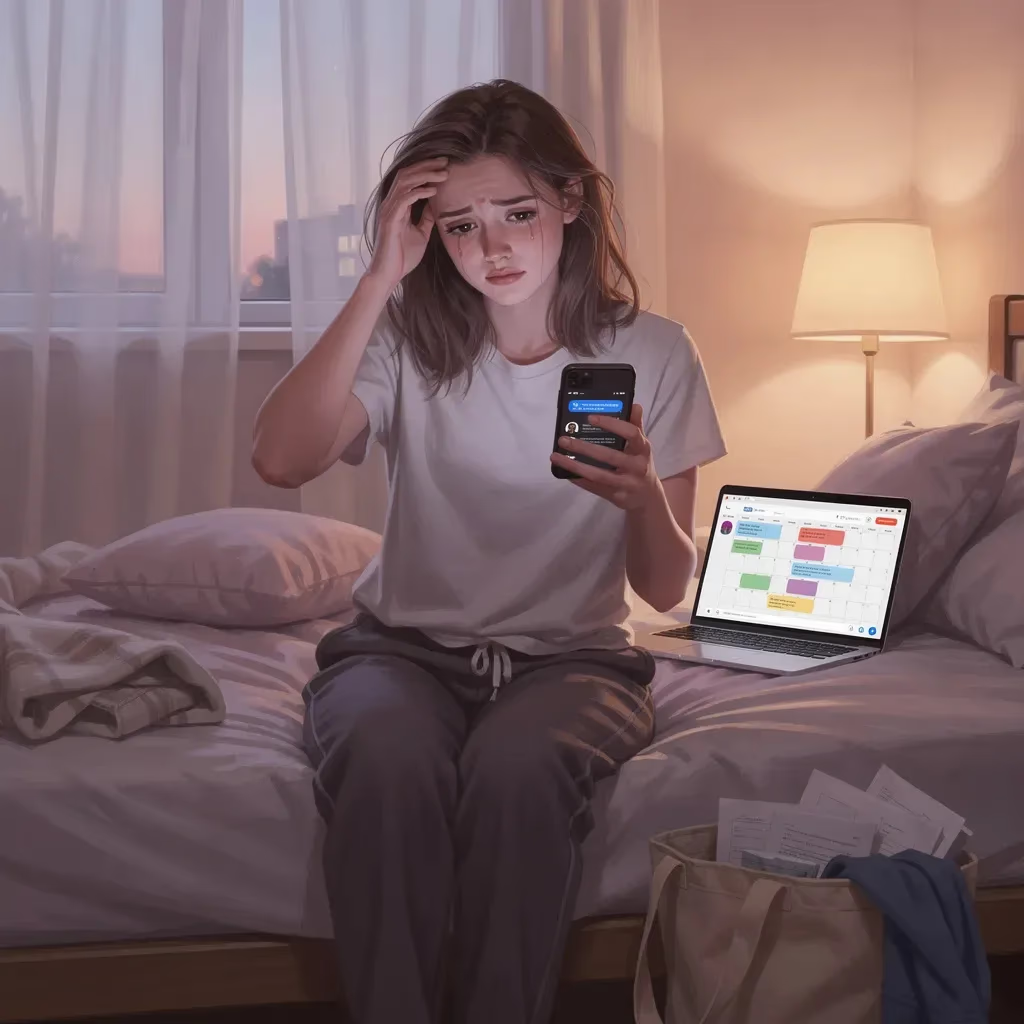
Stretched is that in-between place where you're still doing your life, but you can feel yourself tightening around it. You are showing up. You're replying. You're being "fine."
And then you get quiet and your body finally admits it.
A lot of Stretched women are stuck in this exhausting loop: you google "do I need help", then you talk yourself out of it, then you do it again next week. Stretched is your system asking for care before it has to scream.
If you keep thinking "do I need counseling or therapy", Stretched is often the answer underneath the question: you do not need to be in crisis to deserve a place to talk.
Stretched Meaning
Core Understanding
Stretched means your life is asking more from you than your current support and coping tools can comfortably hold. If you recognize yourself in this pattern, you probably look capable from the outside. Inside, your chest feels braced. Your mind is busy. Your patience is thinner.
This pattern often develops in women who learned that being easy keeps connection. You become the reliable one. The peacemaker. The one who replies fast, smooths things over, and carries the emotional temperature of the room. That is not a flaw. It is a skill you built to stay loved. It just has a cost.
Your body's wisdom here is clear: clenched jaw, shoulders up, tight stomach, restless sleep, that wired-but-tired feeling where you're exhausted but your brain refuses to shut up.
Stretched is also where "do I need counseling or therapy" can feel like both a relief and a fear. Relief because you can imagine being held. Fear because you worry you are "too much." You are not too much. You are carrying too much.
What Stretched Looks Like
- Holding your breath for their reply: You check your phone too often and then judge yourself for it. Externally, you seem casual. Internally, your body is waiting for proof you're still safe.
- Over-functioning as love: You remember everything, you fix everything, you take care of everyone. People call you "thoughtful." You feel like if you stop, you'll be replaced.
- The dread before: Before plans, meetings, or conversations, your stomach drops. You rehearse what you'll say, then decide you'll be chill and say nothing.
- Mood shifts from small cues: A weird tone or a short text lands hard. You try to act normal while your body tightens.
- Productive but not peaceful: You can do the tasks. You just cannot exhale while doing them.
- You edit yourself in real time: You soften needs into hints. You apologize for having feelings. You ask for reassurance sideways.
- Rest feels thin: You rest but do not feel restored. Scrolling looks like downtime from the outside. Inside it feels like hiding.
- You read the room constantly: You notice micro-shifts others miss. It is a gift and also a drain.
- You are the go-to friend: People lean on you. You rarely lean back. You tell yourself it is fine, then you feel lonely anyway.
- Small conflict feels high-stakes: Even gentle feedback can feel like your worth is on trial. You would rather swallow feelings than risk disconnection.
- Thought loops get sticky: You replay conversations and try to solve what you cannot control. Your brain is searching for safety.
- Your emotions show up sideways: Snapping, crying at random, feeling numb, feeling overly sensitive. Not because you're dramatic, because you're overloaded.
- You crave a safe place to be real: Sometimes you do not want advice. You want a witness. That is why so many women ask "do I need counseling or therapy."
- You feel guilty for needing support: The moment you consider asking, the "I'm a burden" voice gets loud. That voice is learned.
How Stretched Shows Up in Different Areas of Life
In romantic relationships: You often crave closeness, but it comes with scanning. If someone gets quiet, you fill in the blanks with worst-case stories. You may ask "Are we okay?" not to create drama, but because silence feels like danger.
In friendships: You're the planner, the check-in friend, the listener. Stretched friendships can be one-sided. You might be surrounded by people and still feel unseen.
At work/school: You're responsible and capable, but you might people-please teachers, bosses, or clients. One vague message can drop straight into your stomach and ruin your afternoon.
Under stress: Your coping tools help less. Your body gets louder. You start asking "do I need help" more often, and "do I need counseling or therapy" starts to feel like a real option.
What Activates This Pattern
- Waiting for a response when you've already decided it means something bad.
- Someone being vague, like "we'll talk later."
- Feeling excluded in small ways (group chat, plans, inside jokes).
- A sudden shift in affection or attention.
- Any criticism, even gentle, that hits your tender spot.
- Having to say no when you fear disappointment.
- Seeing someone else seem fine and wondering why you cannot be.
The Path Toward More Ease
- You are allowed to want steadiness: Not constant attention. Steadiness. Consistency.
- Small shifts, not dramatic transformation: Pausing before you chase reassurance can change everything.
- Practice receiving: Let someone care for you without instantly paying it back.
- What becomes possible: Relationships feel less like guessing games. You start trusting your own signals again.
Stretched Celebrities
- Billie Eilish (Singer)
- Dua Lipa (Singer)
- Taylor Swift (Singer)
- Selena Gomez (Singer)
- Ariana Grande (Singer)
- Millie Bobby Brown (Actress)
- Emma Stone (Actress)
- Mindy Kaling (Actress)
- Simone Biles (Athlete)
- Jessica Alba (Actress)
- Mandy Moore (Singer)
- Jennifer Aniston (Actress)
Stretched Compatibility
| Other result type | Compatibility | Why it feels this way |
|---|---|---|
| Flourishing | 🙂 Works well | Their steadiness helps you breathe, as long as you do not outsource regulation to them. |
| Stretched | 😐 Mixed | You get each other, but you can accidentally amplify each other's worry loops. |
| Depleted | 😕 Challenging | Two tired systems can misread each other and feel rejected easily. |
| In Distress | 😬 Difficult | Their intensity can overwhelm you and push you into panic or shutdown. |
Am I Depleted?

Depleted is the moment you realize rest is not working like it used to. You take a night off and it barely touches the tired.
You keep showing up anyway. Because you always do.
If you've been whispering "do I need help" to yourself, Depleted is often the honest answer: you are not lazy. You're out of fuel. And if "do I need counseling or therapy" has been circling in your mind, it might be because your body knows you cannot talk your way out of exhaustion alone anymore.
Depleted Meaning
Core Understanding
Depleted means your emotional and mental energy is low enough that you cannot "power through" without paying a real price. If you recognize yourself here, you might still be functioning. You might still be achieving. But it feels like dragging a heavy bag through every room you enter.
This pattern often develops after a long season of overgiving, over-responsibility, or living like your needs are optional. Many women in Depleted learned to be low-maintenance to stay loved. You become the helper, the peacekeeper, the one who does not ask for much. That works until your body starts keeping score.
Your body's wisdom in Depleted shows up in quiet, relentless ways: heavy limbs, brain fog, random tears in the shower, getting irritated too easily, wanting to cancel everything, feeling alone even when you are not. It is not drama. It is your system asking for care.
This is also where "do I need counseling or therapy" turns into a softer truth: you deserve a place to put all of this down. Not to be fixed. To be held.
What Depleted Looks Like
- You cannot bounce back: A tough day sticks to you for days. Other people might think you're fine. Internally, it feels like you are always recovering.
- Your body feels heavy: Getting up, showering, cooking, replying. Everything has weight. It is not laziness. It is depletion.
- Your emotions feel muted or tangled: You are not always actively sad. Sometimes you're flat. Like feelings are behind glass.
- You disappear into numb coping: Scrolling, zoning out, sleeping, staying busy. From outside it looks like downtime. Inside it feels like hiding.
- Irritability shows up: Small things make you snap. Not because you're mean. Because your capacity is gone.
- Lonely in a room full of people: You show up, you smile, you listen. You still feel unseen.
- Reaching out feels exhausting: Not because you do not want support. Because explaining feels like another job.
- You fear being "too much": The moment you imagine telling the truth, you picture someone minimizing it. So you swallow it again.
- Your mind keeps replaying: Even when you're tired, your brain runs loops. You are searching for certainty because you feel unsafe.
- You cannot tell what you need: Hunger cues, rest cues, emotional cues feel blurry. This is why "do I need counseling or therapy" keeps returning.
- Guilt for resting: When you lie down, guilt climbs in beside you. Like rest has to be earned.
- You keep performing "fine": Competent at work, okay in texts, smiling in public. Quietly disappearing in private.
- You crave being cared for: Not coached. Not corrected. Cared for.
- Small body alarms: Tight chest, headaches, stomach flips. Stress showing up physically.
- You bargain with yourself: "If I get through this week..." and the weeks keep coming.
How Depleted Shows Up in Different Areas of Life
In romantic relationships: You may crave closeness but feel too tired to ask. Or you may cling to the one person who feels like relief, which can create more anxiety. Depleted love can feel like wanting to be held but not knowing how to say it.
In friendships: You go quiet. Replies take longer. Plans feel like too much. Then you feel guilty and worry they'll forget you.
At work/school: You can still perform, but it feels like pushing a boulder. Focus slips. Motivation drops. You might cry in a bathroom or stare at your screen without absorbing anything.
Under stress: Your coping tools fail faster. Your patience is gone. This is where "do I need help" becomes less philosophical and more urgent.
What Activates This Pattern
- Being needed by everyone at once.
- A vague text like "We need to talk."
- Being minimized, even accidentally.
- Having to pretend you're okay in public.
- No emotional reciprocity for a long stretch.
- Trying to rest while guilt yells at you.
- Feeling trapped, like you cannot say no.
The Path Toward Feeling Like Yourself Again
- You do not have to do this alone: Depleted is often the point where talking to someone helps quickly.
- Gentle support counts: A therapist, a counselor, a support group, or one safe friend.
- Make it smaller: One honest sentence to one safe person is enough.
- What becomes possible: You realize how much you were carrying once you finally put it down.
Depleted Celebrities
- Olivia Rodrigo (Singer)
- Jenna Ortega (Actress)
- Emma Chamberlain (Creator)
- Maisie Williams (Actress)
- Saoirse Ronan (Actress)
- Rooney Mara (Actress)
- Brie Larson (Actress)
- Emily Blunt (Actress)
- Jessica Chastain (Actress)
- Rachel McAdams (Actress)
- Jennifer Garner (Actress)
- Claire Danes (Actress)
Depleted Compatibility
| Other result type | Compatibility | Why it feels this way |
|---|---|---|
| Flourishing | 😐 Mixed | Their steadiness helps, but you may feel ashamed needing more than they do. |
| Stretched | 😕 Challenging | Both of you are near capacity, so misunderstandings can feel huge. |
| Depleted | 😬 Difficult | Without outside support, it can become two people drowning quietly together. |
| In Distress | 😬 Difficult | Their urgency can overwhelm your depleted system and increase shutdown. |
Am I In Distress?

If you landed here, I want this to land clearly: you're not too much. You're not failing at life. You're not broken.
In Distress means things feel intense enough that holding it alone is not working right now. That is not weakness. That is reality.
If you've been asking "do I need help", this result is often a gentle but firm yes. If you're stuck on "do I need counseling or therapy", this is usually the zone where talking to someone soon can create real relief.
In Distress Meaning
Core Understanding
In Distress means your inner world is loud. Anxiety that keeps you up. Sadness that comes in waves. Numbness that scares you because you cannot feel yourself. If you recognize yourself here, it does not mean you're dramatic. It means you've been carrying more than your system can hold without support.
This often develops when stress stacks up without recovery, or when something big hits (loss, breakup, family pressure, work crisis). It can also happen when old wounds get poked and your body reacts like it's happening all over again. Many women in this zone learned to survive by people-pleasing, staying quiet, or overfunctioning. Those strategies kept you connected once. Now they're not enough.
Your body's wisdom here can feel like alarm bells: racing heart, nausea, shaky hands, tight throat, exhaustion that does not lift. Or it can look like shutdown: staring at the wall, feeling far away, moving through life like you're underwater. Either way, your body is saying: "I need care."
If you're thinking "do I need counseling or therapy", In Distress is where the answer is often yes, or at least "talk to someone now." Not to label yourself. To have a steady person hold the thread with you.
What In Distress Looks Like
- Days feel hard to get through: You do what you have to do, but it takes everything. Other people might not see it. You feel it.
- Thought loops are relentless: Your mind replays, predicts, and braces. You want it to stop, and it does not.
- Your body feels unsafe: Tight chest, buzzing skin, shaky hands, stomach flips. You cannot fully settle.
- Panic and numbness can alternate: Crying, then flatness. Intensity, then emptiness. That whiplash is exhausting.
- Fear of being a burden: You want help, but guilt is huge. You start with "Sorry" even when you're truly hurting.
- Hiding how bad it is: You keep showing up because you're scared people will leave if they see the truth.
- Feeling intensely alone: Even with people around, you do not feel held. Like you're behind glass.
- Rejection cues hit harder: A delayed reply can feel like abandonment. A short text can feel like anger.
- Comfort is hard to access: The things that used to soothe you do not work. You try and still feel wired.
- Motivation slips: Eating, showering, studying, working. Everything has friction.
- Life impact is real: Focus, relationships, and normal tasks feel harder than they should.
- Temptation to isolate: Not because you want to be alone, because you do not want anyone to see you unravel.
- Fear of your own intensity: "What if I never feel normal again?" That fear is common. It does not mean it's true.
- The same questions repeat: do I need help, do I need counseling or therapy, and "what if I'm making it up?"
- You want an anchor: Someone steady, trained, and consistent.
How In Distress Shows Up in Different Areas of Life
In romantic relationships: You might cling harder because closeness feels like safety. Or you might shut down completely because you cannot risk more hurt. You read every micro-signal and feel exhausted by it.
In friendships: You disappear, then feel guilty, then spiral. Or you send a long message in a moment of panic, then hate yourself for needing anything.
At work/school: Focus gets harder. You might stare at assignments and absorb nothing. Feedback can feel crushing even when it's mild.
Under stress: Your stress response becomes the default. This is where "do I need help" is no longer just a thought. It's a signal.
What Activates This Pattern
- Silence after you reach out.
- Unexpected conflict, even small.
- Feeling trapped and unable to rest or say no.
- Big life changes.
- Feeling judged for having needs.
- Too many responsibilities with too little support.
- Being alone at night when thoughts get louder.
The Path Toward Safety and Relief
- You deserve real support: Not because you're dramatic. Because you're in pain.
- Start with the safest option available: A trusted person, a counselor, a therapist, or local urgent support if you're worried about safety.
- Make the first ask simple: "I'm not doing okay and I need to talk." That is enough.
- What becomes possible: Relief often starts with not holding it alone.
In Distress Celebrities
- Lady Gaga (Singer)
- Demi Lovato (Singer)
- Adele (Singer)
- Kristen Bell (Actress)
- Kelly Clarkson (Singer)
- Michael Phelps (Athlete)
- David Beckham (Athlete)
- Halle Berry (Actress)
- Denzel Washington (Actor)
- Drew Carey (Comedian)
- Jim Carrey (Actor)
- Alanis Morissette (Singer)
In Distress Compatibility
| Other result type | Compatibility | Why it feels this way |
|---|---|---|
| Flourishing | 😕 Challenging | The gap in intensity can create misunderstandings without extra support. |
| Stretched | 😬 Difficult | They may want to help but get overwhelmed, which can feel like rejection. |
| Depleted | 😬 Difficult | Both of you need care, and the connection can feel too heavy alone. |
| In Distress | 😬 Difficult | Two intense systems can escalate quickly without stabilizing support. |
If you've been whispering "do I need help" to yourself, the problem is not weakness. The problem is carrying feelings that were never meant to be carried alone. This check-in helps you sort "normal stress" from "I need support," including the very real question: "do I need counseling or therapy?"
What this Emotional Check-In can help you do next
- 🧭 Discover whether "do I need help" is a maybe or a clear yes.
- 💬 Understand if "do I need counseling or therapy" fits your current season and your capacity.
- 🫶 Recognize what kind of support feels safe (and what drains you).
- 🧠 Name your pattern so you stop blaming your personality.
- 🌿 Honor your needs without turning it into guilt.
- 📩 Connect with words you can use to reach out.
A small invitation: where you are now vs what becomes possible
| Where you are now | What becomes possible |
|---|---|
| You're functioning, but your body feels tense all the time. | You feel more grounded, like you can exhale again. |
| You keep asking do I need help, then talking yourself out of it. | You get a clear, kind answer and a next step that fits your energy. |
| You're scared you'll be "too much" if you talk. | You learn what safe support feels like, and you stop auditioning for care. |
| You wonder do I need counseling or therapy, but do not know how to decide. | You see what level of support matches your current reality. |
| You're carrying everyone's feelings like it's your job. | You give your empathy boundaries, so it does not cost you your peace. |
| You're tired of guessing what's wrong. | You get language for what's happening, without over-explaining. |
Join over 226,323 women who've taken this under 5 minutes check-in for clarity. Your answers stay private, and your results are just for you.
FAQ
How do I know if I need to talk to someone about my mental health?
You probably need to talk to someone when your inner world starts feeling too heavy to carry alone, especially if it's affecting your sleep, appetite, focus, relationships, or sense of hope. You don't have to be "in crisis" for it to count. If you're asking "how do I know if I need to talk to someone," that question itself is often a sign your system wants support.
So many of us wait until we are falling apart because we think we have to "earn" help. But emotional support is not a reward for suffering enough. It's a tool that helps you suffer less.
Here are clear signs you need to talk to someone, even if you are still functioning on the outside:
- You feel stuck in a loop: the same worries, memories, or fears keep replaying. You might be thinking, "Am I struggling or just stressed?" because you can still show up, but it takes everything in you.
- Your body is waving a flag: headaches, stomach issues, tight chest, jaw clenching, exhaustion that sleep does not fix.
- You're not enjoying things you usually enjoy, or you feel numb. Not dramatic, just flat.
- Small things feel huge: minor feedback, a delayed text, a tiny mistake, and suddenly your nervous system is in full panic mode.
- You are carrying everyone else while quietly resenting it, then feeling guilty for resenting it.
- Your coping tools are getting sharper: more scrolling, more drinking, more isolating, more overworking, more people-pleasing.
- You're starting to worry about yourself: like "Do I need help?" or "Am I okay or do I need therapy?" pops into your head more than once.
A helpful way to think about it: support is useful when your current strategies are costing you more than they are protecting you. A lot of women with anxious attachment patterns are high-functioning on paper, but internally they are holding their breath all day. You deserve relief, not just survival.
If you're trying to decide between talking to a friend vs a professional, this quick filter can help:
- Talk to a trusted friend when you mainly need comfort, perspective, or a reminder you are not alone.
- Talk to a professional when the same pain keeps returning, you are losing functioning, you feel unsafe, or you need tools and structure beyond reassurance.
If you want a gentler starting point, a mental health check in quiz can help you sort your feelings into something clearer. Not a diagnosis. Just clarity.
What are the signs I need therapy vs just being stressed?
The difference is usually not "how intense your feelings are." It's how long it's been going on, how much it's impacting your life, and whether your usual self-care actually helps. Stress comes and goes. When it starts sticking to you, shaping your days, and shrinking your world, therapy starts making a lot of sense.
If you've been quietly wondering, "Am I struggling or just stressed?" you are in very good company. A lot of women are walking around with a normal-looking life and a nervous system that feels like it is constantly bracing for impact.
Here are signs it might be more than everyday stress and you would likely benefit from therapy or counseling:
- Time: It's been weeks or months, not a rough day or a rough week.
- Intensity or reactivity: Your emotions feel outsized compared to the situation, or you feel like you cannot calm down once you're activated.
- Functioning: You are missing work/classes, avoiding responsibilities, struggling to shower/eat, or your grades/work quality is slipping.
- Relationships: You are more irritable, more withdrawn, more clingy, or constantly scanning for signs someone is pulling away. Therapy can help when your nervous system is driving your relationship behavior.
- Sleep and body symptoms: Trouble falling asleep, waking up anxious, panic symptoms, appetite changes, stomach issues.
- Loss of pleasure: You don't feel like yourself. You feel numb, disconnected, or like life is happening at you.
- The same patterns keep repeating: You keep dating the same kind of emotionally unavailable person, or you keep overgiving until you resent everyone, then collapse.
Now, here's the part women rarely get told: therapy is not only for "serious" problems. It is also for clarity, learning emotional regulation, healing people-pleasing, and building a steadier sense of self so relationships stop feeling like a constant test.
If you are specifically searching "do I need counseling or therapy," consider these gentle distinctions:
- Counseling often focuses on a current situation (breakup, grief, work stress, family conflict) and coping skills.
- Therapy can go deeper into patterns, childhood dynamics, attachment wounds, trauma, and emotional regulation.
Both are valid. Both count. The best choice is often the one that feels safest to start.
If you're not ready to pick a path yet, a do I need therapy quiz or do I need professional help quiz can help you name where you are right now: more like Flourishing, Stretched, Depleted, or In Distress. That naming alone can feel like taking your backpack off for a second.
Is a "Do I need to talk to someone?" quiz accurate, or can it be wrong?
A "Do I need to talk to someone?" quiz can be accurate in the way a mirror is accurate. It reflects patterns you might be minimizing, rationalizing, or pushing through. It cannot diagnose you, and it cannot replace a professional. But it can absolutely help you get honest about what you are carrying.
If you've ever searched "do I need to talk to someone quiz free", part of what you're looking for is probably permission. Not permission to fall apart, but permission to stop pretending you are fine when you are not.
Here is what makes a mental health check-in quiz useful (and where its limits are):
What a quiz can do well
- Organize your experience: anxiety, sadness, numbness, overwhelm, burnout. When feelings are messy, structure helps.
- Highlight impact: it nudges you to notice sleep, appetite, energy, motivation, and relationship strain, which we often ignore.
- Reduce self-gaslighting: "Maybe it's not that bad" is a very common survival strategy. A quiz can gently challenge that.
- Give you language: Many women feel "off" but cannot name it. Naming is power.
What a quiz cannot do
- Diagnose mental health conditions (like depression, anxiety disorders, PTSD, etc.).
- Replace professional assessment if you are in crisis or feeling unsafe.
- Capture your full context: culture, trauma history, medical issues, grief, hormones, life changes.
A quiz is most accurate when you answer based on your average week, not your best day and not your worst day. A lot of anxious, high-functioning women answer based on what they "should" feel, not what they actually feel. That is not dishonesty. That is conditioning.
If you're worried a quiz might be wrong, that usually means one of two things:
- Part of you is scared it will say, "Yes, you need help," and then you have to take yourself seriously.
- Or part of you is scared it will say, "You're fine," and you will feel unseen again.
Both are valid fears. The point of this Emotional Check-In is not to label you. It's to help you see whether you're Flourishing, Stretched, Depleted, or In Distress, and what kind of support might fit your real life.
What causes someone to feel like they need help, even when life looks "fine"?
This happens when your external life is functioning, but your internal life is running on emergency power. You can have a job, friends, a partner, grades, plans, and still feel like you're quietly unraveling. Needing help is not proof you're failing. It's often proof you've been strong for too long.
A lot of us were taught to only count "real problems" as problems. So we downplay emotional pain until it has to get louder to be heard. That is why so many women end up Googling "do I need help" in the middle of the night, even though nothing is technically on fire.
Common reasons you might feel this way:
- Chronic stress and burnout: When your nervous system never gets to fully come down. You can be "fine" and still be depleted.
- Emotional labor overload: You're the friend everyone vents to. You're the fixer. You're the peacekeeper. It looks like being capable. It feels like drowning quietly.
- Unprocessed grief: Not only death. Grief from breakups, friendship endings, moving, losing a version of yourself, family disappointments.
- Attachment anxiety and hypervigilance: If you grew up needing to monitor moods or earn love, your body can stay on high alert even in calm environments.
- Life transitions: Graduation, new jobs, moving cities, becoming single, becoming partnered, becoming a caregiver. Change strains even happy lives.
- Hormonal and physical factors: Sleep debt, thyroid issues, anemia, chronic illness, and hormonal shifts can all affect mood and anxiety. (This is why it can help to rule out medical causes too.)
Here's what's really happening underneath: your system is asking for containment. A safe place to put feelings down, untangle them, and learn new ways of coping that do not cost you your peace.
If you're wondering "am I okay or do I need therapy," try this gentle reframe: "Am I okay" can be true, and "I need support" can also be true. Those things are not enemies.
An Emotional Check-In can help you spot which layer is loudest right now, stress, depletion, or distress, and what kind of conversation might help most.
When should I reach out to a professional instead of handling it on my own?
Reach out to a professional when handling it on your own is starting to cost you your health, your relationships, or your sense of safety. Independence is a strength. White-knuckling is not.
A lot of women with anxious attachment patterns try to "self-manage" everything because it feels safer than needing someone. Of course it does. If you've ever been disappointed, dismissed, or made to feel like your emotions were too much, relying on yourself becomes the most logical thing in the world.
Here are strong signs it might be time for professional support (therapy, counseling, or another mental health provider):
- Your symptoms are persistent: Weeks to months of anxiety, sadness, numbness, panic, or irritability.
- You're losing functioning: Work/school performance dropping, trouble doing basic tasks, isolating from friends, struggling with hygiene or meals.
- You are using coping strategies that scare you: self-harm, restricting food, purging, substance misuse, risky behavior, impulsive spending that you cannot control.
- You're having intrusive thoughts that are distressing or feel out of character.
- You feel unsafe with yourself, or you are thinking about suicide. If this is you, you deserve immediate support. In the US, you can call or text 988 for the Suicide and Crisis Lifeline. If you're in immediate danger, call 911 or go to the nearest ER.
Also, professional support can be a great choice even without a crisis if:
- You keep asking, "Do I need professional help quiz," because you want confirmation that you're not making a big deal out of nothing.
- You keep repeating the same relationship patterns, and you are tired of your heart being the thing that pays the price.
- You want tools for emotional regulation, boundaries, and self-trust, not just someone telling you to "be more confident."
If you are trying to decide, a useful question is: If my best friend told me she felt this way, would I want her to carry it alone? You are allowed to treat yourself with the same tenderness.
This Emotional Check-In quiz can help you name whether you're feeling Flourishing, Stretched, Depleted, or In Distress. That clarity can make the next step feel less overwhelming.
How do I talk to someone about what I'm feeling without feeling needy or annoying?
You can talk to someone without being needy by being specific, honest, and clear about what kind of support you are asking for. Wanting connection is not annoying. It's human. Your fear of being "too much" usually comes from past experiences where your needs were treated like a burden.
That moment when you type out a message, delete it, rewrite it, then decide you will "just deal with it" is so common. So many women are craving support while also scanning for rejection. Your nervous system learned that reaching out can be risky.
Here are a few ways to make reaching out feel safer (and more likely to go well):
1) Ask for consent firstThis protects you from the spiral of "they hate me" if they are busy.
- "Hey, do you have bandwidth for something a little heavy today?"
- "Can I vent for 10 minutes?"
2) Name what you need (comfort vs solutions)Most miscommunication happens because one person is problem-solving and the other just wants to be held emotionally.
- "I don't need advice, I just need a calm ear."
- "If you have ideas, I'm open to them. I'm feeling stuck."
3) Keep it simple and realYou do not owe a perfectly organized TED Talk of your pain.
- "I've been feeling really anxious lately, and it's starting to wear me down."
- "I'm not doing great. I'm functioning, but I'm not okay."
4) Try a "one layer at a time" approachIf vulnerability feels scary, you can share one layer and see how they respond.
- Layer 1: "I've been overwhelmed."
- Layer 2: "It's affecting my sleep."
- Layer 3: "I feel alone in it."
If you are worried you are "annoying," that worry itself is information. It often points to a history of having to be easy, convenient, low-maintenance to feel loved. That is not a personality flaw. It's a pattern you can unlearn.
If you want help figuring out whether you're "just stressed" or truly struggling, a mental health check in quiz can help you put words to it before you talk to someone. It can be easier to say, "I think I'm depleted" than to explain every detail.
What should I do after taking an emotional check-in quiz if my result is "Depleted" or "In Distress"?
If your result is "Depleted" or "In Distress," the next step is support and stabilization, not self-criticism. Those results do not mean you're broken. They mean your system has been carrying more than it can sustainably hold right now.
So many women see a tough result and immediately think, "I should have handled this better." But depletion and distress are often what happens when you handle everything alone for too long.
Here is a grounded way to respond, depending on where you landed:
If you're DepletedDepleted usually looks like: you're functioning, but it's taking a lot. You're tired in your bones. Your emotions feel close to the surface. You might be asking, "Do I need counseling or therapy?" because you can still show up, but you cannot keep doing it like this.
What helps most in Depleted:
- Tell one safe person the truth: not the polished version. The honest version.
- Reduce one pressure point this week: one social obligation, one extra task, one perfectionistic standard.
- Choose support that matches your energy: therapy can help, but so can a support group, campus counseling, or talking to a trusted mentor.
- Check basics: sleep, food, hydration, movement, medication adherence. Not as a wellness lecture. As nervous system maintenance.
If you're In DistressIn Distress often means: you're not okay, and it's hard to pretend. Your coping strategies may be slipping. You might be having panic, hopelessness, numbness, or thoughts that scare you.
What helps most in In Distress:
- Reach out for professional support sooner rather than later. This is exactly what professionals are for.
- If you feel unsafe, get immediate help. In the US, call or text 988. If you're in immediate danger, call 911 or go to the nearest ER.
- Increase daily support: more check-ins with safe people, less isolation, less time alone with spirals.
A gentle truth: when you're depleted or distressed, your brain will try to convince you that you are a burden. That is the distortion talking. Support is how we heal. Humans are not meant to regulate alone all the time.
If you haven't taken the quiz yet, or you want to re-check where you are today, this Emotional Check-In is a quick way to get clarity about whether you're Flourishing, Stretched, Depleted, or In Distress.
Can I figure out if I need therapy on my own, or do I need a professional to tell me?
You can absolutely figure out a lot on your own, especially whether you are struggling enough to deserve support. You do not need a professional to "grant permission" for help. At the same time, a professional can help you see patterns you cannot see from inside your own brain, especially if anxiety or shame is doing the talking.
If you've been typing "do I need therapy quiz" or "do I need professional help quiz" into your phone, you're already doing self-assessment. You're listening to the part of you that knows something is off.
Here are self-check questions that are genuinely useful:
- Impact: Is this affecting my sleep, appetite, energy, concentration, or ability to enjoy life?
- Duration: Has this been going on for more than 2-3 weeks?
- Escalation: Is it getting worse, or staying stuck?
- Avoidance: Am I shrinking my life to avoid feelings, conflict, or uncertainty?
- Support: Have I tried talking to someone I trust, and it still feels heavy?
- Safety: Do I feel unsafe with myself, or am I having thoughts of self-harm or suicide? If yes, you deserve immediate support.
You can also look at it through a relationship lens (because for many of us, that is where the pain shows up first):
- Are you constantly monitoring tone, response time, facial expressions?
- Do you feel panicky when someone pulls back, even slightly?
- Do you overexplain, apologize, or try to be "easy" so you do not get left?
- Do you feel like you're always one text away from being abandoned?
If yes, therapy can be incredibly helpful, not because you're "too sensitive," but because your nervous system has been trained to treat connection like a survival task.
A quiz is a softer entry point if you're not ready to commit to therapy yet. A mental health check in quiz can help you name your current state and decide whether you need a friend-level conversation, professional-level support, or both.
What's the Research?
When "I'm fine" isn’t fine: what your body is doing (and why it matters)
That moment when you realize you’ve been kind of holding your breath waiting for someone’s text back, or you can’t remember the last time you felt fully relaxed, isn’t you being dramatic. It’s your stress system doing its job.
Across medical overviews, stress is basically your body responding to a demand or change, whether it’s a real threat or just your brain interpreting something as one (Cleveland Clinic; Harvard Health). Biologically, that response runs through two big pathways: a fast “fight-or-flight” surge (sympathetic nervous system) and a slower hormone pathway that releases cortisol (often called the HPA axis) (Stress (biology) - Wikipedia; Physiology, Stress Reaction - StatPearls).
So when you’re snapping at people, crying in the shower, getting headaches, clenching your jaw, or feeling weirdly numb, it can be your nervous system saying: “We have been on-duty too long.” Physical signs like sleep trouble, muscle tension, stomach issues, racing heart, and exhaustion are all common stress signals, not “personal failures” (Cleveland Clinic).
If you’ve been telling yourself you’re “just stressed,” but it’s showing up in your body and your relationships, that’s not weakness. That’s information.
And one more validating piece: chronic stress (stress that’s intense, repetitive, or prolonged) is the kind that starts to bend your mood, focus, and resilience over time (Physiology, Stress Reaction - StatPearls; Harvard Health).
Social support isn’t “extra.” It’s a protective factor.
A lot of women (especially the ones who are “the strong friend”) wait to talk to someone until things are already unmanageable. Usually because asking for support feels like burdening people, or it triggers that old fear of being “too much.”
But social support isn’t just a nice vibe. Researchers define it as the sense (and reality) that you’re cared for and have help available, emotionally and practically (Social support - Wikipedia; Social Support - NCBI Bookshelf). And it’s tied to real mental and physical health protection, especially during stressful seasons.
Public health guidance makes it pretty plain: supportive relationships help us cope with stressful life challenges and create feelings of belonging and being valued (CDC: Social Connection). Mental Health America also summarizes research showing social support can buffer the impact of stress on anxiety and depression (Mental Health America).
One detail I find weirdly comforting is that researchers distinguish between:
- Perceived support (you believe someone would show up if you needed them) and
- Received support (the actual help you get in the moment)
Perceived support tends to track more consistently with better mental health in a lot of research summaries, which tells us something important: feeling alone can hit hard even when people technically exist around you (Social support - Wikipedia; Social Support - Division of Cancer Control & Population Sciences).
You don’t have to “earn” support by falling apart first. Connection is part of how humans stay okay.
And yes, not all support helps. Getting the wrong kind of support (like advice when you really needed comfort) can feel awful, which is why being clear about what you want matters (Verywell Mind: Types of Social Support).
Help-seeking is a process (not a personality trait)
If you’re here because you Googled something like “how do I know if I need to talk to someone” or you’re quietly taking a “mental health check in quiz,” it usually means one thing: part of you already knows something needs care. You’re just trying to confirm you’re not overreacting.
Help-seeking is studied as a real decision process, not “being needy.” In a health context, it’s basically the steps you take to get assistance when something challenges your ability to cope alone (Help-seeking - Wikipedia; Help-seeking behaviour: concept analysis - PubMed). Researchers also point out that stigma, uncertainty about “how bad it is,” and not knowing where to go are common barriers, especially for students and young adults (Encouraging Help Seeking Behaviour - Campus Mental Health; Conceptual measurement framework for help-seeking - PMC).
A piece that matters for anxious hearts: help-seeking has historically been mislabeled as “dependency” or “incompetence,” even though modern research treats adaptive help-seeking as a healthy coping strategy (Help-seeking - Wikipedia). So if you have that automatic shame response, it’s learned, not truth.
If you’re taking a “do I need therapy quiz” or searching “am I okay or do I need therapy,” the research-backed takeaway is not “only seek help if you’re in crisis.” It’s more like: when your internal coping tools are stretched thin, adding support is a smart move, not a dramatic one (Help-seeking behaviour: concept analysis - PubMed).
Needing help doesn’t mean you’re failing. It means you’re responding to reality.
So… do you need to talk to someone? Here’s what research points to
Here’s the pattern the science keeps circling: stress becomes harmful when it’s intense, repeated, or prolonged, especially when recovery time and support are missing (Physiology, Stress Reaction - StatPearls; Harvard Health). Your body can stay stuck in “activated” mode, and over time that can feed anxiety, depression, and cognitive fog (Stress (biology) - Wikipedia).
Talking to someone (a friend, a counselor, a therapist, a support line) is one of the most direct ways to interrupt isolation and help your nervous system come back toward baseline. The research on social connectedness consistently frames it as protective, not optional (CDC: Social Connection; Social Support - NCBI Bookshelf).
A really practical way to think about it:
- If you’re mostly okay but need a tune-up and perspective, that leans more Flourishing.
- If you’re functioning but everything feels like effort and you’re more emotional than usual, that’s often Stretched.
- If you’re running on fumes, withdrawing, or your body is waving red flags (sleep, appetite, panic-y symptoms), that’s closer to Depleted.
- If you’re feeling unsafe, hopeless, or like you can’t cope, that’s In Distress and deserves real, immediate support.
Those aren’t labels to trap you. They’re a map, so you can stop guessing whether you’re “allowed” to reach out.
The moment you start wondering “do I need help?” is often the moment support would help the most, not the least.
While research reveals these patterns across so many women navigating similar pressure, your report shows which specific patterns are shaping your experience right now, and what kind of support would actually feel relieving for you.
References
Want to go deeper? These are genuinely good reads if you like receipts with your reassurance:
- Understanding the stress response (Harvard Health)
- Stress: What It Is, Symptoms, Management & Prevention (Cleveland Clinic)
- Physiology, Stress Reaction (StatPearls - NCBI Bookshelf)
- Stress (biology) (Wikipedia)
- Biology of Stress (FSU College of Medicine)
- Social Connection: About (CDC)
- Social Support: Getting and Staying Connected (Mental Health America)
- Social Support (NCBI Bookshelf)
- Social support (Wikipedia)
- Social Support (Division of Cancer Control & Population Sciences)
- Help-seeking (Wikipedia)
- Conceptual measurement framework for help-seeking for mental health problems (PMC)
- Help-seeking behaviour: a concept analysis (PubMed)
- Encouraging help-seeking behaviour (Campus Mental Health)
- Types of Support: How Does Social Support Work? (Verywell Mind)
Recommended reading (for when you want to feel even more understood)
If you're sitting with "do I need help" or "do I need counseling or therapy", books can be a steady bridge. Not as a replacement for real support, but as a way to get language for what you're feeling so you do not have to invent the words from scratch.
General books
- Maybe You Should Talk to Someone (Amazon, Bookshop.org, AbeBooks) by Lori Gottlieb - Makes therapy feel human and reachable, especially when you're nervous to start.
- The Gift of Therapy (Amazon, Bookshop.org, AbeBooks) by Irvin D. Yalom - Helps you understand what good support can feel like in a real, grounded way.
- The Body Keeps the Score (Amazon, Bookshop.org, AbeBooks) by Bessel van der Kolk - Helps you understand why your body might still feel on edge even when you are trying to "logic" your way through it.
- Self-Compassion (Amazon, Bookshop.org, AbeBooks) by Kristin Neff - Softens the inner voice that calls you a burden for needing care.
- Feeling Good (Amazon, Bookshop.org, AbeBooks) by David D. Burns - Practical tools for thought loops that keep you stuck.
- The Happiness Trap (Amazon, Bookshop.org, AbeBooks) by Russ Harris - Helps you stop wrestling feelings like enemies and start making space for them.
- Attached: The New Science of Adult Attachment and How It Can Help You Find - and Keep - Love (Amazon, Bookshop.org, AbeBooks) by Amir Levine - This book gives language for why some relationships feel calming and others feel like a constant test you might fail.
- Burnout: The Secret to Unlocking the Stress Cycle (Amazon, Bookshop.org, AbeBooks) by Emily Nagoski - This is foundational for understanding why you can do "all the right things" and still feel fried.
For Flourishing types (protect your steadiness)
- Set Boundaries, Find Peace (Amazon, Bookshop.org, AbeBooks) by Nedra Glover Tawwab - Protect your peace before "fine" turns into quiet overextension.
For Stretched types (turn strain into real support)
- The Anxiety Audit (Amazon, Bookshop.org, AbeBooks) by Lynn Lyons - Names the sneaky anxiety habits that keep you braced all day.
- The Book of Boundaries (Amazon, Bookshop.org, AbeBooks) by Melissa Urban - Real-life scripts for saying no without a guilt spiral.
For Depleted types (refill the parts that ran dry)
- Codependent No More (Amazon, Bookshop.org, AbeBooks) by Melody Beattie - Names the "I carry everyone" pattern with compassion and clarity.
- Running on Empty: Overcome Your Childhood Emotional Neglect (Amazon, Bookshop.org, AbeBooks) by Jonice Webb - Helps when your exhaustion feels like emptiness you cannot explain.
P.S.
If you're still thinking "do I need counseling or therapy or am I overreacting," taking a private Emotional Check-In is a gentle way to stop guessing and start feeling supported.